Can You Use a Chef Knife to Mince Garlic?
Quick Answer
Yes. A chef knife is one of the best tools for mincing garlic. Its broad blade can crush a clove to loosen the skin, while its curved cutting edge lets you rock the knife repeatedly over chopped garlic until the pieces are very fine. Use a stable cutting board, keep your fingers away from the cutting path, and work with a sharp knife rather than forcing a dull blade.
You do not need a garlic press or a specialized knife to mince fresh garlic. A normal chef knife can handle the entire job, from loosening the peel to producing a fine mince or even a rough garlic paste.
The important part is using the blade correctly. Garlic cloves are small and can move under pressure, so control matters more than speed. Once you understand where to place your hands and how to use the rocking motion, the technique becomes straightforward.
Why a Chef Knife Works So Well for Mincing Garlic
A chef knife is designed for exactly this type of cutting. Its broad side can press or lightly crush a garlic clove, while the curved portion of the edge supports repeated rocking cuts over a small pile of garlic.
That combination makes the knife useful for several stages of preparation. As explained in our guide to common chef knife uses, the same blade that chops vegetables can also handle fine work such as mincing garlic and herbs.
The rocking motion is especially useful. Instead of trying to make dozens of perfectly positioned individual cuts, you can roughly chop the garlic first, gather it into a pile, and run the blade over it repeatedly until the pieces reach the texture you need.
Key Insight
You do not need to create a perfect mince with the first cuts. The initial chopping reduces the clove into manageable pieces; the repeated rocking passes create the fine final texture.
How to Mince Garlic With a Chef Knife
 Save
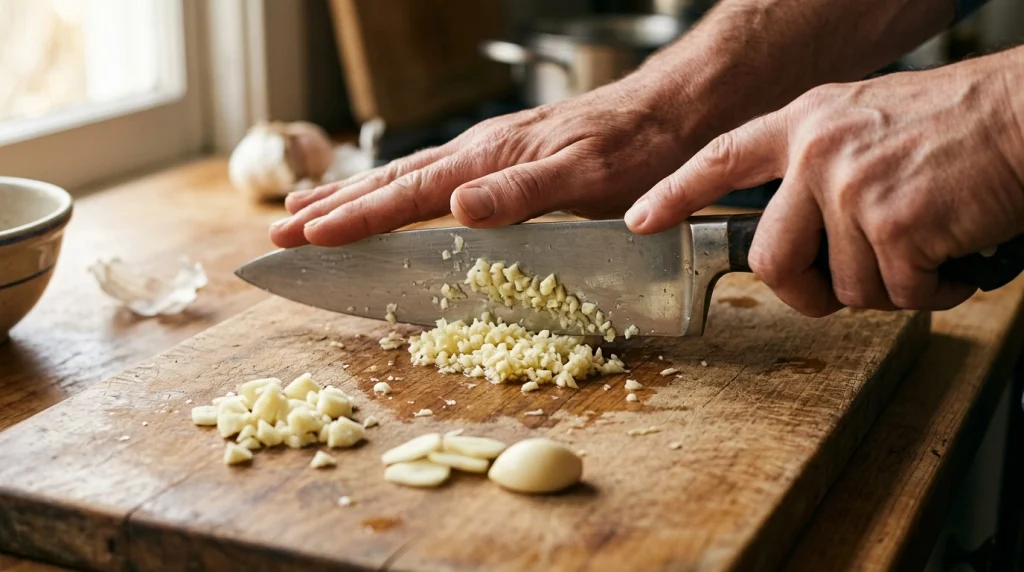
SaveThe easiest method is to peel the clove, break it into smaller pieces, and then use a controlled rocking motion. The Food Network knife-skills guide similarly recommends keeping the knife tip on the cutting board while rocking the blade over garlic until finely minced.
- Place the garlic on a stable cutting board. The board should not slide while you work. If necessary, stabilize it before beginning rather than trying to control a moving board with your knife hand.
- Separate the clove and trim the root end. Remove the hard end of the clove so it does not end up in the finished mince.
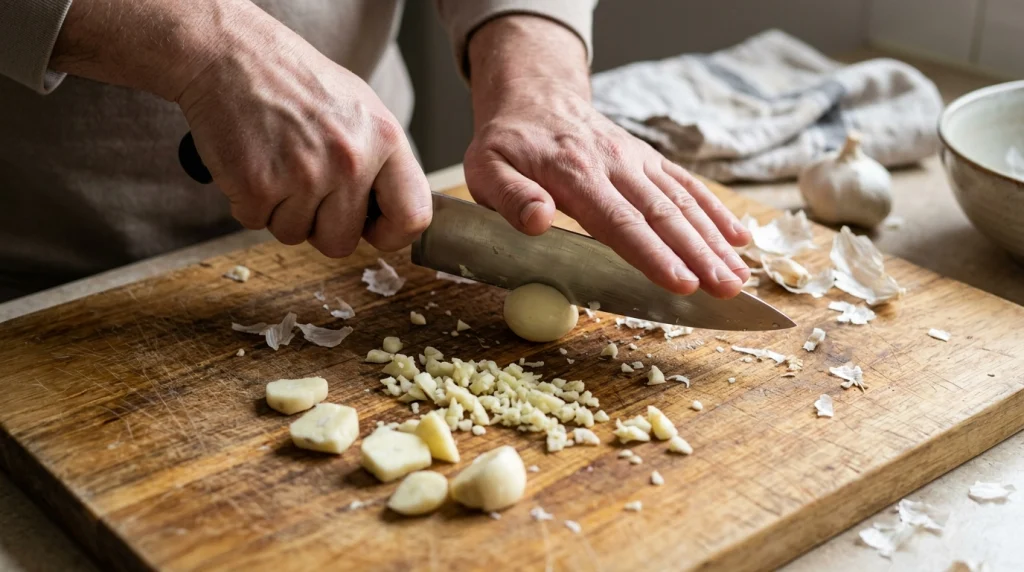
- Loosen the peel. Lay the broad, flat side of the chef knife over the garlic with the sharp edge facing safely away from your other hand. Press down carefully with the heel of your palm until the clove cracks slightly and the papery skin loosens.
- Remove the peel. The skin should now come away more easily. Discard it before cutting.
- Slice or roughly chop the garlic. Cut the peeled clove into thin slices, then cut across those pieces. You do not need perfect cubes because you will mince them further.
- Gather the garlic into a small pile. Keeping the pieces together makes each pass of the blade more effective.
- Rock the knife across the pile. Hold the handle with your dominant hand. With the knife tip resting on or close to the board, move the heel of the blade up and down while rocking across the garlic.
- Regather and repeat. After several passes, gather the scattered pieces together and rock the knife over them again until the mince is as fine as your recipe requires.
Tip
Do not chase individual garlic pieces around the cutting board. Stop periodically, gather them back into a compact pile, and then continue mincing. It is more controlled and usually faster.
How Fine Should Minced Garlic Be?
Minced garlic should consist of very small pieces, noticeably finer than an ordinary chop. It does not, however, have to become a completely smooth paste unless the recipe specifically calls for one.
The practical distinction is texture. Roughly chopped garlic leaves larger pieces that remain more noticeable in the finished dish. A fine mince spreads smaller pieces throughout sauces, dressings, marinades, sautés, and other foods where you want the garlic distributed more evenly.
If your recipe simply says “minced garlic,” stop once the pieces are consistently small. There is little benefit in continuing until the garlic turns into paste unless that finer consistency serves the dish.
Can You Make Garlic Paste With the Same Knife?
Yes. A chef knife can take garlic beyond a mince and closer to a paste. First mince the garlic very finely. Then use the broad side or edge of the blade at a low angle to press and smear the garlic against the cutting board.
Gather it again and repeat the pressing motion until the texture becomes much smoother. Some cooking methods use a small amount of coarse salt to add abrasion while the garlic is being crushed, although that also adds salt to the recipe and is not necessary for making a basic mince.
A paste is useful when you want garlic to disappear almost completely into a dressing, sauce, marinade, or compound mixture. For many cooked recipes, though, a normal mince is enough.
The Most Important Safety Details
Garlic is small, so the main challenge is keeping control of the ingredient and blade. Trying to cut faster than your technique allows is unnecessary.
- Use a stable board. Movement underneath the knife makes precise cutting harder.
- Keep fingertips curled away from the edge. When holding pieces for the first cuts, keep your fingertips out of the knife’s path.
- Keep your free hand clear when smashing garlic. Place pressure on the safe, flat portion of the blade rather than near the cutting edge.
- Use controlled movements. A fine mince comes from repeated passes, not from hitting the board as quickly as possible.
- Keep the blade in good condition. If your chef knife struggles to slice garlic cleanly, our guide to cleaning, sharpening, and maintaining kitchen knives explains the basic maintenance process.
The same fundamentals carry over to other everyday prep jobs. For example, a stable cutting surface and controlled chef-knife technique are also central when learning how to dice an onion properly.
Common Mistakes That Make Garlic Harder to Mince
 Save
SaveTrying to mince a whole round clove immediately
A whole peeled clove can shift under the blade. Crushing it slightly, slicing it, or roughly chopping it first creates smaller, flatter pieces that are easier to control.
Expecting the first cuts to create the final texture
Mincing is usually a progression. Chop first, gather the pieces, rock over them, then repeat if necessary. Trying to make every first cut microscopic only makes the process more awkward.
Letting garlic spread across the board
Once the pieces scatter, much of the knife stroke misses the garlic. Regathering the pile between rounds keeps more garlic beneath the cutting edge.
Using unnecessary force
The blade should do the cutting. Heavy downward pressure is not what makes a fine mince; repeated controlled passes do. If the knife needs excessive force for ordinary prep, check its edge condition.
Relevant Product
Chef Knives
If your current knife is uncomfortable, difficult to control, or no longer suitable for everyday prep, a general-purpose chef knife is the tool designed for jobs such as chopping, slicing, and mincing garlic.
As an Amazon Associate, we earn from qualifying purchases.
Frequently Asked Questions
Do you have to smash garlic before mincing it?
No. Smashing is optional, but it can loosen the peel and flatten the clove, making it easier to control. You can also peel the clove normally, slice it, and then mince it.
Is a chef knife better than a paring knife for mincing garlic?
Usually, yes. A chef knife’s longer cutting edge and curved blade make repeated rocking cuts easier. A paring knife can cut garlic, but its short blade is less convenient for rocking repeatedly over a pile.
Can you mince several garlic cloves at the same time?
Yes. Roughly chop the peeled cloves, gather them into a compact pile, and rock the chef knife across the pile. Avoid making the pile so large that you lose control of the pieces.
Is minced garlic the same as crushed garlic?
Not exactly. Minced garlic is cut into very small pieces. Crushed garlic has been physically pressed or smashed, so its texture can be less uniform and may become closer to a paste depending on how much pressure is used.
Can you use a Santoku knife instead of a chef knife?
Yes. A sharp Santoku can mince garlic effectively. Its cutting motion may feel different because many Santoku blades have less pronounced curvature than a Western-style chef knife, but it can still produce a fine mince.
Do you need a garlic press if you have a chef knife?
No. A chef knife can peel, chop, mince, and crush garlic without another gadget. A garlic press can still be convenient if you prefer its texture or want to process cloves with less knife work.
Conclusion
A chef knife is not merely acceptable for mincing garlic; its shape makes it particularly well suited to the job. Use the flat of the blade carefully to help loosen the peel, reduce the clove to smaller pieces, then gather those pieces and rock the cutting edge over them until they are finely minced. The key is control rather than speed. Keep the cutting board stable, keep your fingers clear, and let repeated knife passes create the texture instead of forcing the blade through the garlic.