Can You Use Sapele for Cutting Boards? Safety, Pros, Cons, and Best Alternatives
Quick Answer
Yes, sapele can be considered for cutting boards, but it isn’t my first choice for everyday food preparation. Its hardness is suitable, yet its relatively large pores and interlocked grain raise practical cleaning and finishing concerns. For a more established option, follow this guide to choosing cutting-board wood. Use sapele for direct food preparation only when its source, construction, and food-contact suitability have been properly evaluated.
Five Things to Know
- Hardness: Sapele measures approximately 1,360 lbf on the Janka scale.
- Grain structure: Its interlocked fibers can create tear-out during woodworking.
- Food safety: The species alone doesn’t establish that a finished board is food-contact suitable.
- Maintenance: Washing, complete drying, and suitable conditioning are essential.
- Best alternative: Hard maple offers a more established everyday cutting-board choice.
My Recommendation
- For daily chopping: Choose a quality hard maple board.
- For decorative projects: Sapele is an attractive candidate, especially for an appropriately finished serving board.
Sapele has a beautiful reddish-brown color and striking ribbon-like grain. It’s easy to see why woodworkers consider it for kitchen projects.
However, I wouldn’t select cutting-board wood based on appearance alone. This guide examines sapele’s properties, possible risks, construction methods, and better alternatives.
What Is Sapele Wood?
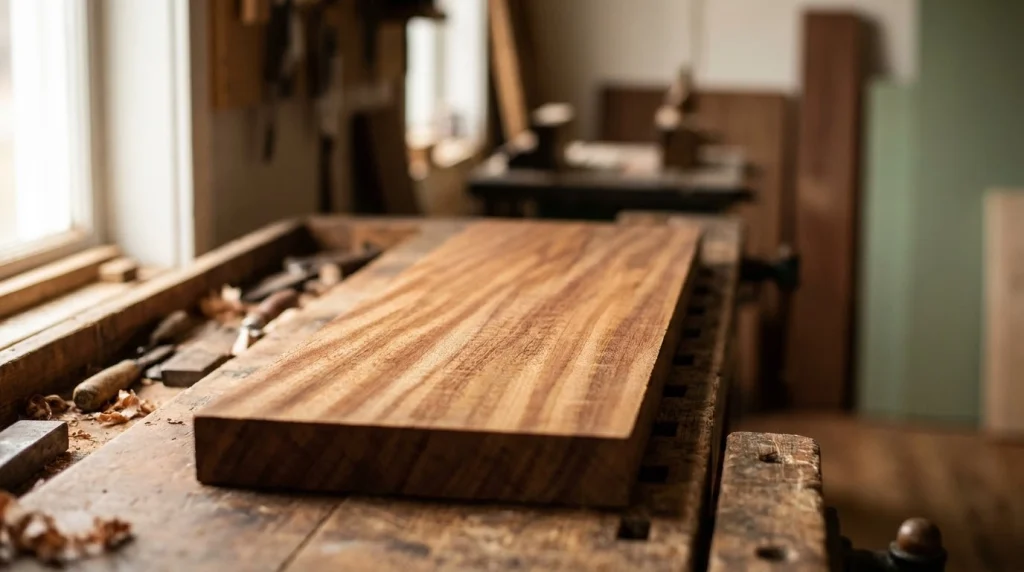
Sapele is a tropical African hardwood from the species Entandrophragma cylindricum. It belongs to the mahogany family, Meliaceae, but isn’t the same species as genuine mahogany.
Definition: Sapele is a reddish-brown hardwood known for its interlocked grain, decorative figure, moderate-to-high hardness, and use in furniture, cabinetry, doors, musical instruments, and interior woodworking.
Quarter-sawn sapele often displays a distinctive ribbon pattern. This appearance makes it attractive for decorative panels and serving surfaces.
Important Sapele Wood Properties
- Scientific name: Entandrophragma cylindricum.
- Common names: Sapele, sapelli, and sapeli mahogany.
- Origin: Tropical Africa.
- Average dried density: Approximately 665 kg/m³.
- Janka hardness: 1,360 pounds-force.
- Grain: Frequently interlocked or wavy.
- Pore arrangement: Diffuse-porous, with relatively large vessels.
- Appearance: Golden-brown to reddish-brown, often darkening with age.
These properties are documented in the Wood Database’s sapele reference. They help explain why sapele is durable but not automatically ideal for cutting boards.
Is Sapele Wood Food Safe for Cutting Boards?
Sapele isn’t automatically unsuitable for every food-related project, but its use as a cutting surface needs careful evaluation. Hardness alone cannot establish food-contact safety.
In the United States, the FDA Food Code identifies hard maple or equivalently hard, close-grained wood as acceptable for certain food-contact equipment. That includes cutting boards.
The same principle appears in Washington’s food-contact wood regulations.
Sapele is comparatively hard, but its pore structure differs from maple. The cited regulation doesn’t specifically identify or approve sapele by name.
What Determines Whether a Sapele Board Is Suitable?
- Known wood identity: Confirm that the material is genuine, untreated sapele.
- Clean surface: Avoid rough grain, splinters, deep pores filled with debris, and unstable areas.
- Suitable construction: Use sound joints and appropriate adhesives where necessary.
- Food-contact finish: Choose an oil or conditioner labeled for cutting-board use.
- Reliable cleaning: The finished surface must tolerate routine washing and thorough drying.
- Intended application: Check applicable commercial requirements before using an unfamiliar species professionally.
Some finished sapele products are sold as cutting boards. However, a seller’s product description alone isn’t independent evidence of universal suitability.
Is Sapele Toxic?
Sapele has been reported as a skin and respiratory irritant, particularly during woodworking. This concern deserves attention when cutting, sanding, or machining the wood.
Those reports don’t establish that ordinary food contact with a finished board causes the same reactions. They also don’t prove that every sapele board is safe.
When woodworking, use effective dust extraction and suitable respiratory protection. Stop working with the material if irritation develops.
Why Does Sapele’s Grain Structure Matter?
Grain structure affects how easily a cutting board can be finished, cleaned, and maintained. Sapele’s interlocked fibers make these considerations especially important.
Unlike a simple straight-grained wood, sapele can have fibers that change direction across a surface. Planing against those fibers may create rough areas or tear-out.
Three Practical Concerns
- Surface tear-out: Interlocked grain can leave small defects if the wood is machined poorly.
- Visible pores: Larger vessels require careful attention when cleaning exposed surfaces.
- Maintenance demands: Rough or damaged areas may need careful resurfacing before continued use.
Visible pores don’t automatically mean a wooden surface is unhygienic. Surface condition, cleaning practices, and board construction matter together.
My main concern is whether a board remains smooth and easy to clean after repeated knife contact. Attractive grain patterns cannot compensate for poor surface quality.
What Are the Pros and Cons of Sapele Cutting Boards?
Sapele offers several appealing physical characteristics. However, its appearance and hardness should be weighed against practical food-preparation requirements.
Advantages of Sapele
- Good hardness: Its 1,360 lbf Janka rating indicates reasonable resistance to indentation.
- Attractive appearance: Deep reddish-brown tones create a distinctive presentation.
- Decorative grain: Ribbon figure can make a finished board visually appealing.
- Solid feel: Its density provides a substantial hardwood surface.
- Woodworking versatility: Suitable stock can be shaped into decorative kitchen accessories.
Disadvantages of Sapele
- Interlocked grain: Machining requires care to prevent tear-out.
- Relatively large pores: These deserve attention when evaluating cleanability.
- Dust irritation: Woodworking dust may affect sensitive skin or airways.
- Less-established choice: Maple has a longer, more familiar history as a kitchen cutting surface.
- Variable construction: A poorly made board may develop rough surfaces or failing joints.
For me, the main advantage is sapele’s appearance. If dependable daily chopping is the priority, I would compare maple first.
Sapele vs. Maple vs. Walnut vs. Cherry: Which Is Better?
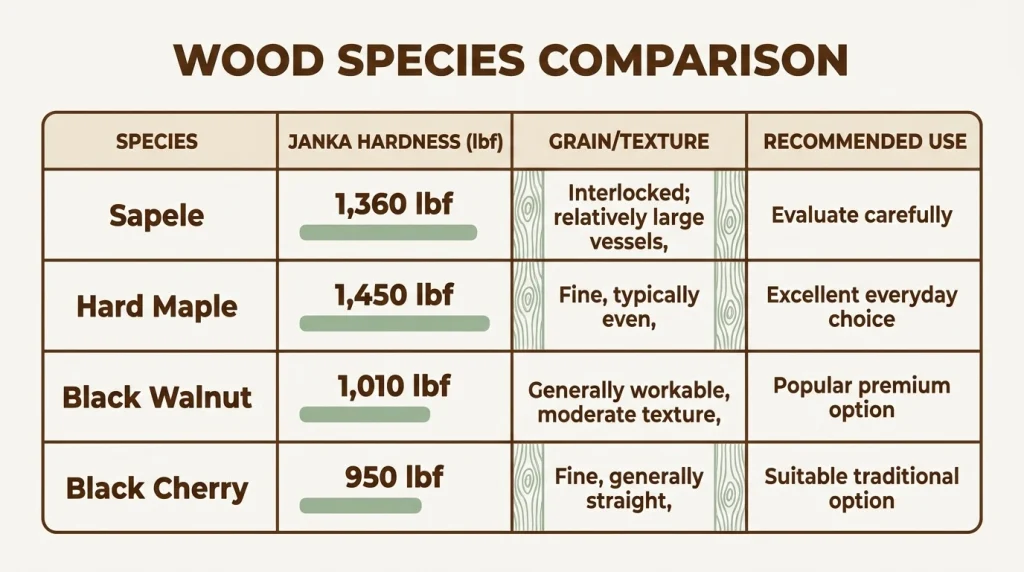
Hard maple is my preferred default for a traditional wooden cutting board. Sapele is similarly resistant to indentation, but the two woods differ in grain structure and practical suitability.
The Janka test measures resistance to indentation. It doesn’t measure food safety, bacterial contamination, or knife-edge wear directly.
Cutting Board Wood Comparison
| Wood | Janka Hardness | Grain Character | Practical Verdict |
|---|---|---|---|
| Sapele | 1,360 lbf | Interlocked; relatively large vessels | Evaluate carefully |
| Hard Maple | 1,450 lbf | Fine, typically even | Excellent everyday choice |
| Black Walnut | 1,010 lbf | Generally workable, moderate texture | Popular premium option |
| Black Cherry | 950 lbf | Fine, generally straight | Suitable traditional option |
Note: Hardness values represent typical published Janka ratings for the named species. Individual boards vary in quality, construction, and maintenance needs.
Is Sapele Harder Than Maple?
No. Hard maple typically measures 1,450 lbf, while sapele measures approximately 1,360 lbf.
The difference is modest compared with the variation among many hardwood species. Still, hardness alone doesn’t make their cutting-board performance identical.
Is Walnut Better Than Sapele?
American black walnut is a more established choice for decorative hardwood cutting boards. Its lower hardness doesn’t automatically make it less suitable.
Walnut offers rich color and attractive grain. I would choose a quality walnut board over an unverified sapele board for regular kitchen use.
Should You Use Edge-Grain or End-Grain Sapele?
Both construction styles are possible woodworking projects, but neither automatically resolves questions about sapele’s food-contact suitability. Construction quality remains important.
Edge-Grain Construction
Edge-grain boards place long wood fibers across the cutting surface. They usually require fewer machining and assembly steps than end-grain designs.
For a decorative sapele project, this is the simpler construction to evaluate. Pay close attention to tear-out and smoothness.
End-Grain Construction
End-grain boards expose the ends of wood fibers. They often require additional cutting, gluing, flattening, and finishing.
Sapele’s interlocked fibers can complicate machining, especially when preparing a level finished surface. Multiple glue joints also require careful workmanship.
For a broader explanation, see my step-by-step end-grain cutting board guide.
How Do You Make a Sapele Cutting Board?
Start by evaluating the material’s suitability for its intended use. If that remains uncertain, make a decorative serving board instead of an active chopping surface.
Materials and Tools
- Known, untreated, properly dried sapele lumber.
- Table saw or another suitable cutting tool.
- Clamps and a flat assembly surface.
- Adhesive documented as suitable for the intended board application.
- 120-, 180-, and 220-grit sandpaper.
- Dust extraction and suitable respiratory protection.
- Food-contact-appropriate mineral oil or conditioner.
- Clean, lint-free finishing cloths.
Seven Basic Construction Steps
- Inspect the lumber: Confirm the species and reject treated, damaged, contaminated, or unsuitable stock.
- Prepare the boards: Cut straight pieces using appropriate woodworking equipment and dust control.
- Check the grain: Examine surfaces for tear-out, splinters, or weak areas.
- Arrange the pieces: Dry-fit the layout and confirm that joints close evenly.
- Assemble carefully: Use an appropriate adhesive and follow its curing instructions completely.
- Sand the surfaces: Progress through suitable grits until the board feels consistently smooth.
- Finish and inspect: Remove dust, apply the specified finish, and verify suitability before food use.
Keep the board flat throughout construction. Avoid using heavy sanding to disguise gaps or poor glue joints.
For sapele, I would spend extra time checking the cutting surface under angled lighting. This can reveal raised fibers and machining defects.
Never run an assembled end-grain board through an ordinary thickness planer without an appropriate specialist method. End-grain machining presents serious safety risks.
What Is the Best Finish for a Sapele Cutting Board?
Food-grade mineral oil is a practical finish for a wooden board that has already been evaluated as suitable for food contact. It helps condition the wood and is easy to renew.
Mineral oil doesn’t turn unsuitable wood, contaminated lumber, or unsafe adhesives into food-safe materials. It also isn’t a substitute for cleaning.
How to Apply Cutting Board Oil
- Wash the board when appropriate and let it dry completely.
- Inspect the entire surface for damage or contamination.
- Apply food-grade mineral oil with a clean cloth.
- Spread a thin, even layer over all exposed sides.
- Allow absorption according to the product instructions.
- Wipe away remaining oil before using or storing the board.
Never substitute an unidentified furniture finish simply because it creates a beautiful shine. Confirm that the manufacturer recommends it for the intended food-contact application.
My full wooden cutting board oiling guide explains conditioning and reapplication in greater detail.
How Do You Clean and Maintain Sapele Cutting Boards?
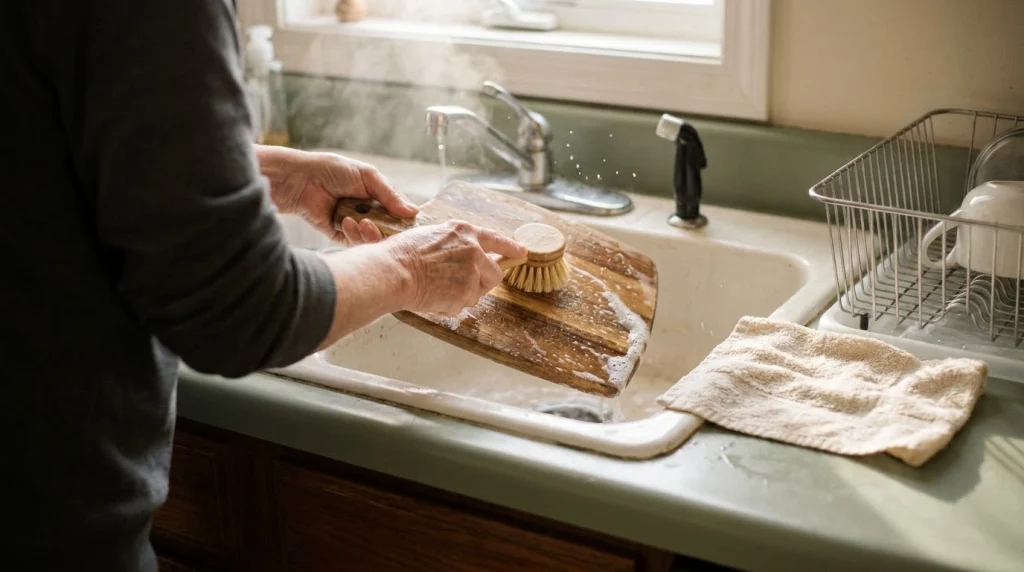
Clean a suitable wooden cutting board promptly after each use and dry it thoroughly. Avoid prolonged soaking and follow the manufacturer’s care instructions.
The University of Maine Cooperative Extension’s cutting-board safety guidance explains appropriate washing, drying, sanitizing, and maintenance practices.
Recommended Cleaning Routine
- Remove debris: Clear away food scraps immediately.
- Wash: Scrub with warm water, mild dish soap, and a clean brush or sponge.
- Rinse: Remove all soap and visible residue.
- Sanitize when needed: Use a method appropriate for the board and food-contact surface.
- Dry: Wipe with a clean towel and allow thorough air circulation.
- Inspect: Check for deep cuts, opening joints, and other damage.
- Condition: Reapply a suitable product when the clean, dry wood needs maintenance.
What Should You Avoid?
- Leaving a wooden board submerged in water.
- Putting it in the dishwasher without manufacturer approval.
- Storing it while moisture remains trapped underneath.
- Using unidentified oils, stains, or varnishes.
- Ignoring deep cuts or separation between glued pieces.
- Assuming oil or wax acts as a disinfectant.
Moisture trapped against a wooden surface can contribute to deterioration and microbial growth. Learn more in my guide on preventing mold on cutting boards.
Can You Cut Raw Meat on a Sapele Board?
I wouldn’t choose an unfamiliar sapele board as my primary raw-meat preparation surface. A purpose-made board with clear cleaning and sanitizing instructions is easier to assess.
Raw meat, poultry, and seafood introduce cross-contamination risks regardless of cutting-board material. Separate boards help prevent raw juices from contacting ready-to-eat foods.
For home kitchens, a dishwasher-safe plastic board can be a practical dedicated option for raw animal products. Replace it when cuts become too deep to clean effectively.
The North Carolina Cooperative Extension’s cutting-board recommendations also explain why material selection and cleaning matter.
When Should You Replace a Sapele Cutting Board?
Replace a board when damage prevents reliable cleaning or threatens structural stability. Cosmetic scratches alone don’t always require disposal.
Warning Signs
- Deep cracks: Open defects can trap moisture and food residue.
- Failed glue joints: Separation creates hard-to-clean spaces.
- Loose splinters: Fibers may detach during food preparation.
- Persistent contamination: Stains or odors that remain despite proper cleaning need investigation.
- Excessive grooves: Severe cutting damage can make sanitizing unreliable.
- Unknown coating: Unidentified treatments can make food-contact suitability uncertain.
A structurally sound board with minor surface wear may benefit from careful resurfacing. My guide to refinishing a wooden cutting board explains that process.
However, refinishing cannot establish the safety of unidentified chemicals or unsuitable construction materials. Replace questionable boards rather than relying on cosmetic repairs.
Is Sapele Better for Serving Boards Than Cutting Boards?
Sapele’s appearance makes it especially appealing for decorative kitchen projects. A serving board experiences different wear from a surface used for repeated chopping.
A suitable finished serving board may work for presenting bread, cheese, or other foods when its food-contact materials have been properly evaluated.
Possible Applications
- Decorative bread presentation boards.
- Charcuterie or cheese-serving boards with suitable food-contact finishes.
- Kitchen display pieces that don’t directly contact food.
- Decorative handles or accents kept away from cutting surfaces.
Food-contact requirements still apply to serving surfaces. Decorative appearance alone doesn’t establish suitability.
What Products Do I Recommend Instead?
As of 2026, I would prioritize an established maple cutting board for everyday chopping. The following products also help with routine wooden-board maintenance.
These are editorial recommendations based on published product specifications, not personal product testing. The scores represent suitability assessments rather than verified customer ratings.
🏆 Best Board Alternative
John Boos Maple R-Board Series
★★★★☆ 4.5/5 Editorial Fit
The R-Board Series uses northern hard rock maple and offers reversible cutting surfaces. I would choose this established hardwood option over an unverified sapele board for regular food preparation.
🪵 Best for Routine Oiling
Howard Cutting Board Oil
★★★★★ 4.8/5 Editorial Fit
This product contains pure food-grade mineral oil designed for wooden cutting boards. I would consider it for maintaining a properly made, food-contact-suitable wooden surface.
✨ Best Wax-Based Conditioner
Howard Butcher Block Conditioner
★★★★☆ 4.4/5 Editorial Fit
This conditioner combines food-grade mineral oil, beeswax, and carnauba wax. I would consider it when a suitable wooden board needs extra surface conditioning.
Frequently Asked Questions
Can you use sapele for cutting boards safely?
Potentially, but the answer depends on the actual board. Sapele has suitable hardness, yet its pore structure, construction, finish, and cleanability need careful evaluation. A food-contact-appropriate finish alone doesn’t establish safety. Hard maple remains a more established choice for everyday chopping.
Is sapele too porous for a cutting board?
Sapele has a diffuse-porous structure with relatively large vessels. This deserves attention when evaluating cleaning and surface quality. It doesn’t automatically mean every finished sapele board is unsafe, but it makes the wood less straightforward than fine-grained hard maple for regular kitchen use.
Is sapele harder than walnut?
Yes. Sapele has a typical Janka hardness of approximately 1,360 lbf, compared with 1,010 lbf for American black walnut. However, hardness measures indentation resistance rather than overall cutting-board suitability. Grain structure, finishing, construction, and cleaning requirements are equally important.
Can you use mineral oil on sapele wood?
Yes, food-grade mineral oil can be used to condition appropriately prepared sapele wood when compatible with the intended application. Apply it according to the product instructions. Mineral oil helps reduce moisture absorption but doesn’t sanitize the surface or make unsuitable materials safe for food contact.
What is the best alternative to sapele for cutting boards?
Hard maple is my first recommendation because it offers a fine grain, dependable hardness, and a long history in cutting-board production. American black walnut and black cherry are also established choices when properly manufactured. Choose a board specifically designed for food preparation.
Final Verdict: Should You Choose Sapele for a Cutting Board?
Sapele offers attractive color, decorative grain, and enough hardness to interest woodworkers. However, those qualities don’t automatically make it the best choice for food preparation.
I would consider sapele for decorative projects and properly evaluated serving surfaces. For a frequently used chopping board, I would prefer an established hard maple product.
My final advice: Choose materials based on food-contact suitability, cleanability, and construction quality before appearance. A dependable cutting surface should be easy to maintain and safe for its intended use.
If you’re planning a new wooden cutting board, start with a known hardwood and a trustworthy manufacturer. That approach removes much of the uncertainty surrounding unfamiliar lumber.