Can Sycamore Wood Be Used for a Cutting Board? Safety, Benefits & Complete Guide
Quick Answer
Yes, sycamore wood can be used for a cutting board when the wood is correctly identified, untreated, properly dried, and maintained. European sycamore is a traditional material for kitchen utensils and chopping boards, as noted by University College Cork. American sycamore can also work, although its lower hardness makes it more vulnerable to knife marks.
What You Should Know
- Food-contact suitability: Clean, untreated sycamore can be suitable for cutting-board construction.
- Species identification: American sycamore and European sycamore are botanically different trees.
- Wood hardness: European sycamore is harder than American sycamore.
- Moisture protection: Food-grade mineral oil helps maintain the wood.
- Daily hygiene: Wash after use and allow the board to dry completely.
My Recommendation
- For occasional home use: A carefully made sycamore board is worth considering.
- For intensive chopping: Hard maple is generally a more durable choice.
Sycamore has an attractive grain and a long history in woodworking. But does that make it a practical surface for cutting vegetables, slicing bread, and preparing everyday meals?
I prefer judging cutting-board wood by its species, hardness, grain, and cleaning requirements. This guide explains where sycamore performs well and when another hardwood makes more sense.
What Is Sycamore Wood?
Sycamore is a common name applied to several tree species. For cutting boards, the most important distinction is between American sycamore and European sycamore.
Both produce useful hardwood timber, but their properties are not identical. That distinction can influence your buying decision.
American Sycamore (Platanus occidentalis)
American sycamore belongs to the plane-tree family and grows across much of the eastern United States. Its timber is typically pale, with occasional darker streaks and distinctive ray patterns.
The grain is often interlocked, which means its fibers change direction as they grow. This can create interesting figure but may complicate machining and sanding.
The USDA’s American sycamore plant guide identifies butcher blocks among the wood’s historical uses.
European Sycamore (Acer pseudoplatanus)
European sycamore is a maple species rather than a plane tree. It produces pale, relatively fine-textured timber that has traditionally been used in kitchenware.
Wooden spoons, rolling pins, chopping boards, and other food-preparation tools are established applications. Its ability to provide a smooth surface makes it attractive for these products.
When shopping for sycamore lumber, I recommend confirming the botanical name. The word “sycamore” alone does not identify which wood you’re buying.
Is Sycamore Wood Safe for Cutting Boards?
Sycamore can be suitable for direct food preparation, provided the material is clean and appropriately finished. However, species identification alone cannot guarantee food safety.
The wood’s origin, previous treatment, surface condition, and maintenance also matter.
What Makes a Sycamore Board Suitable for Food?
- Known wood species: Confirm whether the material is American or European sycamore.
- Untreated lumber: Avoid timber containing unknown preservatives, pesticides, or industrial chemicals.
- Proper drying: Use seasoned lumber with moisture content appropriate for indoor furniture and kitchenware.
- Smooth surface: Remove splinters, rough fibers, and manufacturing debris.
- Appropriate adhesives: Choose a glue suitable for the intended cutting-board application.
- Food-contact finish: Apply a finish specifically identified as safe for food-preparation surfaces.
An old furniture panel is not automatically suitable for cutting food. Its previous coatings or chemical exposure may be unknown.
For that reason, I would choose new, traceable hardwood instead of reclaimed material with an uncertain history.
Does Sycamore Naturally Resist Bacteria?
Do not assume sycamore automatically disinfects itself. Wood can retain moisture and food residue, especially when the cutting surface becomes damaged.
Safe food preparation depends on proper washing, sanitizing when appropriate, and complete drying. A wooden board still requires regular care.
For a broader explanation, read our complete cutting board safety guide.
How Hard Is Sycamore Wood Compared With Other Cutting Board Woods?
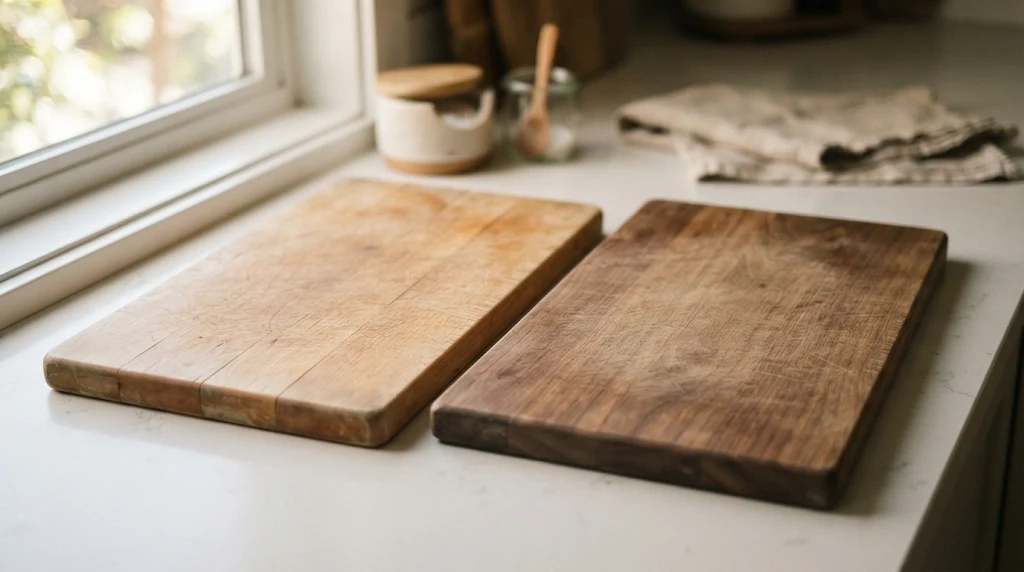
American sycamore has a Janka hardness of approximately 770 pounds-force, while European sycamore measures about 1,050 pounds-force. Both are softer than hard maple.
The Janka test measures resistance to indentation. It is useful for comparing wear potential, although hardness alone cannot predict a cutting board’s performance.
| Wood Species | Janka Hardness | Practical Assessment |
|---|---|---|
| American Sycamore | 770 lbf | Suitable for lighter use; shows wear more readily |
| European Sycamore | 1,050 lbf | Good candidate for kitchenware |
| Hard Maple | 1,450 lbf | Excellent everyday cutting-board choice |
| Black Walnut | 1,010 lbf | Popular balance of appearance and performance |
| Black Cherry | 950 lbf | Moderately soft, attractive cutting-board wood |
These are published species-level hardness values, not measurements of individual boards. Grain orientation, moisture content, and manufacturing quality also influence durability.
In practical terms, American sycamore may develop knife grooves sooner than maple. European sycamore offers a stronger balance for regular slicing.
What Are the Advantages of Using Sycamore for a Cutting Board?
Sycamore offers several advantages beyond its appearance. Its usefulness depends on the species and construction method.
1. Attractive Natural Grain
American sycamore can display unusual ray flecks, especially in quartersawn lumber. These patterns create a distinctive surface without requiring decorative coatings.
European sycamore generally offers a lighter and more uniform appearance. Both can complement a natural kitchen design.
2. Useful Working Properties
Sycamore can be cut, shaped, and finished using conventional woodworking equipment. However, American sycamore’s interlocked grain sometimes produces tear-out during planing.
Sharp tools and controlled cutting passes help produce a cleaner surface.
3. Comfortable Cutting Surface
A properly finished sycamore board provides a wooden work surface rather than a hard stone or glass surface. This is generally preferable for kitchen knife edges.
The wood still needs enough thickness to remain stable during use.
4. Potentially Affordable Material
American sycamore may be an economical choice when locally available. However, specialty milling, drying, and shipping can change the final price.
European sycamore may cost more in markets where it must be imported.
5. Flexible Board Designs
Sycamore can be used in single-piece boards or appropriately glued panels. It also offers interesting possibilities for serving boards and lighter food-preparation tasks.
I particularly like the idea of using distinctive American sycamore grain for a small produce board rather than a heavily used chopping block.
What Are the Disadvantages of Sycamore Cutting Boards?
Sycamore has limitations that buyers should understand. Its attractive appearance does not eliminate normal hardwood maintenance problems.
- Visible knife marks: American sycamore is softer than hard maple and can show wear sooner.
- Moisture sensitivity: Repeated wetting can cause dimensional changes, warping, or cracking.
- Limited decay resistance: Sycamore should not remain damp for extended periods.
- Interlocked grain: American sycamore can be difficult to plane smoothly.
- Species confusion: Sellers may use the same common name for different woods.
- Care requirements: Wooden boards need regular cleaning, drying, and conditioning.
None of these drawbacks automatically disqualifies the material. They simply mean sycamore requires sensible expectations.
For someone who cooks daily and wants minimal maintenance, a standard maple or dishwasher-safe plastic board may be easier to manage.
Can American Sycamore Be Used for a Butcher Block?
Yes, American sycamore has historically been used for butcher blocks. However, traditional use does not make every piece of sycamore suitable for heavy chopping.
American sycamore is moderately soft compared with hard maple. Heavy cleaver work may produce visible marks sooner.
A butcher block also needs strong joinery, stable lumber, and adequate thickness. Simply gluing several rough boards together is not enough.
For demanding work, I would prioritize a proven hard-maple block. I would consider American sycamore mainly when a skilled maker can evaluate the material and construction.
How Do You Make a Sycamore Wood Cutting Board?
Making a sycamore cutting board follows the same general process used for other hardwood boards. Material selection and proper drying are particularly important.
For beginners, a simple edge-grain design is easier than a complex end-grain butcher block.
Step 1: Select Suitable Lumber
Choose correctly identified, untreated sycamore from a reliable supplier. Avoid boards containing soft decay, large cracks, or suspicious discoloration.
Step 2: Check Moisture Content
Use properly dried lumber that has acclimated to your workspace. A wood moisture meter can help identify boards that remain too damp.
A meter reading should be interpreted according to the wood species and manufacturer instructions.
Step 3: Plan the Dimensions
A practical starting size is approximately 12 by 18 inches. Around 1 inch of finished thickness can work for a straightforward household board.
Choose dimensions based on your countertop, available lumber, and intended food-preparation tasks.
Step 4: Cut and Prepare the Pieces
Cut the lumber into straight sections and prepare the mating edges. Keep the board flat and remove unstable or defective material.
Wear appropriate eye protection and follow the safety instructions for your woodworking equipment.
Step 5: Glue the Board
Use an adhesive whose manufacturer identifies it as suitable for the intended cutting-board application. Apply the recommended amount and follow the stated curing instructions.
Clamp the pieces evenly without forcing badly fitting joints together.
Step 6: Flatten and Sand
After the adhesive has fully cured, flatten the panel. Sand progressively until the surface feels smooth and free from raised fibers.
Follow the wood grain where practical and remove all sanding dust before finishing.
Step 7: Soften the Edges
Round or ease the corners to improve handling. Sharp corners can chip and may feel uncomfortable when moving the board.
Step 8: Apply a Food-Safe Finish
Apply food-grade mineral oil according to the product instructions. Cover the cutting faces, edges, and underside.
Remove excess oil before the board returns to food preparation.
Step 9: Inspect Before Use
Check for splinters, loose joints, cracks, or rough areas. Wash and dry the board before preparing food.
For additional woodworking guidance, see how to make a wooden cutting board.
Should You Make an Edge-Grain or End-Grain Sycamore Cutting Board?
Edge-grain boards are generally simpler to build, while end-grain boards require more cutting and glue joints. Both designs can work when appropriately constructed.
Edge-Grain Sycamore
- Uses the lengthwise faces of wood strips.
- Requires fewer manufacturing steps.
- Works well for a straightforward household board.
- May display visible knife marks over time.
End-Grain Sycamore
- Exposes the ends of the wood fibers.
- Can reduce some visible cutting damage.
- Requires more careful machining and assembly.
- Needs dependable glue joints and moisture control.
For a first project, I would start with edge grain. It provides a simpler way to learn how the particular sycamore lumber behaves.
What Is the Best Finish for a Sycamore Cutting Board?
Food-grade mineral oil is a practical finish for an unfinished sycamore cutting board. A food-contact-safe mineral-oil-and-wax conditioner can provide additional surface conditioning.
These products help maintain the wood but do not make it completely waterproof or eliminate the need for sanitation.
Recommended Finishing Materials
- Food-grade mineral oil: Helps condition exposed wood fibers.
- Food-safe beeswax conditioner: Adds a wax-based conditioning layer.
- Food-contact-safe board cream: Offers convenient routine maintenance when used as directed.
Finishes to Avoid
- Unknown industrial wood stains or preservatives.
- Furniture polishes without food-contact approval.
- Ordinary cooking oils that can become rancid.
- Decorative coatings not intended for repeated knife contact.
Oil the board when the wood begins to look dry, following the product directions. Excess conditioner should not remain sticky on the surface.
Our step-by-step wooden cutting board oiling guide explains this maintenance process in more detail.
How Do You Clean and Sanitize a Sycamore Cutting Board?
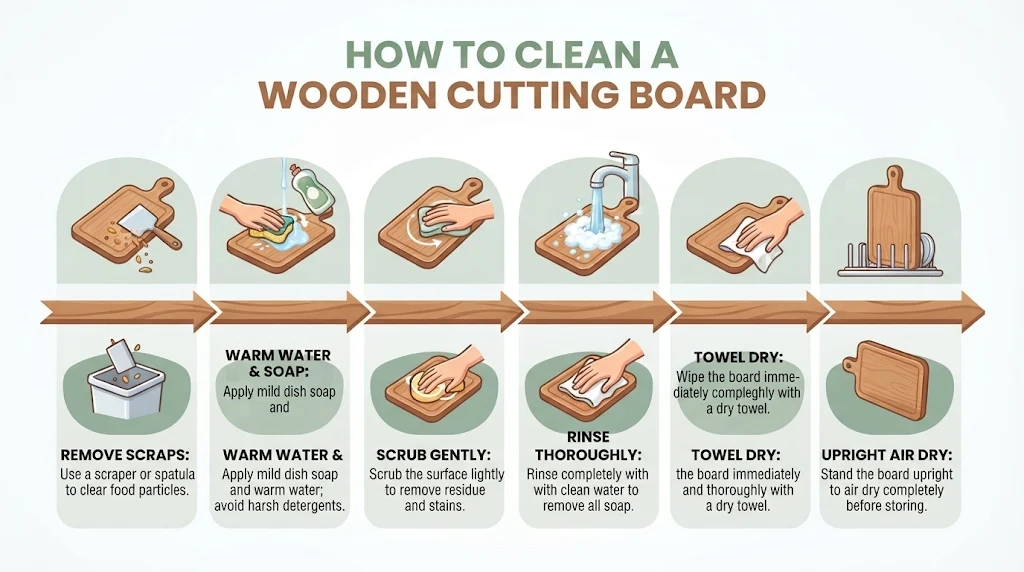
Clean sycamore after every food-preparation session and dry it promptly. Proper cleaning matters more than choosing a supposedly antibacterial wood species.
The University of Maine Cooperative Extension provides practical guidance on wooden cutting-board hygiene and maintenance.
Daily Cleaning Steps
- Remove food scraps: Clear away visible crumbs and food particles.
- Wash the surface: Use warm water and ordinary dish soap.
- Scrub gently: Clean knife marks and areas where food has collected.
- Rinse thoroughly: Remove remaining soap and loosened debris.
- Towel dry: Remove standing water from every side.
- Air dry: Store the board upright with good airflow.
Never leave sycamore soaking in a sink. Long exposure to water increases the risk of swelling, distortion, and joint damage.
When Is Sanitizing Necessary?
Sanitizing becomes especially important after contact with raw animal products. Follow an approved food-contact-surface sanitizer’s label for concentration and contact time.
Separate boards for raw meat and ready-to-eat ingredients reduce cross-contamination risks. A dishwasher-safe plastic board is often more convenient for raw poultry and seafood.
How Often Should You Oil the Board?
Condition the board when its surface begins looking pale or dry. Monthly conditioning is a useful starting point, although usage and washing frequency influence the schedule.
Always clean and dry the wood before applying conditioner. Oiling over food residue is not an acceptable cleaning method.
How Can You Prevent a Sycamore Cutting Board From Warping?
Warping occurs when moisture changes cause different parts of the board to expand or contract unevenly. Balanced moisture exposure and drying help reduce this problem.
- Wash both sides appropriately without prolonged soaking.
- Dry the surface immediately after cleaning.
- Store the board upright with air circulation.
- Avoid placing it beside strong heat sources.
- Condition all exposed sides when the wood requires oil.
- Never place the board in an oven to accelerate drying.
A badly warped board can become unstable beneath a knife. If it rocks or slides during cutting, stop using it until the problem is corrected.
When Should You Replace a Sycamore Cutting Board?
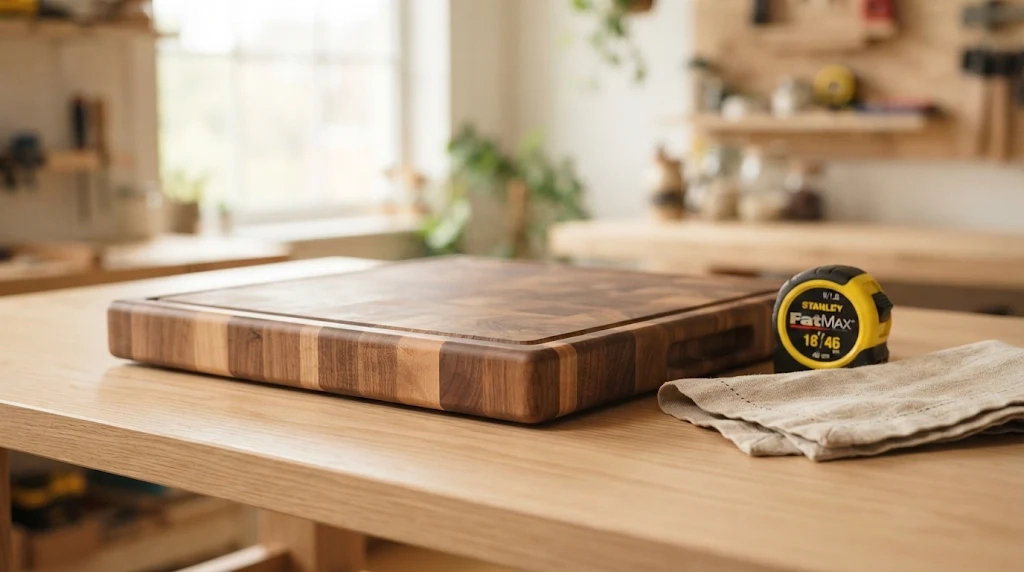
Replace a sycamore board when damage prevents effective cleaning or safe cutting. Surface appearance alone does not determine whether it remains usable.
Warning Signs
- Deep knife grooves that cannot be cleaned thoroughly.
- Open cracks that trap moisture or food debris.
- Loose glued joints or separating sections.
- Persistent mold growth or suspected deep contamination.
- Splinters or deteriorating wood fibers.
- Severe warping that makes cutting unsafe.
Minor superficial knife marks are normal. However, deep structural defects require professional assessment or replacement.
Do not rely on oil or wax to repair a serious crack. Conditioner cannot restore the structural strength of damaged wood.
Is Sycamore Better Than Maple for Cutting Boards?
Hard maple is generally the better all-purpose choice for demanding everyday use. Sycamore remains useful when its appearance, local availability, or traditional applications matter more.
Sycamore vs. Hard Maple
- Hardness: Hard maple is harder than both American and European sycamore.
- Wear resistance: Hard maple generally withstands repeated cutting marks better.
- Appearance: American sycamore can offer unusual ray-fleck patterns.
- Availability: Hard maple is common in manufactured wooden cutting boards.
For regular chopping, I would usually choose a well-made hard-maple board. For a lighter-use specialty board, sycamore can be appealing.
Sycamore vs. Plastic
Wooden boards offer a traditional cutting experience but require hand washing and careful drying. Many plastic boards are easier to sanitize and can be dishwasher-safe.
Our comparison of wood vs. plastic cutting boards explains the practical differences.
What Foods Can You Prepare on a Sycamore Cutting Board?
A smooth, clean sycamore board is useful for many ordinary kitchen tasks. Its suitability depends on the condition of the board and your cleaning practices.
Good Everyday Uses
- Chopping vegetables for soups or salads.
- Slicing apples, pears, and other fruits.
- Cutting bread, rolls, and sandwiches.
- Preparing herbs and other plant ingredients.
- Portioning cheese on a clean food-preparation surface.
For raw meat, poultry, and seafood, use a dedicated board that you can clean and sanitize thoroughly. Do not transfer raw-meat contamination to ready-to-eat food.
What Should You Check Before Buying a Sycamore Cutting Board?
A good cutting board should have a stable construction and a surface suitable for food contact. An attractive grain pattern is only one part of the decision.
Buying Checklist
- Species: Ask whether it is American or European sycamore.
- Construction: Check the board for loose joints or visible cracks.
- Finish: Confirm that surface treatments are intended for food contact.
- Thickness: Choose a board that feels stable during cutting.
- Dimensions: Leave enough space for the ingredients you regularly prepare.
- Maintenance: Check the maker’s washing and conditioning instructions.
As of 2026, it is still worth checking these details rather than relying on a seller’s description of “natural wood.” Material quality varies between manufacturers.
Helpful Products for Sycamore Cutting Board Care
If you already own a suitable sycamore board, maintenance supplies can help preserve it. If you prefer a ready-made alternative, a maple board is worth considering.
Affiliate disclosure: As an Amazon Associate, we may earn from qualifying purchases. The scores below are editorial suitability assessments, not verified customer ratings or hands-on test results.
Best for Routine Oiling
Howard Cutting Board Oil
★★★★☆ 4/5 editorial fit
Made with food-grade mineral oil, this product helps condition unfinished wooden cutting surfaces. I’d consider it a straightforward choice for routine sycamore-board maintenance.
Best for Wax Conditioning
Howard Butcher Block Conditioner
★★★★☆ 4/5 editorial fit
This conditioner combines food-grade mineral oil with beeswax and carnauba wax. I’d consider it when a wooden board needs both oil conditioning and a light wax finish.
Best Ready-Made Alternative
John Boos R-Series Maple Cutting Board
★★★★☆ 4/5 editorial fit
This reversible hard-maple cutting board is available in different sizes and features recessed grips. I’d favor it over softer American sycamore for frequent chopping, provided its maintenance requirements suit your kitchen.
Before purchasing care products, review the manufacturer instructions. For an established example, see the John Boos cutting board care recommendations.
Frequently Asked Questions
1. Is sycamore wood toxic for cutting boards?
American and European sycamore have documented uses in food-related woodworking. However, this does not guarantee that every sycamore board is suitable for food contact. Choose correctly identified, untreated timber and avoid unknown finishes, contamination, decay, or chemical treatments.
2. Is American sycamore harder than maple?
No. American sycamore has a Janka hardness of approximately 770 lbf, compared with about 1,450 lbf for hard maple. This makes American sycamore more vulnerable to indentation and visible wear under similar conditions.
3. Can you use sycamore wood for chopping vegetables?
Yes. A properly made, smooth, clean sycamore board can be useful for cutting vegetables and other everyday ingredients. Wash it after use, avoid prolonged soaking, and allow the wood to dry completely before storage.
4. Can I use olive oil on a sycamore cutting board?
Olive oil is not my recommended maintenance treatment because ordinary cooking oils can oxidize and develop unpleasant odors. Choose food-grade mineral oil or a board conditioner intended for food-contact surfaces instead. Follow the manufacturer’s application instructions.
5. How long does a sycamore cutting board last?
There is no reliable universal lifespan for sycamore cutting boards. Durability depends on the species, construction, frequency of use, cleaning practices, and exposure to moisture. Replace the board when deep damage, unstable joints, or contamination makes safe cleaning difficult.
Final Verdict: Is Sycamore a Good Wood for Cutting Boards?
Yes, sycamore can make a useful cutting board, but the species makes a meaningful difference. European sycamore has a stronger traditional kitchenware history and greater hardness than American sycamore.
American sycamore remains an interesting option for lighter cutting tasks and custom woodworking projects. It deserves realistic expectations about wear and maintenance.
For a heavily used everyday board, hard maple is usually my preferred option. Whatever wood you choose, prioritize a smooth surface, suitable materials, regular cleaning, and complete drying.
The bottom line: A well-made sycamore board can serve your kitchen, but good construction and consistent care matter more than appearance alone.