
Why Do Cutting Boards Have Juice Grooves? A Complete Guide
Quick Answer
Cutting boards have juice grooves to catch liquids released when slicing meat, fruit, and other juicy foods. These shallow channels help stop drippings from flowing over the board and onto your countertop. They make food preparation and carving cleaner, but they don’t replace the cleaning and separation practices recommended by FoodSafety.gov.
Five Things Juice Grooves Do
- Catch meat juices: Collect liquid released when carving cooked roasts, steaks, and poultry.
- Reduce countertop spills: Keep some runoff inside the board’s perimeter.
- Contain fruit juice: Help manage moisture from watermelon, tomatoes, and citrus.
- Support cleaner serving: Make transferring carved meat less messy.
- Collect drippings: Hold some juices that you may want to transfer into a sauce or gravy.
Important Tip
- Check your cooking habits: Choose a grooved board for frequent carving and a flat board for everyday vegetable chopping.
A juice groove might look like a decorative line around a cutting board. I think its real value becomes clear when you carve a juicy roast or slice a large watermelon.
The channel gives escaping liquid somewhere to collect. In this guide, I’ll explain how it works, when it’s useful, and whether it’s worth having in your kitchen.
What Is a Juice Groove on a Cutting Board?
A juice groove is a shallow channel carved or molded around part or all of a cutting board’s perimeter. Its purpose is to collect food liquids before they spill over the edge.
Manufacturers also call these channels drip grooves, drainage grooves, or juice-catching channels. You’ll commonly find them on wooden carving boards and plastic cutting boards designed for meat preparation.
Simple definition: A cutting board juice groove is a recessed channel that collects runoff from food during slicing or carving. It manages liquid; it doesn’t absorb juice or disinfect the cutting surface.
Most designs place the groove near the outer edge, leaving a flat cutting area in the center. Some carving boards include deeper collection wells or specially shaped pouring corners.
The design can vary considerably between products. A narrow decorative groove may hold much less liquid than a wide carving-board channel.
Why Do Cutting Boards Have Juice Grooves?
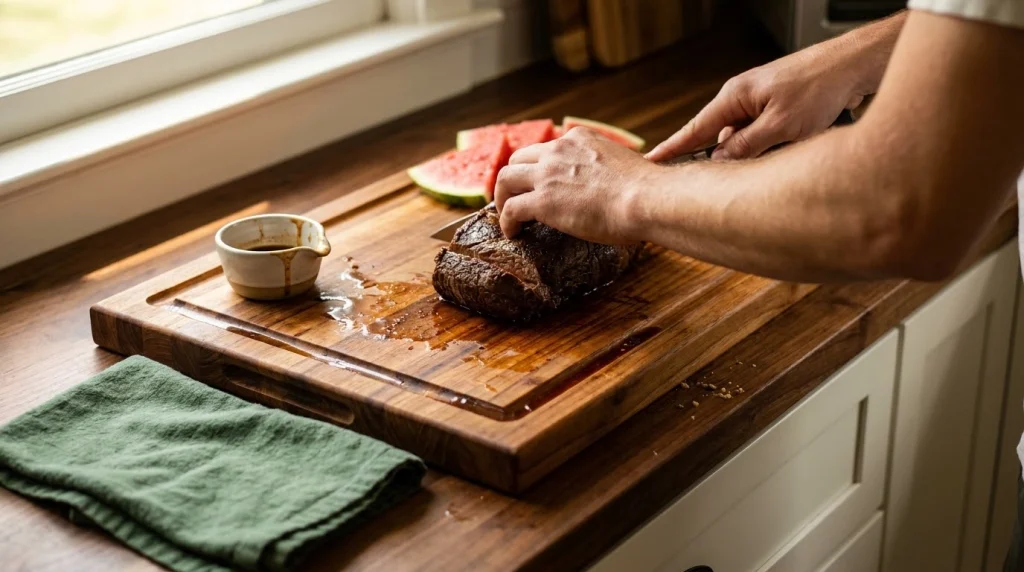
Cutting boards have juice grooves mainly to make food preparation less messy. They help control liquid that would otherwise spread across a countertop or work surface.
The benefits become clearer with certain ingredients and cooking tasks.
1. To Collect Juices When Carving Meat
Cooked meat can release liquid when you slice it. Even after resting, a roast or steak may produce drippings during carving.
Without a surrounding groove, that liquid can travel across the cutting surface and spill over the edge. A channel collects some of it before that happens.
- Roast beef: Captures some drippings released as you slice.
- Roast turkey: Helps manage liquid while carving large portions.
- Steak: Reduces runoff during slicing and serving.
- Roast chicken: Gives remaining carving juices a place to collect.
This feature is particularly helpful when preparing a large meal. You can focus more on carving and less on wiping the counter.
2. To Keep Countertops Cleaner
A flat cutting board has no built-in channel to catch liquid. Once juice reaches its edge, it can drip onto the counter.
A grooved board creates a small holding area around the food. That doesn’t guarantee zero spills, but it can reduce cleanup.
One practical detail matters here: the groove must have enough capacity. A shallow channel can overflow during a large carving job.
3. To Manage Juicy Fruits and Vegetables
Meat isn’t the only ingredient that releases liquid. Watermelon, pineapple, ripe tomatoes, and citrus can create similar messes.
A juice groove helps contain some of this moisture. It’s useful when cutting several portions on the same board.
- Watermelon: Produces substantial liquid during slicing.
- Pineapple: Releases juice while trimming and portioning.
- Tomatoes: Can spread juice and seeds across the work surface.
- Oranges: Release liquid when peeled and segmented with a knife.
For more advice on selecting a stable preparation surface, read my guide on how to use a cutting board safely.
4. To Help Collect Drippings for Gravy
Juices from properly cooked meat can add flavor to sauces and gravy. A clean carving board with a well-designed groove helps collect those drippings.
Some boards have pouring corners that make transfer easier. Others require careful tilting to move the liquid into a small container.
Only save drippings from safely cooked food on a clean board. Never use juices from raw meat as a ready-to-eat sauce.
How Does a Cutting Board Juice Groove Work?
A juice groove works by providing a recessed space where runoff can settle. As liquid spreads from food, some of it reaches the channel and collects there.
The groove doesn’t actively pull liquid across the board. Gravity, surface shape, and the amount of runoff determine how effectively it works.
What Happens During Carving?
- Juice escapes: Slicing releases moisture from the cooked meat.
- Liquid spreads: Some juice moves across the board toward its edges.
- The groove catches runoff: Liquid reaching the recessed channel can settle there.
- Juice collects: The channel temporarily holds some of the drippings.
- You empty the board: Carefully transfer or discard the collected liquid before it overflows.
A board should remain stable while you cut. Deliberately tilting it during knife work can cause the food or knife to slip.
I prefer a board that sits flat and has a wide cutting area inside the channel. The groove should help with mess control without interfering with knife movement.
Which Foods Benefit Most From a Juice Groove?
Juice grooves are most useful for foods that release noticeable liquid during cutting. Dry foods generally don’t need the extra channel.
Here’s a practical comparison.
| Food | Typical Runoff | Groove Usefulness |
|---|---|---|
| Cooked roast beef | Moderate to high | High |
| Roast turkey | Moderate to high | High |
| Watermelon | High | High |
| Ripe tomatoes | Moderate | Moderate |
| Carrots | Low | Low |
| Bread | Minimal | Low |
| Fresh herbs | Minimal | Low |
These are qualitative kitchen-use estimates, not measured liquid volumes. Actual runoff depends on the ingredient, portion size, and cutting method.
A groove is most valuable when you handle juicy ingredients regularly. If you primarily chop onions, carrots, and herbs, a flat board may feel more convenient.
Do You Really Need a Cutting Board With a Juice Groove?
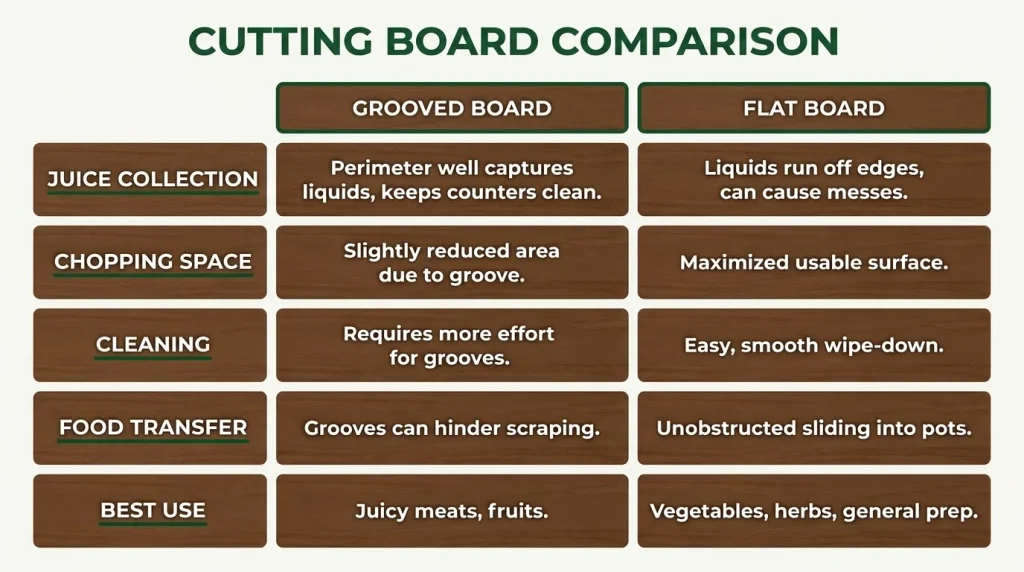
No, a juice groove isn’t essential for every kitchen. Whether you need one depends on the foods you prepare and how often you carve meat.
Many people can manage everyday cooking with a plain cutting board. A grooved carving board becomes more appealing when liquid spills are a recurring problem.
Grooved vs. Flat Cutting Boards
| Feature | Grooved Board | Flat Board |
|---|---|---|
| Juice collection | Built-in collection channel | No dedicated channel |
| Chopping space | Slightly reduced by the groove | More continuous flat space |
| Cleaning | Channel needs extra attention | Usually simpler to scrub |
| Food transfer | Groove can catch chopped pieces | Easy to scrape food off the edge |
| Best use | Carving and juicy foods | General chopping and slicing |
My practical recommendation is to prioritize a stable flat board for routine preparation. Add a grooved board if you frequently carve meat or cut juicy produce.
You can also choose a reversible model with a grooved face and a plain face. Just make sure each intended cutting face rests securely during use.
What Are the Disadvantages of Juice Grooves?
Juice grooves provide convenience, but they also introduce a few trade-offs. The biggest concerns are cleaning, reduced cutting space, and limited liquid capacity.
Less Usable Cutting Space
The perimeter channel takes up part of the board’s surface. That matters most on smaller boards where every inch of chopping space counts.
A wide chef’s knife may approach the groove during long cutting strokes. Keeping food in the center helps maintain better control.
Extra Cleaning Around the Edges
Juice grooves can collect food scraps along with liquid. Small particles may remain in corners if you only wipe the main cutting surface.
Choose a smooth, rounded channel that’s easy to reach with a brush. Avoid designs with rough edges or inaccessible recesses.
Grooves Can Overflow
No cutting-board groove has unlimited capacity. Large roasts and very juicy fruit can produce more liquid than a shallow channel holds.
Empty the groove when necessary instead of continuing until liquid spills. Use a tray beneath the board for particularly messy carving tasks.
Chopped Food Can Get Caught
A groove can interrupt the movement of chopped ingredients toward the edge. Small onion pieces or herbs may fall into the channel.
Use a bench scraper to collect ingredients from the center. Avoid scraping your knife’s sharp edge sideways across the board.
Are Juice Grooves Hygienic and Safe?
Yes, a properly maintained juice groove can be hygienic. Its safety depends on the board’s condition and how thoroughly you clean it.
However, a manufactured juice groove isn’t the same as deep knife damage. Worn, irregular cuts can become difficult to clean effectively.
The University of Illinois Extension cutting-board guidance recommends replacing heavily scored boards that are difficult to clean.
Does a Juice Groove Prevent Cross-Contamination?
No. A groove collects liquid, but it doesn’t stop bacteria from spreading through hands, utensils, or contaminated surfaces.
Raw meat juices can contain harmful microorganisms. Avoid placing ready-to-eat food on a contaminated cutting board without proper cleaning and sanitizing.
- Use separate boards: Keep raw animal products apart from ready-to-eat foods whenever practical.
- Wash immediately: Remove food residue after each preparation task.
- Sanitize when needed: Follow recognized food-contact sanitizing instructions after handling raw meat.
- Inspect the groove: Check for cracks, splinters, and difficult-to-clean damage.
- Dry completely: Don’t store boards while moisture remains trapped.
The University of Maine Cooperative Extension provides additional advice about board materials, cleaning, and food safety.
How Do You Clean a Cutting Board With a Juice Groove?
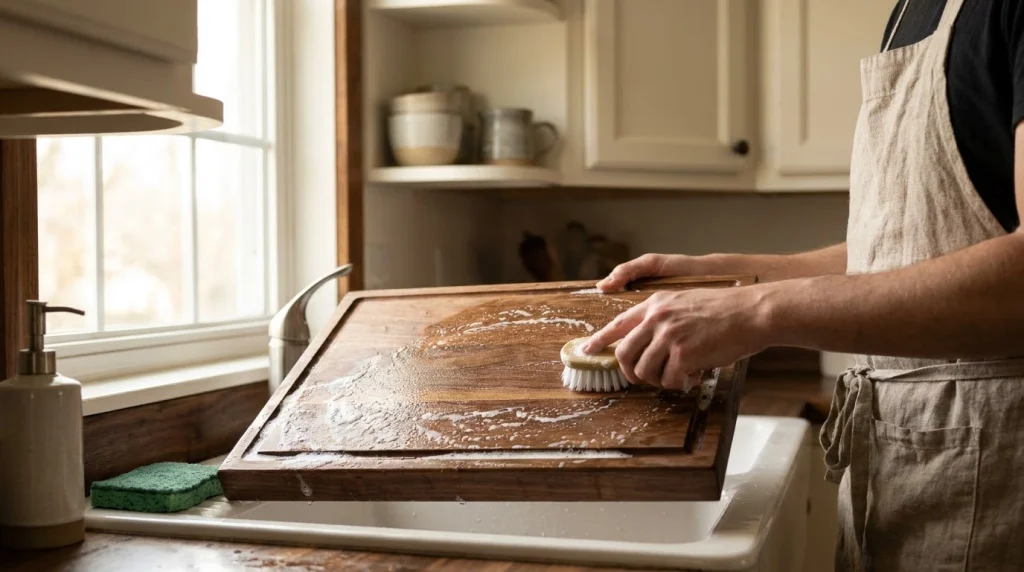
Clean a grooved cutting board with dish soap and warm or hot water. Give the recessed channel extra attention because moisture and food residue can collect there.
The cleaning method also depends on whether your board is wooden, bamboo, plastic, or composite.
Step-by-Step Cleaning Instructions
- Remove food scraps: Clear the main surface and any particles collected inside the groove.
- Apply dish soap: Wash the board using warm or hot water and a suitable dish detergent.
- Scrub the channel: Use a clean nylon brush or sponge to reach the groove’s bottom and corners.
- Clean both faces: Wash the underside, edges, and handles as well.
- Rinse thoroughly: Remove loosened residue and detergent with clean water.
- Sanitize when necessary: Follow food-safe guidance appropriate to the material and previous food contact.
- Dry completely: Pat dry and allow airflow around the board before storage.
Most wooden and bamboo boards should be hand-washed rather than soaked. Dishwasher-safe plastic boards can often go in the dishwasher when the manufacturer allows it.
For additional information about washing and separation, see the Academy of Nutrition and Dietetics cutting-board safety advice.
How Do You Maintain a Wooden Juice Groove?
Wooden channels need the same conditioning as the rest of the board. Food-grade mineral oil can help maintain suitable unfinished wooden surfaces.
Apply conditioner only after the board is clean and thoroughly dry. Work it into the groove, exposed edges, and both faces as recommended by the manufacturer.
For detailed instructions, see my guide on how to oil a wooden cutting board.
If you use a board cream or wax, keep the coating thin and remove excess product. This helps prevent sticky buildup inside the channel.
You can learn more in my guide on how to wax a cutting board.
Are Wooden or Plastic Juice Groove Boards Better?
Both materials can work well, but they suit different priorities. Wood often appeals to people who want a substantial carving surface, while plastic simplifies some cleaning routines.
Wooden Boards With Juice Grooves
Hardwood carving boards provide a firm, attractive work surface. Maple and other suitable hardwoods are common choices.
- Advantages: Durable construction, attractive appearance, and a knife-friendly surface when properly made.
- Limitations: Usually heavier and require careful washing, drying, and conditioning.
- Best for: Serving and carving cooked roasts or preparing large meals.
Plastic Boards With Juice Grooves
Plastic boards are often lighter and easier to maintain. Many models also feature non-slip edges and dishwasher-safe construction.
- Advantages: Convenient cleaning, lower weight, and a broad choice of affordable designs.
- Limitations: Knife cuts can accumulate, eventually making replacement necessary.
- Best for: Frequent raw-meat preparation and everyday kitchen tasks.
As of 2026, both materials remain useful choices. Good cleaning habits matter more than simply choosing wood or plastic.
What Should You Look for in a Juice Groove Cutting Board?
Look beyond the presence of a groove. A useful carving board also needs enough space, stable support, and a design you can clean properly.
Important Buying Features
- Channel capacity: Choose a groove large enough for the amount of liquid you typically encounter.
- Cutting area: Leave enough uninterrupted space inside the groove for comfortable knife work.
- Rounded channel: Smooth contours make cleaning easier.
- Non-slip support: Check the feet, edges, or base for stability.
- Suitable material: Match your board to your washing and maintenance preferences.
- Pouring design: Easy-pour corners can help empty collected juices.
- Reversible construction: A flat second face can offer more preparation options.
What Size Cutting Board Is Best?
Choose the board size according to the food you’re cutting and your counter space. These dimensions are practical shopping starting points rather than universal standards.
- 12 x 8 inches: Compact preparation and smaller portions.
- 15 x 10 inches: General chopping and moderate carving tasks.
- 18 x 12 inches: Larger roasts and more generous carving space.
- 20 inches or longer: Oversized poultry and large serving tasks.
Remember to measure usable space inside the groove. The board’s exterior dimensions can make the cutting area appear larger than it is.
Can You Use Both Sides of a Cutting Board With a Juice Groove?
Yes, some grooved cutting boards have two usable cutting faces. Others have feet or a special carving shape that makes flipping unsuitable.
Read the manufacturer’s instructions and check that the chosen side rests securely. Never cut on a board that rocks or slides.
A reversible board can offer a convenient combination of carving space and ordinary chopping space. Still, flipping doesn’t replace cleaning between contaminated and ready-to-eat foods.
Read my full explanation of whether you can use both sides of a cutting board.
Which Cutting Boards With Juice Grooves Are Worth Considering?
If you’re shopping for a grooved board, I would start with models that clearly describe their liquid-control features. These three offer different benefits for everyday cooking and carving.
Disclosure: The following links may earn us a commission from qualifying purchases. The suitability scores below are editorial assessments of features, not customer-review ratings or claims of hands-on testing.
🏆 Best for Everyday Versatility
OXO Good Grips Carving & Cutting Board
★★★★★
Editorial feature-fit score: 5/5
This 21.1 x 14.5-inch polypropylene board features a grooved carving side, a solid preparation side, non-slip feet, and easy-pour corners. I would choose it for a kitchen needing one versatile board with straightforward maintenance.
🌳 Best Compact Wooden Option
John Boos Maple Chop-N-Slice Board With Juice Groove
★★★★☆
Editorial feature-fit score: 4/5
The 12 x 8 x 1-inch version uses edge-grain hard maple and has a reversible design with a juice groove on one side. I’d consider it for smaller carving jobs when natural wood matters more than maximum capacity.
🍗 Best for Controlled Meat Carving
Joseph Joseph Cut&Carve Plus Cutting Board
★★★★☆
Editorial feature-fit score: 4/5
This dishwasher-safe board uses a sloping base, raised edges, easy-pour corners, and an integrated meat grip. I’d shortlist it for carving cooked poultry because the grip and liquid-control features address two common challenges.
Frequently Asked Questions
Are juice grooves necessary on a cutting board?
No, juice grooves aren’t necessary for most routine chopping tasks. They are especially useful when carving cooked meat or slicing fruit that releases considerable liquid.
If you mainly prepare dry vegetables, bread, and herbs, a flat board may be easier to use and clean.
What is the difference between a juice groove and a drip groove?
The terms usually describe the same feature: a recessed channel intended to collect liquid during cutting. Manufacturers may use either name, and some also refer to drainage channels.
Design matters more than terminology. Check the groove’s size, shape, and ease of cleaning before buying.
Can bacteria grow inside cutting board juice grooves?
Bacteria can remain in any cutting-board area that isn’t cleaned properly, including a juice groove. Food residue and moisture can create additional hygiene problems.
Wash the channel thoroughly, sanitize when necessary, and dry the board completely. Replace boards with cracks or damage that prevents effective cleaning.
Can I use a grooved cutting board for vegetables?
Yes. A grooved board works for vegetables, particularly ripe tomatoes and other ingredients that release liquid.
However, the channel reduces uninterrupted chopping space and may catch small pieces. For large batches of chopped vegetables, a flat board is often more convenient.
Should a cutting board juice groove face up or down?
When using the groove to catch liquid, keep the grooved face upward. This allows the channel to collect runoff during carving.
Some boards have a separate flat cutting face, but use it only as instructed by the manufacturer. Always check that the board stays stable and doesn’t rock.
Final Thoughts: Are Cutting Board Juice Grooves Worth It?
Cutting boards have juice grooves for a simple reason: they help control liquid and reduce mess. That’s particularly useful when carving cooked meat or preparing juicy fruit.
However, a groove doesn’t automatically make a cutting board safer or better. Cleaning access, usable cutting space, and stability are just as important.
For a practical kitchen setup, I would choose a spacious flat board for daily chopping and a grooved board for carving. If storage is limited, a well-designed reversible board can be a useful compromise.
Before your next meal, check your current board. If liquid frequently runs onto your countertop, a cutting board with a properly designed juice groove may be worth adding to your kitchen.

