What Is the Belly of a Chef Knife? Uses Explained
Quick Answer
The belly of a chef knife is the curved portion of its sharpened cutting edge, usually most noticeable between the middle of the blade and the tip. This curve allows the knife to roll smoothly against a cutting board during rocking cuts, making it useful for chopping vegetables, mincing herbs, and preparing garlic. A more pronounced belly generally supports a greater rocking motion, while a flatter edge is better suited to push cutting.
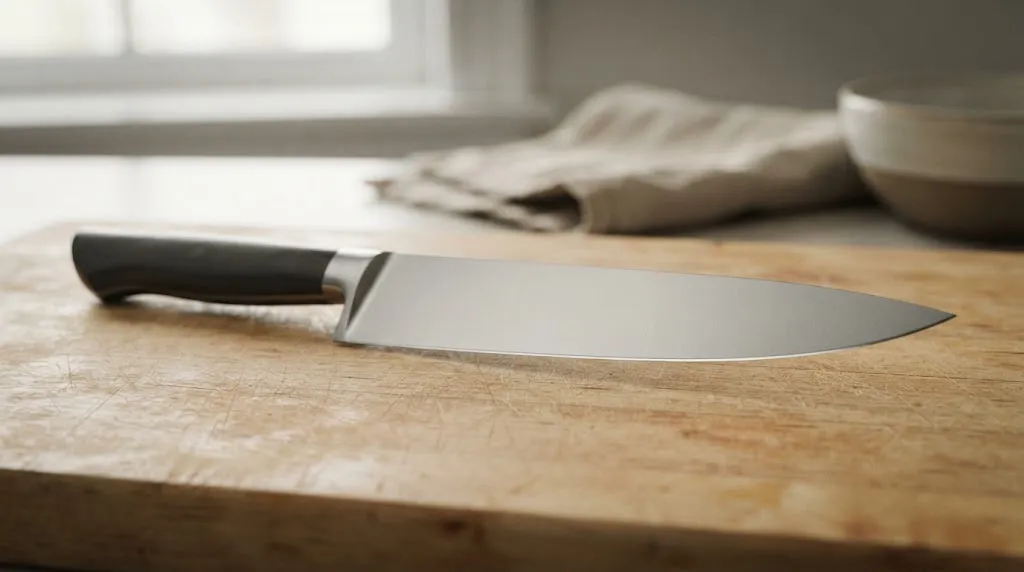
Look at a chef knife from the side, with its cutting edge facing down. Instead of forming a perfectly straight line, the lower edge usually sweeps upward toward the point. That curve is known as the knife belly.
Its shape matters because it affects how the blade meets the cutting board, how naturally the knife moves through ingredients, and which cutting techniques feel comfortable.
Where Is the Belly on a Chef Knife?
 Save
SaveThe belly lies along the lower, sharpened edge of the blade, between the heel near the handle and the tip at the front. On a typical Western chef knife, the curve becomes increasingly visible as the edge approaches the tip.
To identify it, examine the blade from the side without touching its sharp edge:
- Heel: The rear portion of the cutting edge closest to the handle.
- Belly: The curved section of the edge that supports rolling or rocking cuts.
- Tip: The forward section used for delicate and precise cutting.
- Spine: The usually unsharpened upper edge, opposite the cutting edge.
The belly is not a separate attachment, raised feature, or thickened area of steel. It describes part of the blade’s cutting-edge profile.
Knife terminology can overlap slightly. Some descriptions use “belly” for nearly the entire curved lower edge, while others reserve the term for the more pronounced curve toward the front. Both refer to the same basic feature: curvature along the cutting edge.
For a broader understanding of how the blade’s different sections work together, see our guide to chef knife uses.
Why Does a Chef Knife Have a Curved Belly?
The curved belly helps a chef knife move through a controlled rocking motion rather than requiring the entire cutting edge to rise and fall vertically.
When the front portion stays near the cutting board, the rest of the blade can move up and down along its curved profile. Different sections of the edge contact the board as the knife moves.
This is particularly useful when repeatedly chopping ingredients into small pieces.
The Curve Supports Rocking Cuts
During a rocking cut, the forward part of the blade remains close to the board while the handle rises and falls. The belly creates a smooth transition between contact points along the edge.
Without sufficient curvature, attempting the same movement may cause a flatter blade to lift awkwardly or leave portions of the ingredient incompletely cut.
For this reason, many traditional Western chef knives have visibly curved cutting edges.
It Makes Repeated Chopping More Natural
Imagine reducing a pile of parsley into a fine mince. A curved belly lets you repeatedly move the cutting edge across the herbs while maintaining a controlled rhythm.
The advantage is not that the curved edge automatically makes the knife sharper. Rather, its geometry supports a particular cutting movement.
A sharp, flatter blade can still chop parsley effectively, but the most comfortable technique may be different.
Key Insight
The belly primarily determines how the knife moves against the cutting board. Edge sharpness determines how easily the blade cuts into food. A pronounced curve cannot compensate for a dull cutting edge.
What Is the Belly of a Chef Knife Used For?
The belly is especially useful for tasks involving repeated, controlled cuts. Its curved shape allows the cutting edge to roll through food without requiring a completely separate lifting motion for every stroke.
1. Mincing Herbs
Parsley, cilantro, mint, and similar herbs can be finely chopped using the rocking motion supported by a curved belly.
Start with a manageable pile of herbs. Move the knife through the pile using short, controlled strokes, gathering the pieces together again when necessary.
For delicate herbs, clean cuts matter more than cutting speed. Our guide to cutting fresh herbs explains how to reduce crushing and bruising.
2. Mincing Garlic
The belly is useful when turning roughly chopped garlic into much smaller pieces.
After making the initial cuts, gather the garlic into a compact pile and rock the curved edge across it. Repeat until the pieces reach the texture needed for the recipe.
For the complete preparation method, see mincing garlic safely.
3. Chopping Vegetables
The belly supports repeated cuts through ingredients such as celery, zucchini, carrots, and onions.
However, not every vegetable should be cut with an exaggerated rocking motion. Straight slices and push cuts may provide better control when making thin, uniform pieces.
For dense ingredients, the heel and middle portion of the blade may be more suitable for the initial cuts. The belly becomes particularly useful when reducing smaller pieces further.
4. Finely Chopping Nuts
Once larger nuts have been reduced to manageable pieces, the curved belly can help chop them more finely.
Work with small quantities and use controlled movements. Round nuts can roll or scatter if struck forcefully.
Our guide to chopping nuts explains how to handle the initial cuts and finer chopping separately.
How to Use the Belly for Rocking Cuts
A rocking cut works best when the knife has a suitable curved edge, the cutting board is stable, and the ingredient can be held securely.
- Prepare the cutting board. Place it on a stable surface. Use a nonslip mat or a suitable damp towel underneath if the board moves.
- Position the ingredient. Create a flat side on round vegetables when possible so they cannot roll.
- Hold the knife securely. Use a comfortable, controlled grip. A pinch grip, with thumb and index finger on opposite sides of the blade near the handle, is commonly used.
- Keep fingertips clear. Curl the fingers of your guiding hand inward and position them safely away from the cutting path.
- Place the forward edge near the board. Let the front section serve as a controlled contact area rather than forcing the very point into the surface.
- Raise and lower the handle smoothly. Allow the belly to roll through the ingredient while maintaining a manageable cutting rhythm.
- Reset when necessary. Stop, reposition the ingredient, and resume rather than reaching toward a moving blade.
The goal is smooth, controlled cutting, not maximum speed. You do not need to keep the tip pressed against the board with excessive force.
Safety Reminder
Avoid using fast rocking movements until you can consistently control the blade and keep your guiding hand clear. Never attempt to catch a falling knife, and do not use the knife on an unstable cutting board.
Deep Belly vs. Flat Belly: What Is the Difference?
A deep or pronounced belly has a more noticeable upward curve toward the tip. A flatter belly has less curvature, with a longer section of the cutting edge approaching a straight line.
Neither shape is automatically better. Their usefulness depends largely on how you prefer to cut.
| Feature | Pronounced Belly | Flatter Belly |
|---|---|---|
| Edge profile | More noticeably curved | Straighter cutting section |
| Natural movement | Rocking cuts | Push cuts and downward cuts |
| Useful tasks | Repeated mincing and chopping | Controlled, straight slicing |
| Potential limitation | Less edge contacts the board simultaneously | Less natural rocking range |
For example, a cook who frequently minces herbs may appreciate a pronounced belly. Someone who mainly prepares thin vegetable slices with a forward push may prefer a flatter cutting profile.
Blade thickness, sharpness, handle comfort, and overall geometry still influence performance. Belly shape is one important feature, not the only one.
How Belly Shape Differs Between Common Kitchen Knives
Different knife styles tend to favor different edge profiles, although individual models can vary considerably.
German-Style Chef Knives
Many German-style chef knives have a pronounced belly and a relatively generous curve toward the tip.
This makes them well suited to cooks who frequently use a rocking chopping motion.
Japanese Gyuto Knives
Many gyuto knives have a somewhat flatter profile than strongly curved Western chef knives, although the exact shape depends on the maker.
They can support push cutting, slicing, and some rocking techniques. A gyuto should not automatically be considered a completely flat knife.
Santoku and Nakiri Knives
Santoku knives often have relatively flat cutting edges with gentle curvature near the front. Nakiri knives generally feature an even straighter cutting profile.
These designs work naturally with push cuts or controlled downward cuts rather than pronounced rocking motions.
As explained in Napoleon’s knife anatomy guide, the shape of a knife’s cutting edge influences how it moves during food preparation.
How to Tell Whether Your Knife Has Enough Belly for Rocking
You can assess the cutting profile visually and with a careful, unloaded movement on a stable cutting board.
First, look at the side of the blade. Does the edge rise noticeably toward the tip, or is most of it nearly straight?
Next, with no food under the knife and your hands safely positioned, slowly move the blade through a gentle rocking motion on the board.
A compatible edge will allow contact to transition relatively smoothly along the blade. A very flat profile may feel as though it needs to lift away from the board before the next section can contact the surface.
Do not force the motion if the knife feels awkward. Use a push cut instead.
Also inspect whether the edge contacts the board evenly during an ordinary controlled cut. If an area consistently leaves food connected, the issue may involve cutting technique, board condition, or an uneven blade profile rather than an insufficient belly.
Common Mistakes When Using the Knife Belly
Several cutting problems are mistakenly blamed on belly shape when the actual cause involves technique or maintenance.
- Rocking a very flat blade: A flat edge may not roll naturally. Switch to a push or downward cutting motion.
- Using excessive pressure: Forcing the knife downward increases effort without improving blade geometry.
- Trying to compensate for dullness: A curved edge still needs proper sharpening to cut cleanly.
- Chopping too much food at once: Large piles can interfere with controlled blade movement.
- Neglecting the full cutting edge: The belly should not be the only section maintained during sharpening.
An additional mistake is assuming that a more pronounced belly always produces finer cuts. Cutting accuracy also depends on ingredient stability, edge condition, and the operator’s control.
Does Sharpening Change the Belly of a Chef Knife?
 Save
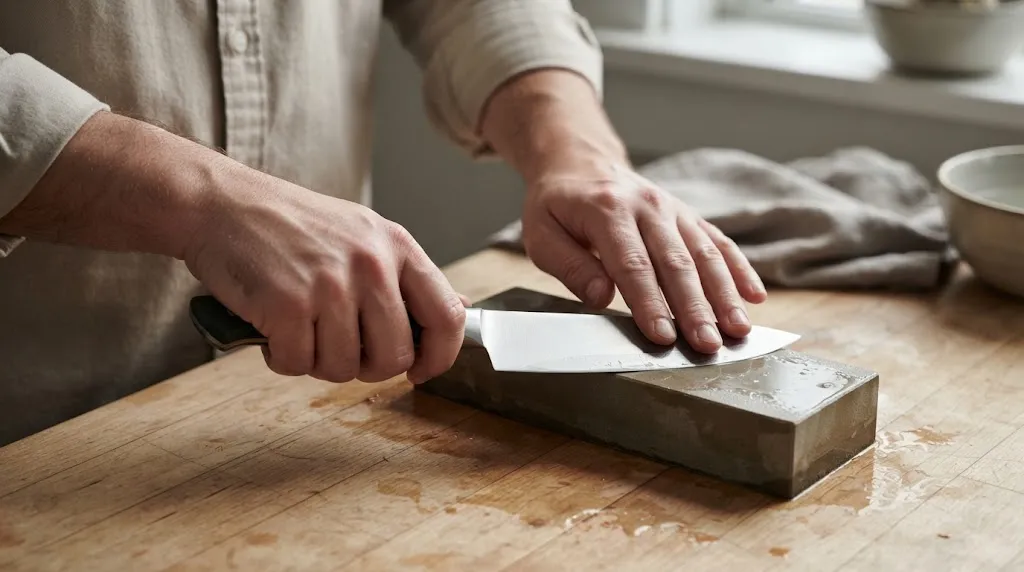
SaveOrdinary sharpening removes small amounts of metal from the cutting edge. Over time, uneven sharpening or excessive material removal can alter its profile, including the curved belly.
This is particularly relevant when one section receives substantially more grinding than another.
A blade that originally rocked smoothly may eventually develop a flatter area, an uneven transition, or a section that no longer contacts the board as expected.
To help preserve the intended shape:
- Follow the existing edge profile when sharpening.
- Avoid concentrating excessive grinding on one small section.
- Use a sharpening method appropriate for the blade.
- Inspect the edge profile periodically for uneven wear.
- Seek an experienced knife sharpener for significant profile correction.
Honing and sharpening are not interchangeable. Honing primarily helps maintain or realign an existing edge, while sharpening removes material to restore cutting geometry.
Maintaining the belly’s curve is especially important for cooks who depend on a predictable rocking motion.
Frequently Asked Questions
Is the belly of a knife the same as its cutting edge?
No. The cutting edge is the entire sharpened line along the blade, while the belly specifically refers to its curved portion. The belly is part of the edge, not a separate component.
Can a chef knife have almost no belly?
Yes. Some chef knives have relatively flat cutting profiles, particularly designs that favor push cutting. They can still perform general kitchen tasks effectively even though their rocking range is limited.
Is more belly always better for chopping?
No. More curvature can make rocking cuts easier, but flatter profiles may provide better board contact for straight downward cuts. The appropriate shape depends on your preferred technique and ingredients.
Can you use the belly to slice meat?
Yes. The curved edge can cut through boneless meat, but smooth drawing or slicing strokes may be more appropriate than repeated rocking. The ideal motion depends on the cut and desired thickness.
Why does my knife leave vegetables connected at the bottom?
Possible causes include an uneven cutting-edge profile, insufficient board contact, a dull edge, or incomplete cutting motion. Check the blade and technique before assuming that the belly shape is defective.
Should beginners choose a knife with a pronounced belly?
A moderately curved chef knife can be a practical choice for beginners interested in learning rocking cuts. However, a comfortable grip, manageable blade size, sharp edge, and stable cutting technique are more important than maximizing curvature.
Conclusion
The belly of a chef knife is the curved section of its sharpened edge, and its main purpose is to support smooth, controlled cutting movements, especially rocking cuts.
A pronounced belly suits repeated chopping and mincing, while a flatter blade often favors push cutting. Understanding this difference helps you use the knife more effectively, select an appropriate cutting technique, and maintain its edge profile over time.

