Can You Use a Chef Knife to Chop Nuts? Yes—Here’s How
Quick Answer
Yes. A chef knife is a good tool for chopping most nuts, including walnuts, pecans, almonds, hazelnuts, pistachios, and cashews. Use a sharp blade on a stable cutting board, gather the nuts into a small pile, and rock the knife through them with controlled strokes. For very large quantities or extremely fine pieces, a food processor may be faster.
A chef knife is actually one of the more practical tools for chopping nuts by hand. Its broad blade gives you room to work, while the curved cutting edge on many Western-style chef knives supports the rocking motion used for repeated chopping.
The challenge is not whether the knife can cut the nuts. It is controlling round or hard pieces that want to roll, jump, or scatter across the board. A few small changes to your setup make the job much easier.
Why a Chef Knife Works Well for Chopping Nuts
A chef knife is designed as a general-purpose cutting tool, and chopping is one of its main jobs. The broad blade, useful weight, and curved edge make it suitable for reducing a pile of nuts from whole pieces to a coarse or relatively fine chop.
École Ducasse’s chef-knife guidance specifically includes nuts such as walnuts, Brazil nuts, and hazelnuts among the foods a chef knife can chop.
The technique also fits the way a conventional chef knife is meant to move. Instead of repeatedly striking straight downward, you can keep the front portion of the blade near the board and move the heel up and down through the pile.
If you want a broader explanation of the blade’s everyday jobs, the CookingFlavour guide to what a chef knife is used for covers chopping, slicing, dicing, mincing, and the limits of this all-purpose knife.
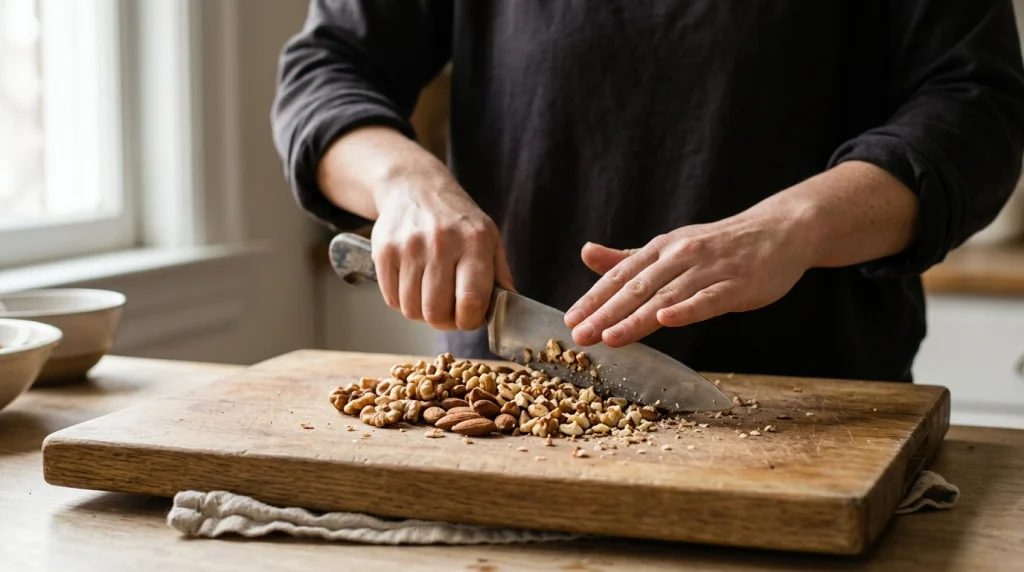
How to Chop Nuts With a Chef Knife
 Save
SaveThe safest approach is controlled rather than fast. Nuts are small and irregular, so rushing tends to create more flying pieces and less consistent results.
- Use a stable cutting board. If the board moves on the counter, place a damp towel or non-slip mat underneath it.
- Start with shelled nuts. A chef knife is for cutting the edible nut, not cracking hard shells.
- Make a compact pile. Keep the nuts near the center of the board rather than spreading them across a wide area.
- Roughly break large pieces first. Large walnut halves, for example, are easier to control after one or two initial cuts.
- Use a rocking motion. Hold the handle securely and move the heel of the blade up and down while the front portion stays close to the board.
- Regroup the nuts as needed. Stop cutting, gather scattered pieces back into a pile, and continue until you reach the texture you need.
The University of Nebraska–Lincoln’s chef-knife guidance describes a similar rocking method, with the knife tip kept in contact with the board during fine chopping and mincing.
Tip
Do not chase individual nuts around the board with the knife. Stop, regroup them into a compact pile, then resume chopping. Control matters more than speed.
Which Part of the Blade Should You Use?
For the first cuts through larger or harder nuts, the heel and lower-middle portion of the blade usually provide the most control. These areas sit closer to your hand than the tip and let you apply downward pressure without balancing the nut beneath a narrow point.
Once the pieces are smaller, the curved belly becomes useful for rocking repeatedly through the pile. This is especially convenient when you want chopped nuts for cookies, bread, salad toppings, oatmeal, or a garnish.
Avoid stabbing individual nuts with the tip. Round nuts can move unexpectedly, and there is little reason to use a pointed motion when a controlled downward or rocking cut does the same job more predictably.
How Fine Can You Chop Nuts With a Chef Knife?
You can move from a rough chop to fairly fine pieces with the same knife. The important part is stopping at the texture your recipe needs.
- Coarse chop: Use only a few passes so recognizable chunks remain. This works well when the nuts should add obvious texture.
- Medium chop: Regroup the pile and rock through it several more times. This size distributes more evenly through batters and fillings.
- Fine chop: Continue rocking across the pile in different directions, regrouping between passes.
A knife is particularly useful when you want control over the final texture because you can inspect the pieces after every few strokes.
There is a limit, though. If the recipe calls for nut meal, nut flour, or a paste-like consistency, hand chopping becomes inefficient. Those are different preparation goals and usually call for equipment designed to process ingredients much more finely.
How to Stop Nuts From Flying Off the Cutting Board
Scattering is the main frustration when chopping nuts by hand. It happens because many nuts are curved, smooth, or brittle. Pressure from the blade can push them sideways before the edge finishes the cut.
Three adjustments help:
- Work with a small batch instead of covering the whole board.
- Break especially large or round nuts into more stable pieces before you begin rapid chopping.
- Use short, controlled strokes rather than hitting the nuts forcefully.
A large cutting board also gives stray pieces somewhere to go without immediately reaching the counter or floor.
Key Insight
Harder chopping is not necessarily better chopping. A sharp edge and controlled motion reduce the amount of force you need, which also makes moving nuts easier to manage.
Does Chopping Nuts Damage a Chef Knife?
Normal chopping of shelled nuts should not be confused with striking extremely hard materials. Nuts such as almonds and hazelnuts are firm foods, but they are ordinary kitchen ingredients a suitable chef knife can handle.
The cutting surface matters more to routine edge wear. Glass, stone, ceramic plates, and similarly hard surfaces are poor choices for knife work. Use a knife-friendly cutting board instead.
Afterward, avoid scraping the chopped nuts off the board with the sharpened edge. Turn the blade around and use the spine, or use a bench scraper. The CookingFlavour guide to cleaning, sharpening, and maintaining kitchen knives explains why cutting-board choice and edge care affect how long a knife stays useful.
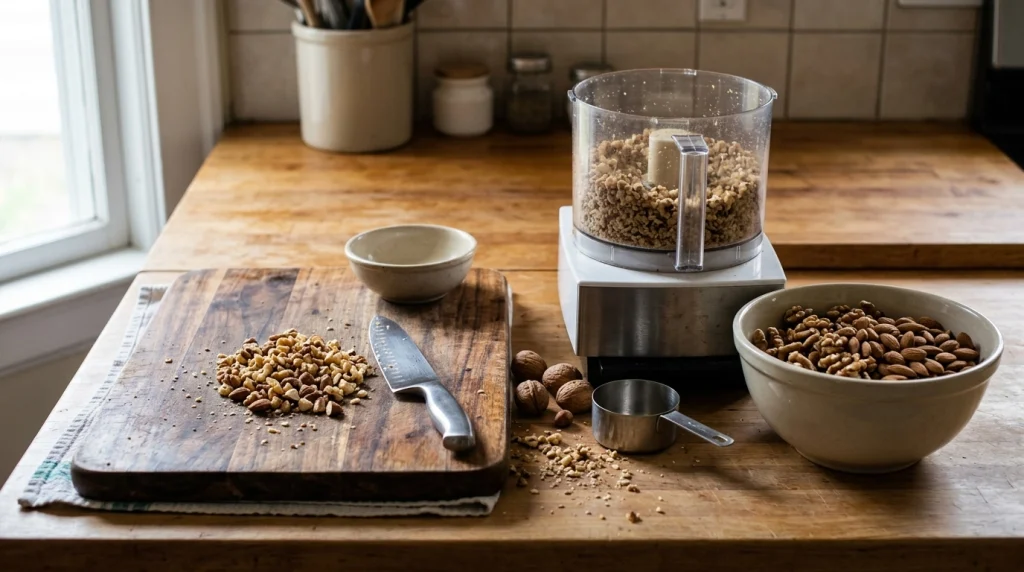
When Is a Food Processor Better?
 Save
SaveA chef knife gives you excellent control for a handful or two of nuts. A food processor becomes more useful when quantity or speed matters more than individual control.
Consider the processor when you need to chop several cups for baking, meal preparation, or a large recipe. Use short pulses and check the texture frequently. Nuts contain natural oils, so continuing far beyond a fine chop can move the mixture toward a paste or nut butter.
For a small amount, the setup and cleanup of a processor can take longer than simply using the chef knife already on your board.
Mistakes That Make Nut Chopping Harder
- Using a dull knife: You may compensate by pressing harder, which gives you less control.
- Overloading the board: A large loose pile encourages pieces to scatter.
- Trying to chop shells: Shell cracking is a separate job and requires an appropriate tool.
- Using an unstable board: A board that slides adds unnecessary risk.
- Moving too fast: Speed before control produces inconsistent pieces and more mess.
- Scraping with the cutting edge: Use the spine or another tool to gather and transfer the nuts.
If your chef knife has become noticeably dull, restore the edge before demanding more force from it. A properly maintained blade should do the cutting rather than requiring you to push aggressively.
Relevant Product
Chef Knives for Everyday Chopping
A comfortable, sharp chef knife can handle nuts along with most everyday chopping, slicing, and mincing tasks, making it a practical general-purpose kitchen tool.
As an Amazon Associate, we earn from qualifying purchases.
Frequently Asked Questions
Can you chop almonds with a chef knife?
Yes. Almonds are harder than walnuts or pecans, but a sharp chef knife can chop shelled almonds. Work with a small batch, use the heel for the first cuts, and regroup the pieces before chopping them finer.
Should you chop nuts before or after toasting them?
Either can work depending on the recipe. If a recipe specifically tells you to toast whole nuts and then chop them, follow that sequence. If it instructs you to toast chopped nuts, chop them first so the pieces match the intended preparation.
Can you mince nuts with a chef knife?
Yes. After the initial chop, gather the pieces together and use repeated controlled rocking passes to make them smaller. Stop before the texture becomes finer than your recipe requires.
Is a santoku knife suitable for chopping nuts?
It can be. A santoku can cut nuts effectively, especially with controlled downward or push cuts. A strongly curved Western chef knife may feel more natural if you prefer a continuous rocking technique.
Can you use a small paring knife to chop nuts?
You can cut individual nuts with one, but it is usually less convenient for chopping a pile. Its short, narrow blade covers less area, so a chef knife provides a more efficient working surface for repeated chopping.
Do you need a special nut chopper?
No. A chef knife is enough for most small and medium batches. A dedicated chopper or food processor becomes useful mainly when you regularly prepare large quantities or want to reduce manual chopping time.
Conclusion
A chef knife is not merely an acceptable substitute for chopping nuts; it is a practical choice for most home-kitchen quantities. Keep the cutting board stable, work with manageable batches, use the heel for controlled initial cuts, and rock the blade through the pile when you want a finer texture. The biggest improvement usually comes from using less force and more control. If you need to process a large quantity or produce an extremely fine texture, switch to a food processor rather than turning a simple hand-chopping job into a long one.