How to Care for a John Boos Cutting Board
Quick Answer
Care for a John Boos cutting board by hand-washing it after each use, drying it upright, and oiling it with food-grade mineral oil when the wood looks dry or pale. Finish with board cream after oiling, learn waxing your board to seal the surface, and never put a Boos board in the dishwasher or soak it in the sink.
The daily routine
- Scrape, then wash: Scrape off food scraps, then wash with hot water and mild dish soap.
- Dry it upright: Towel-dry both sides, then stand the board on edge so air reaches each face.
- Oil when pale: Rub in food-grade mineral oil when the surface looks dry, faded, or thirsty.
- Seal with cream: Add a thin coat of board cream after oiling for a water-resistant finish.
- Skip the dishwasher: Heat and long soaking warp wood, crack glue joints, and strip the finish.
Watch for these signs
- Water soaks in fast instead of beading up.
- Knife marks look pale and rough to the touch.
- The board smells stale after washing and drying.
I bought my first John Boos board years ago, and I still use it most days. It has outlasted two cheaper boards, and the grain looks better now than it did new.
This guide covers the full routine I follow, from daily washing to oiling, waxing, and the occasional refinish. You’ll learn what to do, what to skip, and how to fix the small problems before they turn into cracks.
What Is a John Boos Cutting Board?
A John Boos cutting board is a butcher block board made by John Boos & Co., an American company founded in 1887. Most Boos boards use hard maple, cherry, or walnut, joined in edge-grain or end-grain blocks and finished for food contact.
Hard maple is dense and close-grained, so it holds up to daily chopping without deep scoring. It also stays kind to knife edges, which matters if you own good knives.
End-grain boards show the cut ends of the wood fibers facing up, so small knife marks close up and wear hides well. Edge-grain boards run wood strips side by side like a classic butcher block counter, and they cost less while still lasting for decades with steady care.
Many Boos blocks carry NSF certification for food service use. That stamp shows the board meets strict food-contact standards, which is why pro kitchens use Boos blocks.
How Do You Clean a John Boos Cutting Board After Every Use?
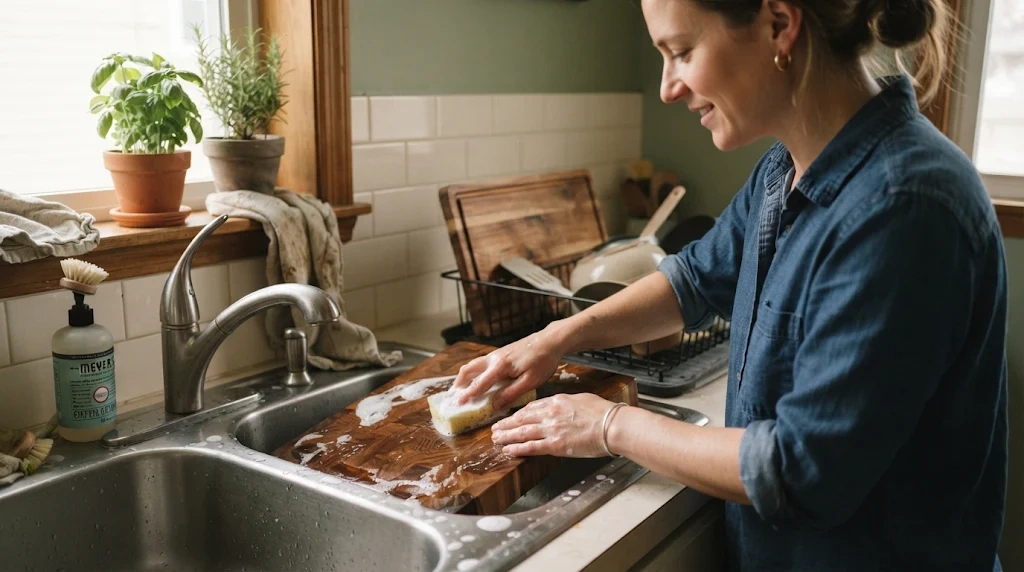
Wash your Boos board by hand with hot water, mild dish soap, and a soft sponge after each use. Scrub with the grain, rinse well, and dry it right away.
Start by scraping off food with a bench scraper or the back of a knife. This step takes ten seconds, and it keeps crumbs out of your sponge.
Use a soft sponge or cloth, not steel wool or a stiff brush. Harsh scrubbers rough up the surface and open the grain to stains.
Rinse under running water and wipe both sides, even if you cut on one face only. Towel-dry the board, then stand it on edge in a dish rack so air reaches both faces.
How do you sanitize a Boos board after raw meat?
Sanitize after raw meat or fish with white vinegar or a diluted bleach rinse, then wash again with soap. The USDA food safety guidance stresses clean surfaces and separate boards for raw meat.
For a vinegar rinse, spray undiluted white vinegar over the surface and let it sit for five minutes. Wipe it off, wash with soap, and dry the board upright.
For a bleach rinse, mix one tablespoon of unscented bleach per gallon of cool water. Wipe the board, wait two minutes, rinse well, and wash with soap.
Never mix vinegar and bleach, and never pour bleach straight from the bottle onto wood.
How Often Should You Oil a John Boos Cutting Board?
Oil a new Boos board once a day for the first week, then once a week for the first month. After that, oil it every three to four weeks with normal home use.
Heavy use calls for more oil, not less. A board that sees daily meal prep in a dry kitchen may need oil every two weeks.
The water test tells you when it’s time. Sprinkle a few drops on the surface and watch what happens next.
- Beads sit on top: The board still holds oil, so you can wait.
- Water soaks in fast: The wood is thirsty, so oil it that day.
- Dark, patchy spots appear: Oil has worn thin in those areas, so give the whole board a coat.
I check my board on the first Sunday of each month, as of 2026. That small habit keeps the schedule honest.
How to Oil a John Boos Cutting Board Step by Step
Oiling takes about ten minutes of hands-on time, plus a few hours of soaking. Start with a clean, fully dry board, since oil won’t soak into damp wood.
- Warm the oil slightly: Set the bottle in warm water for five minutes so it flows thin and soaks deep.
- Pour a generous pool: Cover the surface with food-grade mineral oil, about two tablespoons for a medium board.
- Rub with the grain: Spread the oil with a clean cloth, working in long strokes along the grain.
- Oil every face: Coat the edges, ends, and underside too, so the board gains moisture evenly.
- Let it soak: Leave the board flat for four to six hours, or overnight for a new or bone-dry board.
- Wipe off the extra: Buff away any oil left on the surface with a dry cloth until it feels dry, not tacky.
- Repeat if thirsty: Add a second coat if the first vanished fast, then wipe and rest the board again.
Use food-grade mineral oil, sold as cutting board oil or liquid paraffin, since it never goes rancid and costs far less than a fancy branded oil. The maker sells its own oil too, and the John Boos site lists care products made for its boards.
Board Cream vs Mineral Oil: What Does a Boos Board Need?
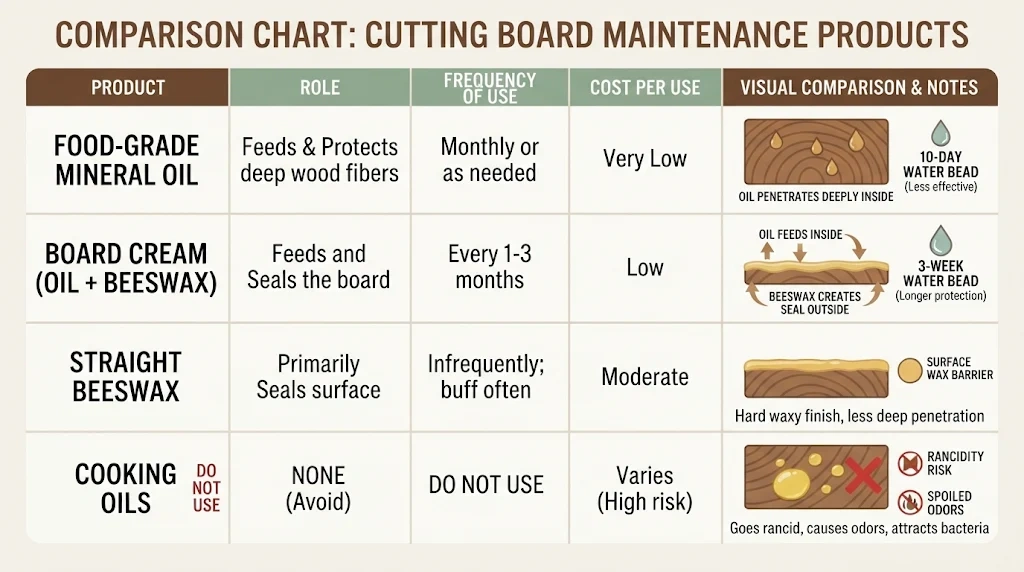
Mineral oil feeds the wood from inside, while board cream seals the surface from outside. Think of oil as water for thirsty wood and cream as a raincoat over it.
| Product | What it does | How often | Cost per use |
|---|---|---|---|
| Food-grade mineral oil | Soaks deep, feeds dry wood, stops cracks | Every 3-4 weeks | Low, about $0.50 per coat |
| Board cream (oil + beeswax) | Seals the surface, repels water and stains | After each oiling | Low, about $1 per coat |
| Straight beeswax | Hard, thick seal, best for display boards | Every 2-3 months | Low, a little goes far |
| Cooking oils (olive, vegetable) | Go rancid, turn sticky, attract odors | Never use these | Not worth the damage |
Apply board cream after the oil has soaked in and you’ve wiped off the extra. Rub a thin layer over the surface, let it sit for four hours, then buff it smooth.
I tested oil alone against oil plus cream on two halves of one board. The cream side beaded water for three weeks, while the oil-only side soaked it up after ten days.
What Oil Should You Never Use on a John Boos Board?
Never use cooking oils like olive, vegetable, coconut, or tung oil blends meant for furniture. Food oils turn rancid in wood pores, and furniture finishes may hold solvents you don’t want near food.
Linseed oil causes the most confusion, since some woodworkers praise it. Raw linseed oil dries slowly and can turn sticky, while boiled linseed oil holds drying agents that aren’t food-safe.
Stick to food-grade mineral oil and board cream made for cutting boards. Both are cheap, stable, and made for daily food contact.
- Safe: Food-grade mineral oil, Boos Mystery Oil, board cream with beeswax.
- Risky: Fractionated coconut oil, walnut oil, and any oil with added scent.
- Never: Olive oil, vegetable oil, canola oil, and furniture tung or Danish oil.
How Do You Remove Stains and Odors From a Boos Board?
Remove stains with a lemon and salt scrub, and lift odors with baking soda paste. Both fixes use pantry staples, and neither harms the finish.
For stains, sprinkle coarse salt over the mark and rub it with half a lemon. The salt scrubs, the acid lifts color, and the lemon leaves a fresh scent.
Let the lemon juice sit for five minutes on a stubborn stain, then wipe and wash the board. Repeat once if the mark still shows, since deep beet or turmeric stains need two rounds.
For odors, spread a paste of baking soda and water over the board and leave it for 15 minutes. Wipe it off, wash with soap, and dry the board upright.
Re-oil the board after any deep stain treatment, since scrubbing strips some finish. I keep a small bottle of oil by the sink for this exact job.
If a stain won’t budge after two scrubs, read my guide on how to remove stains from a cutting board for stronger methods. Sanding is the last step, not the first one.
How Do You Keep a John Boos Board From Warping or Cracking?
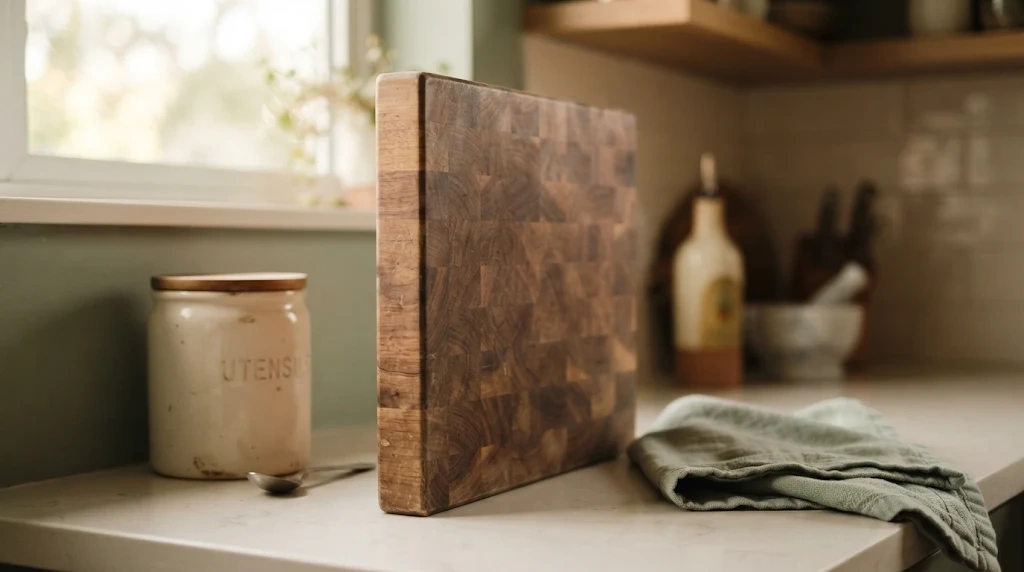
Keep a Boos board from warping by drying it evenly, oiling it on all sides, and storing it where air can move. Uneven moisture is the real cause of most warps and cracks.
Never leave one face wet while the other stays dry. That gap pulls the wood in two directions at once, and the board bows toward the dry side.
Store the board on edge or on feet, never flat against a damp counter. Feet lift the board, let air pass under it, and stop the underside from staying damp.
Keep the board away from heat vents, ovens, and sunny windowsills. Heat dries one edge fast, and that edge shrinks while the rest stays put.
Small cracks along a glue line need oil and time, not glue. Oil the crack, let the wood swell shut, and watch it for a week.
For the full prevention routine, see how to prevent a cutting board from warping. The habits there take minutes, and they save boards.
When Should You Refinish a John Boos Board?
Refinish a Boos board when deep knife grooves trap food, stains won’t lift, or the surface feels rough after oiling. Most home boards need a refinish every two to five years.
Light wear needs sanding, not a full strip. Start with 120-grit sandpaper, move to 220-grit, and always sand with the grain.
Wipe off the dust with a damp cloth, let the board dry for a full day, then oil it twice. The fresh wood will drink the first coat fast, so don’t rush the second one.
For the step-by-step process, read how to refinish a cutting board before you start. It lists the grits, the tools, and the drying times in order.
Common Mistakes That Ruin a John Boos Board
Most Boos boards fail from habits, not from age.
- Dishwasher cycles: Heat and steam swell the wood, crack joints, and void the maker’s care guidance.
- Soaking in the sink: Even 20 minutes of soaking can swell the edges and loosen glue lines.
- Cooking oil finishes: Olive and vegetable oils turn rancid and leave a sticky, stale smell.
- One-sided oiling: Oiling only the top face leaves the bottom dry, and the board cups toward the oiled side.
- Flat, damp storage: A board left flat on a wet counter traps moisture and grows mold under the base.
- Skipping the dry step: A board put away damp stays damp, and damp wood stains, warps, and smells.
Check FoodSafety.gov for safe cleaning steps after raw meat, poultry, and fish. Clean habits protect your board and your family at the same time.
What I Use on My Boos Board
If you’re ready to stock up, here’s what I keep in my own cabinet. These three cover oiling, sealing, and daily care for any Boos board.
🏆 Best for John Boos
John Boos Mystery Oil, 32 oz
★★★★★
Food-grade mineral oil made for Boos boards, in a 32 oz bottle that lasts about a year. I use this on my own Boos board because it soaks in clean and leaves no scent.
🧴 Best Board Cream
John Boos Board Cream, 5 oz
★★★★☆
A beeswax and mineral oil cream that seals the surface after oiling. I rub it on after each oiling, and water beads for weeks after.
💰 Best Budget Oil
Howard Butcher Block Oil, 12 oz
★★★★☆
Food-grade mineral oil in a 12 oz bottle, made for butcher block and cutting boards. I keep this as a backup, since it works well and costs less per ounce.
Frequently Asked Questions
Can you put a John Boos cutting board in the dishwasher?
No, never put a John Boos board in the dishwasher, since heat, steam, and long water contact swell the wood, crack glue joints, and strip the oil finish. Hand-wash it with hot water and mild soap, then dry it upright.
How often should you oil a John Boos board?
Oil a new board weekly for the first month, then every three to four weeks with normal use. Use the water test: if drops soak in fast, oil the board that day.
What is the best oil for a John Boos cutting board?
Food-grade mineral oil is the best choice, and John Boos Mystery Oil is the brand’s own version. It never goes rancid and soaks deep, so follow each oiling with board cream to seal the surface.
Can you use olive oil on a John Boos cutting board?
No, olive oil and other cooking oils turn rancid inside wood pores, leaving a sticky film and a stale smell soap won’t remove. Use food-grade mineral oil or a board cream made for cutting boards instead.
How long does a John Boos cutting board last?
A cared-for John Boos board lasts 10 to 20 years, and many last longer with refinishing. See how long cutting boards last for the full breakdown by material.
The Bottom Line
A John Boos board rewards simple habits done on time. Wash it by hand, dry it upright, oil it monthly, and seal it with cream.
Do those four things, and your board will serve you for years. Skip them, and even the best maple will crack, warp, and stain.
Oil your board this week if it looks pale or drinks water fast. Your future self will thank you at the next meal prep.