How Many Inches of a Chef Knife Do You Need?
Quick Answer
Most standard chef’s knives have a blade measuring 8 inches long, which offers a practical balance of control, cutting space, and versatility. A 6-inch knife suits smaller hands and compact kitchens, while a 10-inch blade provides more cutting length for large vegetables, melons, and bigger batches of food. If you’re choosing your first kitchen knife, an 8-inch model is usually the best starting point.
Which Chef’s Knife Length Should You Choose?
- 6 inches: Best for smaller hands, light prep, and tighter workspaces.
- 7 inches: A useful middle ground for everyday cutting with a shorter blade.
- 8 inches: The most versatile choice for typical home cooking.
- 9 inches: Offers extra reach for larger ingredients and frequent meal preparation.
- 10 inches: Suits experienced cooks who regularly handle large ingredients or high-volume prep.
How to Check the Size
- Measure the blade from its tip to the heel, where the cutting edge meets the handle.
- Choose a length you can control comfortably without crowding your cutting board.
Choosing a chef’s knife sounds simple until you see blades in several different lengths. The right size can make chopping vegetables, slicing meat, and preparing everyday meals feel much more comfortable.
In this guide, I’ll explain standard chef’s knife lengths, how blade size affects control, and which measurements make sense for different cooking needs.
What Is the Standard Length of a Chef’s Knife?
A chef’s knife is a versatile kitchen knife designed for chopping, slicing, mincing, and dicing a wide range of ingredients. Its blade commonly measures 8 inches, although manufacturers also offer shorter and longer versions.
When people ask how many inches a chef’s knife should be, they usually mean the blade length rather than the knife’s total length.
- Blade length: The measurement from the blade tip to the heel.
- Overall length: The distance from the blade tip to the end of the handle.
- Blade width: The distance between the cutting edge and the spine at a given point.
An 8-inch blade measures approximately 20.3 centimeters. The complete knife will be longer because its handle adds several inches.
For most home cooks, an 8-inch chef’s knife provides enough blade for everyday ingredients without feeling excessively long on a standard cutting board.
How Many Inches Should a Chef’s Knife Be?
 Save
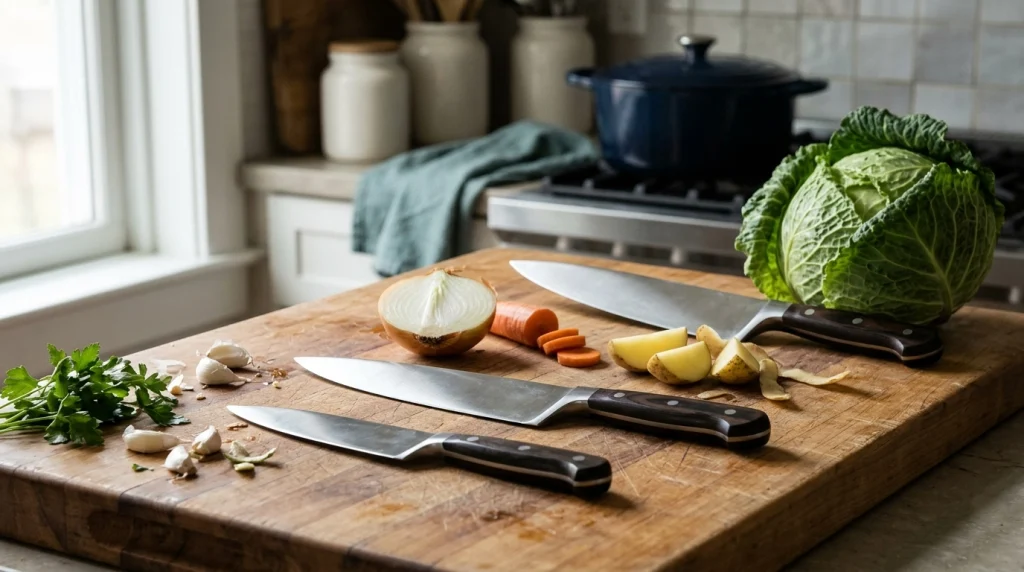
The best chef’s knife length depends on your hand size, cutting habits, workspace, and the ingredients you prepare most often. An 8-inch blade works well for many people, but it isn’t automatically the right choice for everyone.
| Blade length | Best suited for | Main consideration |
|---|---|---|
| 6 inches | Small hands and light prep | Less cutting reach |
| 7 inches | Compact everyday cooking | A useful balance of reach and control |
| 8 inches | Most general kitchen tasks | Versatile all-round size |
| 9 inches | Larger ingredients and frequent prep | Needs more working room |
| 10 inches | Large batches and experienced cooks | May feel unwieldy to beginners |
These categories are practical guidelines, not strict rules. Two knives with the same blade length can feel different because of their weight, handle shape, blade height, and balance.
Is an 8-Inch Chef’s Knife Big Enough?
Yes, an 8-inch chef’s knife is large enough for most everyday cooking tasks. It can handle onions, carrots, potatoes, herbs, boneless meat, and many medium-sized fruits.
Its main advantage is versatility. You get enough cutting edge for larger ingredients without committing to the extra reach of a 10-inch knife.
If you cook regular family meals, prepare vegetables most days, or want one primary kitchen knife, start by considering an 8-inch model.
Is a 6-Inch Chef’s Knife Too Small?
No, a 6-inch chef’s knife can be an excellent choice for smaller hands, compact kitchens, and cooks who prefer a lighter, shorter blade. It can manage everyday vegetable preparation when the ingredients fit comfortably within its cutting edge.
However, you may need more strokes when cutting a large cabbage, watermelon, or substantial piece of meat. A shorter blade can also require more careful positioning when working with bulky ingredients.
Why Does Chef’s Knife Blade Length Matter?
Blade length affects how much cutting edge you have available, how easily you move the knife, and how much space you need on your board. The difference becomes noticeable when you switch between small ingredients and large ones.
- Cutting efficiency: A longer blade can slice through large ingredients in fewer passes.
- Control: A shorter blade may feel easier to manage for precise, small-scale preparation.
- Workspace: Longer knives need more room to move safely across the board.
- Storage: The blade and handle must fit comfortably inside your knife drawer, block, or protective sheath.
- Comfort: Weight distribution and handle design can matter as much as the measurement itself.
Length alone doesn’t determine performance. A well-balanced 8-inch knife may feel easier to use than a poorly balanced 6-inch knife.
How Do You Choose the Right Chef’s Knife Length?
Start with your usual cooking tasks, then consider how the knife feels in your hand. You don’t need the longest blade available to prepare food efficiently.
1. Consider Your Hand Size
People with smaller hands often prefer shorter blades because they can feel easier to position and maneuver. However, hand size alone doesn’t determine the ideal length.
Handle thickness, grip style, and overall knife weight also affect comfort. If possible, hold the knife before buying it and check whether you can guide the blade without straining your wrist.
2. Match the Knife to Your Ingredients
The foods you prepare most often provide a useful starting point for choosing a blade. Consider these examples:
- Herbs and small vegetables: A 6- or 7-inch knife may provide sufficient cutting space.
- Onions, carrots, and potatoes: An 8-inch blade handles these common tasks comfortably.
- Large cabbages and melons: A 9- or 10-inch blade can provide additional reach.
- Large batches of ingredients: A longer blade may make repetitive slicing more efficient.
For very large or hard ingredients, use a suitable knife and safe cutting technique rather than forcing the blade through the food.
3. Think About Your Cutting Board
A long blade needs enough clear space to move without hitting nearby objects. If your kitchen counter or cutting board is small, an 8-inch or shorter knife may be more convenient.
Choose a stable board that provides room for both the food and your guiding hand. Keep the work area clear before you start cutting.
4. Check the Knife’s Weight and Balance
Two 8-inch chef’s knives can feel surprisingly different. One might have a heavier handle, while another places more weight toward the blade.
When comparing knives, pay attention to whether the knife feels comfortable during a controlled cutting motion. A longer blade isn’t useful if you struggle to guide it accurately.
Practical tip: When comparing two knife sizes, hold each one in your usual grip and mimic a gentle chopping motion with the blade safely away from people and objects. Choose the knife that feels controlled rather than the one that simply looks more impressive.
8-Inch vs. 10-Inch Chef’s Knife: Which Is Better?
An 8-inch chef’s knife generally suits everyday home cooking, while a 10-inch knife offers more reach for large ingredients and high-volume preparation. Neither size is universally better.
| Feature | 8-inch knife | 10-inch knife |
|---|---|---|
| Metric blade length | 20.3 cm | 25.4 cm |
| Everyday versatility | Excellent for most home cooks | Excellent with enough space and experience |
| Large ingredients | Suitable for many medium-sized items | More reach for bulky ingredients |
| Small prep areas | Usually easier to accommodate | Requires more clearance |
| Beginner friendliness | Often a comfortable starting point | May require more adjustment |
For example, an 8-inch knife is usually sufficient for dicing several onions and slicing carrots for dinner. A 10-inch blade may feel more convenient when preparing large quantities of vegetables.
Remember that blade length doesn’t automatically mean better cutting performance. Sharpness, blade geometry, and technique also make a substantial difference.
How Do You Measure a Chef’s Knife in Inches?
Measure the blade itself, not the entire knife. Most manufacturers specify blade length in product descriptions, but you can verify it with a ruler or tape measure.
- Place the knife on a stable surface with the cutting edge facing away from you.
- Identify the blade tip and the heel, where the cutting edge meets the handle.
- Measure the straight-line distance between those two points.
- Compare the measurement with the manufacturer’s stated blade length.
Don’t measure from the blade tip to the end of the handle, because that gives the overall knife length. If a manufacturer uses a slightly different measurement convention, its stated specification may not match your measurement exactly.
What Other Chef’s Knife Dimensions Should You Check?
Blade length is only one part of choosing a comfortable kitchen knife. Blade height, thickness, handle dimensions, and total weight can change how the knife performs.
- Blade height: A taller blade can provide more clearance for your knuckles above the cutting board.
- Blade thickness: Thinner blades may pass through some ingredients more easily, depending on their geometry and edge.
- Handle shape: A comfortable handle helps you maintain a secure, relaxed grip.
- Total weight: A lighter knife may feel easier to maneuver during prolonged prep, while some cooks prefer a heavier feel.
- Blade profile: The curve of the cutting edge influences rocking, slicing, and chopping motions.
As of 2026, standard 8-inch chef’s knives remain a sensible starting point for comparing mainstream kitchen knives. Still, there is no single blade length that works best for every cook or every kitchen.
Common Mistakes When Choosing a Chef’s Knife Size
Avoid choosing a knife based only on appearance or the assumption that a longer blade must be more professional. Comfort and control should guide your decision.
- Buying the longest blade: Extra length can become inconvenient when you have limited board space.
- Ignoring the handle: An uncomfortable handle can make an otherwise suitable knife difficult to control.
- Confusing blade and total length: An 8-inch blade does not mean the complete knife measures 8 inches.
- Overlooking maintenance: Every knife needs appropriate cleaning, drying, storage, and sharpening.
- Using one knife for every job: A paring knife or serrated knife may be better suited to certain small or delicate tasks.
A chef’s knife is a versatile general-purpose tool, not a replacement for every specialized kitchen knife. Choosing the right size for your main preparation tasks is a more useful goal than finding one knife that does absolutely everything.
Which Chef’s Knives Are Worth Considering?
 Save
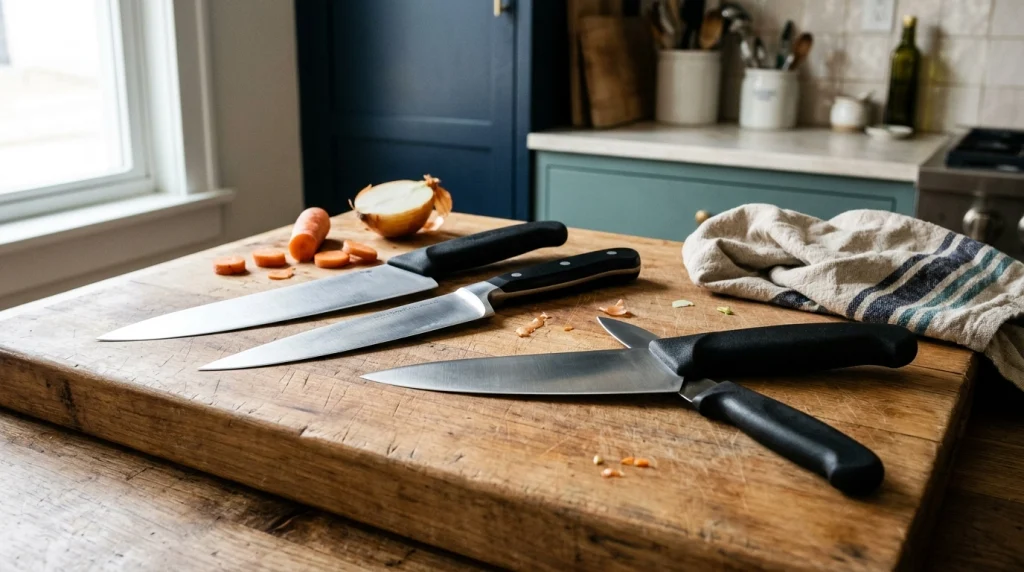
If you’ve decided which blade length suits your kitchen, comparing established knife models can help you narrow down your options. The following are recognizable choices to investigate, not products I’ve personally tested or a claim that their current prices or ratings have been verified.
🏆 BEST EVERYDAY CHOICE
Victorinox Fibrox Pro 8-Inch Chef’s Knife
This popular 8-inch option has a practical blade length and a textured handle designed for a secure grip. I’d consider it when comparing straightforward, everyday kitchen knives that don’t require a premium budget.
🥇 PREMIUM ALTERNATIVE
Wüsthof Classic 8-Inch Cook’s Knife
This German-style knife offers an 8-inch blade and a traditional handle design. I’d compare its balance, weight, and grip with lighter alternatives before paying more for a premium everyday knife.
🔪 SHORTER BLADE OPTION
Victorinox Fibrox Pro 6-Inch Chef’s Knife
A 6-inch blade is worth considering if you have limited counter space or prefer shorter cutting tools. I’d compare it with an 8-inch version to decide whether maneuverability matters more than extra blade reach.
Before ordering, confirm the exact blade length, handle design, and current product specifications. These recommendations are comparison starting points, not personally tested rankings or verified live prices.
Frequently Asked Questions
Is an 8-inch chef’s knife the standard size?
Yes, 8 inches is a common standard size for a chef’s knife, particularly for everyday home cooking. It provides enough blade length for most vegetables, fruits, and boneless meats while remaining manageable for many cooks. Individual comfort still depends on weight, balance, handle shape, and cutting technique.
Is a 10-inch chef’s knife too long for home use?
A 10-inch chef’s knife isn’t necessarily too long for home use, but it requires adequate cutting-board space and comfortable handling. It can be helpful for large ingredients and repetitive slicing. If you’re a beginner or have a compact kitchen, an 8-inch model is often easier to manage.
Does chef’s knife length include the handle?
No, the stated blade length usually measures the blade rather than the entire knife. An 8-inch chef’s knife therefore has a blade approximately 8 inches long, with additional length from its handle. Always check the manufacturer’s specifications when comparing measurements across different brands.
What chef’s knife size is best for beginners?
An 8-inch chef’s knife is a useful starting point for many beginners because it handles a wide variety of everyday kitchen tasks. However, cooks with smaller hands or limited workspace may prefer a 6- or 7-inch blade. Choose a knife that feels secure and controlled rather than simply choosing the most common size.
How many inches should a chef’s knife be for vegetables?
An 8-inch chef’s knife works well for most vegetable preparation, including chopping onions, slicing carrots, and dicing potatoes. A 6-inch knife can be more convenient for small vegetables and compact workspaces, while a 10-inch blade may help with large cabbages or high-volume preparation.
Final Takeaway: Choose the Length You Can Control
For most home cooks, an 8-inch chef’s knife offers the best starting point because it balances cutting reach with everyday maneuverability. A 6-inch blade can suit smaller hands and tighter kitchens, while a 10-inch knife makes sense when you regularly prepare large ingredients.
Before making your choice, consider your cutting board, the foods you prepare, and how the handle feels in your hand. The right knife isn’t necessarily the longest or most expensive one; it’s the one you can use comfortably, confidently, and safely.
If you’re still unsure, compare an 8-inch knife with a shorter alternative before buying. That simple comparison can help you find a blade length that fits your cooking routine.
For more knife education, explore our guides to what a chef’s knife is used for, the parts of a chef’s knife blade, and chef’s knife blade profiles.
For additional culinary training resources, visit the Institute of Culinary Education and explore its cooking education resources.

