Chef Knife Primary Bevel Explained: Geometry & Performance
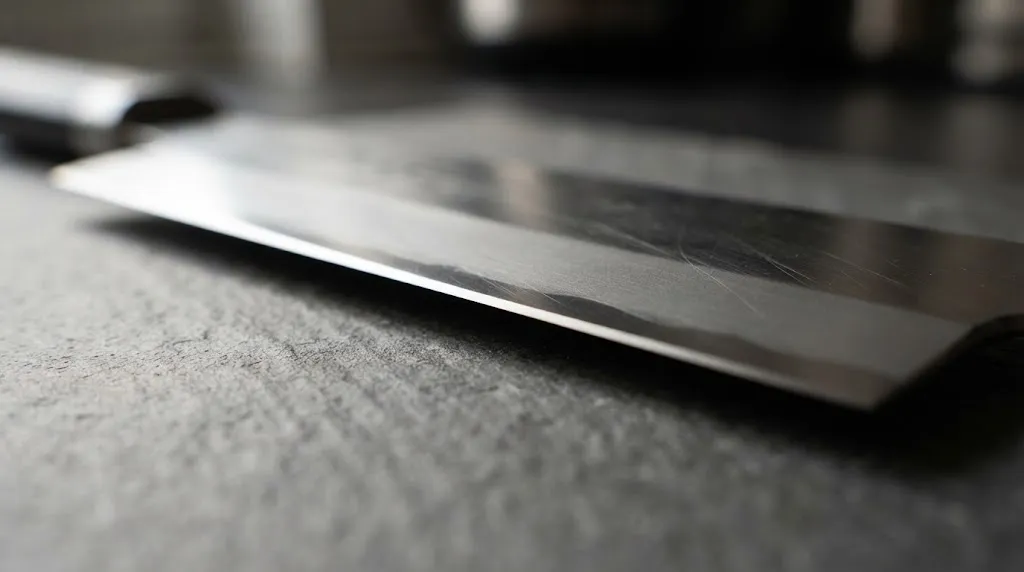
When examining a kitchen knife profile, the blade is composed of several distinct geometric zones. The primary bevel is the principal ground surface of the blade. It forms the transition from the thicker spine down toward the cutting edge.
Depending on the manufacturing style and forging tradition, this bevel can take several forms, ranging from a continuous flat taper to a smooth convex curve. Understanding this geometry helps explain why certain knives glide effortlessly through dense ingredients while others require more downward force.
The primary bevel works in tandem with the secondary bevel—the small, steep micro-edge at the very apex of the blade—to balance cutting performance with structural durability.
Primary Bevel vs. Secondary Bevel
 Save
A common point of confusion in knife maintenance is the difference between the primary and secondary bevels. Each serves a distinct mechanical purpose.
- Primary Bevel: The large surface running across the main body of the blade. It determines the cross-sectional thickness and how much wedge resistance the knife encounters as it cuts deeper into food.
- Secondary Bevel (Edge Bevel): The narrow apex angle formed at the very bottom of the blade during sharpening. It provides a durable cutting edge that resists rolling or chipping under normal kitchen use.
While sharpening typically focuses on maintaining the secondary edge bevel, thinning the primary bevel becomes necessary over years of heavy use to preserve the blade’s thin cutting geometry.
Common Primary Bevel Geometries
Knifemakers utilize different primary grind profiles to achieve specific performance traits. The geometry chosen dictates how the blade handles food release, friction, and impact resistance.
Flat Grind
A flat grind tapers uniformly from the spine or thick middle section straight down to the edge. This creates a thin cross-section that minimizes drag, making it exceptionally popular for precision vegetable prep and general culinary tasks.
Convex Grind
A convex grind curves smoothly outward toward the edge without sharp transition lines. This geometry adds considerable structural strength behind the edge, making it resilient for heavy-duty tasks, butchery, and outdoor knives.
Hollow Grind
A hollow grind features a concave radius ground into the sides of the blade. While this allows the edge to be extremely thin and sharp initially, it leaves less steel behind the edge, which can increase vulnerability to chipping when cutting hard items.
How Primary Bevel Geometry Affects Cutting Performance
The thickness and taper of the primary bevel directly govern how a knife interacts with food. When a chef’s knife moves through a dense root vegetable like a carrot, the blade must push the material apart.
A thin primary bevel reduces wedging friction, allowing the knife to slice cleanly without cracking or splitting rigid ingredients. Conversely, a thicker primary bevel increases durability but creates more resistance, causing the blade to wedge or bind in deep cuts.
Tip
If your chef knife starts splitting hard vegetables rather than slicing smoothly, the issue may not be a dull edge, but rather thick shoulders behind the edge that require thinning the primary bevel.
Symmetrical vs. Asymmetrical Bevels
Most Western chef knives feature a symmetrical primary and secondary bevel, meaning the blade is ground evenly on both the left and right sides. This design ensures neutral steering, allowing the knife to track straight down during cuts.
Many traditional Japanese culinary knives utilize asymmetrical grinds, such as a chisel grind or a compound bevel biased toward one side. These configurations offer distinct advantages for specialized cutting techniques, clean slice separation, and enhanced edge sharpness, though they require specific sharpening proficiency for left- or right-handed users.
Maintenance and Blade Thinning Over Time
 Save
As a chef knife is repeatedly sharpened over years of use, the steel directly behind the secondary edge naturally thickens because the overall blade tapers upward. Eventually, the knife begins to feel like it is wedging rather than cutting efficiently.
Restoring peak performance requires thinning the primary bevel. This maintenance procedure involves laying the flat side of the blade against a sharpening stone to remove excess steel above the edge, restoring the original thin cross-sectional geometry.
Warning
Thinning the primary bevel removes significant amounts of steel and alters the knife’s finish. Practice on older knives before attempting this technique on high-end or clad Japanese blades.
Related Product
Knife Sharpening Stones
A quality water stone set helps maintain proper edge geometry and allows for precise thinning of the primary bevel over time.
As an Amazon Associate, we earn from qualifying purchases.
Frequently Asked Questions
What is the main function of a chef knife primary bevel?
The primary bevel establishes the overall blade thickness and taper, which directly controls cutting resistance, food release, and how easily the knife moves through ingredients.
Is the primary bevel the same as the sharp edge?
No. The primary bevel is the large tapering surface running down the body of the blade, while the sharp edge is the small secondary bevel formed at the very bottom apex.
How often should a primary bevel be thinned?
Primary bevel thinning is typically required only after years of regular sharpening have thickened the steel immediately behind the cutting edge.
Do all chef knives have the same primary bevel geometry?
No. Knife manufacturers use various profiles, including flat, hollow, and convex grinds, tailored to specific cutting tasks and regional knife-making traditions.
Can I thin the primary bevel myself?
Yes, using water stones or specialized abrasive sheets, though it requires patience and proper technique to maintain a clean, uniform finish across the blade.
Why does my knife wedge in carrots even when sharp?
If the edge is sharp but the knife still splits dense food, the primary bevel has likely thickened due to previous edge sharpening, increasing the wedge resistance.
Conclusion
The primary bevel is a foundational element of kitchen knife geometry, dictating how a blade balances cutting efficiency, slicing resistance, and structural durability. By understanding how flat, convex, and hollow grinds perform, culinary enthusiasts can better evaluate knife performance and recognize when a blade requires maintenance beyond standard edge sharpening.

