What Is a Chef Knife? Definition, Purpose, and Key Features
Quick Answer: A chef knife (also written “chef’s knife”) is the all-purpose kitchen knife with a broad blade, typically 8 to 10 inches long, and a gentle curve along the cutting edge. It handles most everyday cutting tasks — chopping vegetables, slicing meat, mincing herbs — which is why it is usually the first and most-used knife in both home and professional kitchens.
If you have ever wondered why almost every knife set starts with this one blade, the answer is simple: the chef knife is designed to be the knife you reach for when no other knife is obviously right. This guide explains exactly what it is, what it does well, what it does poorly, and which features actually matter when you look at one.
What Is a Chef Knife? The Definition
A chef knife is a general-purpose kitchen knife built around a wide, tapered blade that narrows to a pointed tip. The blade is tall enough that your knuckles clear the cutting board while chopping, and the edge curves gently up toward the tip — a shape called the “belly” — so the knife can rock through push cuts and mincing motions.
The name comes from its role rather than its shape: it is the knife a chef uses for the majority of prep work. Its origin is usually traced to the French couteau de chef, and Western designs were later adapted in Japan into related shapes such as the gyuto. Either way, the defining idea is the same — one blade that covers most cutting jobs instead of specializing in a single one.
That generality is the whole point, and it comes with a trade-off. A chef knife is deliberately a compromise: better at more tasks than any specialist knife, but not the absolute best at any single one of them.
What Is a Chef Knife Used For?
 Save
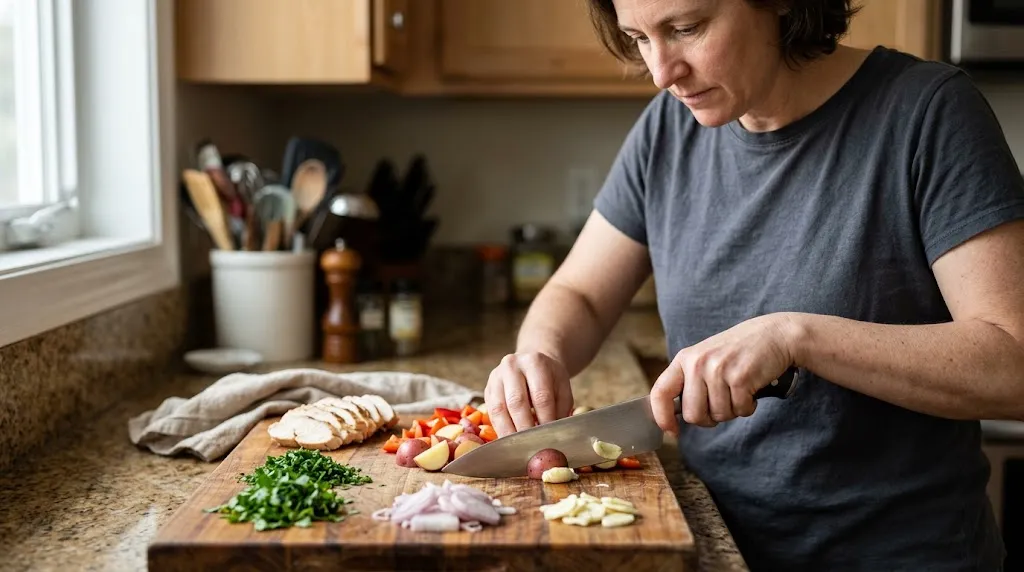
SaveA chef knife covers the bulk of daily kitchen prep. In practice, that means:
- Chopping and dicing vegetables and fruit — the tall blade and rocking edge make this its core task.
- Slicing cooked and raw meat — including portioning chicken breasts and slicing steaks against the grain.
- Mincing herbs, garlic, and shallots — the curved edge lets you rock the tip on the board.
- Disjointing large cuts — separating chicken leg quarters and similar joints (cutting through bone itself is a different job).
- Crushing garlic — pressing the flat side of the blade onto a clove with the heel of your hand.
Equally important is what it is not for. It is the wrong tool for cutting through hard bones (that is a cleaver or butcher knife), peeling small produce (a paring knife), slicing crusty bread (a bread knife), and precise filleting work around fish bones. Reaching for the chef knife for those jobs either damages the edge or produces worse results. For a closer look at the split of duties, see our guide to boning knife vs chef knife.
Key Features That Define a Chef Knife
Feature lists can get endless, but only a handful of attributes genuinely change how a chef knife performs. These are the ones worth understanding.
Blade Length
Most chef knives fall between 6 and 12 inches, and the most common size sold today is 8 inches (about 20 cm). The 8-inch blade sits in the middle: long enough to slice large vegetables and portion meat, short enough to stay controllable for most hand sizes. A 10-inch blade suits big-batch cooking and wide produce like melons; a 6-inch blade suits small hands and tight workspaces.
Blade Shape and Edge Curve
The combination of a pointed tip, a curved belly, and a tall blade is what makes the chef knife versatile. The tip handles detail work and piercing, the belly drives the rocking motion for mincing, and the height keeps knuckles off the board and adds knuckle clearance when scooping chopped food.
Steel Type
Most chef knives today are made from stainless steel with a meaningful carbon content — commonly labeled “high-carbon stainless steel.” Stainless steels contain roughly 12% or more chromium, which resists rust and staining, while the carbon content allows the blade to take and hold a sharp edge. The practical divide is simple: high-carbon stainless steel offers the best balance of sharpness, toughness, and low maintenance for most kitchens; pure high-carbon (non-stainless) steel can get sharper but needs care to prevent rust and discoloration. We explain the material in depth in our article on what high-carbon stainless steel is.
Construction: Forged vs Stamped
Forged blades are shaped from a single heated bar of steel; stamped blades are cut from a large sheet. Forged knives typically have a thicker spine, a built-up area between blade and handle called the bolster, and a heftier feel. Stamped knives are lighter and often less expensive. Neither method guarantees a better knife — heat treatment and finishing quality matter more — but the construction explains most of the weight and balance differences you will feel. Our forged vs stamped knives guide covers the differences in detail.
Handle, Tang, and Balance
The tang is the strip of steel that continues into the handle. A “full tang” runs the entire length of the handle, which generally improves strength and balance. The handle material matters less than the fit: what you want is a shape you can grip securely when wet or greasy, with the balance point landing close to where blade meets handle.
| Part | What it is | Why it matters |
|---|---|---|
| Tip | The pointed front end of the blade | Detail cuts, piercing, incisions |
| Edge (belly) | The sharpened bottom curve of the blade | Chopping, slicing, the rocking motion |
| Heel | The rear section of the edge nearest the handle | Power for tough or thick items |
| Spine | The thick, unsharpened top of the blade | Stiffness; some chefs press it to crack garlic |
| Bolster | The thick steel junction between blade and handle (on forged knives) | Balance and a finger guard between handle and blade |
| Tang | The steel extending into the handle | Strength and balance; full tang is the standard on quality knives |
Read the table as a map of the knife rather than a checklist. When you pick a chef knife up, the parts that decide whether it will feel right in your hand are the blade height, the weight, and where it balances — the rest is detail.
Chef Knife vs Other Common Kitchen Knives
Understanding the chef knife is easiest next to the knives it shares a drawer with. Each of these specializes where the chef knife generalizes.
| Knife | Blade | Best at |
|---|---|---|
| Chef knife | 8–10 in, broad, curved edge | General prep: chopping, slicing, mincing |
| Santoku | Usually shorter (5–7 in), flatter edge | Straight up-down cuts, thin slicing, smaller hands |
| Paring knife | 3–4 in, narrow | Peeling, trimming, in-hand detail work |
| Bread knife | Long, serrated | Crusty loaves, tomatoes, delicate items without crushing |
| Boning knife | 5–7 in, thin, often flexible | Cutting meat away from bones and joints |
| Cleaver | Wide, thick, heavy rectangle | Chopping through bones and hard rinds |
The pattern is clear: the santoku is the chef knife’s closest rival, but its flatter edge suits a straight up-and-down cutting style rather than rocking. If you are weighing the two, our boning knife vs santoku comparison and the guide to the knives professional chefs actually use both give useful context. For a plain-language walkthrough of the general-purpose role, see what a chef’s knife is used for.
Common Misconceptions About Chef Knives
- “A chef knife can do everything.” It does more tasks than any other knife, but bones, frozen food, and very dense squash still damage edges. Using it as the only knife you own works; using it as the only knife for every job does not.
- “More expensive means better.” Above a modest threshold, extra price often buys steel prestige, handle materials, or branding — not better cutting. Fit, finish, and heat treatment matter more than the logo.
- “A bigger blade is better.” A 12-inch blade is unwieldy for most home cooks and most cutting boards. The right length is the one that matches your hand, your board, and your counter space.
Warning
Never twist, hack, or rock a chef knife through hard bone, frozen food, or pumpkin shells — that is the fastest way to chip an edge. Use a cleaver or a dedicated bone knife, or thaw first.
How to Keep a Chef Knife Performing the Way It Should
 Save
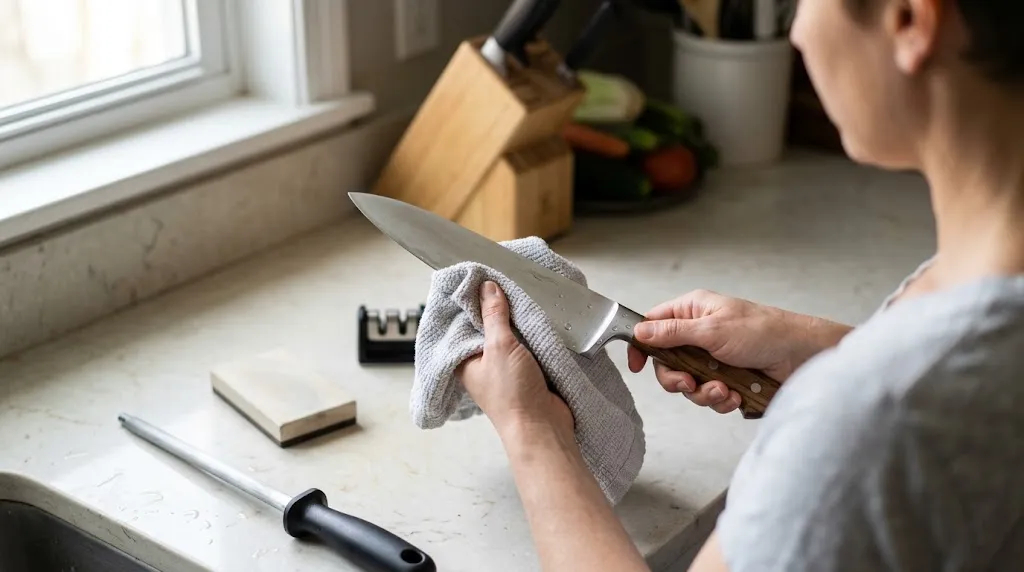
SaveA chef knife is only as good as its edge, and edge care is mostly habits rather than effort. Three habits carry nearly all the value:
- Hand wash and dry immediately. Dishwashers toss knives against racks, and prolonged moisture attacks both steel and handle.
- Hone regularly, sharpen occasionally. A few passes on a honing rod realign the edge between uses; actual sharpening restores it when honing stops working.
- Store it protected. A knife block, magnetic strip, blade guard, or drawer insert prevents the edge from contacting other hard objects.
For the complete routine, see our guide on how to clean, sharpen, and maintain kitchen knives. If you are new to handling knives safely, the fundamentals in basic knife skills for beginners apply directly to the chef knife’s pinch grip and rocking cuts.
Who Needs a Chef Knife?
Almost everyone who cooks. If you own one knife, this is the one that handles the widest range of everyday tasks; specialists like paring, bread, and boning knives add value only once the general-purpose base is covered. What varies between buyers is not whether to own a chef knife but which size and weight suit your hand and your cooking volume — the criteria in what makes a high-quality kitchen knife translate directly to this decision.
Relevant Product
8-Inch Chef Knife
If this article convinced you that a general-purpose blade is what your kitchen is missing, an 8-inch chef knife is the standard starting point: versatile enough for daily prep and manageable for most hands.
As an Amazon Associate, we earn from qualifying purchases.
FAQ
Why is it called a chef’s knife?
Because it is the knife chefs rely on for most of their prep. The name describes its role in a professional kitchen — the general-purpose workhorse — rather than any single design feature.
Is an 8-inch chef knife right for everyone?
It fits most adults and most cutting boards, which is why it is the most common size. Choose a 6-inch blade if you have smaller hands or limited space, and a 10-inch blade mainly if you regularly prep large roasts or wide vegetables.
Can a chef knife cut through bone?
No. A chef knife is built for flesh and produce, not bone. Cutting through bone chips the edge; use a cleaver or a dedicated butcher/boning knife for that work.
Is a santoku a better choice than a chef knife?
It depends on cutting style more than quality. The santoku’s shorter, flatter blade suits straight up-and-down cuts and smaller hands; the chef knife’s curved edge and greater length suit rocking cuts, larger produce, and a wider range of tasks.
The takeaway: a chef knife is the general-purpose core of any knife collection — a broad, 8-to-10-inch blade designed to cover chopping, slicing, and mincing for almost any ingredient you prepare. Understand its few key features (length, edge curve, steel, and balance) and its real limits (no bones, no frozen food), and it will outperform every specialist knife at the majority of your daily prep.