Foods You Should Not Cut With a Chef Knife
Quick Answer
Avoid using a standard chef knife to cut through bones, fully frozen foods, hard fruit pits, nutshells, hard shells, and extremely tough foods that require heavy chopping force. These can chip, roll, bend, or otherwise damage a fine cutting edge. A chef knife works best on vegetables, fruit, herbs, boneless meat, poultry, and fish that can be cut with controlled slicing rather than force.
A chef knife handles a remarkable range of kitchen prep, but “all-purpose” does not mean indestructible. The important question is not simply whether the blade is physically capable of getting through an ingredient. It is whether the food can be cut without excessive impact, twisting, prying, or sideways pressure on the edge.
If you are unsure what the knife is designed to handle in normal use, this guide to chef knife uses and limits covers the broader role of the blade. Here, the focus is narrower: foods that are better left to another tool.
The Foods Most Likely to Damage a Chef Knife
The highest-risk foods share one feature: they create much more resistance than normal slicing ingredients. Instead of moving smoothly through the food, the edge may strike something hard, become wedged, or be forced sideways.
| Food | Main Problem | Better Approach |
|---|---|---|
| Thick bones | Hard impact can damage the edge | Bone cleaver or suitable butcher tool |
| Frozen food | Very high resistance; blade may chip or become trapped | Thaw before cutting |
| Hard pits and stones | Sudden hard contact can damage edge or tip | Cut around the pit and remove it |
| Hard shells | Requires force and may twist the blade | Shellfish tool or heavy-duty knife |
| Very hard rinds or husks | Knife can wedge and require dangerous force | Use a tool suited to the specific ingredient |
The exact limit depends partly on blade construction. A sturdy Western chef knife may tolerate tougher prep better than a thin, hard Japanese-style edge, but that does not make every hard ingredient appropriate for it.
Do Not Chop Through Thick Bones
 Save
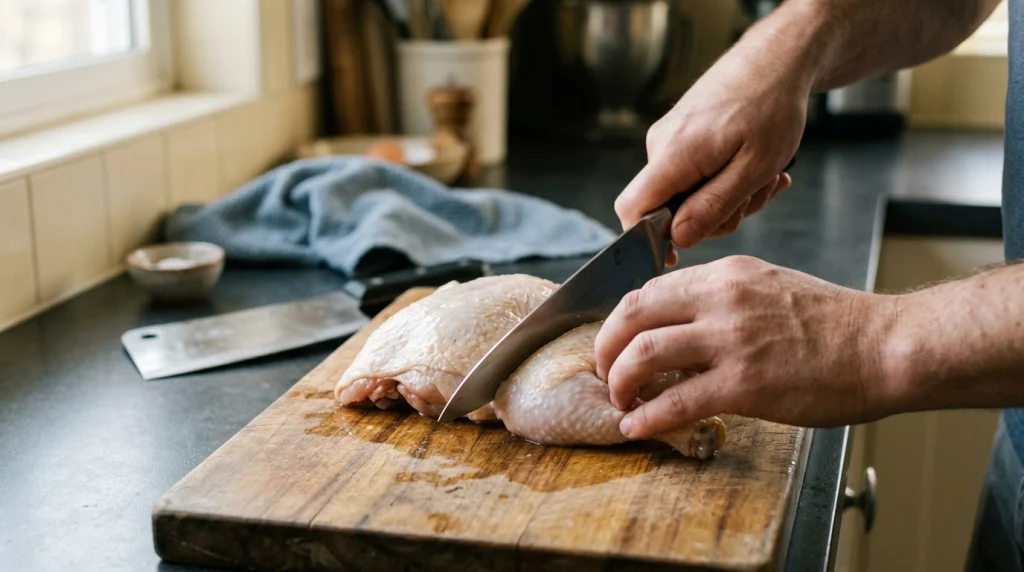
SaveA standard chef knife should not be treated as a bone cleaver. Beef bones, pork bones, lamb bones, thick poultry bones, and similar hard structures can put concentrated impact directly on a relatively thin cutting edge.
This distinction matters when preparing poultry. A chef knife can work well on chicken meat and can separate many portions when you locate the natural gap in a joint. That is different from swinging the knife directly through the solid bone. Our guide to cutting chicken with a chef knife explains that difference in more detail.
When you need to remove meat closely from a skeleton rather than chop through it, a narrow boning knife is usually more controllable. See how to use a boning knife for that type of precision work.
Warning
If the knife suddenly stops against something hard, do not compensate by hitting harder or twisting the handle. Stop, reposition the ingredient, locate the joint if applicable, or switch to a tool designed for bone work.
Let Frozen Food Thaw Before Cutting
Fully frozen meat, fish, fruit, and other solid frozen foods should generally be thawed enough to cut safely instead of being forced apart with a chef knife. Major knife manufacturers specifically caution against using fine kitchen knives on frozen foods because the resistance can damage the cutting edge.
Frozen food creates another practical problem: the blade may enter partway and become stuck. Trying to free a trapped knife by rocking or twisting it places sideways force on an edge designed primarily to cut forward and downward.
This does not mean every ingredient must be room temperature. Slightly firm or partially chilled food can sometimes be useful for controlled slicing. The problem is food that remains hard enough that you must force the knife through it.
Avoid Striking Hard Fruit Pits and Stones
Peach stones, plum pits, mango stones, avocado pits, and similar hard centers should be treated as obstacles rather than cutting targets. Slice the edible flesh around them instead of driving the knife edge directly into the pit.
Avocados deserve particular care. Cut around the pit with the fruit resting securely on the board, separate the halves, and remove the pit using a controlled method. Avoid aggressive movements that combine a sharp knife, a hard pit, and a hand holding the fruit.
Hard pits can also surprise you because the surrounding fruit is soft. The knife moves through the flesh easily and then encounters a sudden hard surface, concentrating force on a small area of the edge.
Hard Shells and Coconuts Need Heavier Tools
A chef knife is not the best choice for breaking lobster shells, thick crab shells, nutshells, coconut shells, or similarly hard outer structures. These jobs often require impact rather than slicing, and impact is exactly what a fine chef-knife edge is not optimized for.
WÜSTHOF, for example, describes its fine-edged Chinese chef knives as unsuitable for bones and very hard fruit such as coconut, directing those heavier jobs toward cleavers or butcher-style knives.
Use the tool designed for the ingredient: kitchen or seafood shears for appropriate shellfish tasks, a nutcracker for nuts, or a sufficiently heavy knife or cleaver when the food preparation genuinely requires chopping through a hard structure.
What About Squash, Pumpkin, and Other Dense Produce?
Dense produce is more conditional. Foods such as butternut squash, pumpkin, rutabaga, large sweet potatoes, pineapple, and melons are not automatically off-limits to every chef knife. A sturdy, sharp chef knife can handle many of them when the ingredient is stable and the blade passes through without excessive force.
The warning sign is resistance. If the blade becomes deeply wedged and you feel tempted to twist it sideways, hit the spine, or force the handle back and forth, stop. That movement can be harder on the edge than the initial cut.
Key Insight
The category of food matters less than the force required. If a chef knife can make a clean, controlled cut, the task may be appropriate. If the job requires impact, prying, twisting, or heavy leverage, change tools.
Foods a Chef Knife Can Cut—but Another Knife May Do Better
Some foods are safe for a chef knife but still benefit from a specialized blade.
Crusty bread: A chef knife can cut softer bread, but a serrated bread knife grips a hard crust and slices through the loaf without requiring as much downward pressure.
Delicate tomatoes: A very sharp chef knife works beautifully. If the edge is less than sharp, a serrated utility knife may penetrate the skin more easily without crushing the flesh.
Small peeling and trimming jobs: A chef knife is unnecessarily large for peeling, hulling, coring, and detailed hand work. A paring knife offers better control.
Whole fish: A chef knife is excellent for portioning boneless fillets, but following a backbone, working through tight curves, or removing skin may be easier with a fillet or boning knife. The guide to using a chef knife for fish explains where the chef knife works and where a narrower blade becomes useful.
How to Tell When You Should Switch Knives
You do not need to memorize a rule for every ingredient. Watch what happens during the cut.
- The blade hits a solid obstacle: Stop rather than striking harder.
- The knife becomes wedged: Do not pry sideways to free it.
- You need repeated heavy chopping: A more robust knife may be appropriate.
- The food moves or rolls under pressure: Stabilize it before continuing.
- You are cutting close around bones: Use a boning knife rather than forcing a wide chef knife into tight spaces.
- The job depends on sawing through a hard exterior: Consider a serrated or purpose-built tool.
A sharp chef knife should normally feel controlled rather than forced. Needing significantly more pressure than expected is a useful signal to stop and reassess the ingredient, cutting angle, knife sharpness, or tool choice.
Why Hard Foods Can Damage the Edge
 Save
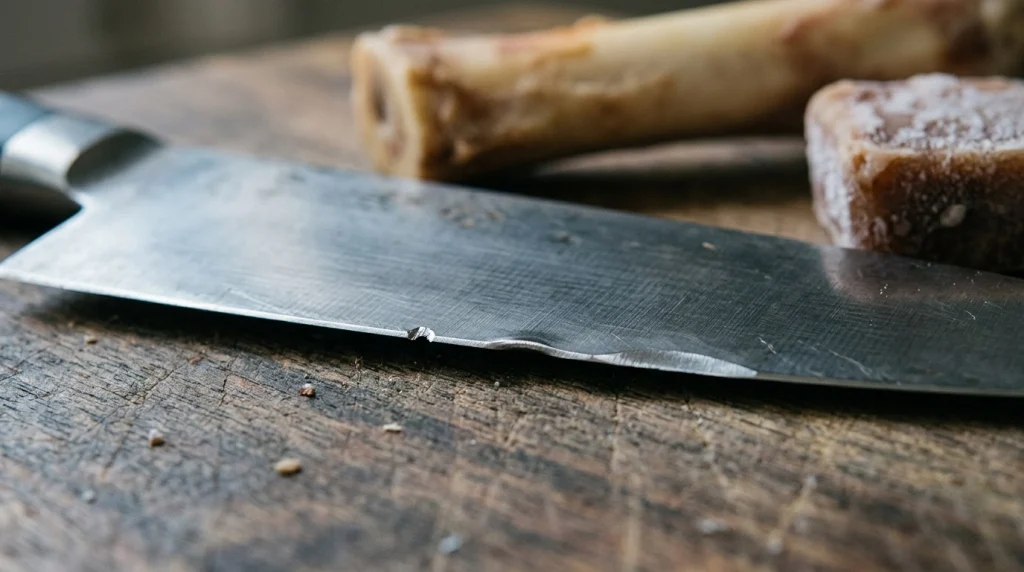
SaveA sharp kitchen knife has a very thin cutting edge. That thin geometry is why it slices food efficiently, but it also means the edge is not designed to absorb every type of impact.
Depending on the blade and the force involved, misuse can lead to small chips, edge rolling, a damaged tip, or rapid dulling. Thin, hard Japanese-style blades can be particularly sensitive to impact and lateral force, while tougher Western-style blades may tolerate more abuse but still have practical limits.
Manufacturer guidance reinforces this distinction. Shun’s knife care guidance tells users not to use its precision knives on bones, joints, or frozen foods. WÜSTHOF likewise recommends heavier cleavers for demanding bone work.
Relevant Product
Heavy-Duty Meat Cleaver
If you regularly prepare cuts that genuinely require chopping through bones or other hard structures, a purpose-built heavy cleaver is more appropriate than sacrificing the fine edge of your everyday chef knife.
As an Amazon Associate, we earn from qualifying purchases.
Frequently Asked Questions
Can a chef knife cut chicken bones?
A standard chef knife can portion chicken effectively when you cut through natural joints, cartilage, meat, and skin. It should not be used as a cleaver to repeatedly chop through hard sections of bone.
Can I cut frozen meat with a chef knife?
Fully frozen meat is best thawed before cutting with a normal chef knife. Manufacturer care guidance commonly warns that hard frozen food can damage a fine cutting edge.
Can a chef knife cut butternut squash?
Often, yes, provided the knife is sturdy and sharp, the squash is stable, and the cut does not require twisting or excessive force. If the blade becomes firmly wedged, stop rather than using it as a lever.
Should I use a chef knife to open a coconut?
A normal fine-edged chef knife is not the ideal tool for cracking or chopping through a coconut shell. Use a method and tool designed for the coconut rather than striking the shell with a delicate cutting edge.
Can a chef knife cut bread?
It can cut soft bread, especially when very sharp, but a serrated bread knife usually handles crusty loaves better because its teeth grip the crust without requiring as much downward pressure.
What is the easiest rule for knowing when not to use a chef knife?
If the task requires heavy impact, prying, twisting, or forcing the blade through something extremely hard, switch tools. Chef knives perform best with controlled slicing and chopping rather than brute force.
Conclusion
A chef knife should handle most everyday vegetables, fruit, herbs, boneless meat, poultry, and fish without needing excessive force. The foods to avoid are those that turn normal slicing into impact work: thick bones, fully frozen foods, hard pits, tough shells, and unusually hard structures.
Use resistance as your warning sign. If the blade becomes stuck or you need to twist, pry, hammer, or strike harder, stop and choose a more suitable tool. That simple habit protects the knife edge and gives you better control over the cut.