Damascus Steel Chef Knife: Performance, Care & Buying Guide
Quick Answer
A Damascus steel chef knife is a kitchen knife made from layered, pattern-welded steel that produces a distinctive wavy surface pattern. The performance depends almost entirely on the specific steels used and the heat treatment—not the pattern itself. Modern Damascus knives can be excellent, but they demand more care than standard stainless knives, especially if the blade contains high-carbon steel.
What Damascus Steel Actually Means on a Modern Chef Knife
The word “Damascus” on a modern kitchen knife does not refer to a single type of steel. It describes a construction method: pattern welding.
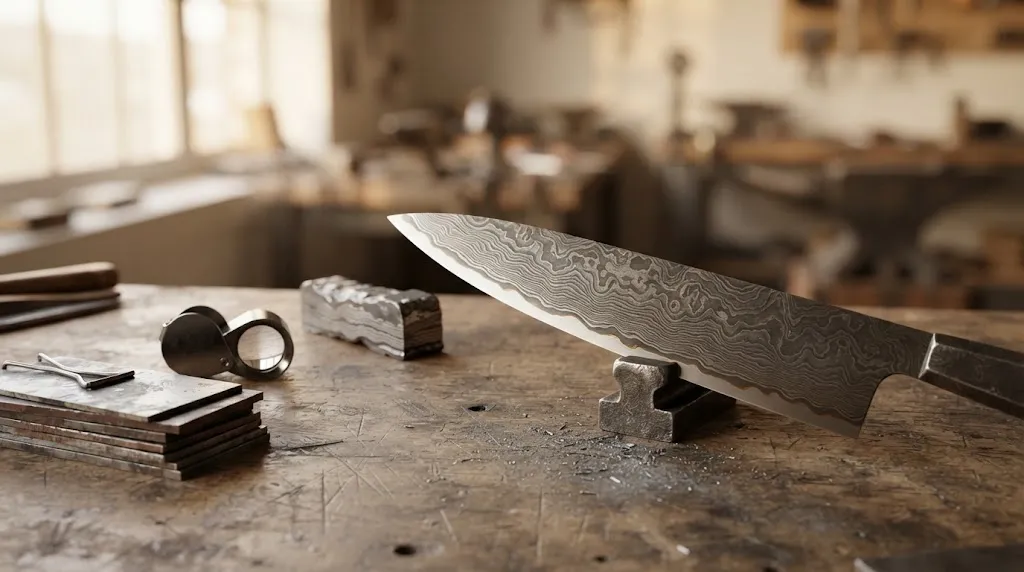
Bladesmiths stack or forge-weld two or more different steels together, then fold, stack, and weld them repeatedly. The layers create the visible banding or wavy pattern after the blade is shaped, ground, and often acid-etched. A single knife might have dozens or even hundreds of layers, though the exact count varies by maker [citation:2][citation:4].
This is different from the legendary ancient Damascus steel of historical swords. Modern Damascus is a deliberate aesthetic and structural choice, not a lost metallurgical secret. What matters for cutting performance is not the layer count but the core steel and the heat treatment.
The Core Steel Is the Real Performer
 Save
Many production Damascus chef knives use a hard core steel—such as VG-10, AUS-10, or 10Cr15CoMoV—sandwiched between softer Damascus-patterned cladding [citation:4][citation:6]. The core does the cutting; the outer layers provide visual appeal and some corrosion resistance.
When you see a Damascus knife described as “67 layers,” that figure typically refers to the total layer count of the cladding, not the cutting core. A well-hardened core at 60–61 HRC can hold a keen edge. A poorly treated core at the same stated hardness may not.
Key Insight
The Damascus pattern is a result of the construction, not a guarantee of superior sharpness. A monosteel knife made from a high-quality powder metallurgy steel can outperform a Damascus knife with a mediocre core. Judge the steel, the hardness, and the maker’s reputation—not the swirls.
How a Damascus Chef Knife Performs in Real Use
Performance depends on the steel and geometry, but several general patterns hold true for most Damascus chef knives.
Edge retention is often good to excellent when the core steel is hard and properly treated. Knives with cores in the 60–62 HRC range can go longer between sharpenings than softer German-style stainless blades, though they may be more prone to chipping if abused [citation:6][citation:10].
Sharpness out of the box varies widely. Some makers sharpen to acute angles (10–15 degrees per side), which feels extremely sharp but is less durable for heavy work. Others use more conservative angles around 15–20 degrees [citation:6][citation:9].
The weight and balance depend on construction. Full-tang Damascus knives with dense handles can feel substantial, while some Japanese-style Damascus blades are thinner and lighter. Neither is inherently better; it comes down to cutting style and preference.
What Damascus Steel Does Not Do
It does not make a knife rust-proof. Even “stainless” Damascus cladding can develop surface oxidation if left wet, and carbon steel Damascus will rust readily without care [citation:3][citation:13].
It does not stay sharp forever. No steel does. The pattern has no effect on how long an edge lasts.
It does not justify a high price on its own. Labor-intensive forging and finishing drive cost, but a $30 Damascus-pattern knife and a $300 one may look similar in photos while performing completely differently.
Carbon Damascus vs. Stainless Damascus: The Care Difference That Matters
This is the most important distinction for anyone considering a Damascus chef knife.
| Attribute | Carbon Damascus | Stainless Damascus (clad) |
|---|---|---|
| Rust risk | High—rusts quickly if left wet | Low to moderate—cladding resists oxidation, but edges and scratches can still corrode |
| Oiling | After every use is safest | Before extended storage; optional for regular use |
| Dishwasher | Never | Never—heat and detergent damage handles and edges regardless |
| Patina | Develops a grey-blue patina that is protective; do not remove it | Minimal patina; may develop spots at layer boundaries |
If you are not willing to dry and oil a knife immediately after every use, a stainless-clad Damascus knife is the practical choice. If you enjoy the ritual of knife care and want the performance characteristics of high-carbon steel, carbon Damascus can reward that attention—but it will punish neglect.
Warning
Never put any Damascus chef knife in the dishwasher. The prolonged heat, moisture, and harsh detergents will damage the edge, degrade the handle (especially wood or resin), and accelerate corrosion at the layer boundaries. This applies even to “stainless” Damascus knives [citation:3][citation:8].
How to Care for a Damascus Chef Knife So It Lasts
The core routine is simple: keep it dry, keep it clean, and oil when needed.
- Wash by hand immediately after use. Use mild soap and warm water. Do not let the blade soak.
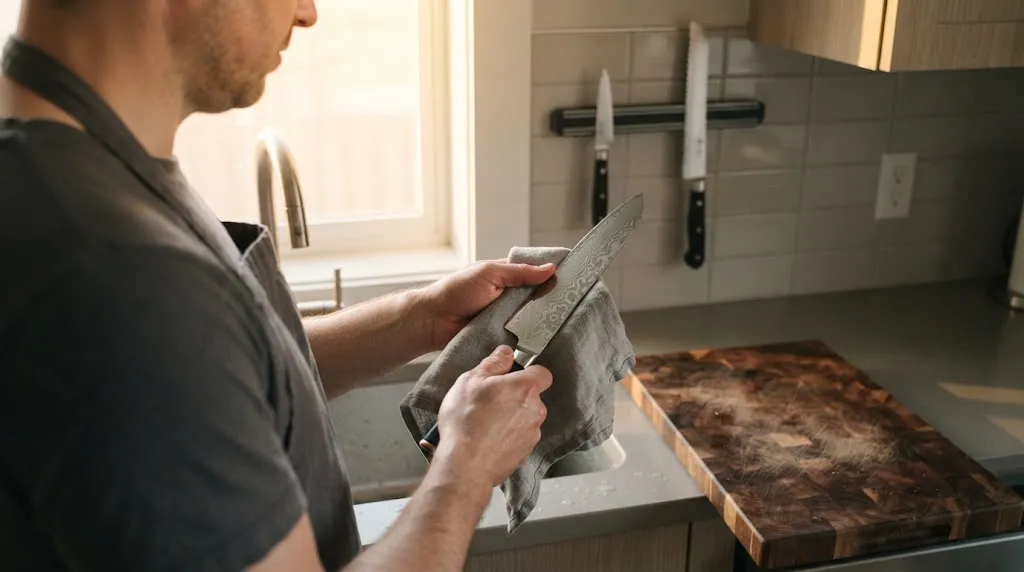
- Dry completely with a soft cloth. Pay attention to the area where the blade meets the handle, where moisture can hide.
- Oil the blade if it is carbon steel or if the knife will be stored. A thin coat of food-grade mineral oil is sufficient. For carbon Damascus used daily, oiling after each wash is the safest habit [citation:3][citation:5].
- Store dry and exposed to air. Avoid leaving the knife in a wet sheath or a damp drawer. A magnetic strip or a dry knife block works well.
- Sharpen carefully. Damascus steel sharpens like any comparable steel, but you should avoid aggressive grinding on the flat of the blade, which can remove the etched pattern. A whetstone at the appropriate angle (typically 15–20 degrees per side for kitchen knives) is the standard method [citation:19].
If the pattern fades over time—which is cosmetic, not structural—it can often be refreshed with a mild acid treatment or by a professional. This is optional and does not affect cutting performance [citation:16][citation:19].
Who Should Consider a Damascus Chef Knife—and Who Should Not
 Save
A Damascus chef knife makes sense if you value the visual character of a patterned blade, you are willing to hand-wash and dry immediately, and you understand that you are paying partly for aesthetics and craftsmanship, not just cutting ability.
It may not make sense if you want a knife you can leave in the sink for a few minutes, you prefer a low-maintenance tool, or you are shopping on a tight budget. A well-made monosteel stainless knife will cut just as well for most home cooks and require far less attention.
For cooks who want Damascus aesthetics with lower maintenance, a stainless-clad Damascus knife with a hard core steel is the middle path. It still requires hand washing, but it tolerates brief neglect far better than carbon Damascus.
Related Product
Damascus Steel Chef Knife
If you are ready to care for a Damascus blade, browse chef knives with verified layer counts and core steel specifications.
As an Amazon Associate, we earn from qualifying purchases.
Frequently Asked Questions
Is Damascus steel actually sharper than other knife steels?
No. Sharpness depends on the edge geometry and the hardness of the core steel, not the Damascus pattern. A well-sharpened monosteel knife can be just as sharp as a Damascus knife with the same core steel and edge angle.
Can I use a Damascus chef knife on bones or frozen food?
Avoid both. Hard, thin Damascus blades—especially those with acute edge angles—can chip or roll when forced through bone or frozen food. Use a dedicated cleaver or heavier knife for those tasks [citation:6].
How often does a Damascus knife need to be oiled?
Carbon Damascus should be oiled after every use for best protection. Stainless Damascus needs oil only before extended storage or if the blade will be exposed to moisture for long periods [citation:3][citation:16].
Will the Damascus pattern wear off with use?
The pattern is part of the steel, not a coating, so it does not “wear off” in normal use. However, the acid-etched contrast can fade over time and with repeated washing. The pattern can be refreshed professionally or with a mild acid treatment if desired [citation:19].
Is a Damascus knife worth the price for a home cook?
It depends on what you value. If you appreciate the craftsmanship and visual character and are willing to care for the blade, yes. If you want maximum cutting performance per dollar with minimal maintenance, a good monosteel knife is the more practical choice.
Can I sharpen a Damascus knife at home?
Yes, with a whetstone. Use a consistent angle (typically 15–20 degrees per side for chef knives) and avoid grinding the flat of the blade, which can damage the pattern. If you are not confident, practice on a less expensive knife first [citation:19].
Conclusion
A Damascus steel chef knife is a tool with two distinct identities: a cutting instrument and a visual object. The cutting performance comes from the core steel and heat treatment, not the pattern. The pattern comes from a labor-intensive forging process that adds cost and aesthetic value.
If you choose one, the care routine is non-negotiable. Dry it immediately, oil it when needed, never dishwasher it, and sharpen it with patience. Do that, and a Damascus chef knife can serve well for years. Skip those steps, and even an expensive blade will disappoint.

