What Is the Edge of a Chef Knife? Explained
Quick Answer
The edge of a chef knife is the sharpened lower portion of the blade that cuts through food. It runs from the heel near the handle toward the tip. Most chef knives have a plain, double-bevel cutting edge, meaning both sides are sharpened to meet at a fine cutting line called the apex. The edge’s angle, shape, and sharpness determine how efficiently the knife slices, chops, and dices.
Where Is the Cutting Edge on a Chef Knife?
The cutting edge is located along the bottom of a chef knife’s blade, opposite the thick, unsharpened back known as the spine. It extends from the heel, close to the handle, toward the pointed front of the knife.
When you place a chef knife on a cutting board, the cutting edge is the part designed to make contact with ingredients. Unlike the broad sides of the blade, this narrow cutting line concentrates force into a very small area.
Different sections of the edge serve slightly different purposes:
- Heel: The rear section, useful for controlled cuts through firm vegetables.
- Middle: The main working area for everyday slicing, chopping, and dicing.
- Belly: The curved portion that supports a smooth rocking motion.
- Front edge: The section approaching the tip, useful for smaller, more precise cuts.
Not every chef knife has the same edge profile. A German-style chef knife often has a more pronounced curve, while some Japanese-style chef knives have a flatter cutting section.
This difference affects how naturally the blade performs rocking cuts or straight downward cuts.
What Makes a Chef Knife Edge Sharp?
 Save
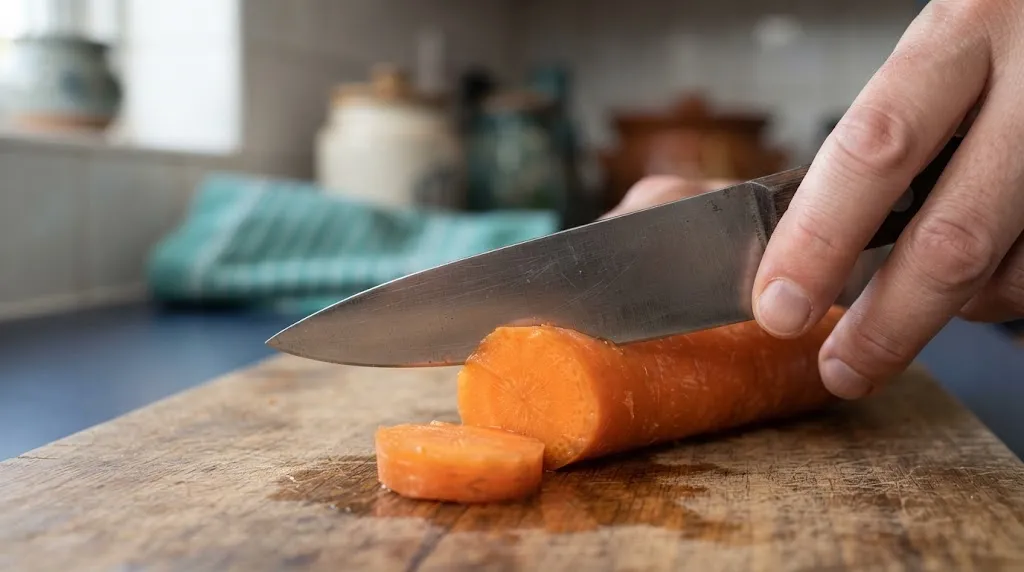
SaveA chef knife cuts effectively because two ground surfaces meet at a very narrow point called the apex.
The sharper and more consistent this meeting point is, the more easily the blade can begin cutting food. A dull edge has a rounded, flattened, or damaged apex that requires greater force to push through ingredients.
Three closely related features influence cutting performance.
1. The Cutting Apex
The apex is the actual point where the sharpened surfaces meet. Although it appears as a continuous line to the naked eye, it can contain tiny irregularities and imperfections.
Repeated cutting, contact with hard surfaces, and ordinary wear can gradually damage or round this fine edge.
2. The Bevel
The bevel is the angled surface that leads toward the cutting apex. On many chef knives, you can see a narrow polished strip immediately above the cutting edge.
That strip is often the final sharpening bevel, although some blade designs have additional bevels or smoothly blended transitions.
The bevel angle helps determine how easily the edge enters food and how much support the surrounding steel provides.
3. Blade Thickness Behind the Edge
Sharpness alone does not determine how easily a knife cuts. The thickness of the blade immediately behind the edge also matters.
A relatively thin blade can move through dense vegetables with less resistance. A thicker blade may create more wedging pressure, even when its cutting apex is sharp.
For example, two knives might both slice paper cleanly, yet the thinner one may require less effort to cut a large carrot.
Key Insight
A sharp edge and an efficient cutting blade are not exactly the same thing. The apex starts the cut, while the blade geometry behind it influences how easily the knife passes through the ingredient.
What Type of Edge Does a Chef Knife Have?
Most everyday chef knives feature a plain-edge, double-bevel design. The cutting line is continuous rather than serrated, and both sides of the blade are ground toward the apex.
However, several edge-related terms describe different features, so they should not be treated as interchangeable.
| Edge Type | Description | Typical Use |
|---|---|---|
| Plain edge | Continuous cutting edge without saw-like teeth | General slicing, chopping, and dicing |
| Double bevel | Cutting bevels ground on both sides | Most Western and many Japanese chef knives |
| Single bevel | Primary cutting bevel on one side | Specialized traditional Japanese knives |
| Serrated edge | Toothed or scalloped cutting profile | Bread knives and certain specialty blades |
A chef knife can be both plain-edged and double-beveled because these terms describe different characteristics.
Some manufacturers also offer hollow-edge chef knives. In product descriptions, this often means the blade has shallow dimples above the cutting edge to reduce food adhesion. It does not necessarily mean the knife has a hollow-ground cutting bevel.
What Is the Typical Edge Angle of a Chef Knife?
Many modern chef knives are sharpened somewhere around 10–20 degrees per side, but there is no universal angle for every knife.
The correct angle depends on the manufacturer’s design, blade geometry, steel characteristics, and intended use.
For a symmetrical double-bevel edge, the total included angle is approximately twice the angle measured on one side.
For example:
- 15 degrees per side produces an included angle of approximately 30 degrees.
- 20 degrees per side produces an included angle of approximately 40 degrees.
A narrower angle can reduce initial cutting resistance, but the fine edge may be less tolerant of twisting, lateral force, or contact with hard materials.
A wider angle generally provides more supporting material near the apex, although it can increase cutting resistance.
The relationship is not absolute because edge durability also depends on steel properties, heat treatment, blade thickness, and technique.
For a specific manufacturer example, WÜSTHOF’s blade-angle guidance identifies a 14.5-degree-per-side angle for its European chef knife compared with 10 degrees per side for its referenced Santoku design.
Rather than automatically sharpening every chef knife at the same angle, start with the manufacturer’s guidance or preserve the existing bevel if it is appropriate and undamaged.
How Does the Edge Shape Affect Cutting Techniques?
The shape of a chef knife’s cutting edge determines how it meets the cutting board and moves through food.
A curved edge supports different movements from a nearly straight edge.
Rock Chopping
A rounded belly lets the cook keep the front portion of the blade near the board while raising and lowering the handle.
This rocking movement works especially well for repeatedly chopping herbs, garlic, and small vegetables.
Push Cutting
A flatter cutting profile can provide more direct contact with the board during a downward and forward slicing motion.
This technique works well for evenly cutting vegetables and creating controlled slices.
Draw Slicing
Pulling the edge smoothly through an ingredient uses a longer section of the cutting blade.
It can help produce clean slices in foods such as cooked meat, tomatoes, and soft vegetables without relying on heavy downward pressure.
The best technique depends on the knife’s shape, the ingredient, and the cook’s control. There is no need to force a strongly curved knife into perfectly flat chopping movements or use an almost flat blade for exaggerated rocking cuts.
How Can You Tell if a Chef Knife Edge Is Dull?
A dull edge often reveals itself through cutting performance before obvious damage becomes visible.
Look for these common signs:
- The blade slides across tomato skin instead of beginning the cut easily.
- Soft ingredients become crushed rather than sliced cleanly.
- You need noticeably more pressure for routine chopping.
- Paper catches or tears during a carefully controlled cutting test.
- Small chips or flattened sections are visible along the edge.
No single test gives a complete measurement of sharpness. For example, a knife that cuts paper smoothly may still wedge noticeably in dense vegetables because of its blade thickness.
A practical kitchen check is to see whether the knife can slice a ripe tomato with a gentle, controlled motion.
Never test sharpness by dragging a finger along the cutting edge.
Safety Note
If a knife slips on food or requires excessive cutting pressure, stop and inspect its edge. Keep fingers clear of the blade, use a stable cutting board, and do not attempt to compensate for dullness by forcing the knife downward.
How Do You Maintain the Edge of a Chef Knife?
Keeping the cutting edge in good condition requires appropriate use, regular cleaning, suitable storage, and occasional maintenance.
 Save
SaveHoning Versus Sharpening
Honing and sharpening are related, but they are not identical.
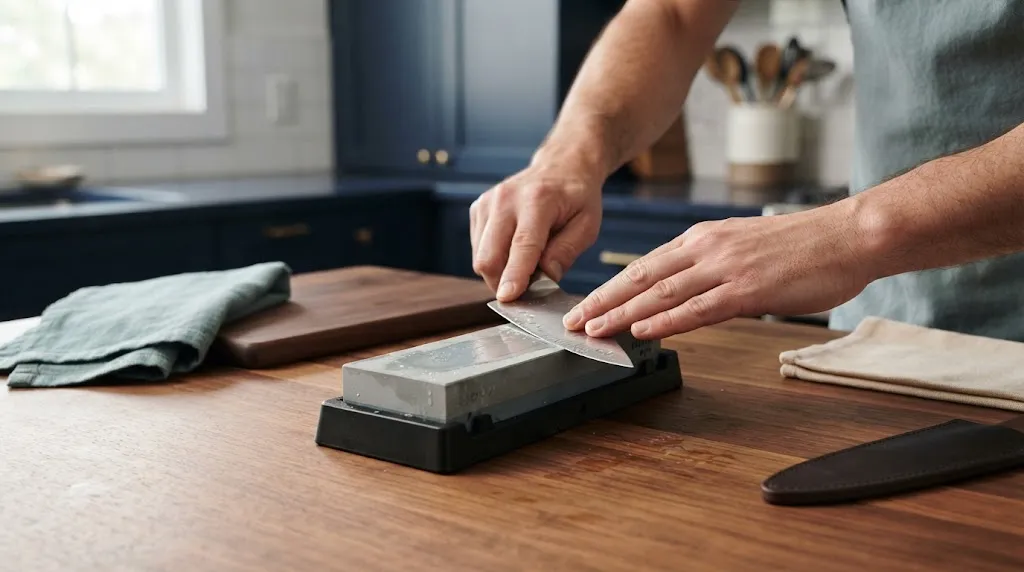
Honing with a suitable steel can help maintain an edge that has developed minor irregularities. Some honing tools primarily realign portions of the edge, while abrasive rods can also remove small amounts of metal.
Sharpening deliberately removes material to create or restore a cutting bevel and apex.
If a knife remains dull after appropriate honing, sharpening may be necessary. Significant chips or damaged bevel geometry may require more substantial repair.
The manufacturer’s ZWILLING knife sharpening guide explains the distinction between routine edge maintenance and restoring a worn cutting edge.
Choosing a Suitable Cutting Surface
Wooden and suitable plastic cutting boards are generally more forgiving on knife edges than glass, stone, or ceramic surfaces.
Repeated contact with very hard surfaces can accelerate wear or damage the fine apex.
Avoid twisting the blade against the board or scraping chopped food sideways with its sharp edge.
Use the spine or a separate bench scraper when moving ingredients.
Cleaning and Storage
Wash the knife carefully by hand, keeping the edge directed away from your fingers. Dry it promptly, especially if the blade contains carbon steel or other corrosion-prone materials.
A protective sheath, properly designed knife block, or magnetic storage system can prevent the edge from contacting other utensils.
Avoid leaving an uncovered knife loose in a drawer, where its edge can strike metal objects and create an injury risk.
What Should You Avoid Cutting With a Chef Knife?
A typical chef knife edge is designed for food preparation, not for every material that fits beneath its blade.
Avoid using an ordinary chef knife for:
- Frozen solid foods that require chopping force.
- Hard bones or heavy-duty butchery tasks.
- Prying open containers or packages.
- Cutting on glass, stone, or ceramic countertops.
- Twisting the blade through hard ingredients.
These actions can chip, bend, or otherwise damage the cutting edge. A thin, finely sharpened knife may be particularly vulnerable to lateral loading.
For hard bones or heavy chopping, use equipment specifically designed for that purpose.
What Matters Most About a Good Chef Knife Edge?
A useful chef knife edge balances sharpness, durability, cutting efficiency, and ease of maintenance.
For everyday cooking, look beyond the idea that the smallest sharpening angle must always be best.
A practical edge should cut ordinary ingredients cleanly, resist avoidable damage during appropriate use, and be maintainable with tools suited to its construction.
The blade profile should also support your preferred cutting movements. Someone who frequently rock-chops herbs may appreciate more belly, while a cook who favors controlled push cuts may prefer a flatter profile.
The most useful measure is how comfortably and consistently the knife performs the tasks it was designed to handle.
Related Knife Care Tool
Knife Sharpening Whetstone
A suitable sharpening stone can help restore a worn chef knife cutting edge while allowing control over the sharpening angle. Check the stone’s instructions and compatibility with your knife before use.
As an Amazon Associate, we earn from qualifying purchases.
Frequently Asked Questions
Is the edge of a chef knife the same as the blade?
No. The blade is the entire metal cutting portion of the knife, while the edge is the sharpened area along its lower boundary. The blade also includes features such as the spine, blade face, and tip.
Does a chef knife have one cutting edge or two?
A standard chef knife has one continuous cutting edge along the bottom of the blade. Most have bevels on both sides of that edge, which is why they are described as double-bevel knives. Two bevels do not mean two separate cutting edges.
Is a 15-degree edge better than a 20-degree edge?
Not automatically. A 15-degree-per-side edge is more acute and may cut with less resistance, while a 20-degree-per-side edge can provide more support near the apex. The best choice depends on the knife’s design, steel, and intended cutting tasks.
Can a chef knife edge become too thin?
Yes. An excessively thin edge may become vulnerable to chipping, rolling, or other damage when subjected to forces beyond its intended use. Edge geometry should balance cutting performance with adequate durability.
Why does my chef knife lose its edge quickly?
Common reasons include cutting on hard surfaces, contact with bones, twisting the blade, unsuitable sharpening, and abrasive storage conditions. Edge retention also varies with steel properties, heat treatment, geometry, and frequency of use.
Can a chipped chef knife edge be repaired?
Many small chips can be removed through careful sharpening, although doing so removes some blade material. Larger chips, cracks, or substantial damage may require professional assessment. Continuing to use a significantly damaged blade is not advisable.
Final Thoughts
The edge of a chef knife is the sharpened cutting line that runs along the bottom of its blade. Understanding the apex, bevel, angle, and edge profile makes it easier to recognize how a knife performs and what maintenance it needs.
For reliable everyday cutting, prioritize a properly maintained edge, suitable cutting techniques, and an angle appropriate for your particular knife rather than chasing sharpness alone.

