Can You Use a Chef Knife to Cut Fruit? Complete Guide
Quick Answer
Yes, you can use a chef knife to cut fruit. A sharp chef’s knife is especially useful for medium and large fruit such as apples, pears, mangoes, melons, pineapple, and watermelon. For very small, delicate, or precision tasks such as hulling strawberries, peeling an apple in your hand, or trimming citrus segments, a paring knife is usually easier to control.
A chef’s knife is not just for onions, meat, and herbs. Its long blade, broad profile, and comfortable cutting-board motion make it one of the most practical tools for fruit prep. The important question is not whether a chef’s knife can cut fruit, but whether its size and edge suit the particular fruit and cut you are making.
For most everyday slicing, dicing, wedging, and chopping, the answer is yes. The main exceptions are very small detail work and fruits whose soft flesh or slippery skin may be easier to handle with a smaller or serrated knife.
Which Fruits Work Well With a Chef’s Knife?
 Save
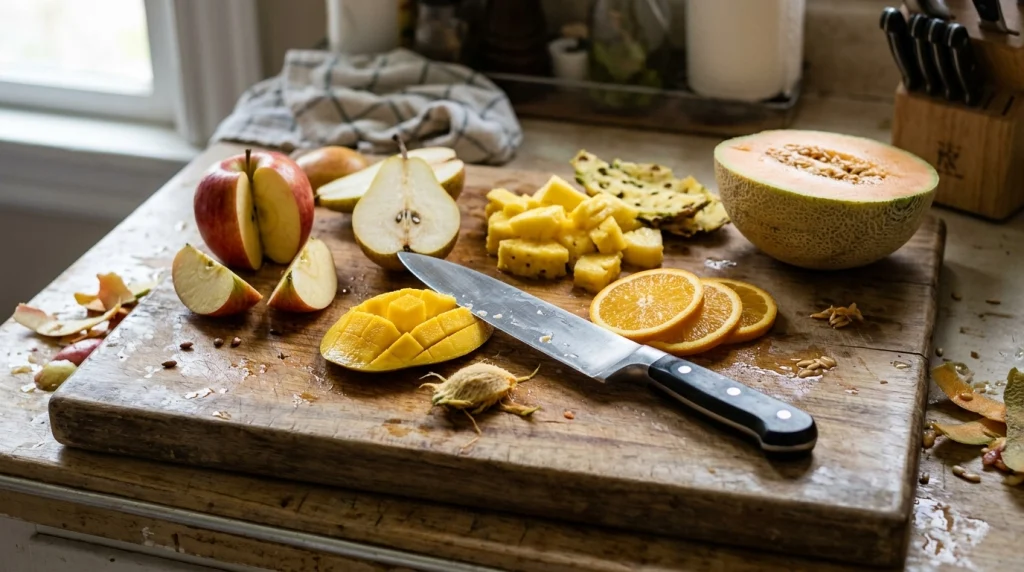
SaveA chef’s knife works best when the fruit is large enough to sit securely on a cutting board and the blade can make a clean downward or slicing cut. The University of Nebraska–Lincoln Extension describes the chef’s knife as a general tool for slicing, chopping, and preparing fresh fruits and vegetables, which fits the way most home cooks use it.
| Fruit | Chef’s knife suitability | Best use |
|---|---|---|
| Apple or pear | Very good | Halves, wedges, slices, dice |
| Mango | Very good | Removing cheeks and making large cuts |
| Pineapple | Excellent | Removing crown, skin, quarters, chunks |
| Melon or watermelon | Excellent | Halving, rind removal, slices, cubes |
| Orange or grapefruit | Good | Halves, rounds, removing top and bottom |
| Strawberry or small kiwi | Usable, but oversized | Simple slicing on a board |
The pattern is simple: the larger the fruit and the more cutting-board work involved, the more useful a chef’s knife becomes. A long blade can cross a melon or pineapple in one controlled path instead of forcing you to saw through it with a knife that is too short.
When Is a Chef’s Knife Not the Best Choice?
A chef’s knife can perform many fruit tasks, but “can” does not always mean “most convenient.” A paring knife gives better control when the job happens close to your fingers or requires a small pointed tip. That includes hulling strawberries, removing small blemishes, peeling by hand, coring small fruit, and making decorative cuts.
A serrated knife may also be easier on fruit with a delicate interior and a skin that resists a straight blade. Very ripe peaches, plums, and tomatoes are common examples. If a straight-edged chef’s knife is extremely sharp, it can still work well, but a serrated edge can grip the surface with less downward pressure.
If you are deciding which basic knives deserve space in your kitchen, CookingFlavour’s guide to the three most useful knife types in a typical set explains how chef, paring, and serrated knives cover different jobs instead of competing for the same one.
Key Insight
Choose the knife by the cut, not just by the ingredient. A chef’s knife may be ideal for quartering an apple, while a paring knife is more convenient for removing the core or peeling a thin strip of skin.
How to Cut Fruit Safely With a Chef’s Knife
Fruit can be round, wet, and slippery, so stability matters as much as sharpness. The safest setup is a clean, stable cutting board with enough room to keep the fruit and your guiding hand under control. NC State Extension recommends a sturdy, non-slip board, a controlled grip, and smooth cutting motions when using a chef’s knife.
- Wash the fruit before cutting. The U.S. Food and Drug Administration’s produce-safety guidance advises rinsing fresh produce under running water before peeling or cutting so dirt and bacteria on the outside are less likely to be transferred inward by the knife.
- Dry the fruit when practical. Removing surface water improves grip, especially on apples, mangoes, melons, and citrus.
- Create a flat side. If the fruit rolls, cut off a small end or halve it, then place the flat surface on the board. This gives you a more stable cutting position.
- Use a secure grip. Hold the knife close to the blade for control and curl the fingertips of your guiding hand away from the edge. If you want to practice this technique on a familiar ingredient, the site’s guide to proper chef-knife grip and controlled dicing demonstrates the same basic hand positions.
- Let the edge cut instead of forcing it. Use a smooth downward, forward, or rocking motion depending on the fruit. If you have to press unusually hard, the edge may be dull or the knife may be poorly matched to the task.
Warning
Do not hold a large fruit in your hand while trying to make full chef-knife cuts. Put it on a stable cutting board, create a flat base when needed, and keep the blade path away from your fingers.
Sharpness Matters More Than Fruit-Specific Branding
You do not need a knife marketed specifically as a “fruit knife” for ordinary fruit prep. A well-maintained chef’s knife can make cleaner cuts with less pressure than a dull specialty knife. That is particularly noticeable with apples, pears, mangoes, and ripe fruit, where a dull edge tends to crush, skid, or tear before it slices.
If your chef’s knife drags through fruit skin, slips sideways, or requires force, check the edge before assuming the knife style is wrong. CookingFlavour’s guide to cleaning, sharpening, and maintaining kitchen knives covers the maintenance steps that keep a general-purpose knife useful.
Also use a cutting surface that is friendly to the edge. Hard plates, glass, stone, and ceramic surfaces can dull a knife much faster than a normal cutting board. After cutting juicy or acidic fruit, wash the blade, rinse it, and dry it rather than leaving residue on the knife.
Chef’s Knife vs. Paring Knife for Fruit
 Save
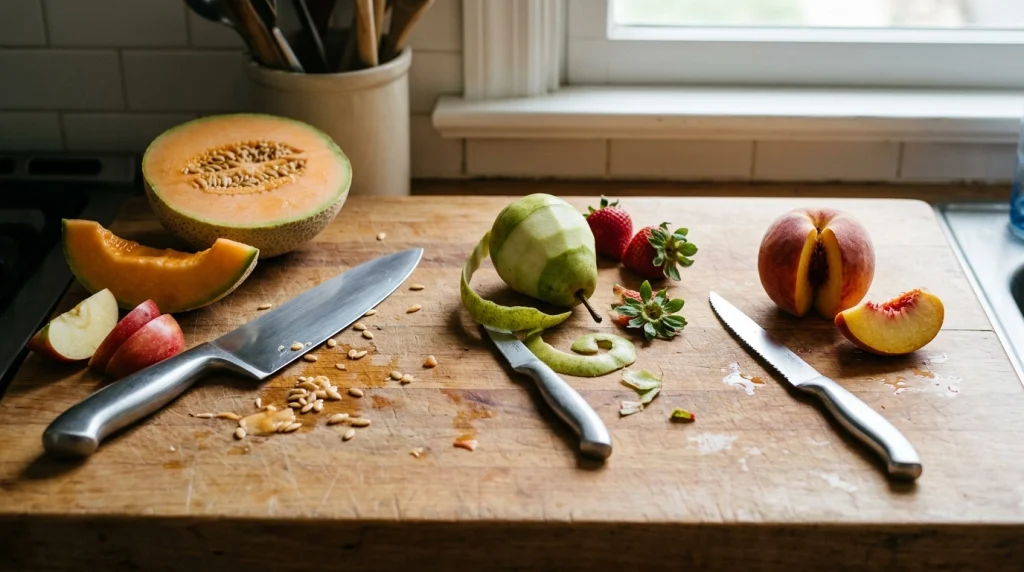
SaveThe easiest way to choose between the two is to ask where the work happens and how much precision it needs.
- Use a chef’s knife for board-based slicing, chopping, dicing, halving, quartering, and breaking down large fruit.
- Use a paring knife for peeling, hulling, trimming, coring small fruit, and other detailed cuts where a short blade gives better control.
- Use a serrated knife when a soft fruit has a skin that is difficult to start cleanly with your straight-edged knife.
There is no need to switch knives just because a recipe says “fruit.” If an 8-inch chef’s knife feels comfortable and the fruit sits securely on the board, it can handle most of the actual cutting. The smaller knife becomes valuable when the task changes from broad cutting to detail work.
After prep, clean and store the blade safely. If you are reorganizing your knife setup, the guide to safe kitchen-knife storage methods covers blocks, magnetic strips, and in-drawer options that keep edges protected.
Related Product
Paring Knife for Fruit Prep
A small paring knife complements a chef’s knife for peeling, hulling strawberries, trimming blemishes, and other precise fruit-prep tasks.
As an Amazon Associate, we earn from qualifying purchases.
Frequently Asked Questions
Can you use a chef’s knife to cut watermelon?
Yes. A sharp chef’s knife is one of the most practical tools for watermelon because the long blade can handle large cuts on a board. Stabilize the melon first and avoid trying to force a short blade through the rind.
Can you peel fruit with a chef’s knife?
You can remove thick peel from large fruit such as pineapple or melon with a chef’s knife, but a paring knife or peeler is usually better for thin, controlled peeling on apples, pears, or small fruit.
Is a chef’s knife too big for strawberries?
It is larger than necessary. You can slice strawberries on a board with a chef’s knife, but a paring knife gives better control for hulling and removing only a small amount around the leafy top.
Should you use a serrated knife for peaches?
A serrated knife can be useful for a very ripe peach because the teeth can start through the skin with little pressure. A very sharp straight-edged chef’s or paring knife can also work if it cuts cleanly without crushing the flesh.
Can you cut fruit on a plate instead of a cutting board?
It is better to use a proper cutting board. Plates, especially ceramic or glass, are hard on knife edges and may offer less stable working space than a board designed for cutting.
Do you need a separate knife only for fruit?
No. Most home cooks can handle fruit with a sharp chef’s knife plus a small paring knife, with a serrated knife useful for certain soft-skinned fruits. A dedicated fruit-only knife is optional rather than necessary.
Conclusion
A chef’s knife is a strong choice for cutting fruit as long as it is sharp, comfortable to control, and used on a stable cutting board. It is especially useful for apples, pears, mangoes, pineapple, melons, and watermelon, where blade length makes broad cuts easier. Keep a paring knife for small precision jobs and consider a serrated blade for especially soft or slippery-skinned fruit. The most useful setup is not a special knife for every fruit; it is a few well-maintained knives matched to the size of the ingredient and the precision of the cut.

