Chef Knife Rivets: Purpose, Types, and Care Guide
Quick Answer
Chef knife rivets are metal fasteners that help attach the handle to the knife’s tang, the portion of the blade extending into the handle. On many Western-style knives, they hold two handle scales in place. Good rivets sit flush, feel smooth, and show no movement. A loose rivet or shifting handle needs attention before the knife is used again.
The small metal circles on a chef knife handle are easy to overlook. Yet they are part of the connection between your hand and the blade. Their condition can tell you whether the handle remains securely assembled.
Not every chef knife uses rivets, and not every round metal fitting is technically a rivet. Knowing the differences helps you inspect a knife, care for it correctly, and recognize when a damaged handle needs repair.
What Are Chef Knife Rivets?
 Save
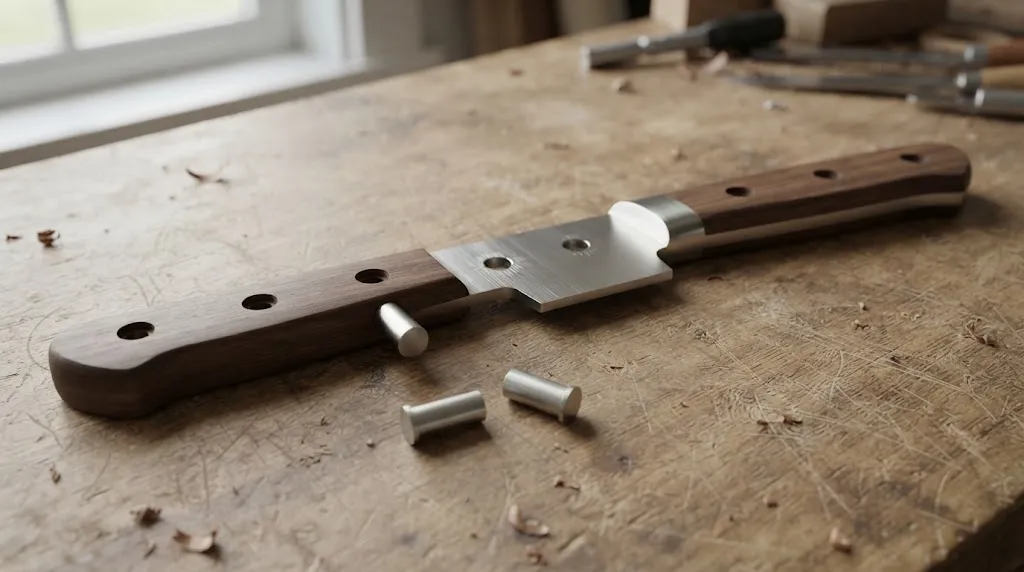
SaveChef knife rivets are mechanical fasteners used to secure a knife handle. They commonly appear as two or three smooth metal circles on the sides of a traditional Western-style chef knife.
To understand them, picture three layers: a handle scale on one side, the steel tang in the middle, and another scale on the opposite side. A fastener passes through aligned holes to help keep those parts together.
The tang is the extension of the blade that enters the handle. The scales are the pieces of wood, synthetic material, or composite that form the grip. Rivets or other fasteners connect these components. Adhesive may also help bond the scales to the tang.
The visible circles are usually smooth and flush with the handle surface. Raised edges, gaps, or movement are not normal features of a well-finished handle.
What Do Rivets Actually Do on a Chef Knife?
Rivets help keep the handle attached and aligned as you grip, lift, and cut with the knife. They provide a mechanical connection between the handle material and the underlying steel.
They resist handle movement
Fasteners passing through the handle and tang help resist sliding or shifting between the parts. Some designs also press the scales toward the tang, reducing the chance that the handle will lift away from the steel.
How much clamping they provide depends on the fastener design. A peened rivet or threaded fastener works differently from a straight decorative pin held largely by adhesive.
They support a consistent grip
A firmly assembled handle lets you hold the knife without feeling the scales shift. That matters during controlled kitchen tasks such as chopping onions, slicing meat, and mincing herbs.
Rivets themselves do not make the blade sharper or determine cutting quality. Their contribution is to the handle assembly, not the cutting edge.
They can be part of the knife’s design
Polished stainless-steel or brass-colored fittings can also be decorative. Still, appearance alone does not establish how well a handle is attached. The underlying construction matters more than the number of shiny dots you can see.
Rivets, Pins, and Bolts: What Is the Difference?
People often call every round handle fastener a rivet. Knife makers use several attachment systems, however, and their mechanical behavior differs.
| Fastener | How it works | What to know |
|---|---|---|
| Peened rivet | Metal ends are expanded or formed to retain the handle parts. | Provides mechanical retention when properly fitted. |
| Straight pin | A metal rod passes through the scales and tang, commonly with adhesive. | Resists sideways movement but may provide little direct clamping. |
| Corby-style bolt | Threaded halves draw the scales together. | Can look like a solid rivet once finished flush. |
The practical lesson is simple: you cannot reliably identify a fastener’s internal construction by its polished surface alone. The maker’s specifications or a qualified repairer may be needed to identify it.
Knife-making supplier Jantz Supply’s Corby rivet description explains that these screw-together fittings are tightened and then finished to suit the handle. They illustrate why a fitting that looks like a rivet may actually use threads.
Do All Chef Knives Have Rivets?
No. Traditional Western knives often use visibly riveted, full-tang handles, but many other construction methods are legitimate.
Some Japanese-style knives use a narrow or hidden tang inserted into a one-piece wooden handle. Others have molded synthetic handles around the tang. These designs may have no visible rivets at all.
A rivet-free handle is not automatically weak. Its durability depends on how the tang, handle material, and attachment method work together.
Likewise, three visible rivets do not guarantee exceptional quality. Inspect the fit between components rather than using rivet count as a shortcut for judging a knife.
How Can You Tell Whether Chef Knife Rivets Are in Good Condition?
A visual and gentle handling check can reveal obvious signs of trouble. You do not need to disassemble the knife.
- Clean and dry the knife. Make sure residue is not hiding the edges of the fittings.
- Look at each rivet. Check for cracks, lifted edges, unusual discoloration, or missing pieces.
- Inspect the handle seams. Look where the handle scales meet the tang and around the bolster, if present.
- Check for movement gently. With the knife safely stationary and its edge protected, see whether the handle appears to shift during ordinary light handling. Never twist or flex the blade to test it.
- Notice the grip. A protruding rivet, sharp edge, or open seam can make the handle uncomfortable and difficult to clean.
A slightly different rivet color is not by itself proof of failure. Changes in the handle material, corrosion, or a widening gap are more important when they accompany movement or damage.
Warning
Stop using a chef knife if the handle shifts, a fastener is missing, the scales are separating, or a rivet has developed a sharp raised edge. A compromised grip can make the blade harder to control.
Why Do Chef Knife Rivets Become Loose?
A loose-looking rivet is sometimes the result of changes elsewhere in the handle, not simply a defective metal fastener.
Handle material expands or shrinks
Wood responds to changes in moisture and temperature. Over time, movement around a rigid metal fitting may expose a small edge or create a gap. Repeated wetting and drying can make the problem worse.
The adhesive or joint deteriorates
Where adhesive contributes to the assembly, a failing bond can let scales separate even if the pins remain in place. The visible fastener may appear secure while the surrounding handle moves.
Impact or long-term wear damages the assembly
Dropping a knife or repeatedly subjecting it to heavy forces can damage handle material, fasteners, or the bond between them. Corrosion at exposed metal joints can also contribute to deterioration.
These causes cannot always be distinguished by sight. Treat visible movement as a reason for inspection, not as permission to try forceful home repairs.
Can You Tighten or Replace a Loose Knife Rivet?
Sometimes a damaged handle assembly can be repaired, but a flush, permanent rivet is not like a household screw that you can simply turn tighter.
Peened fittings may require specialized tools to reform or replace. Straight pins may be bonded in place. Finished Corby-style bolts generally are not intended to be routinely unscrewed after their heads are ground flush.
The correct repair may involve removing the scales, fitting new fasteners, rebuilding the adhesive joint, or replacing the handle entirely. The choice depends on the original construction and the extent of the damage.
Avoid hammering a loose rivet while the knife is assembled. Striking it without proper support can crack the scales, damage the tang area, or create a protruding edge. Household glue applied to the outside of a loose seam is not a dependable substitute for rebuilding a failed joint.
For a valuable or otherwise serviceable knife, contact the manufacturer or a professional knife maker who handles re-scaling and handle repairs. For a heavily damaged inexpensive knife, replacing the knife may be more sensible than repairing it.
How to Care for Riveted Chef Knife Handles
 Save
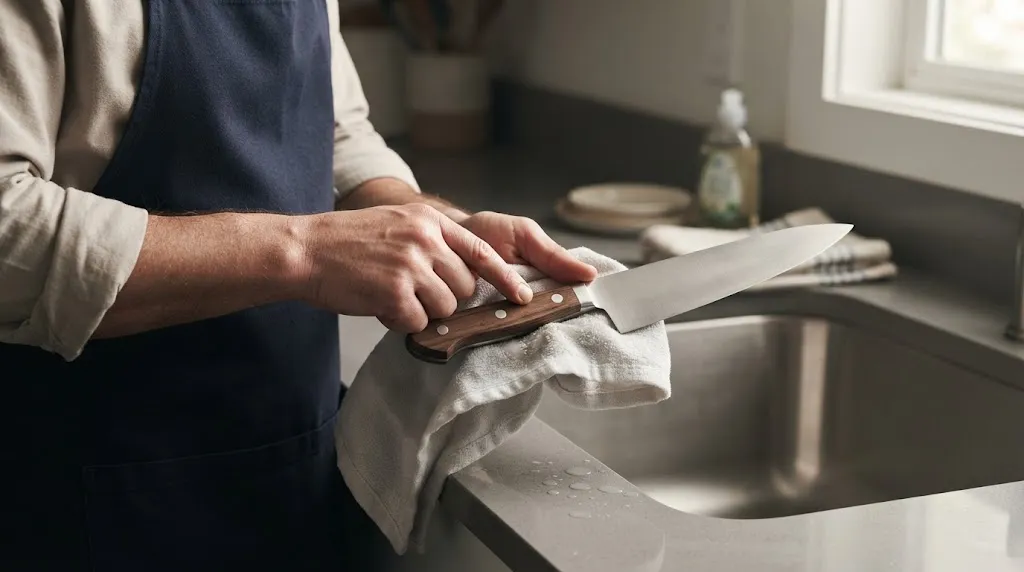
SaveGood care focuses on the whole handle rather than polishing the rivets alone. The goal is to keep moisture, impact, and excessive heat from stressing the assembled materials.
- Hand-wash after use. Use mild dish soap and warm water, while keeping your fingers away from the cutting edge.
- Dry promptly. Pay attention to the area where the metal fittings meet the handle.
- Do not soak the knife. Prolonged contact with water can affect some handle materials and joints.
- Avoid the dishwasher. Heat, moisture, detergent, and contact with other utensils may damage the knife or handle finish.
- Store it securely. Use a sheath, guarded drawer compartment, or appropriate knife block so it does not strike other utensils.
- Inspect periodically. Look for a widening gap, movement, or a fastener that no longer sits comfortably flush.
The manufacturer’s own care instructions should take priority for a particular knife. For example, WÜSTHOF’s knife-cleaning guidance recommends hand-washing, immediate drying, and avoiding dishwashers or sink soaking.
Tip
After drying, run a visual check along the handle-to-tang seam. Catching a developing gap early can help you arrange a repair before the handle becomes noticeably unstable.
What Matters More Than the Number of Rivets?
Good handle construction comes from several details working together. Rivet count is only one visible characteristic.
Fit: Scales should meet the tang neatly, without open seams or uneven gaps. Finish: Fasteners should feel smooth rather than cutting into the palm. Material stability: The handle should remain intact with normal care. Assembly quality: The fasteners and any adhesive should keep the scales secure under ordinary kitchen use.
Balance and grip shape matter too. A beautifully riveted handle can still feel awkward for your hand, while a well-made rivet-free handle may provide comfortable, reliable control.
If you are evaluating an existing knife, inspect its real condition rather than assuming that more metal circles mean a stronger handle.
Related Product
Soft Kitchen Knife Cleaning Cloths
A soft, absorbent cloth helps you dry the handle and the area around rivets after hand-washing, without using abrasive pads.
As an Amazon Associate, we earn from qualifying purchases.
Frequently Asked Questions
Are brass rivets better than stainless-steel rivets?
Not automatically. Both materials can be suitable in a properly designed handle. Stainless steel is commonly chosen for corrosion resistance, while brass offers a distinctive appearance. Construction and fit matter more than appearance alone.
Why does my knife rivet look raised after years of use?
The surrounding handle material may have changed shape or worn down, leaving the metal more exposed. Have it checked if the edge catches your hand, the handle is cracked, or the scales move.
Can dirt collect around knife rivets?
Yes, especially if a gap develops at the junction between the fastener and the handle. Wash and dry the area carefully. An open seam that cannot be cleaned properly deserves professional assessment.
Do rivets run all the way through the knife handle?
In traditional scale-handled construction, fasteners usually pass through the handle scales and a hole in the tang. The exact arrangement depends on whether the knife uses pins, rivets, or a threaded fastening system.
Can I replace a broken rivet without replacing the handle?
It may be possible if the surrounding scales and tang are sound. Some assemblies require partial or complete handle removal, however, so a repairer must evaluate the construction before promising a simple replacement.
Are decorative mosaic pins as secure as rivets?
Mosaic pins often act like straight pins used with adhesive. They can be suitable for a correctly built handle, but their decorative appearance does not prove they provide the same clamping action as a peened rivet or threaded fastener.
Final Thoughts
Chef knife rivets are small parts of a larger handle assembly. They help connect the grip to the tang, but their effectiveness depends on the fastener type, surrounding materials, and workmanship. Keep the handle clean and dry, inspect it for gaps or movement, and stop using the knife if the connection becomes unstable.

