Chef Knife Choil: Meaning, Purpose & Sharpening
Quick Answer
A chef knife choil is the small unsharpened recess or curved transition at the back of the blade, where the cutting edge ends near the handle. It can give a sharpening stone clearance at the heel and, depending on the shape, make a pinch grip more comfortable. Not every chef knife has a distinct notch.
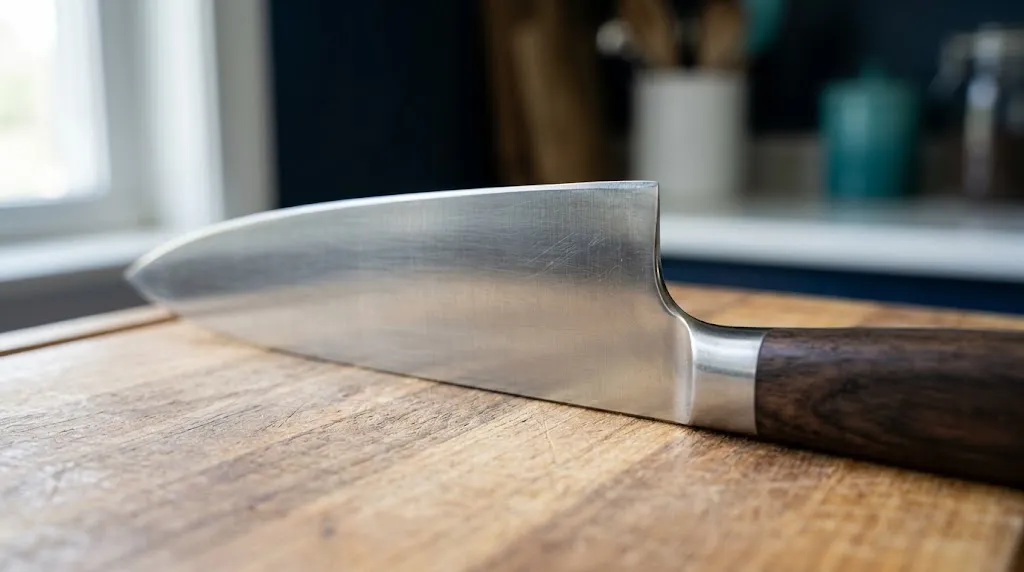
Look closely at the underside of a chef knife where its blade meets the handle. On some knives, the sharp edge ends beside a tiny half-moon cutout. On others, the metal simply curves upward toward the handle. That area is commonly called the choil.
Where Is the Choil on a Chef Knife?
 Save
SaveThe choil sits at the rear underside of the blade, immediately behind or beside the heel of the sharpened edge. It is close to the handle, not at the pointed tip or along the top spine.
To find it, place the knife flat on a stable surface with the edge facing away from you and examine its outline without touching the edge. Follow the lower blade profile backward from the tip toward the handle. Where the sharp cutting line stops, look for a small recess, notch, or rounded transition.
Some Japanese-style chef knives have an exposed, curved rear blade corner with no obvious semicircular cutout. Some Western designs end at a substantial bolster. Both can have a heel-to-handle transition even if there is no separate, visible sharpening notch.
For orientation, the belly of a chef knife describes the curve along the usable cutting edge farther forward. The choil is at the rear boundary of that edge.
What Does a Chef Knife Choil Actually Do?
Its two most relevant roles are providing clearance near the heel and affecting comfort at the blade-to-handle junction. How much either role matters depends on the actual design.
It can help you sharpen the edge all the way back
A small sharpening choil creates a gap between the sharpened edge and nearby thicker steel. That gap can let a whetstone or another sharpening surface approach the heel without striking the shoulder of the unsharpened blade or bolster.
This is a clearance benefit, not a guarantee of sharpness. A knife with a choil can still be sharpened unevenly, and a knife without a notch can still be maintained well when its heel is accessible.
The knife-industry explanation in BLADE Magazine’s discussion of choil terminology emphasizes the recess as a feature that helps the full length of the edge be sharpened.
It can change how the knife feels in a pinch grip
Many cooks use a pinch grip: thumb and index finger hold the blade just ahead of the handle, while the remaining fingers wrap around the handle. In this position, the side and underside of the rear blade can touch the index finger.
A rounded, smoothly finished choil area usually feels less abrasive than one with abrupt, rough corners. However, a tiny sharpening notch is not automatically a finger rest, and you should never place a fingertip inside a recess unless its dimensions and surrounding edge make that position clearly safe.
Sharpening Choil vs. Finger Choil: What Is the Difference?
These names refer to different jobs. A sharpening choil is a small relief cut at the end of the cutting edge. A finger choil is a larger recess designed to accommodate a finger in certain knife grips.
| Feature | Sharpening choil | Finger choil |
|---|---|---|
| Typical size | Small notch | Larger curved recess |
| Main purpose | Sharpening clearance | Finger positioning |
| Common relevance to chef knives | May help at the heel | Less common as a pronounced cutout |
| Safe to place a finger inside? | No, not by design | Only when designed and used for that purpose |
Large finger choils are more familiar on certain outdoor and utility knives. A chef knife more often relies on blade height, a comfortable rear edge, and a standard pinch grip rather than a large finger-shaped opening.
Choil, Heel, Bolster, and Ricasso: Easy Ways to Tell Them Apart
All four terms concern the rear blade area, but they do not name the same feature.
- Choil: A recess or transition where the sharpened edge ends.
- Heel: The rear portion of the actual cutting edge, nearest the handle.
- Bolster: A thicker junction of steel between the blade and handle on some knives.
- Ricasso: An unsharpened, relatively flat blade section between the main grind and handle or guard, more commonly identified on other knife types.
Imagine cutting a firm carrot close to the handle. If the food meets a sharp section, that is the heel of the edge. The little relief behind the heel is the choil. If thicker metal extends downward beside it, that may be part of the bolster.
This distinction matters during sharpening. You want to work on the edge at the heel rather than accidentally grinding the bolster or rounded junction. The site’s guide to chef knife tip uses also explains how the rear blade, belly, and tip serve different cutting jobs.
Do All Chef Knives Have a Choil?
No. Every chef knife has a point where its sharpened edge ends, but not every design has a clearly cut-out sharpening choil. Sometimes the transition is a smooth curve; sometimes the edge approaches a bolster or another unsharpened section without a noticeable notch.
A missing notch is not automatically a design flaw. What matters is whether you can sharpen the usable edge properly and hold the knife comfortably. On many bolsterless knives, the heel remains easy to access even without a separate circular relief.
Likewise, a prominent choil does not automatically mean the knife is higher quality. A badly finished notch can collect residue, snag material, or introduce a rough pressure point against the hand.
Key Insight
Judge the choil by its finish and the access it gives to the heel, not by whether a large notch is visible.
How Does the Choil Affect Sharpening?
Sharpening requires the abrasive to reach the edge consistently from the tip to the heel. At the very back, the stone may run into thick, unsharpened metal if the transition is crowded. A small choil can leave extra room for that movement.
Before sharpening, look at the last few millimeters of the edge. Ask whether that portion can meet the stone while you maintain your intended sharpening angle. If a full bolster extends below or level with the worn edge, the stone may not contact the heel evenly.
A cutout does not fix a bolster that has become too tall relative to the edge. Nor should you deliberately drag an abrasive sideways into the finger-contact area to make an existing notch larger.
A simple check before sharpening
- Clean and dry the knife so its outline is easy to see.
- Set it down securely and identify the heel, the end of the edge, and any nearby bolster.
- Check visually for a recess and whether the heel is accessible from the side.
- During normal sharpening, use controlled strokes and avoid striking the handle or bolster.
- Afterward, inspect the heel for a remaining blunt section rather than assuming the notch has solved everything.
If the heel remains blunt because the bolster obstructs the stone, a qualified knife-sharpening service can assess the blade geometry. Removing bolster steel or cutting a new choil changes the knife permanently and is not an ideal first project for a beginner.
Can a Sharp or Rough Choil Make a Knife Uncomfortable?
Yes. Although the cutting edge is intentionally sharp, the rear blade surfaces that touch your hand should not have burrs or harsh corners. A poorly finished transition may rub the side of an index finger during a pinch grip.
Check the grip with the knife still and away from food. Keep fingers clear of the cutting edge. Notice whether the rear blade corner presses into a finger even before you begin chopping. A comfortable grip should feel stable without requiring you to squeeze hard.
If the area is visibly chipped, cracked, or burred, stop using the knife until it can be inspected. For a merely rough finish, an experienced sharpener may be able to smooth the non-cutting contact surfaces without disturbing the edge.
Knife safety also depends on how you move the blade. For instance, when mincing garlic with a chef knife, an intentional grip and controlled rocking motion matter far more than the appearance of a small notch.
Should You Add a Choil to a Chef Knife?
Usually, there is no need. Do not cut a notch just because another knife has one. First identify an actual problem, such as a heel that cannot be sharpened cleanly because nearby steel blocks the stone.
Creating a new choil removes hardened blade material. Poor placement can reduce useful edge length, leave a weak or sharp corner, and create a place where food collects. Heat from unsuitable grinding can also damage the blade’s heat treatment near the worked area.
If your chef knife sharpens all the way to the heel and feels comfortable, leave the factory geometry alone. If it does not, discuss the specific obstruction with a professional sharpener or the manufacturer rather than modifying the blade by trial and error.
Warning
Do not use a rotary tool or file to carve a choil into a finished chef knife without appropriate training and equipment. The blade can slip, overheat, or develop an unsafe edge transition.
How to Keep the Choil Area Clean and Safe
 Save
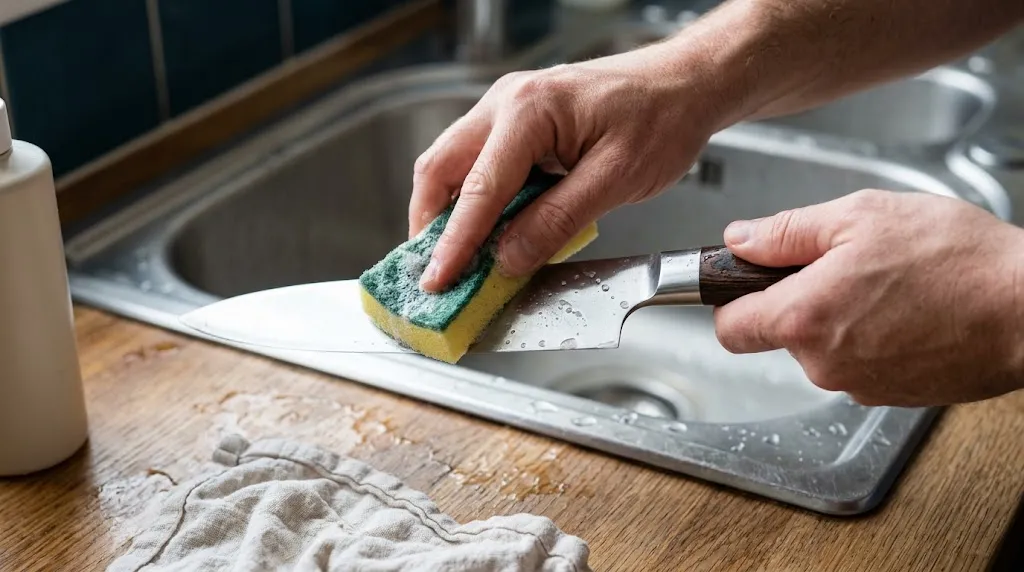
SaveBecause the choil sits near the junction of blade and handle, small particles and moisture can remain in that corner after food preparation. The remedy is ordinary careful knife cleaning, not aggressive scraping or special chemicals.
- Wash the knife by hand with mild dish soap and water, following its maker’s care instructions.
- Use a soft sponge or cloth to clean around the notch while keeping your fingers away from the cutting edge.
- Rinse away any food residue, especially around a deep recess or bolster.
- Dry the entire blade and the handle junction promptly before storage.
Avoid probing the notch with bare fingertips to check for leftover debris. You can inspect the area visually under good light instead. If the knife develops persistent rust, pitting, or a rough chip at the junction, handle it as a blade-maintenance issue rather than simply polishing harder.
Frequently Asked Questions
Is the choil supposed to be sharp?
The choil itself is generally an unsharpened transition. Its adjacent cutting edge will be sharp, but finger-contact surfaces should not have rough burrs or dangerous corners.
Can a chef knife have a choil without a visible notch?
Yes. In culinary-knife discussions, the term can describe a rounded rear transition. Other definitions reserve choil for an actual recess, so terminology varies.
Does a choil make food cutting easier?
Not directly. Edge geometry, blade shape, sharpness, and technique have a greater effect on cutting. A well-finished choil may improve comfort or maintenance access.
Can food get stuck inside a sharpening choil?
Small scraps can collect in a deeper notch. Normal handwashing and careful drying should clear them without requiring you to touch the cutting edge.
Is the choil the same as a finger guard?
No. A finger guard is a feature intended to discourage the hand from slipping toward the edge. A choil primarily identifies a recess or transition at the end of the sharpened blade.
Does a larger choil mean a better chef knife?
No. A larger cutout may sacrifice usable edge length and is unnecessary on many chef knives. Sharpening access, safe finishing, and grip comfort are more useful measures.
Final Thoughts
The chef knife choil is a small part of the heel-to-handle transition, but understanding it can prevent confusion about sharpening and grip comfort. Look for a clean, smoothly finished transition and a heel that remains accessible to your sharpening method. A distinct notch can be useful, but it is not a requirement for a good kitchen knife.

