What Is the Heel of a Chef Knife Used For?
Quick Answer
The heel of a chef knife is the rear section of the sharpened blade, located closest to the handle. It is mainly used for controlled, forceful cuts through firm ingredients such as carrots, potatoes, and root vegetables. Because this part of the blade sits near your gripping hand, it offers better leverage for demanding cuts than the knife’s tip.
Where Is the Heel on a Chef Knife?
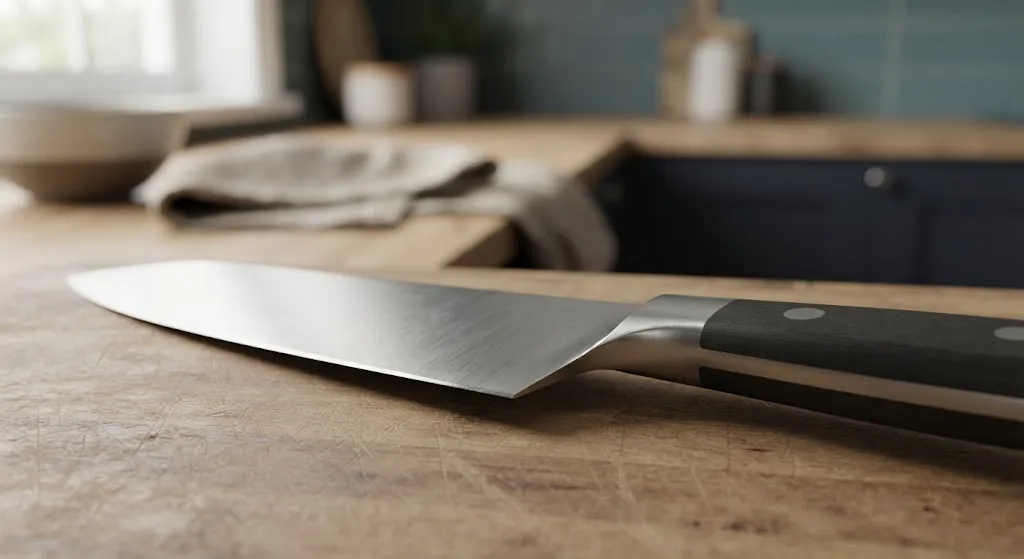
The heel is the back portion of the cutting edge, directly in front of the knife’s handle. On many Western-style chef knives, it is the deepest section of the blade, providing room for your knuckles above the cutting board.
To locate it, place a clean chef knife flat on a stable surface with the cutting edge facing away from you. Follow the sharpened edge backward from the pointed tip toward the handle. The section nearest the handle is the heel.
The heel is sometimes confused with the bolster, but these are different parts. The heel is part of the cutting edge, while the bolster is a thickened junction between blade and handle on knives that have one.
Not every chef knife has the same heel shape. Some have a pronounced rear corner and tall blade, while others have a more rounded transition or a thinner profile. These variations affect cutting clearance, edge maintenance, and how comfortably the knife handles particular ingredients.
What Is the Heel of a Chef Knife Used For?
 Save
SaveThe heel is especially useful when the ingredient requires more pressure than a delicate slicing motion can provide. Its position near your hand makes it easier to guide the blade downward while maintaining control.
1. Cutting Firm Vegetables
Firm vegetables are among the most practical uses for the heel. Thick carrots, potatoes, turnips, and similar ingredients often require a deliberate, stable cutting motion.
Rather than beginning with the delicate tip, position an appropriate section of the rear cutting edge against the ingredient. Apply steady downward-and-forward pressure while keeping the food stable.
The heel can reduce the effort needed to initiate a cut, but it does not compensate for a dull blade. If a vegetable feels unusually difficult to cut, check the knife’s sharpness and the ingredient’s stability before increasing pressure.
2. Chopping Ingredients Into Smaller Pieces
The heel can help with preliminary chopping when preparing ingredients for soups, stews, or other recipes.
For example, a large potato may first need to be divided into manageable sections. Once those sections have stable, flat surfaces, the middle of the blade can be used for smaller and more uniform cuts.
This illustrates an important distinction: the heel is useful for stronger initial cuts, but it does not need to perform every stage of food preparation.
3. Starting Controlled Cuts Through Thick Ingredients
Some ingredients are too large or dense to cut comfortably with the front section of a chef knife alone.
The heel can provide a controlled starting point, particularly when a firm vegetable has already been trimmed to create a stable surface.
Use a smooth cutting movement instead of striking the ingredient. Very hard squash, bones, frozen food, and other exceptionally resistant materials may require a different cutting tool or preparation method.
4. Supporting Rocking Cuts
On a curved Western-style chef knife, the heel works with the blade’s belly during a rocking chopping motion.
The front portion of the blade can remain near the cutting board as the handle rises and falls. During the downward portion of the movement, the rear edge completes the cut.
This is useful when chopping vegetables or herbs into smaller pieces. The exact movement depends on the blade’s curve, however. A flatter-edged knife may work better with a push-cutting technique than an exaggerated rocking motion.
Key Insight
The heel is not a separate heavy-duty blade. It is a useful cutting zone on a chef knife, offering greater leverage because it sits closer to your hand. The knife’s overall thickness, sharpness, and construction still determine what it can safely cut.
Why Does the Heel Provide More Cutting Power?
The heel gives a mechanical advantage primarily because of its position relative to your hand and the knife’s handle.
When you grip a chef knife, the heel sits relatively close to where you control the blade. This allows you to apply downward pressure without relying as heavily on the long forward section of the knife.
The heel also tends to be located where the blade is relatively tall and well supported by its overall construction. That can make it feel stable during firmer cutting tasks.
However, more leverage does not necessarily mean a better cut. A thick blade may wedge in dense food, while a thinner sharp blade can pass through some ingredients with less resistance.
For clean results, combine the appropriate blade section with a sharp edge, stable cutting board, suitable food positioning, and a controlled slicing motion.
Virginia Tech’s basic knife skills guidance specifically identifies the heel as a useful part of the knife when greater cutting force is needed.
How to Use the Heel of a Chef Knife Safely
Using the heel effectively is less about force and more about positioning, grip, and control. These steps are suitable for ordinary firm vegetables that your chef knife is designed to cut.
- Prepare a stable cutting surface. Place a cutting board on a level countertop. If it slides, secure it with a suitable nonslip mat.
- Stabilize the ingredient. Trim a small section if necessary to create a flat base. Avoid trying to control a rolling vegetable with excessive hand pressure.
- Hold the knife securely. A pinch grip, with the thumb and index finger controlling the blade just ahead of the handle, often provides good control.
- Protect your guiding hand. Curl the fingertips inward and keep them behind the cutting path. Avoid placing fingers underneath or directly in front of the heel.
- Position the rear cutting edge. Set the heel or adjacent rear section of the blade against the ingredient without twisting the knife.
- Cut smoothly. Use controlled downward pressure combined with a slight slicing motion where appropriate. Stop if the blade binds or requires excessive effort.
- Finish with the most suitable blade section. After the ingredient is divided, use the middle section for routine slicing or dicing when that offers better control.
According to the Institute of Culinary Education’s knife skills guidance, grip, body positioning, and protecting the guiding hand are fundamental parts of reliable knife technique.
Safety Warning
Never strike the spine of a chef knife with your palm, twist a stuck blade, or use the heel to chop bones or frozen ingredients unless the manufacturer explicitly approves that task. Excessive force can cause slipping, edge damage, or loss of control.
Heel vs. Middle vs. Tip: Which Part Should You Use?
Different parts of a chef knife serve different cutting needs. Understanding those differences makes it easier to choose the most controlled movement for each ingredient.
| Blade Section | Best General Use | Main Advantage |
|---|---|---|
| Heel | Firm vegetables and controlled forceful cuts | Leverage near the hand |
| Middle | Everyday slicing, chopping, and dicing | Versatile cutting contact |
| Tip | Small cuts, scoring, and precision work | Accurate positioning |
The boundaries between these sections are not rigid. During a long slicing motion, several areas of the edge may contact the food in sequence. The purpose of choosing a blade section is better control, not following an inflexible rule.
Common Mistakes When Using the Heel
Most heel-related problems come from using the wrong cutting motion or treating the rear edge as stronger than the knife’s construction allows.
- Applying excessive downward force: This increases slipping risk if the blade cannot pass through the ingredient. Reposition the food or change tools instead.
- Cutting round ingredients without stabilizing them: Potatoes and other vegetables can roll unexpectedly. Create a flat cutting surface first.
- Using the heel as a cleaver: A standard chef knife is not automatically suitable for chopping hard bones or frozen food.
- Ignoring a dull rear edge: A knife may feel sharp near the middle but struggle at the heel if that area has not been maintained properly.
- Forcing a rocking motion: Knives with flatter cutting edges may not rock comfortably. Match the movement to the blade shape.
Another common mistake is lifting the handle too high during chopping. The resulting movement can become harder to control, particularly when the ingredient is small or the guiding hand is close to the cutting edge.
Does the Heel Need Sharpening?
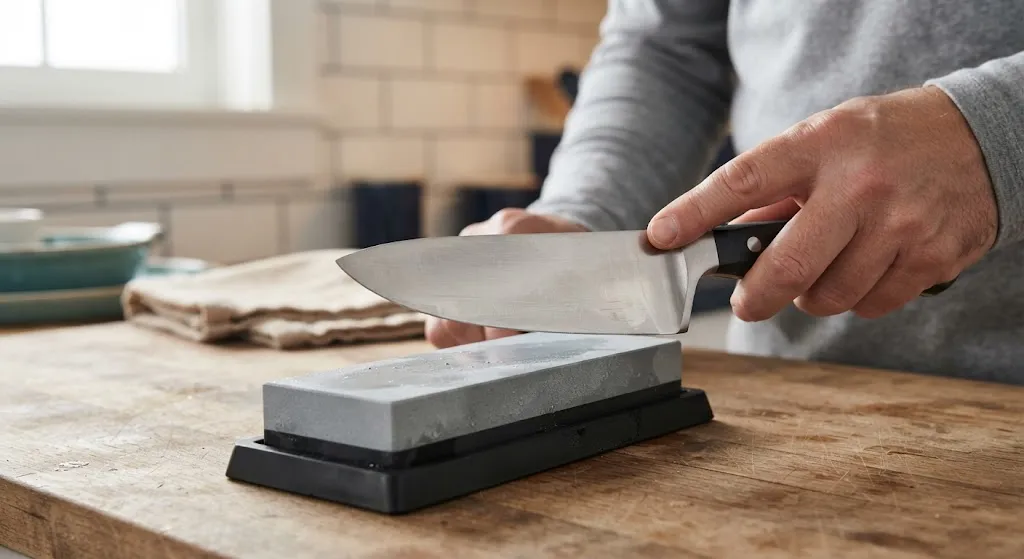
Yes. The heel is part of the cutting edge and should receive appropriate sharpening and maintenance, just like the middle and tip.
A poorly maintained heel may leave partially connected vegetable slices even when the rest of the knife appears to cut well.
Some chef knives have a full bolster extending toward the cutting edge. Depending on the design, this can make the heel more difficult to sharpen and can interfere with full cutting-board contact after repeated sharpening.
A half-bolster or bolsterless design generally makes it easier to reach the entire edge. Cleveland Clinic’s culinary medicine knife guide explains the maintenance differences between full and partial bolsters.
If your heel stops touching the board while the rest of the edge does, inspect the blade profile and bolster before assuming ordinary sharpening will solve the problem. A qualified knife sharpener may be needed to correct uneven wear.
When Should You Avoid Using the Heel?
 Save
SaveThe heel is not always the most effective cutting section. For soft tomatoes, thin herbs, delicate garnish work, and other precision tasks, the middle or front of a properly sharpened blade may provide better results.
A very large or unusually hard ingredient can also present a problem. If the blade becomes trapped, the correct response is not to force the heel farther through it.
For example, a large winter squash may need to be stabilized and divided using a safe method appropriate to its size and hardness. Some situations call for a different knife, a different preparation approach, or avoiding the cut altogether.
The practical rule is simple: use the heel when it improves control and leverage, not merely because an ingredient feels difficult.
Relevant Product
Chef Knife Sharpening Stones
A suitable sharpening stone can help maintain the cutting edge from heel to tip. Choose a stone and sharpening method compatible with your knife’s steel and edge geometry. A full bolster may still limit access to the heel.
Explore Sharpening Stones on Amazon
As an Amazon Associate, we earn from qualifying purchases.
Frequently Asked Questions
Is the heel of a chef knife sharp?
Yes. On most chef knives, the heel is part of the sharpened cutting edge. Its sharpness depends on the knife’s design, condition, and maintenance. Some knives have an unsharpened section immediately beside the handle or bolster.
Can you use the heel to cut meat?
Yes. The heel can help make controlled cuts through suitable boneless meat, especially when beginning a thicker cut. It should not be treated as a bone-cutting tool unless the knife is specifically designed for that purpose.
Is the heel the same as the bolster?
No. The heel is the rear section of the cutting edge. The bolster is a thicker section near the blade-handle junction on certain knife designs. Some chef knives have no bolster at all.
Why does my knife leave vegetables connected at the bottom?
The rear edge may be dull, the heel may not be reaching the cutting board, or a protruding bolster may be interfering with the cut. Check the blade’s condition and board contact before attempting another cut.
Do Japanese chef knives have a heel?
Yes. Japanese-style chef knives such as gyuto knives also have a rear cutting-edge section. However, blade height, thickness, edge curvature, and the presence or absence of a bolster can differ from Western designs.
Should beginners use the heel of a chef knife?
Yes, for appropriate ingredients and with safe cutting technique. Beginners should practice slowly on stable vegetables, use a secure grip, protect their fingertips, and avoid forcing the blade through resistant food.
Final Thoughts
The heel of a chef knife is designed to give you controlled cutting leverage near the handle. It is particularly useful for firm vegetables, initial chopping cuts, and certain rocking motions.
For the best results, keep the entire edge sharp, stabilize ingredients before cutting, and choose the blade section that matches the task. A well-used heel makes preparation more efficient without requiring unnecessary force.

