What Is the Tip of a Chef Knife Used For? 7 Uses
Quick Answer
The tip of a chef knife is mainly used for precision cutting, making small controlled incisions, and guiding the blade during rocking motions. It is particularly useful for finely cutting garlic, shallots, herbs, and other small ingredients. The pointed tip can also help start shallow scoring cuts or trim delicate areas. However, it is not designed for prying, twisting, or forcing through hard materials.
A chef knife does much more than chop vegetables. Different sections of its blade perform different jobs, and the narrow point at the front is especially useful when accuracy matters.
Learning how to control this part of the knife can make small cuts easier, reduce unnecessary hand movements, and help you choose a safer technique for each ingredient.
What Is the Tip of a Chef Knife?
The tip is the pointed end of a chef knife, located farthest from the handle. It is formed where the upper edge, called the spine, meets the sharpened cutting edge.
Although people sometimes use the words interchangeably, the tip and the front cutting edge are not exactly the same thing. The tip is the point itself, while the front cutting edge is the sharpened portion immediately behind it.
This distinction matters because many tasks described as “tip work” actually use both areas together.
For example, when making tiny cuts in garlic, the point helps position the blade precisely. During rocking, the front portion stays near the cutting board while the curved middle section performs much of the chopping.
The tip offers control, but it is not automatically the best cutting surface for every ingredient. Its narrow shape makes it useful for detail work rather than heavy downward cutting.
7 Practical Uses for the Tip of a Chef Knife
 Save
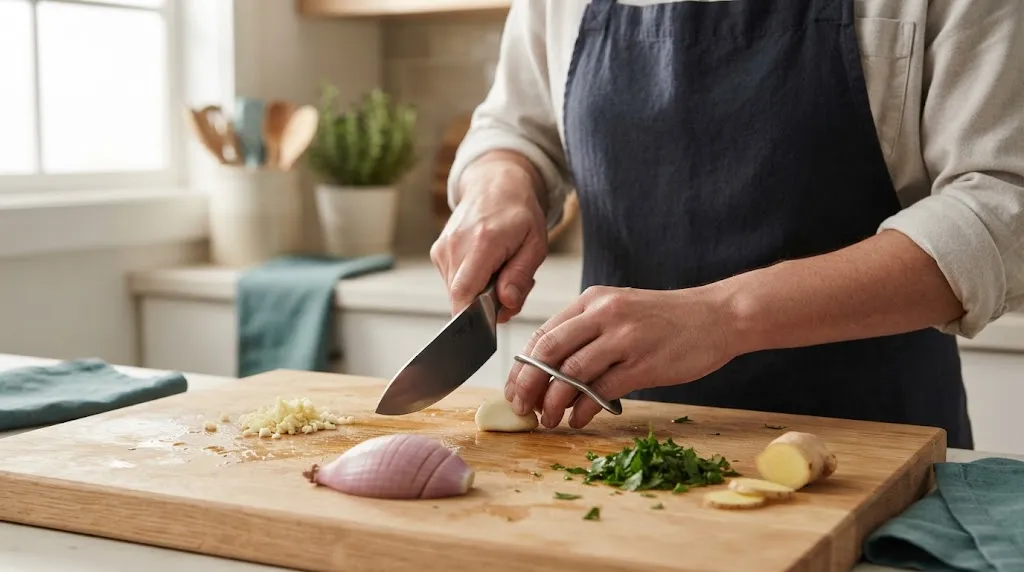
SaveThe following tasks show where the pointed front section provides a real advantage and where the rest of the blade should share the work.
1. Making Small, Precise Cuts
The tip is useful when a cut needs to begin in an exact location or follow a short, controlled path.
For example, you might use it to trim a tiny blemish from a firm vegetable or make an accurate starting cut before bringing more of the cutting edge through the ingredient.
The benefit comes from visibility and positioning. Compared with the wide heel of the knife, the point makes it easier to see where the cut begins.
Use light, controlled pressure. For intricate work on a very small ingredient, a shorter paring knife may offer better handling.
2. Cutting Garlic into Fine Pieces
Garlic is one of the most practical ingredients for learning precise knife-tip control.
After peeling a clove, place it on a stable surface and make thin slices using the front cutting edge. Smaller pieces can then be gathered together and minced with a gentle rocking motion.
The point helps position the initial cuts, while the curved blade turns larger fragments into finer pieces.
There is no need to stab or repeatedly jab the garlic. Controlled slicing produces a more predictable result.
For the full preparation method, see our guide on mincing garlic safely with a chef knife.
3. Creating Fine Cuts in Shallots and Onions
The tip can help make short, accurately positioned cuts in a halved shallot or onion.
Place the ingredient cut-side down so it cannot roll easily. Then make a series of closely spaced cuts while keeping your supporting fingertips curled away from the cutting edge.
When preparing an onion, leaving the root end intact during the initial cuts can help hold its layers together.
The knife tip can guide where each cut starts, but the front and middle cutting edge should do the slicing. Avoid forcing the point into the cutting board.
If the ingredient is too small to hold comfortably, reposition it or choose a smaller knife rather than bringing your fingers close to the point.
4. Rocking the Knife While Mincing Herbs
One of the most familiar uses of the chef knife’s front section is as a contact point during rocking cuts.
When chopping parsley, cilantro, or similar soft herbs, the point stays on or near the cutting board while the handle rises and falls. The curved portion of the blade passes repeatedly through the herbs.
This produces a smooth, controlled chopping rhythm without lifting the entire knife high above the board.
For better results, start with dry herbs, gather them into a manageable pile, and avoid chopping excessively if you want to preserve their texture.
Tip
Think of the front of the blade as a guide during rocking. Keep it near the board, raise the handle only as much as necessary, and let the curved edge make the cuts.
5. Making Shallow Scoring Cuts
The pointed end can be useful for starting shallow incisions in the surface of suitable ingredients.
For instance, light scoring can help mark the surface of a vegetable or create a deliberate pattern before cooking.
The important distinction is between a shallow slice and a forceful puncture. Use the sharp front edge to draw a controlled line instead of pushing straight down with the point.
If scoring requires substantial pressure, the material may be too hard, the knife may be unsuitable, or another tool may be safer.
For particularly delicate or detailed scoring, a small dedicated knife usually gives better control than a full-size chef knife.
6. Trimming Small Sections of Soft Food
The tip can assist with minor trimming when removing a small unwanted piece from an otherwise usable ingredient.
Examples include tidying an irregular vegetable edge or making a short cut around a soft, accessible section.
However, detailed peeling, coring, and cutting around curved surfaces often feel awkward with a large chef knife.
If the knife’s length blocks your view or forces an uncomfortable wrist position, switch to a paring knife.
A useful rule is to choose the smallest knife that comfortably handles the task without sacrificing control.
7. Guiding Controlled Slices Through Small Ingredients
The front cutting edge can help begin a clean slice through small, stable pieces of food.
For example, when cutting a small piece of ginger or a thin vegetable strip, you can position the front edge accurately before completing the cut with a smooth movement.
Here the tip helps establish the cutting path; the full edge does not need to remain vertical throughout the movement.
Do not use this technique to chase rolling or unstable ingredients. First create a flat supporting surface or use an appropriate alternative tool.
How to Use the Tip of a Chef Knife Safely
Good tip control starts with a stable cutting surface, a suitable grip, and deliberate blade movements. The goal is accuracy rather than speed.
- Secure your cutting board. Use a nonslip board or place a damp towel beneath it so it cannot slide during cutting.
- Use a pinch grip. Grip the blade near the handle between your thumb and index finger, with the remaining fingers around the handle. Keep your gripping fingers away from the sharpened edge.
- Stabilize the ingredient. Place a flat surface against the board whenever possible. Avoid working on food that rolls or shifts.
- Protect your supporting hand. Curl your fingertips inward in a claw grip and keep them behind the cutting line.
- Position the tip carefully. Let the pointed end guide the beginning of the cut instead of driving it downward with force.
- Use a small controlled movement. For fine slices, move the sharpened edge through the ingredient. For mincing, rock the blade while keeping the front near the board.
- Stop and reposition when needed. If the food moves, the tip catches, or your wrist becomes uncomfortable, pause before making another cut.
The University of Nebraska–Lincoln knife-skills guidance explains both the pinch grip and controlled rocking method used for ordinary chef-knife work.
Chef Knife Tip vs. Belly vs. Heel: Which Should You Use?
Choosing the correct section of the blade can make cutting more comfortable and predictable.
| Blade Section | Best Use | Main Advantage |
|---|---|---|
| Tip and front edge | Precise positioning, small cuts, guiding rocking motions | Accuracy |
| Belly or curved middle | Rocking, chopping, mincing, everyday slicing | Smooth cutting motion |
| Heel near the handle | Controlled cuts through larger or firmer ingredients | Leverage and stability |
These sections work together rather than acting as separate tools. In a rocking cut, for example, the tip guides the motion while the belly slices through the food.
For a broader explanation of how a chef knife handles different kitchen tasks, the guide on chopping nuts safely provides another practical example of why the heel and middle section often work better for firmer ingredients.
What Should You Never Do With the Tip of a Chef Knife?
The pointed end of a chef knife is relatively narrow and should not be treated as a multipurpose tool for applying force.
- Do not pry open containers. Twisting the tip under a lid can damage the blade and cause unexpected slipping.
- Do not use it as a screwdriver. A chef knife is built for cutting food, not turning fasteners or separating hard objects.
- Do not force it through bones. A general-purpose chef knife is not designed for heavy bone chopping.
- Do not stab unstable food. Round ingredients can move suddenly and redirect the point.
- Do not cut toward your supporting hand. Keep fingers outside the intended blade path.
- Do not work with a damaged tip. A bent, chipped, or broken point may catch or cut unpredictably.
Warning
Never twist a chef knife tip when it is lodged in hard food or another material. Stop applying pressure, stabilize the item, and use a more suitable tool. Sudden slips can cause injury.
The Virginia Tech knife safety guide also emphasizes keeping the tip on the board for rocking cuts and using the heel when greater cutting force is required.
Why Does the Shape of the Knife Tip Matter?
Not every chef knife has the same point or blade curvature. These design differences influence how naturally the knife handles precise cuts and rocking motions.
Many Western-style chef knives have a pointed end and a noticeably curved belly. This combination makes it convenient to keep the front of the knife near the board while moving the heel through ingredients.
Other kitchen knives have flatter edges or different point shapes. A flatter edge can favor certain straight-down cutting styles, while a more curved edge generally makes rocking easier.
The important question is not which tip looks sharpest. It is whether the blade shape supports the movement you are trying to make.
When practicing, observe how much of your knife’s cutting edge contacts the board and adjust your motion without forcing the blade into an unnatural angle.
Common Mistakes Beginners Make With the Knife Tip
Most problems come from applying too much pressure, choosing the wrong movement, or using a large blade for work that requires a smaller tool.
Lifting the Entire Knife Too High
For fine rocking cuts, unnecessarily raising the whole blade creates more movement than needed. Keeping the front near the board makes the motion easier to control.
Using the Point Instead of the Cutting Edge
Many small cutting tasks need the sharpened edge behind the point rather than a puncturing action. Begin the cut accurately, then let the edge move through the ingredient.
Holding Food Too Close to the Tip
Small ingredients can tempt beginners to hold food with exposed fingertips. If there is not enough room for a safe claw grip, reposition the ingredient or switch tools.
Using a Dull or Damaged Blade
A dull edge may encourage additional force, making precise work less predictable. Maintain the cutting edge properly and inspect the point for visible damage before use.
If the tip is chipped or bent, avoid detailed tip work until the knife has been assessed and repaired appropriately.
When Is a Paring Knife Better Than a Chef Knife Tip?
 Save
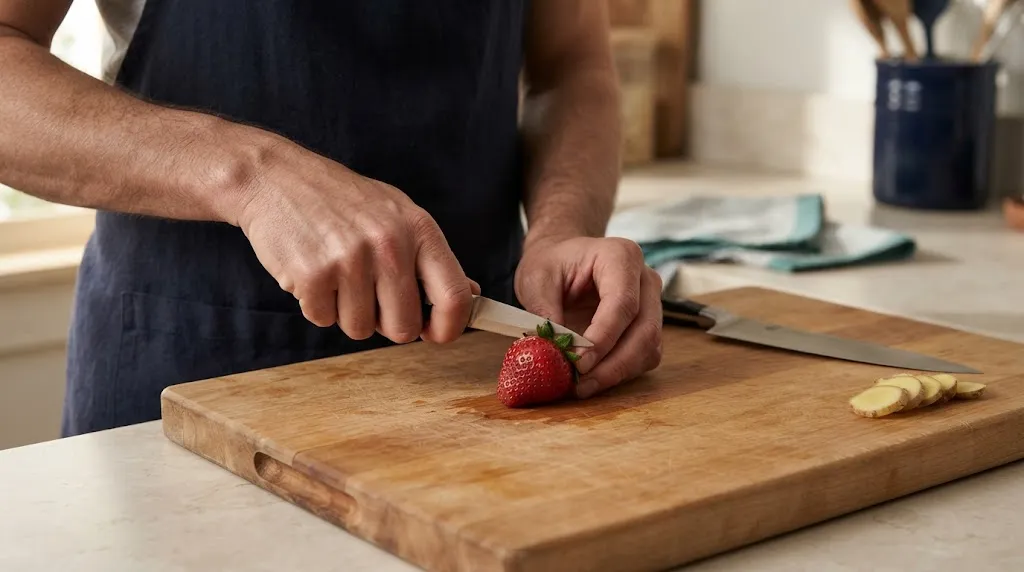
SaveA paring knife is often the better choice when working closely around very small or curved ingredients.
For example, peeling a small fruit, removing a strawberry hull, or trimming a detailed shape may be more comfortable with a short blade.
A chef knife remains useful when the ingredient can rest securely on a cutting board and the movement benefits from a longer cutting edge.
The distinction is practical: use the chef knife for board-based preparation and controlled mincing, but consider a paring knife for delicate trimming that would be awkward with a large blade.
Never perform a cut toward your palm simply because a smaller knife makes it possible. Keep the work supported and your hands outside the cutting path.
Key Insight
The tip is most valuable for positioning and guiding a cut. The rest of the sharpened edge usually completes the slicing. Understanding this difference helps prevent the mistake of using the point as a forceful cutting tool.
Related Kitchen Tool
Chef Knife for Everyday Precision Cutting
A comfortable, sharp chef knife with a curved cutting edge can support controlled chopping, mincing, and rocking techniques.
As an Amazon Associate, we earn from qualifying purchases.
Frequently Asked Questions
Is the tip of a chef knife supposed to be sharp?
Yes. On a typical pointed chef knife, the tip meets the sharpened cutting edge and should be capable of precise cutting. However, the point should not be used for prying or twisting.
Should the tip stay on the cutting board when chopping?
During a traditional rocking cut, the tip generally stays in contact with or very close to the board while the handle moves up and down. Other cutting styles may lift the blade differently.
Can you use the tip of a chef knife to peel vegetables?
The tip may help with limited trimming, but a paring knife or vegetable peeler is usually more practical for detailed peeling. Choose the tool that keeps the ingredient stable and your hands clear of the blade.
What happens if the tip of a chef knife breaks?
A broken tip can leave an irregular or sharp damaged area. Stop using the knife for detailed work, account for any missing fragment, and have the blade professionally assessed for repair or replacement.
Can you sharpen the tip of a chef knife?
Yes, the sharpened edge near the tip can be maintained as part of normal knife sharpening. However, reshaping a damaged or broken point requires additional skill and should not be confused with ordinary edge maintenance.
Is a pointed chef knife better than a rounded-tip knife?
Not for every task. A pointed chef knife offers useful precision for starting small cuts, while other tip shapes may suit different cutting styles or safety requirements. Blade geometry, sharpness, grip, and the intended task matter more than point shape alone.
Final Thoughts
The tip of a chef knife is useful for precise positioning, fine cuts, light scoring, and guiding rocking motions. It works best as part of the whole blade rather than as a separate tool for applying force.
Use the point for accuracy, the curved belly for smooth chopping, and the heel when firmer ingredients require greater leverage. Matching the blade section to the task makes everyday knife work more controlled and practical.

