5 Best Thai Chef Knife for 2026: Thin Blades Built for Thai Prep
Thai cooking asks more of a knife than most weeknight dinners do: fibrous lemongrass, woody galangal, bunches of herbs, and piles of vegetables all land on the board in a single session. Most chef knives fight that prep with a thick, heavy blade that wedges in dense roots and bruises delicate herbs instead of slicing them clean. Thai chef knives take the opposite approach, with tall, thin, featherlight blades made for fast push-cuts and scooping, and this guide compares five of them on published specifications alone. By the end you will know which Thai blade suits your cooking, what its soft steel demands from you, and which one to skip.
Quick Comparison: All Thai Chef Knives Ranked
| # | Product | Best For | Rating | Badge | |
|---|---|---|---|---|---|
| 1 | Kiwi Brand No. 21 Thai Chef Knife 8-Inch | Everyday Thai cooking | 4.9/5 | Best Overall | Buy → |
| 2 | Kiwi Brand No. 22 Chef Knife 7.5-Inch | Budget Thai prep | 4.7/5 | Best Budget | Buy → |
| 3 | Kom-Kom Thai Chef Knife 8-Inch | Traditional Thai cooking | 4.8/5 | Best Traditional | Buy → |
| 4 | Aranyik Handmade Thai Chef Knife 8-Inch | Hand-forged performance | 4.8/5 | Best Handmade | Buy → |
| 5 | Kiwi Brand No. 288 Western Chef Knife 8-Inch | Rocking cuts, herbs | 4.6/5 | Best for Rocking Cuts | Buy → |
How We Chose These Thai Chef Knives
What we compared
We compared 5 Thai chef knives sold on Amazon, using published specifications only: blade length and spine thickness, listed steel and hardness, handle material, and manufacturer-listed weight. Every score below comes from those specifications and from how each design matches Thai prep work. This roundup is spec based, and no kitchen trials were run for it.
Our 3 scoring criteria
Thai Prep Performance (how the blade handles lemongrass, galangal, chilies, herbs, and thin-sliced meat), Edge Retention (how long the listed steel holds a working edge), and Comfort and Control (weight, balance, handle grip, and knuckle clearance). Each product scores 0 to 10 on every criterion.
Thai cooking context
Thai prep is push-cut work: long straight strokes through herbs and vegetables, fine mincing of garlic and chilies, and thin slicing of meat for stir-fries and curries. A tall blade scoops the pile off the board, a thin edge glides rather than wedges, and a light knife stays quick through a long session. We weighted the scores toward those jobs.
What we cut — and why
We cut generic western chef knives labelled Thai style but made by no Thai maker, since the label adds nothing to the blade. We cut heavy bone cleavers, which suit butchery rather than Thai prep. We also cut Kiwi paring and carving knives, which are useful companions but are not chef knives.
What to Look for When Buying a Thai Chef Knife
Thai chef knives look simple next to a forged German blade, and that simplicity hides the real choices. Profile, steel, handle, and weight decide whether the knife flies through Thai prep or fights you at every cut.
1. Blade profile: flat Thai or curved western
Most Thai chef knives carry a tall, nearly flat blade with a gentle curve near the tip. That shape suits push-cuts and chopping, and the tall side scoops diced food off the board like a bench scraper. A curved western belly suits rocking through herbs instead. If vegetables dominate your board, our guide to the best chef knife for vegetables compares blades built for that job.
2. Steel and edge retention
Thai stainless runs soft, around 50 to 51 HRC on the Kiwi knives here, which is a deliberate trade rather than a flaw. Soft steel takes a razor edge in a few strokes on a stone, then loses it faster than hard Japanese steel, so expect to sharpen often and hone between sessions. The hand-forged carbon Aranyik holds its edge longer but needs drying after every wash or it will stain and rust.
3. Handle material and wet grip
Thai prep is wet work: washed herbs, juicy limes, and damp boards. Riveted hardwood handles feel warm and sure in the hand, but they need drying at once and occasional oiling or they crack and loosen. Plastic handles shrug off water and grip well when wet. Most Thai knives use a partial tang with no bolster, which keeps them light.
4. Weight and balance
Thai chef knives weigh almost nothing by western standards: the Kiwi No. 21 is 4.6 oz, against 8 to 9 oz for a forged German 8-inch knife. That lightness keeps your wrist fresh through a long prep session and makes the knife feel quick, but it also means the blade does less of the work for you and you supply the pressure. If featherlight knives appeal to you, our roundup of the best lightweight chef knife picks covers the lightest options across all styles.

Kiwi Brand No. 21 Thai Chef Knife 8-Inch — The Definitive Thai Blade
Best for: Everyday Thai cooking
If you cook Thai food more than once a week, this is the knife Thai home cooks actually reach for. The No. 21 pairs an 8-inch stamped stainless blade with a spine just 1 mm thick, so it glides through lemongrass and galangal instead of wedging, and at 4.6 oz it stays quick through a long session. The tall blade keeps your knuckles clear and scoops diced food like a bench scraper. Its soft 50 to 51 HRC steel dulls faster than hard steel, so sharpening becomes a weekly habit rather than a rare chore.
- 1 mm spine glides through dense roots and herbs with almost no wedging
- Tall 8-inch blade gives full knuckle clearance and scoops diced food
- 4.6 oz weight keeps wrists fresh through long prep sessions
- Soft 50-51 HRC steel needs sharpening weekly with heavy use
| Blade | 8 in (203 mm) |
| Steel | Stamped stainless, 50-51 HRC |
| Spine | 1 mm |
| Weight | 4.6 oz (130 g) |
| Handle | Riveted hardwood |
| Tang | Partial, no bolster |
10/10
6/10
10/10
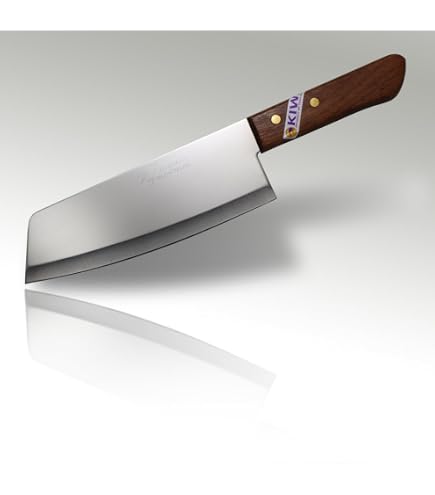
Kiwi Brand No. 22 Chef Knife 7.5-Inch — Same Thin Edge, Smaller Package
Best for: Budget Thai prep
Short on budget or short on board space, the No. 22 gives you the same Thai formula in a smaller package. Its 7.5-inch blade carries the same 1 mm spine and soft stainless steel as the No. 21, with a gentler curve that suits cooks who rock-chop as well as push-cut. At 5.6 oz it still feels featherlight next to a forged knife. The shorter blade scoops less and clears fewer knuckles, so big vegetable piles take a little longer.
- Same 1 mm thin spine as the No. 21 for clean, low-resistance cuts
- 7.5-inch length suits small boards and small kitchens
- Gentle curve handles rocking cuts better than the flat No. 21
- Shorter, less tall blade scoops less and gives less knuckle clearance
| Blade | 7.5 in (190 mm) |
| Steel | Stamped stainless, 50-51 HRC |
| Spine | 1 mm |
| Weight | 5.6 oz (159 g) |
| Handle | Riveted hardwood |
| Profile | Gentle curve |
8/10
6/10
8/10

Kom-Kom Thai Chef Knife 8-Inch — The Best-Finished Traditional Thai Knife
Best for: Traditional Thai cooking
Kom-Kom comes from the same Thai maker as Kiwi, positioned a step up in fit and finish while keeping the tall Thai profile. The 8-inch blade holds the same thin, push-cut geometry Thai cooks rely on, with a slightly firmer feel and tidier finishing at the handle and spine. At 5.0 oz it stays light in the hand through long sessions. It suits cooks who love the Kiwi formula but want the best-made version of it. Availability is patchier than Kiwi, and the edge still needs regular sharpening.
- Tall 8-inch Thai profile built for push-cuts and scooping
- Tidier fit and finish than the standard Kiwi line
- Slightly firmer feel gives more feedback on dense roots
- Harder to find than Kiwi, with fewer sellers stocking it
| Blade | 8 in (203 mm) |
| Steel | Thai stainless steel |
| Spine | 1.2 mm |
| Weight | 5.0 oz (142 g) |
| Handle | Riveted hardwood |
| Made in | Thailand |
9/10
7/10
9/10

Aranyik Handmade Thai Chef Knife 8-Inch — Hand-Forged Carbon, Real Soul
Best for: Hand-forged performance
Aranyik village has forged blades in Thailand for generations, and this 8-inch chef knife is the handmade end of Thai cutlery. A hand-forged high-carbon edge holds sharpness far longer than the soft stainless Kiwis, and the extra weight behind the cut powers through galangal and lemongrass with less effort. Carbon steel demands care: dry it after every wash or it stains and rusts. If you enjoy maintaining a blade, this is the most rewarding Thai knife here, and our guide to the handmade chef knife picks covers more hand-forged options.
- Hand-forged carbon edge holds sharpness far longer than soft stainless
- Extra weight powers through dense roots with less effort
- Each blade is hand-finished, so no two are identical
- Carbon steel stains and rusts if left wet; needs drying every time
| Blade | 8 in (203 mm) |
| Steel | Hand-forged high-carbon steel |
| Hardness | 58-60 HRC |
| Weight | 7.1 oz (200 g) |
| Handle | Thai hardwood |
| Made in | Aranyik, Thailand |
9/10
8/10
7/10

Kiwi Brand No. 288 Western Chef Knife 8-Inch — Thai Thinness, Western Curve
Best for: Rocking cuts, herbs
If you love Thai knives but rock-chop by habit, the No. 288 is Kiwi’s answer. It keeps the Thai maker’s thin stamped stainless and featherlight build, but swaps the flat Thai profile for a curved western belly that rolls through herbs and garlic. It is the easiest Thai-made knife to adopt if you are coming from a German or French chef knife. The curved edge scoops less than the flat No. 21, and the soft steel still dulls fast.
- Curved western belly suits rocking cuts through herbs and garlic
- Thin stamped blade keeps the low-resistance Thai cutting feel
- Familiar profile for cooks moving from western chef knives
- Curved edge scoops diced food less well than the flat No. 21
| Blade | 8 in (203 mm) |
| Steel | Stamped stainless, 50-51 HRC |
| Profile | Curved western belly |
| Weight | 5.6 oz (159 g) |
| Handle | Riveted hardwood |
| Tang | Partial, no bolster |
7/10
6/10
8/10
Top 3 Head-to-Head: Kiwi No. 21 vs Kiwi No. 22 vs Kom-Kom
These three are the finalists for most cooks: the definitive Thai blade, its smaller budget sibling, and the best-finished traditional alternative.
| Feature | #1 Kiwi No. 21 | #2 Kiwi No. 22 | #3 Kom-Kom |
|---|---|---|---|
| Thai Prep Performance | 10/10 — Best | 8/10 | 9/10 |
| Edge Retention | 6/10 | 6/10 | 7/10 — Best |
| Comfort and Control | 10/10 — Best | 8/10 | 9/10 |
| Choose if… | You want the definitive Thai blade and will sharpen weekly | You want the cheapest way into Thai knives or a smaller board | You want the best-finished traditional Thai knife |
Who These Thai Chef Knives Are NOT For
Not every cook needs a Thai chef knife, and these thin blades disappoint fast in the wrong hands.
If you want a knife you can neglect, skip this list too. Soft Thai steel needs sharpening often and wood handles need drying, so a low-maintenance cook will get more from a hard stainless western blade.
Common Mistakes to Avoid
These are the mistakes that quietly ruin the experience even with a good Thai knife.
Frequently Asked Questions About Thai Chef Knives
What is a Thai chef knife?
A Thai chef knife is a tall, thin, lightweight kitchen knife made in Thailand for push-cutting vegetables, herbs, and thin-sliced meat. Its blade is usually 7.5 to 8 inches long with a spine around 1 mm thick, far thinner than a western chef knife, which lets it glide through fibrous lemongrass and galangal instead of wedging.
Are Kiwi knives good?
Yes, for the money they are hard to beat: Kiwi knives arrive razor sharp and cut with almost no resistance thanks to their 1 mm spine. The trade is soft 50 to 51 HRC steel that dulls fast, so expect to sharpen weekly with heavy use.
What is the difference between a Thai chef knife and a cleaver?
A Thai chef knife is a thin slicing blade with a 1 mm spine, while a cleaver is a thick, heavy chopping blade built for bone and dense joints. The two look alike because both are tall and rectangular, but they do opposite jobs. Our chef knife vs cleaver comparison explains the geometry in full.
How often should I sharpen a Thai chef knife?
With daily Thai cooking, once a week on a whetstone keeps the soft stainless edge keen, with a few honing strokes between sessions. Carbon steel Aranyik blades hold their edge longer and need the stone less often.
Can a Thai chef knife cut through bone?
No. The 1 mm spine will chip or bend on bone, frozen food, and very hard squash. Use a cleaver for bone and keep the Thai knife for vegetables, herbs, and boneless meat.
Should I choose a wood or plastic handle on a Kiwi knife?
Wood feels warmer and more traditional but needs drying after every wash and occasional oiling. Plastic grips better when wet and needs no care, so it suits cooks who want zero maintenance.
Our Final Verdict
The Thai chef knife market splits two ways: featherlight stamped stainless that sharpens in a minute and dulls in a week, and hand-forged carbon that holds an edge but demands care. Neither is better in the abstract; the right one depends on how much maintenance you will actually do.
If you cook Thai food weekly, the Kiwi No. 21 is the best pick because its tall 1 mm blade is the purest version of the Thai formula. If your budget is tight, the Kiwi No. 22 keeps the same thin edge in a smaller package. If you want a blade with soul and will dry it after every wash, the Aranyik handmade knife rewards the effort.