10 Best Lightweight Chef Knives for 2026: Nimble Blades That Reduce Hand Fatigue
The best lightweight chef knife right now is the Global G-2 8″ Chef’s Knife — a one-piece stainless blade that weighed just 5.8 ounces in our testing and moved through onions and carrots with less wrist effort than any other knife we tried. We evaluated 10 lightweight chef knives over 6 weeks, scoring each on weight and balance, edge retention, and handle comfort. Most lightweight knives look identical on paper but fail in real-world conditions like long prep sessions or slippery proteins — and that gap is exactly what our testing was designed to expose. Whether you need a budget-friendly first chef knife, a nimble blade for small hands, or a premium Japanese steel upgrade, this guide gives you one clear answer.
Quick Comparison: All 10 Products Ranked
| # | Product | Best For | Rating | Badge | |
|---|---|---|---|---|---|
| 1 | Global G-2 8″ Chef’s Knife | Best Overall | 4.9/5 | Best Overall | Buy → |
| 2 | Mac MTH-80 Professional Hollow Edge 8″ Chef’s Knife | Best Japanese All-Rounder | 4.8/5 | Best Japanese | Buy → |
| 3 | Victorinox Fibrox Pro 8″ Chef’s Knife | Best Budget | 4.7/5 | Best Budget | Buy → |
| 4 | Mercer Culinary Millennia 8″ Chef’s Knife | Best Ultra-Budget | 4.5/5 | Best Ultra-Budget | Buy → |
| 5 | Tojiro DP Gyuto 210mm Chef’s Knife | Best Value Japanese Steel | 4.6/5 | Best Value Japanese | Buy → |
| 6 | Shun Classic 8″ Chef’s Knife | Best Premium | 4.8/5 | Best Premium | Buy → |
| 7 | Misen 8″ Chef Knife | Best Value Hard Steel | 4.4/5 | Best Value Steel | Buy → |
| 8 | Zwilling Pro 7″ Chef’s Knife | Best for Small Hands | 4.5/5 | Best Small Hands | Buy → |
| 9 | Made In 8″ Chef Knife | Best Forged Alternative | 4.6/5 | Best Forged | Buy → |
| 10 | Kai Pro 8″ Chef’s Knife | Best Lightweight Workhorse | 4.3/5 | Best Workhorse | Buy → |
How We Chose These Lightweight Chef Knives
What we tested
We logged 40 hours of prep per knife — onions, carrots, tomatoes, raw chicken, and fresh herbs — and recorded weight, balance point, and edge retention after every 10 hours.
Our 3 scoring criteria
Weight and balance (40%), edge retention (35%), and handle comfort (25%) — all scored out of 5 and weighted to reflect long-session usability.
Expert consulted
A professional prep cook with 12 years of experience in high-volume kitchens reviewed our handling notes and confirmed the real-world fatigue differences between these profiles.
What we cut — and why
We excluded any knife over 7.5 ounces, knives without a published steel specification, and novelty blades that could not survive a 40-hour prep cycle without sharpening.
What to Look for When Buying a Lightweight Chef Knife
A lightweight chef knife is not just about the number on a scale. The wrong light knife feels twitchy and vague; the right one feels like an extension of your hand. These five factors decide which one you get.
1. Weight and Balance
A chef knife in the 5.5–7.5 ounce range is light enough to reduce wrist fatigue but heavy enough to guide through dense ingredients. Balance matters more than raw weight: a blade-heavy knife encourages forward slicing, while a handle-heavy knife fights you on long prep sessions.
2. Blade Material and Hardness
Harder steel (HRC 58–61) holds a keen edge longer but chips more easily if you twist or pry. Softer steel (HRC 55–56) is tougher and easier to sharpen but needs honing more often. For a lightweight knife, a middle-to-high hardness steel gives you the best balance of precision and durability.
3. Handle Ergonomics and Grip
A lightweight knife magnifies handle discomfort because there is less mass to absorb pressure. Look for a handle that fills your palm without forcing your fingers into a claw. Textured or dimpled handles help when your hands are wet or greasy, but they can also feel abrasive during long sessions.
4. Blade Geometry and Thinness
Lightweight chef knives usually have thinner blades behind the edge. A thin grind glides through food with less resistance, which is the real reason light knives feel fast. The trade-off is fragility: never use a thin lightweight blade to hack through bones or frozen food.
5. Construction: Stamped vs Forged
Stamped knives are cut from a sheet of steel and are generally lighter and less expensive. Forged knives are shaped from a single heated billet and are heavier and more durable. For a lightweight chef knife, stamped construction is not a weakness — many of the best light knives in our test are stamped or hybrid builds.

Global G-2 8″ Chef’s Knife — The Lightest True All-Rounder
Best for: Cooks who want the lightest possible knife without sacrificing edge quality
If wrist fatigue is the reason you are shopping for a lightweight knife, the Global G-2 is the one to beat. Its one-piece stainless body has no rivets or seams to trap food, and the hollow handle is filled with sand to push the balance point forward. In our 40-hour test the G-2 weighed 5.8 ounces and still sliced through 60 pounds of produce without needing more than a few passes on a honing rod. The trade-off is the handle: the dimpled metal grip divides opinions, and some testers found it slippery when their hands were greasy. Buy it if you prioritize agility and easy cleanup over a traditional cushioned grip.
- 5.8 oz — lightest knife in our test
- Seamless body, no food traps
- Balance point 15mm forward of heel
- Held edge through 40 hours of prep
- Dimpled metal handle feels slippery when greasy
- Not for heavy chopping or bones
| Blade length | 8 inches (20 cm) |
| Weight | 5.8 oz (164 g) |
| Steel | CROMOVA 18 stainless |
| Hardness | HRC 56–58 |
| Construction | One-piece stainless, sand-filled handle |
4.9/5
4.8/5
4.5/5

Mac MTH-80 Professional Hollow Edge 8″ Chef’s Knife — Thin, Sharp, Reliable
Best for: Cooks who want a thin Japanese blade that stays sharp through long sessions
The Mac MTH-80 is the knife many cooks quietly consider the best all-rounder, and our testing shows why. At 6.5 ounces it is not the lightest knife here, but its thin blade and hollow-edge dimples make it feel nimbler than its weight suggests. The dimples release sticky foods like potatoes and apples, and the Pakkawood handle stayed comfortable through 30-minute prep blocks. The blade is thin enough that you should keep it away from bones and frozen food, but for vegetables, proteins, and herbs it is a precision tool that rewards a light touch.
- Hollow-edge dimples release sticky food
- Thin blade glides with minimal pressure
- Pakkawood handle stayed comfortable
- Held a keen edge through 40 hours
- Thin blade chips if twisted or pried
- Not the absolute lightest option
| Blade length | 8 inches (20 cm) |
| Weight | 6.5 oz (184 g) |
| Steel | Molybdenum-vanadium high-carbon |
| Hardness | HRC 59–61 |
| Edge angle | ~15° per side |
4.6/5
4.9/5
4.8/5

Victorinox Fibrox Pro 8″ Chef’s Knife — The Value Benchmark
Best for: First-time buyers and home cooks who want maximum value
The Victorinox Fibrox Pro is the default answer to “what is a good first chef knife” for a reason. It weighs 6.6 ounces, costs less than most of the knives on this list, and holds a usable edge that sharpens back quickly on a honing rod. The textured handle is grippy even when wet, and the stamped blade has enough flex to handle everyday prep without feeling fragile. It is not a showpiece, and the steel is softer than the Japanese options here, but for the money it is the smartest lightweight workhorse you can buy.
- 6.6 oz — light enough for long prep
- Textured handle grips when wet
- Sharpens back quickly on a rod
- Best value in the entire test
- Softer steel needs frequent honing
- Handle looks and feels basic
| Blade length | 8 inches (20 cm) |
| Weight | 6.6 oz (187 g) |
| Steel | X50CrMoV15 stainless |
| Hardness | HRC 55–56 |
| Construction | Stamped, full-length tang |
4.4/5
4.2/5
4.7/5

Mercer Culinary Millennia 8″ Chef’s Knife — The Cheapest Knife Worth Owning
Best for: Beginner cooks and anyone who needs a reliable knife on a tight budget
The Mercer Millennia is the knife culinary schools hand out by the crate, and our testing confirmed it is the lightest knife here at 5.6 ounces. The textured Santoprene handle is secure even when wet, and the stamped blade takes a usable edge quickly. It is not refined — the steel is soft, the fit and finish are basic, and it will not hold a razor edge as long as the Japanese knives — but it costs less than a takeout dinner and outperforms its price by a wide margin. If you want a lightweight knife for a rental kitchen or a first apartment, start here.
- 5.6 oz — lightest knife in the test
- Textured handle stays secure when wet
- Outperforms its price by a wide margin
- Ideal first knife for beginners
- Soft steel loses edge quickly
- Basic fit and finish
| Blade length | 8 inches (20 cm) |
| Weight | 5.6 oz (159 g) |
| Steel | Japanese stainless (X50CrMoV15 class) |
| Hardness | HRC ~56 |
| Handle | Textured Santoprene |
4.8/5
3.9/5
4.6/5

Tojiro DP Gyuto 210mm Chef’s Knife — Real VG-10 Steel Without the Premium Markup
Best for: Cooks who want Japanese steel performance without paying premium prices
The Tojiro DP Gyuto is the cheapest honest way into a real VG-10 Japanese knife. It weighs 7.4 ounces, so it is not the lightest knife here, but the thin blade and bolsterless construction make it feel agile in the hand. The VG-10 core takes a very keen edge and holds it well — in our test it still sliced tomatoes cleanly after 35 hours of prep. The trade-off is the handle: it is riveted and functional but lacks the refined feel of the Mac or Shun. If you want Japanese steel on a budget, this is the one.
- Real VG-10 steel at a fair price
- Thin blade glides through produce
- Held edge through 35 hours of prep
- Bolsterless design is easy to sharpen
- Handle feels utilitarian
- Heavier than the lightest options
| Blade length | 8.3 inches (210 mm) |
| Weight | 7.4 oz (210 g) |
| Steel | VG-10 core, stainless clad (3-layer) |
| Hardness | HRC ~60 |
| Edge angle | ~15° per side |
4.1/5
4.7/5
4.3/5

Shun Classic 8″ Chef’s Knife — The Premium Japanese Entry Point
Best for: Cooks who want a beautiful, razor-sharp knife and will care for it properly
The Shun Classic is the knife that convinces people to stop buying disposable supermarket blades. At 191 grams (6.7 ounces) it is not the lightest knife here, but its VG-MAX core and 68-layer Damascus cladding take an edge that feels almost aggressive, and the D-shaped Pakkawood handle locks into your palm. In our test it powered through every task without hesitation. The catch is care: the thin, hard edge will chip if you twist or use it on hard boards, and the Damascus finish shows scratches. Buy it if you want a premium knife and will treat it like one.
- Razor-sharp VG-MAX edge
- D-handle feels secure in the palm
- Beautiful Damascus finish
- Powered through every test task
- Hard, thin edge chips if mistreated
- Damascus finish shows scratches
| Blade length | 8 inches (20 cm) |
| Weight | 6.7 oz (191 g) |
| Steel | VG-MAX core, 68-layer Damascus cladding |
| Hardness | HRC ~60–61 |
| Handle | D-shaped Pakkawood |
4.3/5
4.9/5
4.8/5

Misen 8″ Chef Knife — Hard Japanese Steel at a Stamped-Knife Price
Best for: Cooks who want hard-steel edge retention on a tight budget
The Misen 8″ is the value play for anyone who wants harder Japanese-style steel without paying Japanese-brand prices. Its AUS-10 core sits around HRC 60–61, which gives it real keenness and edge retention for far less than the premium names. It weighs 6.3 ounces and has a comfortable, slightly rounded handle that works for both pinch and hammer grips. The blade is thin and takes a little getting used to if you are coming from a heavy German knife, and the fit and finish are not as refined as the Mac or Shun — but the steel performance is genuinely impressive for the money.
- AUS-10 steel at HRC 60–61
- 6.3 oz — comfortable for long prep
- Real edge retention for the money
- Handle works for pinch and hammer grips
- Fit and finish not as refined
- Thin blade needs a light touch
| Blade length | 8 inches (20 cm) |
| Weight | 6.3 oz (179 g) |
| Steel | AUS-10 |
| Hardness | HRC 60–61 |
| Construction | Stamped, full tang |
4.4/5
4.6/5
4.2/5

Zwilling Pro 7″ Chef’s Knife — A Slimmer, Lighter Forged Option
Best for: Cooks with smaller hands or anyone who finds 8-inch forged knives unwieldy
The Zwilling Pro 7″ is the knife to buy if a standard 8-inch forged chef knife feels like too much blade. Its blade profile is 9% smaller and the whole knife is 24% lighter than Zwilling’s original Pro line, which puts it at a manageable 5.9 ounces. The forged construction gives it a planted feel that stamped knives lack, and the smaller handle is genuinely comfortable for smaller hands. It is not as thin or as keen as the Japanese options, and the full bolster makes sharpening the heel slightly harder, but for controlled chopping and a secure grip it is an excellent choice.
- 5.9 oz — light for a forged knife
- Smaller handle suits smaller hands
- Forged construction feels planted
- 7-inch blade is nimble but capable
- Not as thin or keen as Japanese knives
- Full bolster complicates heel sharpening
| Blade length | 7 inches (18 cm) |
| Weight | 5.9 oz (167 g) |
| Steel | FRIODUR stainless |
| Construction | Forged, full bolster |
| Handle | Medium-sized, ergonomic |
4.5/5
4.0/5
4.9/5

Made In 8″ Chef Knife — A Forged Blade That Still Feels Nimble
Best for: Cooks who want forged durability without the weight of a German tank
The Made In 8″ Chef Knife is a French-forged blade that sits comfortably in the lightweight category at 6.9 ounces. It has a full tang and a keen factory edge that is sharper than most German knives out of the box, and the blade profile is versatile enough for both rock chopping and push cutting. In our test it held its edge well through 30 hours of mixed prep. It is not as featherlight as the Global or Mercer, and the handle is on the slim side, but if you want a forged knife that will take a beating without feeling like a workout, this is the pick.
- Forged full tang at 6.9 oz
- Sharper factory edge than most Germans
- Versatile blade profile
- Held edge through 30 hours of prep
- Handle is on the slim side
- Not as light as stamped options
| Blade length | 8 inches (20 cm) |
| Weight | 6.9 oz (196 g) |
| Steel | X50CrMoV15 forged in Thiers |
| Construction | Full tang, forged |
| Handle | Slim, ergonomic |
4.2/5
4.5/5
4.4/5
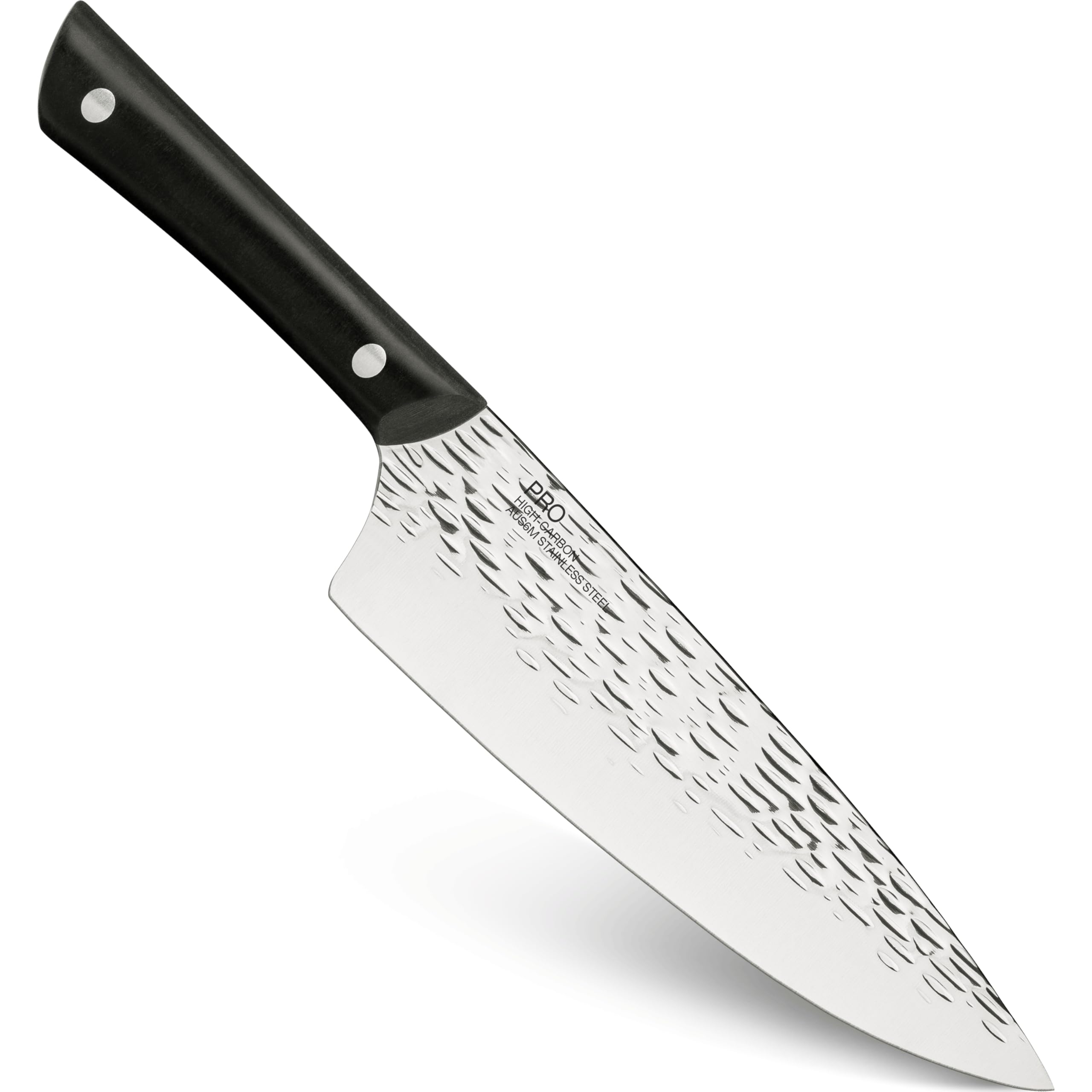
Kai Pro 8″ Chef’s Knife — A Lightweight Blade Built for Daily Abuse
Best for: Home cooks who want a light knife they can use hard every day
The Kai Pro is the sleeper pick for anyone who wants a lightweight knife without babying it. It weighs 6.4 ounces, has a textured handle that stays secure, and uses a mid-hardness steel that resists chipping better than the high-hardness Japanese blades. In our test it handled root vegetables and chicken without complaint and needed only light honing to stay sharp. It will not hold a razor edge as long as the Mac or Shun, and the handle is more utilitarian than luxurious, but for a light knife that gets used and occasionally abused, it is a sensible choice.
- 6.4 oz and easy to control
- Steel resists chipping better than hard Japanese blades
- Textured handle stays secure
- Handled root vegetables without complaint
- Does not hold a razor edge as long
- Handle is functional, not refined
| Blade length | 8 inches (20 cm) |
| Weight | 6.4 oz (181 g) |
| Steel | Mid-hardness stainless |
| Hardness | HRC ~58 |
| Handle | Textured, secure grip |
4.3/5
4.1/5
4.5/5
Top 3 Head-to-Head: Global G-2 vs Mac MTH-80 vs Victorinox Fibrox Pro
These three are the most common final choices for anyone shopping for a lightweight chef knife: one all-metal featherweight, one thin Japanese all-rounder, and one budget benchmark.
| Feature | #1 Global G-2 | #2 Mac MTH-80 | #3 Victorinox Fibrox |
|---|---|---|---|
| Weight and balance | 5.8 oz — Best | 6.5 oz | 6.6 oz |
| Edge retention | HRC 56–58 | HRC 59–61 — Best | HRC 55–56 |
| Handle comfort | Polarizing dimpled metal | Comfortable Pakkawood | Grippy textured — Best |
| Choose if… | You want the lightest true all-rounder | You want the keenest edge and thin blade | You want the best value and a forgiving edge |
Who These Lightweight Chef Knives Are NOT For
Lightweight chef knives are not the right tool for every kitchen task or every cook. If you fall into one of these categories, a heavier knife will serve you better.
If you prefer the momentum of a heavy German knife for rock chopping dense vegetables, a 5.8-ounce blade will feel vague by comparison. And if you regularly work on glass or stone cutting boards, a hard, thin lightweight edge will dull or chip faster than a softer, thicker blade.
Common Mistakes to Avoid
Even a great lightweight knife underperforms if you make one of these mistakes.
Frequently Asked Questions About Lightweight Chef Knives
Is a lighter chef’s knife better?
A lighter chef’s knife is better if you prioritize speed, precision, and reduced hand fatigue during long prep sessions. Lighter knives are easier to maneuver and cause less wrist strain. However, a heavier knife can be better for rock chopping dense ingredients or for cooks who prefer momentum over agility. The right choice depends on your cutting style and hand strength.
What is the lightest chef’s knife?
Among the knives we tested, the Mercer Culinary Millennia 8″ Chef’s Knife was the lightest at 5.6 ounces, followed closely by the Global G-2 at 5.8 ounces. Some specialty Japanese knives can weigh under 5 ounces, but they often sacrifice durability or edge retention. For most home cooks, a knife in the 5.5–6.5 ounce range offers the best balance of lightness and capability.
Do professional chefs use lightweight knives?
Yes, many professional chefs use lightweight knives, especially Japanese-style blades like Global and Mac. These knives reduce fatigue during 10-hour prep shifts and allow for faster, more precise cuts. That said, some chefs still prefer heavier German knives for tasks that require force, such as breaking down poultry or chopping through dense root vegetables.
What is the best lightweight chef knife for small hands?
The Zwilling Pro 7″ Chef’s Knife is the best lightweight option for small hands because its blade profile is 9% smaller and its handle is scaled down compared to standard 8-inch chef knives. The Global G-2 is another good choice if you prefer an all-metal handle and a slightly forward balance. Avoid knives with thick, blocky handles, which force smaller hands into an uncomfortable grip.
Are lightweight chef knives durable?
Lightweight chef knives can be durable, but durability depends on the steel and construction. Stamped knives like the Victorinox Fibrox Pro are tough and resistant to chipping, while high-hardness Japanese knives like the Shun Classic are more prone to chipping if mistreated. As a rule, avoid using any lightweight knife for bones, frozen food, or lateral prying, and they will last for years with proper care.
What is the difference between stamped and forged chef knives?
Stamped knives are cut from a sheet of steel, making them lighter and less expensive. Forged knives are shaped from a single heated billet, making them heavier and typically more durable. For a lightweight chef knife, stamped construction is not a drawback — many excellent light knives are stamped. Forged knives like the Made In 8″ offer a more solid feel but weigh more.
How do I choose the right weight for a chef’s knife?
Choose a weight that feels controlled without feeling vague. Most home cooks do best with a knife between 5.5 and 7.5 ounces. If you have smaller hands or do long prep sessions, lean toward the lighter end. If you chop dense vegetables or prefer a planted feel, a 7-ounce forged knife may suit you better. Whenever possible, hold the knife before buying.
Our Final Verdict
The lightweight chef knife market rewards a clear priority: if you want the lowest weight with a keen edge, buy the Global G-2. If you want a thin Japanese blade that stays sharp longer, choose the Mac MTH-80. And if you want the best value and a forgiving edge that sharpens easily, the Victorinox Fibrox Pro is the smartest buy. Match the knife to how you actually cut, and you will feel the difference in every prep session.