Chef Knife Edge Chips: Causes, Repairs, and Prevention
Quick Answer
Chef knife edge chips are small pieces of metal missing from the cutting edge, usually caused by impact with hard surfaces, cutting bones or frozen foods, or using an edge that is too thin for the task. Stop using a visibly chipped knife until you inspect and repair it. Small chips may be removed with suitable sharpening equipment, while deep chips, cracks, and damaged tips generally need professional attention. For more context, see this guide to what a chef’s knife is designed to cut.
What to do about a chipped edge
- Inspect the damage: Look for missing metal, cracks, bent sections, or a broken tip under good lighting.
- Stop risky cutting: Keep the knife away from food preparation until the damaged edge is assessed.
- Choose the repair: Use professional sharpening for substantial chips or unfamiliar blade damage.
- Use suitable boards: Choose wood or knife-friendly plastic instead of glass, stone, or ceramic.
- Change your technique: Avoid twisting the blade, striking bones, or cutting frozen ingredients.
- Protect the edge: Store the knife in a blade guard, suitable block, or secure magnetic rack.
How to check the knife
- Clean and dry the blade, then examine both sides under bright light without running your fingers along the edge.
- If you find a crack, a large missing section, or a loose handle, stop using the knife and seek professional advice.
A chipped chef knife can turn routine food preparation into a frustrating task. You may notice a rough cut through an onion, a snag in a tomato skin, or a tiny notch that catches the light.
I’m Michael, and in this guide I’ll explain what causes knife edge chips, how to distinguish them from ordinary dullness, and which repair methods make sense. I’ll also cover the habits that help protect your blade in everyday cooking.
What Are Chef Knife Edge Chips?
 Save
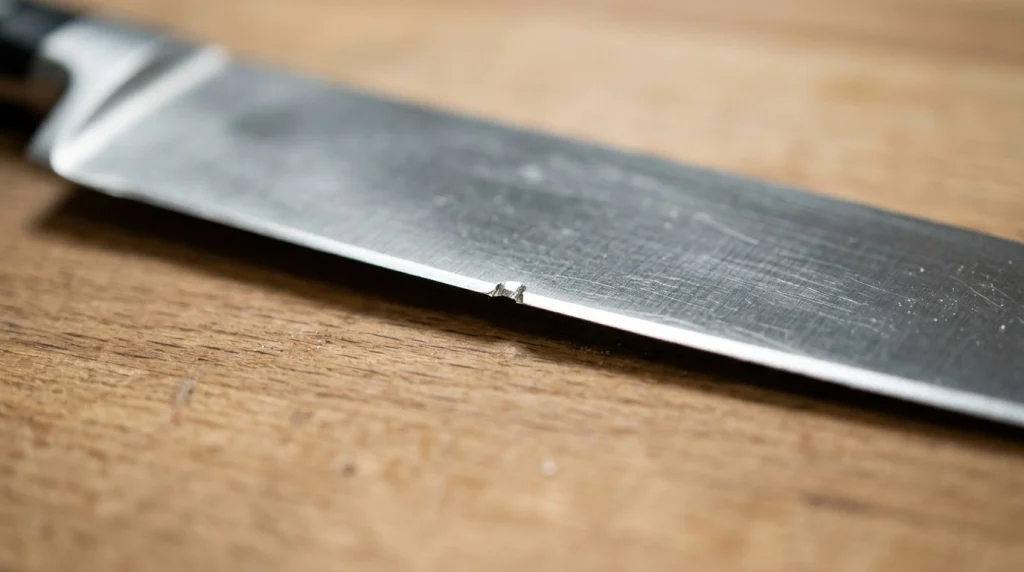
A chef knife edge chip is a small section of the cutting edge where metal has broken away. Unlike a dull edge, which gradually loses its cutting ability, a chipped edge has an irregular gap or notch.
The damage may be obvious, or it may be small enough to notice only when the knife snags during a cut. Understanding the difference helps you choose the right repair instead of sharpening unnecessarily.
How to recognize a chipped knife edge
- Visible notches: Small gaps interrupt the otherwise smooth cutting edge.
- Uneven slicing: The knife catches at a particular point when cutting food.
- Bright spots: Missing or damaged sections may reflect light differently from the surrounding edge.
- Repeated snagging: The same section catches during careful cutting, even after routine maintenance.
Always inspect the blade carefully before deciding that a snag means chipping. A rolled edge, uneven sharpening, or a damaged cutting board can create similar symptoms.
Why Does a Chef Knife Edge Chip?
Most chips develop when the thin cutting edge experiences more force than it can withstand. The cause may be a sudden impact, an unsuitable cutting surface, an overly delicate edge, or an inappropriate sharpening technique.
Identifying the cause matters because repairing the metal without changing the underlying habit can lead to repeated damage.
1. Cutting bones or frozen food
Many chef knives are designed for vegetables, boneless meat, herbs, and similar ingredients rather than heavy chopping. Striking bones or forcing the edge through frozen food can cause small pieces of steel to break away.
Use a suitable cleaver or another purpose-built tool for tasks involving bones. Let frozen ingredients thaw appropriately before cutting them with a standard chef knife.
2. Using glass, stone, or ceramic cutting surfaces
Hard cutting boards can damage a knife edge through repeated contact. Glass, granite, marble, and ceramic surfaces are particularly poor choices for routine knife work.
Choose a suitable wooden board or knife-friendly plastic board instead. A softer cutting surface helps reduce unnecessary impact and wear during everyday chopping.
3. Twisting or prying with the blade
A chef knife works best when its edge moves through food in a controlled cutting motion. Twisting the blade inside a dense ingredient or using its tip as a lever places sideways stress on the edge.
For moving chopped ingredients, turn the knife over and use its spine rather than dragging the cutting edge across the board. Use another tool for opening packages or prying objects apart.
4. Sharpening at an unsuitable angle
An edge sharpened too thinly for its intended use may chip under impact. Excessive pressure, inconsistent angles, and aggressive honing can also damage a delicate edge.
Follow the knife manufacturer’s sharpening recommendations rather than assuming every blade needs the same angle. Japanese-style knives and sturdier Western knives may require different maintenance approaches.
5. Steel properties and existing damage
Steel hardness, toughness, blade thickness, and edge geometry all influence how a knife responds to stress. A thin, hard edge can cut exceptionally well, but it may be less forgiving of sideways force or hard impacts.
Repeated chips without an obvious misuse event deserve closer inspection. If careful cutting and appropriate maintenance do not prevent the problem, ask a qualified sharpener or the manufacturer to assess the blade.
How Can You Tell Whether a Knife Is Chipped or Just Dull?
A dull knife usually needs its cutting edge restored, while a chipped knife has missing metal that must be removed during repair. A rolled edge is different again: the metal bends rather than breaking away.
Use the appearance of the blade alongside its cutting behavior. Do not rely on a single test to diagnose every type of damage.
| Condition | Typical signs | Appropriate response |
|---|---|---|
| Dull edge | Cuts poorly along much of the blade without obvious missing sections. | Sharpen using a suitable method. |
| Rolled edge | The edge bends to one side and may look uneven under light. | Assess whether appropriate honing can realign it. |
| Chipped edge | One or more notches interrupt the cutting edge. | Remove damaged metal through suitable sharpening or professional repair. |
| Cracked or broken blade | A crack, major fracture, or substantial structural damage. | Stop using it and seek professional assessment or replacement. |
A paper-cutting test can help assess sharpness, but it cannot prove that a blade is free of chips. Inspect the edge visually first, and keep your fingers away from the cutting surface throughout the process.
How Do You Fix Small Chips in a Chef Knife?
Small chips can often be repaired by removing enough metal to recreate a continuous cutting edge. The process requires suitable abrasives, a controlled sharpening angle, and patience because removing too much material changes the blade’s shape.
For a valuable knife, a delicate Japanese blade, or damage you cannot confidently assess, professional sharpening is the safer option.
Step 1: Inspect and clean the blade
Wash the knife carefully, dry it completely, and inspect the damaged section under bright light. Look at both sides of the blade and check whether the damage affects only the edge or extends farther into the blade.
Do not run a fingertip along the edge to locate a notch. If the blade has a crack, a large missing section, or other structural damage, stop and seek expert advice.
Step 2: Select the right sharpening equipment
Repairing a chip generally requires more material removal than routine sharpening. A suitable coarse sharpening stone or professional sharpening system can remove damaged metal before finer abrasives refine the edge.
Choose equipment appropriate for your knife’s steel and construction. Avoid using an unfamiliar powered grinder or applying heavy pressure in an attempt to remove the chip quickly.
Step 3: Restore a continuous edge
The damaged section must disappear into a consistent cutting profile. This can mean removing material across more than just the visible notch, which is why major chips are difficult to repair without changing the blade’s geometry.
Keep the sharpening angle consistent with the manufacturer’s recommendations. Work carefully and reassess the edge frequently rather than grinding away steel blindly.
Step 4: Refine the repaired edge
Once the damage has been removed, finer sharpening abrasives can refine the bevel and restore cutting performance. The exact sequence depends on the sharpening system, steel, and amount of material removed.
Clean the blade thoroughly afterward and inspect it again under good lighting. If a notch remains, the blade has developed a new uneven profile, or you are uncertain about the result, hand the repair to a qualified sharpener.
Step 5: Check the result safely
After cleaning the blade, examine its edge without touching it. If the repair appears consistent, test the knife carefully on an appropriate cutting board using a suitable food item.
Stop if the knife catches, feels unstable, or shows further damage. A repair should restore a dependable cutting edge, not merely make the blade appear shiny.
Practical tip: Sharpening removes metal, while honing primarily realigns a slightly bent edge. A honing rod cannot replace the material missing from a genuine chip.
When Should You Use a Professional Knife Sharpener?
Professional repair makes sense when the damage is too deep for a straightforward home sharpening, or when the knife’s value makes an avoidable mistake costly. It is also the better choice if you do not have the equipment or experience to maintain the original blade profile.
There is no single chip-size threshold that applies to every knife. Blade thickness, steel, damage location, and the depth of the missing metal all affect what is practical.
- Deep chips: Large notches may require substantial material removal and a complete edge reprofile.
- Cracks: Damage extending beyond the cutting edge needs expert assessment.
- Broken tips: Restoring the tip can change the blade’s shape and length.
- Repeated chipping: A professional can assess the edge angle, steel condition, and possible underlying problem.
- Specialty knives: Thin, hard, or single-bevel blades may require a sharpener familiar with their construction.
Ask the sharpener whether the chip can be removed without excessive loss of blade height. For a premium knife, also check the manufacturer’s service and warranty policies before authorizing repair.
Can a Chipped Chef Knife Still Be Used?
A visibly chipped knife should be taken out of service until the damage has been assessed. The damaged edge may cut unpredictably, and a severely compromised blade can pose additional risks during food preparation.
Do not assume that a tiny chip is harmless simply because the knife still cuts. Repair it appropriately, inspect the finished edge, and avoid using a damaged knife around food.
If a chip breaks away while preparing food, stop and inspect the food and work area for any missing metal fragments. Discard food that may contain fragments, and clean the work area before resuming preparation with a safe knife.
How Can You Prevent Chef Knife Edge Chips?
Prevention starts with matching the knife to the task and avoiding hard impacts. A few consistent maintenance habits can reduce edge damage without requiring frequent sharpening.
- Choose the right board: Use a suitable wooden or knife-friendly plastic cutting board.
- Avoid bones: Use a cleaver or another appropriate tool for bone-heavy work.
- Thaw frozen food: Do not force a standard chef knife through frozen ingredients.
- Cut with control: Avoid twisting, prying, or striking the blade against hard objects.
- Maintain the edge correctly: Follow the manufacturer’s guidance for honing and sharpening.
- Store the knife safely: Use a block, blade guard, magnetic rack, or suitable drawer insert that prevents contact with other utensils.
- Clean and dry it promptly: Follow the care instructions for the blade and handle materials.
Routine care matters, but aggressive maintenance can create its own problems. Excessive honing pressure or an unsuitable sharpener may damage the edge instead of protecting it.
For general guidance on knife care and cutting technique, the University of Nebraska–Lincoln’s chef’s knife guide explains appropriate cutting surfaces and basic care. You can also consult Victorinox’s sharpening instructions for the distinction between honing and sharpening.
Which Knife Maintenance Tools Are Worth Considering?
 Save
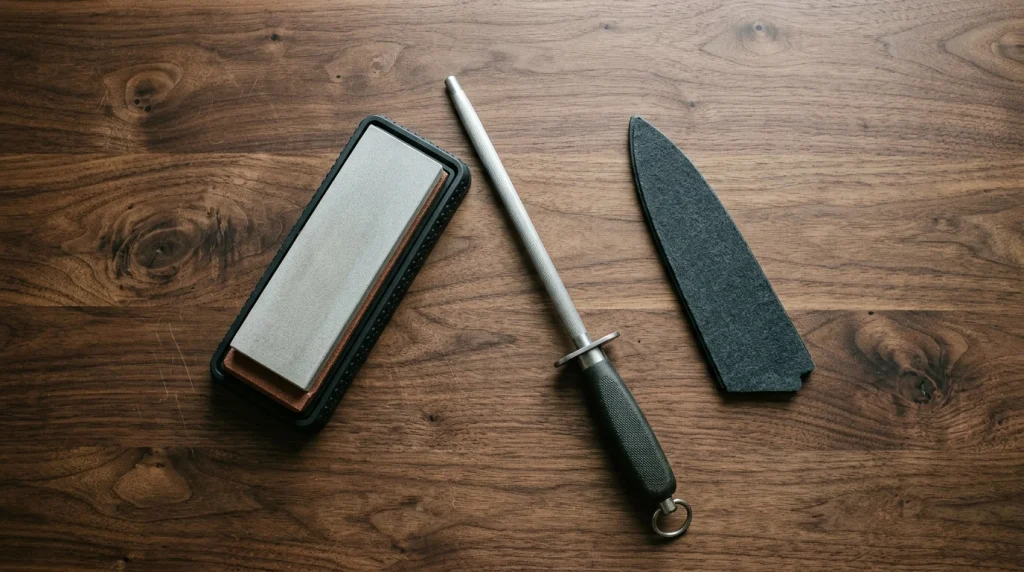
The best tool depends on whether you need routine edge maintenance, actual chip removal, or safer storage. No single accessory solves every knife problem, and the correct technique matters as much as the equipment.
| Tool | Best use | Important limitation |
|---|---|---|
| Whetstone | Controlled sharpening and edge repair when the grit is appropriate. | Requires practice and careful angle control. |
| Honing steel | Routine edge alignment when suitable for the knife. | Does not replace chip removal. |
| Guided sharpener | Helping maintain a repeatable sharpening angle. | Not every system suits every blade. |
| Blade guard | Protecting an edge during drawer storage or transport. | Does not repair existing damage. |
| Professional service | Deep chips, damaged profiles, or unfamiliar blades. | Service availability and repair costs vary. |
For a beginner, a suitable whetstone and a reliable storage solution are sensible starting points. If your knife has a significant chip, consider professional repair before investing in specialized equipment.
Recommended Tools for Preventing and Repairing Knife Edge Chips
If you want to maintain your chef knife at home, choose equipment that matches your skill level and the type of maintenance required. These options represent different approaches rather than a claim that any product can repair every damaged edge.
🏆 Best for Manual Sharpening
KING KW65 Combination Whetstone
★★★★☆
This combination water stone provides a practical starting point for routine sharpening and edge refinement. It suits cooks willing to learn controlled sharpening, but substantial chips may require a more suitable coarse abrasive or professional repair.
💡 Best for Routine Maintenance
Victorinox Sharpening Steel
★★★★☆
A suitable honing steel helps maintain an edge between sharpening sessions by realigning minor edge deformation. Choose a model compatible with your knife and use controlled strokes; honing will not replace the removal of missing metal.
🛡️ Best for Edge Protection
Blade Guard for an 8-Inch Chef Knife
★★★★☆
A properly fitted blade guard helps prevent the cutting edge from striking utensils or drawer surfaces. Check the guard’s internal dimensions and secure fit before purchasing; it protects the blade but cannot correct existing chips.
These are practical tool categories to consider, not independently verified product ratings or hands-on test results. Check current specifications, compatibility, and manufacturer instructions before buying.
Frequently Asked Questions
Can a small chip in a chef knife be repaired at home?
Yes, a small chip may be repairable with an appropriate sharpening stone and careful technique. The repair removes metal until the cutting edge becomes continuous again. If the chip is deep, the blade is expensive, or you lack sharpening experience, professional service is a better choice.
Does honing remove chips from a chef knife?
No. Honing primarily realigns a slightly bent edge, while repairing a chip requires removing enough metal to eliminate the missing section. Repeatedly running a chipped knife over a honing steel will not replace the lost steel and may worsen damage if you apply excessive force.
Why does my chef knife keep chipping after sharpening?
Repeated chipping can result from hard cutting surfaces, contact with bones, frozen food, sideways pressure, or an edge that is too delicate for the work. An unsuitable sharpening angle or a problem with the blade may also contribute. Review your technique and ask a qualified sharpener to assess recurring damage.
Is a chipped chef knife dangerous to use?
A chipped knife can cut unpredictably, and damaged metal may break away during use. Stop using it until the edge has been assessed and repaired. If a fragment may have entered food, inspect the food and surrounding area carefully, and discard any portion that may contain metal fragments.
Should I replace a chef knife with a large chip?
Not necessarily. Some substantial chips can be repaired, but doing so may require considerable material removal and change the blade’s shape. A professional can determine whether repair is practical. Replacement may be the better option if the blade has structural cracks, severe damage, or an uneconomical repair cost.
Final Takeaway: Keep Your Chef Knife Edge in Good Condition
Chef knife edge chips usually indicate that the cutting edge has experienced an impact or stress it could not withstand. The right response is to identify the damage, stop using an unsafe blade, and choose an appropriate repair rather than simply honing it harder.
Use a suitable cutting board, avoid bones and frozen ingredients with an ordinary chef knife, and store the blade where its edge cannot strike other objects. Consistent care helps reduce unnecessary damage and keeps your knife ready for everyday food preparation.
If you notice repeated chipping despite careful use, have the knife inspected by a qualified sharpener or its manufacturer. Finding the underlying cause is the best way to avoid repeating the same repair.
Affiliate disclosure: This article contains affiliate links. If you purchase through these links, CookingFlavour may earn a commission at no additional cost to you.

