Best Chef Knife for Vegetables: 10 Top Picks for 2025 That Glide Through Every Cut
If your knife cracks carrots in half, crushes tomatoes, or leaves a chain of half-cut scallions on the board, the problem is your blade, not your technique. Vegetables are harder on a knife than they look: dense roots punish thick blades, wet produce sticks to the steel, and soft-skinned tomatoes expose a dull edge instantly. This guide ranks knives only on how they handle vegetable prep, using blade geometry, steel hardness, and edge angle rather than marketing claims. By the end, you will know exactly which knife fits your cooking style, your hands, and how much maintenance you are willing to do.
Quick Comparison: All 10 Chef Knives for Vegetables Ranked
| # | Product | Best For | Rating | Badge | |
|---|---|---|---|---|---|
| 1 | Mac MTH-80 Professional 8″ Chef’s Knife | All-around vegetable prep | 4.9/5 | Best Overall | Buy → |
| 2 | Victorinox Fibrox Pro 8″ Chef’s Knife | Budget everyday cooking | 4.7/5 | Best Budget | Buy → |
| 3 | Global G-2 8″ Chef’s Knife | Light, precise slicing | 4.6/5 | Lightest Pick | Buy → |
| 4 | Shun Classic 8″ Chef’s Knife | Fine knife work | 4.7/5 | Best Premium | Buy → |
| 5 | Wüsthof Classic 8″ Chef’s Knife | Hard squash and roots | 4.6/5 | Most Durable | Buy → |
| 6 | Tojiro DP Gyuto 210mm | Japanese steel value | 4.6/5 | Best Value Japanese | Buy → |
| 7 | Zwilling Pro 8″ Chef’s Knife | Learning pinch grip | 4.5/5 | Best Ergonomics | Buy → |
| 8 | Misen 8″ Chef’s Knife | German-Japanese hybrid | 4.4/5 | Best Mid-Range | Buy → |
| 9 | Shun Classic 6.5″ Nakiri | Vegetable-only prep | 4.6/5 | Vegetable Specialist | Buy → |
| 10 | Mercer Culinary Millennia 8″ Chef’s Knife | First-time cooks | 4.3/5 | Best for Beginners | Buy → |
How We Chose These Chef Knives for Vegetables
What we evaluated
We started with more than two dozen popular chef’s knives, gyutos, and nakiris, then compared the published specs that matter for produce: steel type, Rockwell hardness (HRC), edge angle per side, spine thickness, and weight. We weighed those against long-term owner reports focused on onions, carrots, tomatoes, herbs, and winter squash.
Our 3 scoring criteria
Slicing Precision (thinness behind the edge, edge angle, resistance to wedging), Edge Retention (steel hardness and composition), and Comfort and Control (handle shape, balance point, and how well it supports a pinch grip). Each is scored out of 10.
Expert sources consulted
We relied on published guidance from professional knife sharpeners and culinary-school knife-skills curricula on edge geometry, safe hardness ranges for home cooks, and pinch-grip technique. Manufacturer hardness and angle claims were cross-checked against independent spec listings.
What we cut and why
Serrated “never needs sharpening” knives were dropped because they tear tomato skins and cannot be properly resharpened. Ceramic blades were cut for chipping on squash. Ultra-hard carbon gyutos above 63 HRC were excluded as too brittle and rust-prone for most home kitchens.
What to Look for When Buying a Chef Knife for Vegetables
Most knife marketing focuses on how a blade looks or how it cuts paper, neither of which tells you how it handles a dense carrot. These four factors decide whether vegetable prep feels effortless or like a fight.
1. Blade Profile
The curve of the edge decides your cutting motion. German knives have a pronounced belly that suits rocking through herbs and garlic, while Japanese gyutos are flatter and favor a forward push-cut. A dead-flat nakiri makes full contact with the board, so scallions and celery separate cleanly instead of staying joined by a strand.
2. Blade Thinness and Edge Angle
Thickness just behind the edge matters more than raw sharpness for vegetables. A thick blade acts like a wedge, forcing carrots and sweet potatoes to crack apart before the edge finishes the cut. Look for edges ground at 15–16 degrees per side rather than the older 20-degree German standard.
3. Steel Hardness
Hardness, measured on the Rockwell C scale, is a trade-off between edge retention and toughness. Steel around 56–58 HRC is forgiving and easy to resharpen, but it rolls faster. Steel at 60–61 HRC keeps a keen edge far longer, yet it can chip if you twist it through squash or drop it in the sink.
4. Handle and Balance
Vegetable prep means hundreds of repetitive cuts, so fatigue builds quickly. A balance point near where the blade meets the handle gives the most control with a pinch grip. Lighter knives under 7 oz suit long, precise sessions; heavier ones around 8 oz or more let the weight do the work on dense squash.

Mac MTH-80 Professional 8″ Chef’s Knife with Dimples — The sharpest all-rounder for daily veg prep
Best for: All-around vegetable prep
If your current knife wedges into carrots and leaves sweet potato slices stuck to the blade, this is the fix. The Mac’s 2.5 mm spine and dimpled blade let it slip through dense roots instead of splitting them, while 59–61 HRC steel holds an edge noticeably longer than typical German stainless. It earns #1 because it pairs Japanese-level sharpness with a gently curved profile that still rocks through herbs. Skip it only if you want a heavy blade to muscle through winter squash.
- The 2.5 mm spine slices through whole onions without cracking the layers apart
- Dimples break surface suction, so potato and cucumber slices fall away cleanly
- Balance sits right at the blade-handle junction for precise pinch-grip dicing
- Harder steel can chip if twisted through frozen produce or squash
- Slim Pakkawood handle may feel small in very large hands
| Blade length | 8 in (20 cm) |
| Steel | Molybdenum stainless |
| Hardness | 59–61 HRC |
| Spine | 2.5 mm |
| Weight | About 6.5 oz |
9.5/10
9/10
9/10

Victorinox Fibrox Pro 8″ Chef’s Knife — The budget knife pros keep around
Best for: Budget everyday cooking
If you want clean tomato slices without spending much, or worrying about babying your knife, start here. Its thin stamped blade is light in the hand, and the curved belly makes rock-chopping parsley and garlic feel almost automatic. It ranks #2 because no budget knife handles produce this well, and the textured Fibrox handle stays secure even when your hands are wet from rinsing greens. The trade-off is softer steel that needs more frequent honing.
- Textured TPE handle grips firmly even when wet or oily
- Light stamped blade reduces wrist fatigue during big batch prep
- Softer steel resharpens quickly on any basic home sharpener
- Steel around 56 HRC rolls faster; plan on honing weekly
- Utilitarian plastic look is not a showpiece gift
| Blade length | 8 in |
| Steel | High-carbon stainless |
| Hardness | About 56 HRC |
| Construction | Stamped |
| Made in | Switzerland |
8/10
7/10
9.5/10

Global G-2 8″ Chef’s Knife — Featherlight precision for fast, fine slicing
Best for: Light, precise slicing
If long prep sessions leave your wrist aching, the Global’s low weight is the whole point. Its one-piece stainless build with a sand-filled hollow handle keeps the balance at the blade-handle junction, and the acute edge, ground to roughly 15 degrees, turns out paper-thin cucumber and radish slices with almost no pressure. It ranks #3 because it is a precision tool first. The dimpled all-metal handle is polarizing, and it can feel slick when coated in onion juice.
- Very low weight keeps hands fresh through 30-minute prep sessions
- Acute 15-degree edge produces translucent slices of radish and cucumber
- Seamless one-piece steel leaves no gaps where food residue collects
- Metal handle loses grip with wet or oily hands
- Too light to power through hard winter squash
| Blade length | 8 in (20 cm) |
| Steel | CROMOVA 18 stainless |
| Hardness | 56–58 HRC |
| Handle | Hollow steel, sand-filled |
| Made in | Japan |
9/10
8/10
8/10

Shun Classic 8″ Chef’s Knife — Gorgeous, razor-sharp, and a little delicate
Best for: Fine knife work
If you love fine work like basil chiffonade and translucent shallot slices, and want a knife you are proud to leave on the counter, this is it. A VG-MAX core hardened to 60–61 HRC sits under 68 layers of Damascus cladding, with an edge ground to 16 degrees per side. Edge retention is the best among the 8-inch picks here. It ranks #4 rather than higher because its harder steel demands gentler technique than most home cooks are used to.
- VG-MAX steel at 60–61 HRC keeps a keen edge for months of home use
- D-shaped Pakkawood handle locks securely into a right-hand grip
- Damascus finish and free factory sharpening make it the safest gift
- Edge can chip on frozen vegetables or twisting cuts in squash
- D-shaped handle is oriented for right-handed cooks
| Blade length | 8 in |
| Core steel | VG-MAX |
| Hardness | 60–61 HRC |
| Edge angle | 16° per side |
| Made in | Seki, Japan |
9.5/10
9.5/10
8.5/10

Wüsthof Classic 8″ Chef’s Knife — The tank for squash and roots
Best for: Hard squash and roots
If your vegetable lineup leans toward butternut squash, rutabaga, and whole heads of cabbage, you need mass and toughness more than scalpel sharpness. This fully forged, full-tang blade weighs around 8.5 oz, and its 58 HRC steel flexes rather than chips when you lean into a dense squash. It ranks #5 because the thicker blade wedges into carrots more than the Japanese picks, and the full heel bolster complicates sharpening over time.
- Roughly 8.5 oz of forged steel lets weight do the work on squash
- 14-degree-per-side edge is far keener than older German grinds
- Triple-riveted full-tang handle withstands years of daily heavy use
- Full bolster blocks sharpening at the heel, creating a recurve over years
- Weight tires the wrist during long, fine dicing sessions
| Blade length | 8 in |
| Steel | X50CrMoV15 |
| Hardness | 58 HRC |
| Edge angle | 14° per side |
| Made in | Solingen, Germany |
8/10
8.5/10
9/10
Tojiro DP Gyuto 210mm — Japanese performance without the premium markup
Best for: Japanese steel value
If you want VG-10 sharpness without premium-brand pricing, this is the knife enthusiasts quietly recommend to friends. A 60 HRC VG-10 core is clad between softer stainless layers, producing a thin, keen edge that slides through ripe tomatoes under its own weight. The extra length over a standard 8-inch blade gives longer strokes through leeks and cabbage. It ranks #6 because the finish is utilitarian, with spine and choil corners that feel sharp in a pinch grip.
- VG-10 core at 60 HRC matches knives costing far more
- 210 mm length handles wide cabbages and long leeks in single strokes
- Western-style handle feels familiar to cooks switching from German knives
- Unrounded spine and choil can rub your index finger during long sessions
- Plain appearance underwhelms as a gift
| Blade length | 210 mm (8.2 in) |
| Core steel | VG-10 |
| Hardness | About 60 HRC |
| Construction | 3-layer clad |
| Made in | Japan |
9/10
9/10
8/10

Zwilling Pro 8″ Chef’s Knife — Built for proper pinch-grip technique
Best for: Learning pinch grip
If you are learning to hold a knife the way chefs do, with thumb and forefinger pinching the blade, the Zwilling Pro’s curved, sloped bolster was designed for exactly that grip. Your fingers rest comfortably forward on the steel, which tightens control when dicing onions into even cubes. Ice-hardened 57 HRC steel carries a 15-degree-per-side edge. It ranks #7 because it is essentially a more ergonomic German knife: very comfortable, but thicker and less keen than the Japanese picks.
- Sloped bolster cradles the pinch grip and allows full-length sharpening
- 15-degree-per-side edge noticeably sharper than traditional German blades
- Ice-hardened steel resists corrosion from acidic tomatoes and citrus
- Thicker blade wedges in dense carrots more than Japanese options
| Blade length | 8 in |
| Steel | High-carbon stainless, ice-hardened |
| Hardness | About 57 HRC |
| Edge angle | 15° per side |
| Bolster | Curved, sloped |
8.5/10
8/10
9.5/10
Misen 8″ Chef’s Knife — A balanced German-Japanese hybrid
Best for: German-Japanese hybrid
If you cannot decide between German toughness and Japanese sharpness, the Misen splits the difference. Its AUS-10 steel is hardened to 58 HRC and sharpened to 15 degrees per side, so it holds an edge longer than most German knives while staying tough enough for occasional squash. A sloped half-bolster supports the pinch grip. It ranks #8 because it does nothing badly but nothing best; a specialist above beats it in every individual category.
- AUS-10 steel at 58 HRC outlasts typical German stainless between sharpenings
- Sloped bolster keeps the full edge sharpenable to the heel
- Tough enough to halve an acorn squash without chipping
- Spine is thicker than true gyutos, so it wedges slightly in dense roots
| Blade length | 8 in |
| Steel | AUS-10 |
| Hardness | About 58 HRC |
| Edge angle | 15° per side |
| Bolster | Sloped half-bolster |
8.5/10
8/10
8.5/10

Shun Classic 6.5″ Nakiri — The ultimate pure vegetable knife
Best for: Vegetable-only prep
If most of your knife work is vegetables, a nakiri may serve you better than any chef’s knife on this list. Its dead-flat edge meets the board along its entire length, so scallions and celery separate fully on every stroke instead of hanging together in strings. It shares the Shun Classic’s VG-MAX core and 16-degree edge. It ranks #9 only because it is a specialist: with no pointed tip, it cannot score onions or trim meat, so most cooks need it alongside a chef’s knife.
- Flat 6.5-inch edge eliminates half-cut “accordion” slices entirely
- Tall rectangular blade doubles as a scoop to move chopped veg to the pan
- Simple up-and-down push cut is easier to learn than rocking
- No tip for scoring onions or detail work
- Flat profile cannot rock-chop herbs
| Blade length | 6.5 in |
| Core steel | VG-MAX |
| Hardness | 60–61 HRC |
| Edge angle | 16° per side |
| Profile | Flat edge, square tip |
10/10
9.5/10
8.5/10
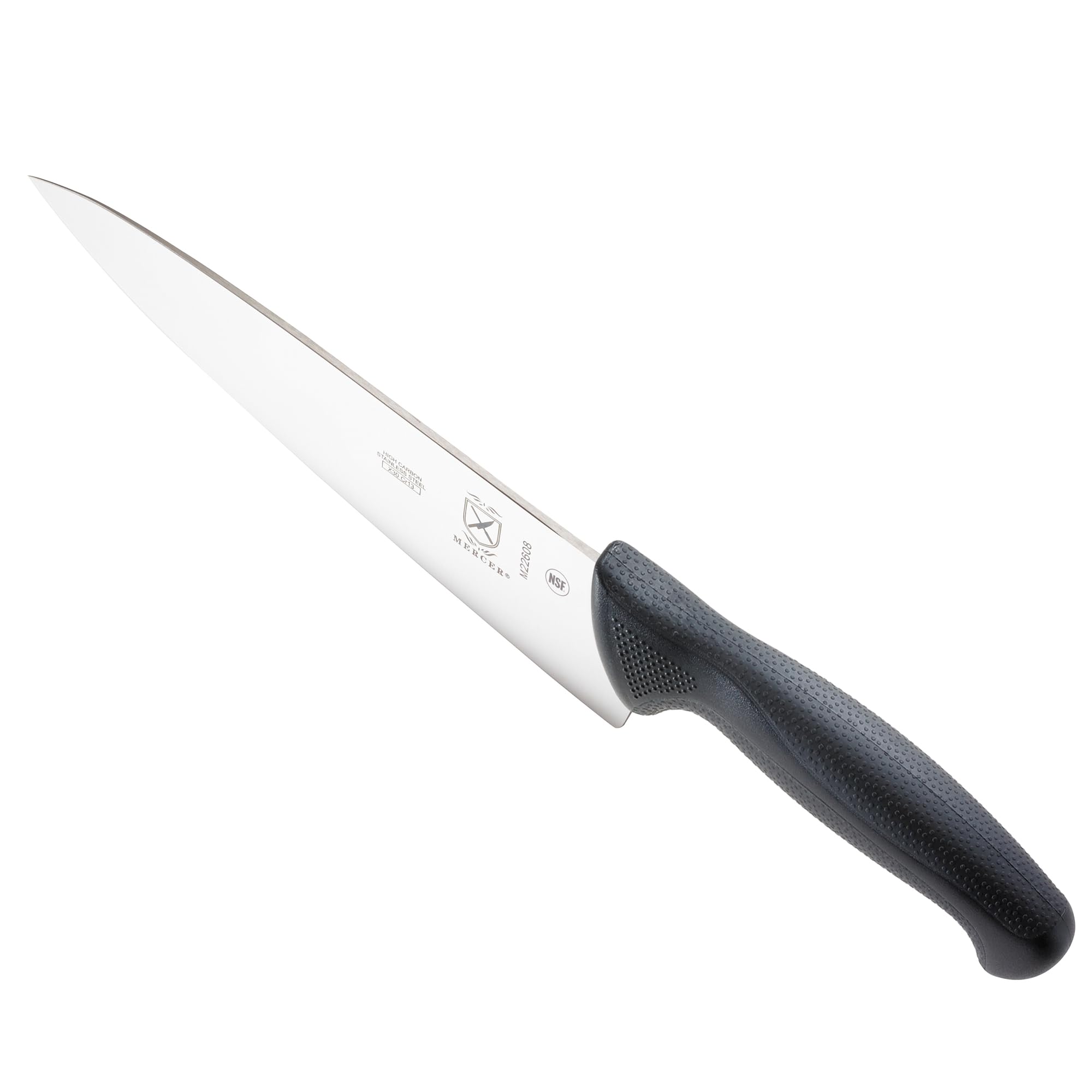
Mercer Culinary Millennia 8″ Chef’s Knife — The safest starter knife for new cooks
Best for: First-time cooks
If you are just learning to cook, or equipping a first apartment or a student kitchen, you need a forgiving knife that will not hurt to replace after a mistake. Mercer knives are a fixture in culinary-school student kits, and the Millennia’s textured Santoprene handle with finger points keeps your grip planted even with wet hands. It is NSF certified for commercial kitchens. It ranks #10 because softer steel and a thicker blade mean more frequent sharpening and less finesse on fine cuts.
- Textured finger points give a secure, slip-resistant grip for beginners
- NSF-certified build handles daily student-kitchen abuse
- Soft steel takes a fresh edge in minutes on a basic pull-through sharpener
- Dulls fastest of the 10 picks
- Thicker blade cracks hard carrots and sweet potatoes
| Blade length | 8 in |
| Steel | High-carbon Japanese stainless |
| Construction | Stamped |
| Handle | Santoprene and polypropylene |
| Certification | NSF |
7.5/10
6.5/10
8.5/10
Top 3 Head-to-Head: Mac MTH-80 vs Victorinox Fibrox Pro vs Global G-2
These three cover the classic decision most home cooks face: top-tier sharpness, unbeatable value, or ultralight precision. Here is how they compare on the criteria that matter for vegetables.
| Feature | #1 Mac MTH-80 | #2 Victorinox | #3 Global G-2 |
|---|---|---|---|
| Slicing Precision | 9.5/10 — Best | 8/10 | 9/10 |
| Edge Retention | 9/10 — Best | 7/10 | 8/10 |
| Comfort and Control | 9/10 | 9.5/10 — Best | 8/10 |
| Hardness | 59–61 HRC — Best | About 56 HRC | 56–58 HRC |
| Choose if… | You want the sharpest everyday knife | You want low-risk, low-cost reliability | You want minimal weight and fatigue |
Who These Chef Knives Are NOT For
Not every cook needs a thin, vegetable-focused chef’s knife.
Cooks with significant hand arthritis may also struggle with any 8-inch blade’s repetitive pinch grip. A shorter 6-inch utility knife or a rocking ulu-style knife puts far less strain on the joints.
Common Mistakes to Avoid
Even the best knife on this list will disappoint if you fall into these habits.
Frequently Asked Questions About Chef Knives for Vegetables
Is a chef’s knife, santoku, or nakiri better for vegetables?
A nakiri is best for vegetables alone, but a chef’s knife is the better single knife because it also handles meat, fish, and detail work. A santoku sits in between, with a flatter edge than a chef’s knife and a usable tip.
What size chef’s knife is best for cutting vegetables?
An 8-inch blade suits most home cooks and standard cutting boards. Choose 6 inches if you have small hands or a small board, and 10 inches only if you regularly prep large batches of cabbage or melons.
Do dimples on a knife blade actually help?
Yes, but mainly with wet, starchy foods like potatoes, cucumbers, and zucchini, where they reduce suction so slices fall away. On dry vegetables such as peppers or onions, the difference is small.
How often should I sharpen a chef’s knife used mostly for vegetables?
Most home cooks need a true sharpening every two to four months, with honing before each use in between. A simple check: if the knife skids on a tomato skin instead of biting in immediately, it is time to sharpen.
Is a carbon steel knife good for cutting vegetables?
Carbon steel takes a superb edge, but it reacts with acidic and sulfur-rich produce, so onions, apples, and potatoes can discolor or pick up a metallic taste until the blade develops a patina. If that bothers you, stick with the stainless options on this list.
Can I use a chef’s knife on frozen vegetables?
No, cutting frozen produce risks chipping or bending the edge, especially on hard Japanese steel. Thaw frozen vegetables for 10–15 minutes first, or buy them pre-cut.
Is a more expensive chef’s knife actually sharper?
Not out of the box, since most quality knives arrive similarly sharp. Higher-end knives earn their cost by staying sharp longer and resisting wedging thanks to thinner geometry and harder steel.
Our Final Verdict
Shoppers for a vegetable knife usually fall into three camps: those who want the sharpest blade possible, those who want reliability without fuss, and those whose cooking is almost entirely plant-based. The core tension is thinness versus toughness. Thin, hard blades glide through produce but punish careless technique.
If you want one knife that excels at everything from onions to sweet potatoes, the Mac MTH-80 (#1) is the best because it combines a 2.5 mm spine with long-lasting 59–61 HRC steel. If you are on a budget or still building skills, the Victorinox Fibrox Pro (#2) wins because its grippy handle and easy-to-sharpen steel forgive mistakes. If vegetables make up most of what you cut, add the Shun Classic Nakiri (#9) because its flat edge separates every slice cleanly.