How to Fix a Chipped Chef Knife: A Step-by-Step Guide
Quick Answer
To fix a chipped chef knife, first inspect the damage for cracks, bending, or a broken tip. A tiny chip may disappear during careful sharpening, while a shallow, visible chip usually needs a coarse whetstone or diamond plate to remove enough steel to restore a continuous edge. For deep chips or structural damage, consult a professional knife sharpener rather than removing excessive metal at home.
Quick repair steps
- Inspect the blade: Clean and dry the knife, then examine the edge under bright light without touching it.
- Choose the right method: Use careful sharpening for tiny chips and professional repair for deep or cracked damage.
- Secure the stone: Place the appropriate whetstone on a nonslip base and follow its water or oil instructions.
- Remove minimal steel: Maintain the knife’s existing bevel and work with controlled strokes until the chip disappears.
- Refine the edge: Move to a medium-grit stone, then a finer stone if needed, and remove the remaining burr.
- Clean and test: Wash and dry the blade, then test its cutting performance carefully on a suitable food item.
Important safety tip
- Never run your finger along the cutting edge, force a damaged blade through food, or try to repair a crack by ordinary sharpening.
A chipped chef knife can often be restored without replacing the entire blade, but the right repair depends on the size and location of the damage. I’ll walk you through how to assess a chip, choose suitable sharpening tools, and restore a usable edge without unnecessarily shortening your knife.
You’ll also learn when a DIY repair makes sense, which common mistakes to avoid, and how to prevent the same damage from happening again.
What Is a Chipped Chef Knife?
A chipped chef knife is a knife whose cutting edge has lost small pieces of steel, leaving tiny gaps or visible notches along the blade. Unlike a rolled edge, where the metal bends sideways, a true chip involves missing material.
The distinction matters because the two problems require different solutions. Honing can realign a slightly rolled edge, but it cannot replace steel that’s already missing.
Key principle: Repairing a chip means removing enough surrounding steel to create a continuous cutting edge again, while preserving as much of the original blade as possible.
How Do You Know Whether a Chef Knife Chip Is Repairable?
 Save
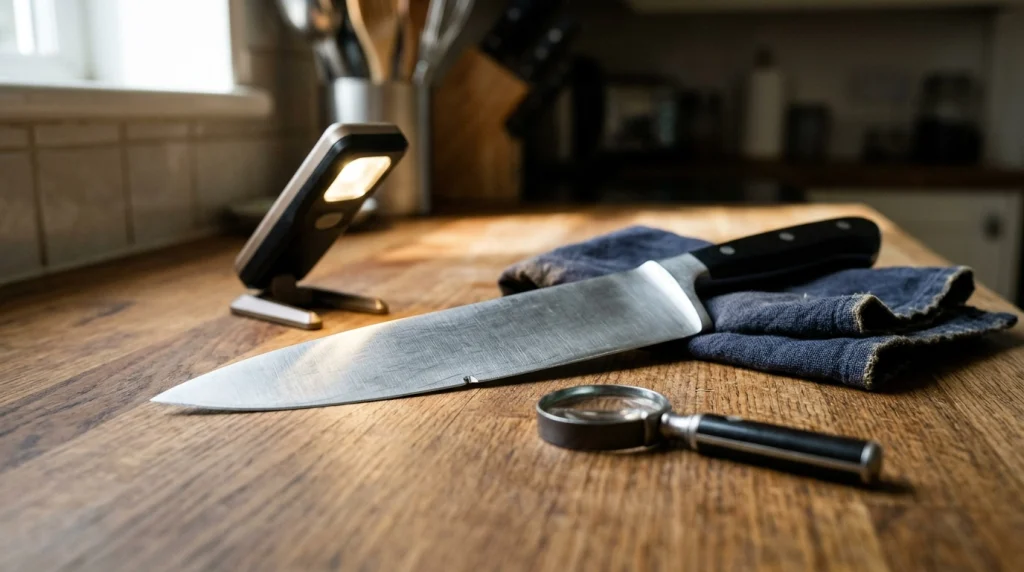
Inspect the blade before choosing a repair method. A small nick confined to the cutting edge is very different from a deep chip, a crack, or a damaged tip.
Wash and dry the knife, place it securely on a stable surface, and examine the edge under bright light. Look at the blade from several angles without running your fingers along its edge.
| Damage type | What you’ll notice | Best next step |
|---|---|---|
| Tiny microchip | A pinpoint nick or slight interruption in the edge | Careful sharpening on a suitable medium stone may remove it. |
| Shallow visible chip | A small notch with no crack extending into the blade | Use a coarse whetstone or diamond plate, followed by finer sharpening. |
| Deep chip | A large missing section that requires substantial reshaping | Seek professional assessment and repair. |
| Crack or bent blade | A crack extending above the edge, a bend, or structural damage | Stop using the knife until a qualified professional assesses it. |
| Broken tip | The pointed end is shortened or missing | Professional reshaping is preferable, especially for expensive or thin blades. |
There isn’t one chip-size measurement that determines whether every knife is safe to repair at home. Blade thickness, steel hardness, grind geometry, and the chip’s depth all influence the decision.
If you see a crack, don’t treat it as an ordinary sharpening problem. Stop using the knife for food preparation until a professional has assessed the damage.
What Causes a Chef Knife to Chip?
Most chips result from impact, excessive sideways force, or a cutting surface that’s too hard for the blade. Even a quality chef knife can chip if it’s used outside its intended purpose.
- Cutting frozen food: Hard, frozen ingredients can place excessive stress on a thin cutting edge.
- Hitting bones: A standard chef knife isn’t designed for chopping through dense bones or joints.
- Using glass or ceramic boards: These surfaces can damage the edge through repeated contact.
- Twisting the blade: Levering or twisting a knife while it’s embedded in food can stress the cutting edge.
- Opening cans or packages: Using the edge as a pry tool or makeshift opener can cause chips.
- Improper storage: Loose blades can strike other utensils inside a drawer.
Japanese-style chef knives with thin, hard edges can be particularly sensitive to lateral force. However, chip resistance varies by steel, heat treatment, blade geometry, and how the knife is used.
Which Tools Do You Need to Fix a Chipped Chef Knife?
For a small, repairable chip, a stable sharpening setup and the right abrasive are more important than owning a large collection of tools. Choose a stone that can remove the damaged steel without forcing you to grind for hours.
- Coarse whetstone: Removes steel efficiently when a visible chip needs reshaping.
- Diamond plate: Offers an alternative for controlled material removal, depending on its grit and design.
- Medium-grit whetstone: Refines the new edge after the chip disappears.
- Fine-grit stone: Helps polish and refine the edge when appropriate for the knife.
- Non-slip stone holder: Keeps the abrasive stable while you work.
- Bright task light and clean cloth: Help you inspect the edge and clean away sharpening residue.
Use the manufacturer’s instructions to determine whether your stone requires soaking, surface wetting, or oil. Never switch a stone between water and oil unless its manufacturer explicitly allows it.
For reference, TOG Knives’ care and sharpening guidance explains why actual chips require abrasive material removal rather than simple honing.
How to Fix a Chipped Chef Knife Step by Step
For a small, non-structural chip, the goal is to remove only enough steel to restore an uninterrupted edge. Work slowly, maintain the existing bevel, and stop if the damage proves deeper than expected.
Step 1: Clean and inspect the blade
Wash the knife, dry it completely, and examine the damaged section under a bright light. Check for cracks, bends, or damage extending beyond the cutting edge.
If the blade has a structural defect, set it aside for professional assessment. Don’t try to grind a crack away with a sharpening stone.
Step 2: Choose an appropriate abrasive
Use a medium stone for a tiny chip that can disappear during normal sharpening. A visible notch generally needs a coarser whetstone or suitable diamond plate to remove the surrounding steel more efficiently.
Very coarse abrasives remove material quickly, but they also make mistakes easier. If you haven’t repaired a chipped knife before, consider professional sharpening for anything beyond a minor nick.
Step 3: Stabilize the whetstone
Place the stone in a secure holder on a flat, nonslip work surface. Prepare it according to its instructions, and keep the sharpening area clear of loose utensils.
Make sure the stone stays stable throughout the repair. Never attempt to sharpen a damaged knife on a stone that slides around under pressure.
Step 4: Maintain the original sharpening angle
Follow the knife’s existing bevel rather than automatically choosing a new angle. Many kitchen knives use an edge angle in the neighborhood of 15–20 degrees per side, but the correct geometry depends on the particular blade.
Use light, controlled strokes across the damaged section, keeping the angle consistent. Avoid grinding aggressively at the bottom of the chip because this can create a hollow or uneven edge.
Step 5: Remove the chip gradually
Work with deliberate strokes and inspect the edge frequently. Continue only while the damaged area is clearly improving and you can maintain control of the blade.
The surrounding edge must meet smoothly once the missing section disappears. Don’t rush to make the chip vanish by pressing harder or using an unnecessarily aggressive stone.
Practical tip: Check the edge frequently under bright light instead of counting a fixed number of strokes. Different steels, chip depths, and abrasives require different amounts of work.
Step 6: Refine the edge with a medium stone
Once the chip has disappeared, switch to a medium-grit stone to refine the newly formed edge. Keep the original bevel as consistent as possible on both sides of a double-bevel knife.
If the blade has a single-bevel or specialized Japanese grind, follow its specific sharpening instructions rather than treating both sides identically. Incorrect grinding can change the knife’s cutting geometry.
Step 7: Remove the burr and clean the knife
Sharpening can leave a thin burr, which is a tiny lip of metal along the edge. Use light finishing strokes appropriate to your knife and stone to remove it without rounding the cutting edge.
Wash and dry the blade carefully, clean the stone according to its instructions, and inspect the finished edge. Never check sharpness by running a finger along the blade.
Step 8: Test the cutting edge safely
Place a stable cutting board on the counter and test the knife on a suitable food item, such as a ripe tomato. Use controlled cuts and keep your fingers clear of the edge.
If the knife still catches at the repaired section, the chip may not be completely removed or the edge may need further refinement. If you notice a crack, unusual flex, or worsening damage, stop and seek professional help.
Should You Use a Whetstone, Honing Rod, or Electric Sharpener?
A coarse whetstone or diamond plate is generally the better choice for removing a true chip. A honing rod can realign a slightly rolled edge, while many standard electric sharpeners aren’t designed to repair substantial edge damage.
| Tool | Best use | Limitation |
|---|---|---|
| Coarse whetstone | Removing small chips and reshaping an edge | Requires angle control and careful technique. |
| Diamond plate | Efficient material removal and sharpening | An aggressive plate can remove steel quickly. |
| Medium whetstone | Refining an edge after repair | May be slow for deeper chips. |
| Honing rod | Realigning a rolled edge | Doesn’t replace steel missing from a chip. |
| Electric sharpener | Routine sharpening when compatible with the knife | May not handle deep chips or specialized bevels appropriately. |
For additional technique guidance, Shimomura Cutlery’s knife-sharpening FAQ explains the roles of coarse, medium, and finishing stones.
Can You Fix a Chipped Chef Knife Without a Whetstone?
Sometimes, but the alternative must still remove metal safely and evenly. A suitable diamond sharpening plate can work, and a professional sharpening service is often the better option for a valuable or badly damaged knife.
A honing rod alone won’t repair a genuine chip. Likewise, ordinary kitchen scissors sharpeners, pull-through devices, and improvised abrasives may not provide the control needed to restore the original edge.
If your knife is ceramic rather than steel, don’t use an ordinary metal-knife repair method without checking the manufacturer’s instructions. Ceramic blades need compatible abrasives and may qualify for specialized repair services.
When Should You Take a Chipped Chef Knife to a Professional?
Professional repair makes sense when removing the damage would require extensive grinding, alter the blade’s profile, or risk weakening an already damaged section. A skilled sharpener can assess whether the knife can be restored economically and safely.
- Deep chips: Large notches can require significant steel removal and edge reshaping.
- Cracks or bends: Structural damage needs assessment beyond routine sharpening.
- Broken tips: Restoring the point may require reshaping and thinning the blade.
- Expensive Japanese knives: Thin blades and specialized bevels can be difficult to repair without changing their geometry.
- Repeated chipping: Recurring damage may indicate unsuitable cutting technique, excessive lateral force, or an edge geometry problem.
Ask the sharpener how much material the repair will remove and whether the original blade profile can be preserved. For a low-cost knife with severe damage, replacement may be more practical than extensive restoration.
What Mistakes Should You Avoid When Repairing a Chipped Knife?
Most avoidable problems come from removing too much metal, changing the bevel unnecessarily, or attempting a repair beyond your skill level. A slow, controlled approach helps preserve the knife.
- Don’t use a honing rod to erase a chip: Realigning metal isn’t the same as replacing missing material.
- Don’t grind at random angles: Inconsistent angles can leave a thick, uneven, or unstable edge.
- Don’t start with an excessively coarse abrasive: Use only the material-removal speed the damage requires.
- Don’t press excessively hard: Heavy pressure can reduce control and create uneven wear.
- Don’t ignore cracks: A crack extending into the blade requires professional assessment.
- Don’t test sharpness on your fingers: Use a controlled cutting test on a suitable food item instead.
One useful lesson is that a repair isn’t successful simply because the visible notch disappears. The edge should also cut properly, retain a sensible profile, and show no signs of structural damage.
How Can You Prevent Your Chef Knife from Chipping Again?
Good cutting habits and suitable storage reduce unnecessary stress on the edge. You don’t need complicated maintenance routines to protect a properly used kitchen knife.
- Use a suitable board: Choose wood or a knife-friendly plastic board instead of glass, stone, or ceramic.
- Avoid hard materials: Use an appropriate cleaver or other suitable tool for tasks involving bones and very hard ingredients.
- Don’t twist the blade: Use straight, controlled cuts instead of levering the knife sideways.
- Store the knife securely: Use a blade guard, knife block, or suitable magnetic rack.
- Maintain the edge regularly: Sharpen when needed rather than waiting until the knife performs poorly.
- Follow the manufacturer’s guidance: Different blade steels and geometries need different care.
For everyday maintenance, the BC Centre for Disease Control’s knife-care guide provides practical advice on sharpening and choosing an appropriate work surface.
How Much Steel Should You Remove During a Repair?
 Save
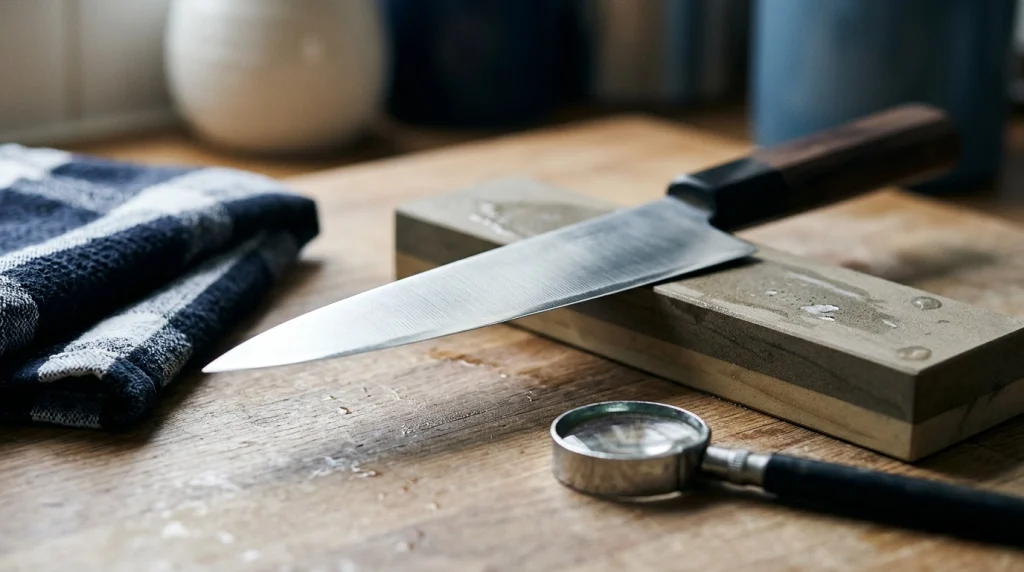
Remove only enough material to create a continuous edge, and avoid reshaping the entire blade unless the damage makes it necessary. The amount depends on the chip’s depth, the blade’s thickness, and the existing bevel.
As a practical example, a tiny nick may disappear during ordinary sharpening, while a deeper notch can require extensive grinding. If the repair starts changing the blade’s shape noticeably, pause and reassess rather than continuing automatically.
After the chip disappears, the edge may still need refinement to cut well. That is why repair and finishing are separate stages, even when the damaged area looks small.
Is a Chipped Chef Knife Worth Repairing?
A quality chef knife with a minor chip is often worth repairing because the damage may be limited to the cutting edge. Repair becomes less attractive when the blade has structural damage or needs so much reshaping that its balance, profile, or useful life would suffer.
Consider the knife’s replacement cost, sentimental or professional value, repair price, and condition of the rest of the blade. When in doubt, get an assessment before deciding to replace it.
Recommended Tools for Repairing and Maintaining a Chipped Chef Knife
If you’re preparing to repair a minor chip yourself, choose tools that match the damage and your sharpening experience. These are useful options to compare, not products I’ve personally tested or independently rated.
Best for beginners
Sharp Pebble Whetstone Sharpening Kit
A whetstone kit is worth considering for routine sharpening and minor edge maintenance. Check the included grit, stone preparation requirements, and compatibility with your knife before attempting chip repair.
Best for controlled material removal
DMT Diamond Whetstone
Diamond sharpening plates offer an alternative to traditional stones for removing steel and maintaining an edge. Select an appropriate grit and use controlled pressure to avoid removing more material than necessary.
Best for routine maintenance
Idahone Ceramic Sharpening Rod
A ceramic rod can help maintain a suitable steel knife’s edge between sharpening sessions. It won’t fill a chip, so use it for maintenance only after the damaged edge has been properly repaired.
Frequently Asked Questions
Can a small chip in a chef knife be repaired at home?
Yes, a small chip without cracks or structural damage can often be repaired with careful sharpening. Use an appropriate abrasive, maintain the original bevel, and remove only enough steel to restore a continuous edge. If the chip deepens or the blade’s shape changes significantly, consult a professional.
Can you fix a chipped chef knife with a honing steel?
No, a conventional honing steel cannot replace steel missing from a chipped edge. Honing primarily realigns a slightly rolled edge, whereas chip repair requires removing material from the surrounding blade. A suitable whetstone or diamond plate is more appropriate for a true chip.
What grit whetstone should you use for a chipped knife?
The right grit depends on the chip’s depth and the blade’s construction. A coarse stone can remove material faster from a visible chip, while a medium stone works for minor damage and edge refinement. Follow the knife manufacturer’s recommendations and avoid aggressive abrasives unless necessary.
Is it safe to use a chef knife with a chipped blade?
It’s best to stop using a visibly chipped knife until you’ve assessed the damage and repaired it appropriately. A damaged edge can catch during cutting, and loose fragments may contaminate food. If the blade has a crack, bend, or substantial missing section, seek professional assessment before using it again.
Should you replace a chef knife with a deep chip?
Not necessarily. A professional sharpener may be able to restore a deeply chipped blade, although the repair can change its profile and remove considerable steel. Compare the repair cost and likely outcome with replacement, and don’t attempt a major repair if you lack the necessary tools or experience.
Final Takeaway: Restore the Edge Without Rushing
Learning how to fix a chipped chef knife starts with identifying the damage, choosing an appropriate abrasive, and preserving the blade’s original geometry. Tiny chips may need only careful sharpening, while deep chips, broken tips, and cracks call for professional attention.
Most importantly, don’t sacrifice the blade’s shape just to remove a notch quickly. Use appropriate cutting boards, avoid twisting the knife, and store it safely to help prevent future damage.

