
Best Cutting Boards for Japanese Knives: Top Picks for 2026
Quick Answer
The best cutting boards for Japanese knives are soft synthetic-rubber boards, hinoki cypress boards, and quality end-grain hardwood boards. Hasegawa Pro-Soft Lite is my top recommendation for protecting delicate edges, while Shun Hinoki is excellent for traditional Japanese knife work. For everyday versatility, maple and walnut are practical choices. Learn more about cutting boards that help keep knives sharp.
Best Choices by Cutting Style
- Best overall: Hasegawa Pro-Soft Lite provides a forgiving surface for delicate Japanese knife edges.
- Best traditional wood: Shun Hinoki offers a lightweight Japanese cypress cutting surface.
- Best everyday hardwood: John Boos Maple R-Series provides a sturdy board for general kitchen preparation.
- Best premium wood option: A quality walnut or maple end-grain board provides comfortable cutting and lasting durability.
- Surfaces to avoid: Glass, stone, ceramic, and metal are unnecessarily harsh on fine knife edges.
Important Buying Tip
- Prioritize blade protection: Choose a food-safe surface with some give, enough working space, and care requirements you can follow.
Japanese knives deserve a cutting board that complements their sharp, finely ground edges. A beautiful knife can lose its cutting performance faster when paired with an unsuitable surface.
I prefer choosing a board around the knife, the food, and the cleaning routine. This guide explains which materials work best, compares useful products, and helps you avoid expensive mistakes.
What Makes a Cutting Board Good for Japanese Knives?
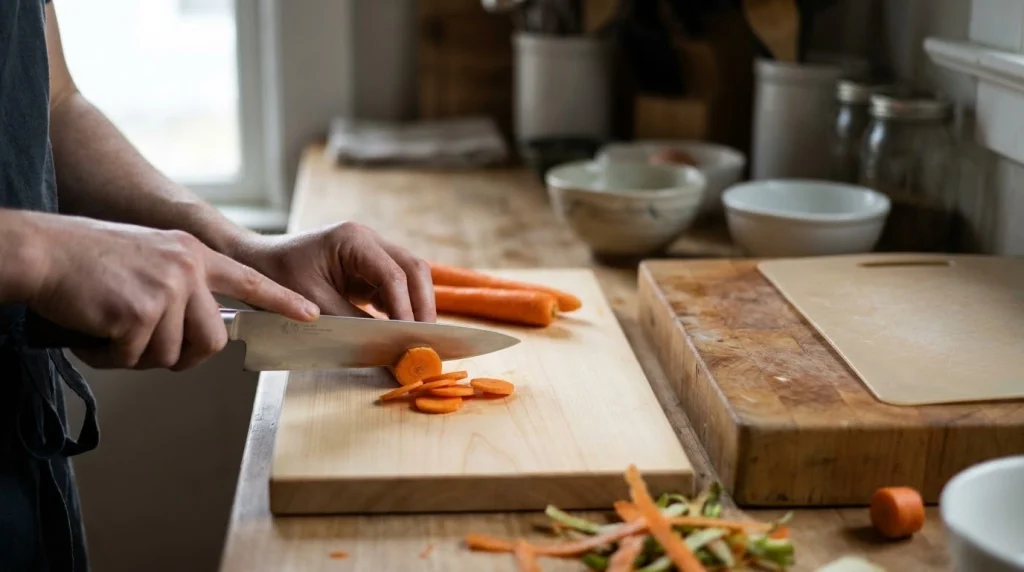
The best cutting board for a Japanese knife provides a stable, food-safe surface that gives slightly under the blade. That combination helps limit unnecessary edge stress while supporting controlled cutting.
Japanese knives often feature thin blade geometry and relatively hard steel. These characteristics support precise slicing but can make the cutting edge less tolerant of twisting and heavy impacts.
A knife-friendly cutting board is a preparation surface designed to support repeated cutting without exposing the blade to excessively hard contact.
Four Features That Matter Most
- Surface resilience: Slight give reduces abrupt contact between the blade and the board.
- Stable construction: A board should remain flat and resist sliding during preparation.
- Practical cleaning: The surface must tolerate appropriate washing and drying.
- Suitable dimensions: Enough space allows comfortable knife movements without hitting nearby objects.
Surface hardness is only one consideration. Construction quality, cutting technique, and maintenance also influence how a board performs.
For example, a soft board may protect a thin edge during straight chopping. However, twisting a knife while its edge remains embedded can still cause damage.
Which Cutting Board Materials Are Best for Japanese Knives?
Soft synthetic cutting boards, hinoki cypress, and suitable hardwood boards offer the strongest combination of cutting comfort and edge protection. Each material has different cleaning requirements and durability trade-offs.
1. Soft Synthetic Rubber: Best for Delicate Knife Edges
Specialized soft synthetic boards are popular among cooks who prioritize edge preservation. Their forgiving surfaces can absorb some cutting impact without requiring thick solid-wood construction.
Hasegawa makes wood-core cutting boards with resilient synthetic surfaces. Its Pro-Soft Lite product information describes a lightweight, rigid, blade-friendly design.
These boards are particularly appealing for precise push cuts and repeated vegetable preparation.
- Best for: Gyuto, nakiri, santoku, and other thin-edged kitchen knives.
- Advantages: Forgiving cutting feel, good stability, and easy handling.
- Limitations: Higher purchase cost and possible surface marking.
- Maintenance: Follow the specific manufacturer’s cleaning and temperature instructions.
2. Hinoki Cypress: Best Traditional Japanese Cutting Surface
Hinoki is a Japanese cypress valued for its relatively soft texture and natural fragrance. Its cutting surface yields more readily than many dense hardwoods.
Knife manufacturer Shun recommends medium-soft cutting surfaces, including hinoki, in its knife care guidance.
Hinoki boards make an appealing match for Japanese-style slicing and vegetable preparation. Their lighter construction also makes them convenient to lift and store.
- Best for: Traditional Japanese knife work and daily produce preparation.
- Advantages: Lightweight design, gentle cutting feel, and natural wood appearance.
- Limitations: Easier denting, possible warping, and sensitivity to moisture.
- Maintenance: Gentle hand washing, careful drying, and no dishwasher.
3. End-Grain Hardwood: Best Premium Wooden Alternative
End-grain cutting boards expose the ends of wood fibers rather than their long sides. This construction creates a distinctive cutting feel and can help accommodate repeated knife contact.
Maple, walnut, and cherry are common choices for quality end-grain boards. Their performance depends on wood quality, construction, and maintenance.
End-grain boards tend to be thicker and heavier than simpler edge-grain designs. They also require more storage space and regular conditioning.
If you enjoy woodworking, our guide to making an end-grain cutting board explains the construction process.
4. Edge-Grain Hardwood: Best for Everyday Versatility
Edge-grain boards use long wooden strips with the grain running across the cutting surface. They are often lighter and more affordable than comparable end-grain butcher blocks.
Hard maple is an established choice for daily chopping and slicing. Walnut and cherry are also attractive options when you prefer a somewhat softer cutting feel.
A well-made edge-grain board is sufficient for many home cooks. You don’t need an expensive butcher block to protect a Japanese knife.
Japanese Knife Cutting Board Material Comparison
The table below compares common surfaces by blade friendliness, upkeep, and practical use. These are qualitative assessments rather than laboratory measurements of edge wear.
| Material | Knife Friendliness | Maintenance | Best Use |
|---|---|---|---|
| Soft synthetic rubber | Excellent | Model-dependent cleaning | Precision knife work |
| Hinoki cypress | Excellent | Hand wash and air-dry | Traditional Japanese preparation |
| Maple or walnut end grain | Very good | Hand wash and condition | Frequent general chopping |
| Maple edge grain | Good | Hand wash and condition | Everyday home cooking |
| Food-grade polyethylene | Varies with hardness | Often dishwasher-safe | Separate raw-meat preparation |
| Bamboo | Less ideal for delicate edges | Usually hand wash | General light preparation |
| Glass or stone | Poor | Surface-specific cleaning | Serving, not knife work |
My recommendation: Start with soft synthetic rubber or hinoki when protecting delicate edges is your main priority. Choose a well-made hardwood board when everyday versatility matters more.
Is Hinoki Better Than Maple for Japanese Knives?
Hinoki is generally more forgiving under a fine Japanese knife edge, while maple offers better resistance to everyday wear. Both can work well when the boards are properly constructed and maintained.
Hinoki is especially appealing when you’re using controlled, light cutting strokes. It also feels less substantial than a thick maple butcher block.
Maple handles repeated chopping and varied kitchen work well. Its denser construction generally makes it more resistant to visible dents.
Choose Hinoki When:
- You regularly use thin Japanese blades.
- You prefer light, precise chopping movements.
- You want a traditional Japanese cutting surface.
- You can hand-wash and dry the board carefully.
Choose Maple When:
- You need one board for varied daily preparation.
- You want a thick, stable cutting surface.
- You prefer better resistance to everyday knife marks.
- You are comfortable with occasional wood conditioning.
Wood species also influences appearance, weight, and maintenance. Our comparison of the best woods for cutting boards explains those differences in greater detail.
Are Bamboo Cutting Boards Bad for Japanese Knives?
Bamboo cutting boards are generally not my first choice for delicate Japanese knife edges. Many bamboo boards feel comparatively hard, although exact properties depend on construction and manufacturing.
Bamboo is made from strips of grass that are processed and bonded into a board. The resulting hardness and cutting feel can vary between products.
A bamboo board won’t automatically chip a Japanese knife. Cutting pressure, edge geometry, and improper movements also affect damage risk.
However, softer alternatives provide a more comfortable margin for thin edges. I’d choose hinoki or suitable soft synthetic rubber when possible.
Cutting Surfaces I Would Avoid
- Glass: Its rigid surface is harsh on sharp knife edges.
- Marble and granite: These hard materials are better suited to pastry work or serving.
- Ceramic: It provides almost no cushioning during knife contact.
- Metal: It is unnecessarily unforgiving for routine chopping.
- Damaged boards: Deep grooves and cracks can complicate effective cleaning.
What Size Cutting Board Is Best for a Japanese Chef’s Knife?
A cutting board around 18 × 12 inches is a practical starting point for many Japanese chef’s knives. Smaller boards work for light preparation, while larger boards suit frequent ingredient processing.
Your blade should move comfortably without striking the board’s edges or nearby objects. Leave enough room for both uncut and prepared ingredients.
Recommended Sizes by Kitchen Use
- Small, around 12 × 8 inches: Garnishes, herbs, and occasional small tasks.
- Medium, around 15 × 10 inches: General home preparation with a santoku or compact gyuto.
- Large, around 18 × 12 inches: Comfortable daily preparation with a 210 mm gyuto.
- Extra-large, around 24 × 18 inches: High-volume preparation when counter space allows.
A longer knife benefits from a larger working surface. However, choosing the biggest board available isn’t always practical.
Consider your sink and drying area before purchasing. A board you cannot wash comfortably may become inconvenient to maintain.
How Should You Choose a Cutting Board for Different Japanese Knives?
The right cutting surface depends partly on blade shape and cutting technique. Japanese kitchen knives are not all designed for the same movements.
Gyuto
A gyuto is a versatile Japanese chef’s knife used for meat, vegetables, and general slicing. A medium or large rubber, hinoki, or quality hardwood board provides suitable working space.
Santoku
Santoku knives handle routine chopping, slicing, and dicing. Their compact lengths pair comfortably with medium-sized cutting boards.
Nakiri
A nakiri has a straight cutting edge designed mainly for vegetable preparation. Soft, stable boards work especially well with its controlled up-and-down cutting movements.
Yanagiba
A yanagiba is a long, typically single-bevel knife associated with precise raw-fish slicing. A forgiving, spacious board supports controlled cuts without excessive edge contact.
Deba
A deba is a heavier Japanese knife commonly used for fish preparation. Choose a stable board and avoid twisting the edge or striking heavy bones improperly.
How Do You Prevent Japanese Knives From Chipping on a Cutting Board?
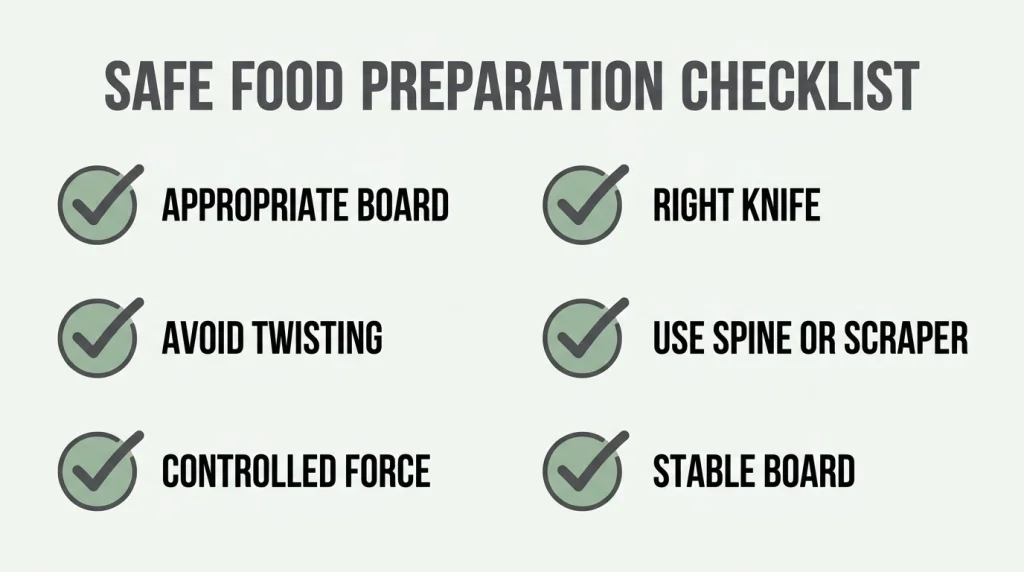
Preventing knife chips requires a suitable board and careful cutting technique. Even an excellent soft board cannot compensate for twisting, lateral pressure, or striking hard objects.
Thin cutting edges are designed primarily for controlled cutting. Sideways force can damage them when the edge becomes trapped in food or the board.
Six Practical Knife-Protection Habits
- Use an appropriate board: Select hinoki, suitable rubber, or well-made hardwood.
- Avoid twisting: Lift the blade before changing cutting direction.
- Control downward force: Let the sharp edge perform the cutting.
- Use the correct knife: Don’t force a thin gyuto through bones or frozen food.
- Avoid scraping with the edge: Use the spine or a bench scraper to move chopped food.
- Keep the board stable: Use suitable nonslip feet or a clean, damp towel underneath.
One overlooked issue is how cooks move chopped ingredients. Dragging a delicate edge sideways across a board creates unnecessary contact.
My preferred rule is simple: cut with the edge, move food with the spine. This small habit is worth developing alongside good board selection.
How Do You Clean a Cutting Board Used With Japanese Knives?
Clean the board according to its material and manufacturer’s instructions. Proper washing matters more for food safety than whether the board is expensive or inexpensive.
The CDC’s food safety recommendations advise keeping raw meat, poultry, and seafood separate from ready-to-eat foods.
Cleaning Hinoki Cutting Boards
- Remove food scraps promptly after cutting.
- Wash gently with mild detergent and water.
- Rinse thoroughly without soaking the wood.
- Wipe away excess moisture using a clean towel.
- Let the board air-dry with good airflow.
- Keep it out of direct sunlight and the dishwasher.
Shun recommends wetting its hinoki boards before use to help reduce staining. Follow the instructions for your specific board rather than assuming every wooden board needs identical treatment.
Cleaning Soft Synthetic Boards
Many synthetic boards are easier to maintain than natural wood. However, dishwasher compatibility depends on the exact product.
Hasegawa specifies dishwasher compatibility for its Pro-Soft Lite series. Other soft synthetic or rubber products may require hand washing.
- Remove food debris before washing.
- Use a compatible mild detergent.
- Inspect scratches and surface grooves.
- Follow manufacturer-approved temperature limits.
- Allow the board to dry before storage.
Cleaning Maple and Walnut Boards
Wooden boards need prompt washing and thorough drying. Leaving wood submerged or placing an unsuitable board in the dishwasher can cause damage.
The University of Maine Cooperative Extension provides guidance on cutting board selection, cleaning, and maintenance.
Condition compatible hardwood boards with food-grade mineral oil when needed. Our guide to oiling a wooden cutting board explains the process step by step.
Should You Use Separate Boards for Meat and Vegetables?
Yes. Using separate cutting boards for raw animal products and ready-to-eat foods helps prevent cross-contamination.
Japanese knives can prepare a wide variety of ingredients, but the cutting surface must remain clean. Raw fish and poultry require particular attention to food safety.
A Practical Two-Board Kitchen Setup
- Produce board: Hinoki, hardwood, or suitable soft synthetic material for vegetables and ready-to-eat ingredients.
- Raw-meat board: A separate food-safe board that you can clean and sanitize effectively.
This arrangement also makes daily preparation more organized. You can focus on knife technique without repeatedly moving between incompatible cleaning routines.
For more guidance, read our article explaining how to use a cutting board safely.
Common Mistakes When Buying a Japanese Knife Cutting Board
Many buying mistakes happen because shoppers focus on appearance instead of cutting performance. A premium-looking board isn’t necessarily the best match for a delicate blade.
Mistakes Worth Avoiding
- Choosing by appearance alone: Decorative stone or glass surfaces are unsuitable for regular knife work.
- Ignoring the dimensions: A narrow board limits the working space available to a longer gyuto.
- Overlooking maintenance: Some wooden boards require careful washing and occasional conditioning.
- Assuming all rubber boards are alike: Material hardness and dishwasher compatibility vary.
- Buying an unstable board: A slippery cutting surface increases the chance of losing control.
- Ignoring visible damage: Deep cracks and difficult-to-clean grooves may make replacement necessary.
I would rather choose a simple, well-constructed board than an elaborate one with uncertain materials. Function matters more than decoration.
Best Cutting Boards for Japanese Knives: Product Recommendations
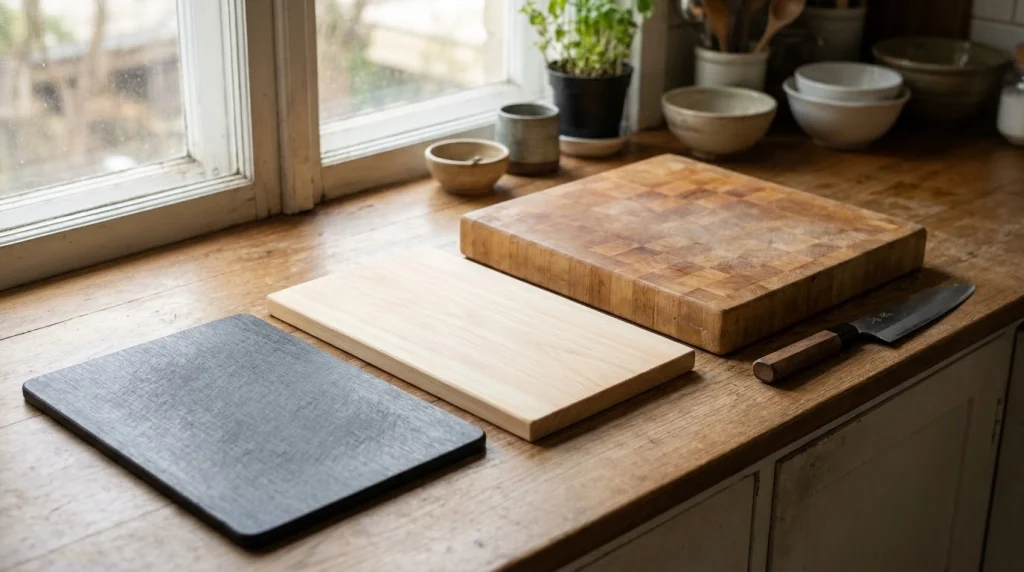
For 2026, these three established products represent different priorities: blade protection, traditional cutting feel, and everyday hardwood versatility. The selections rely on published specifications and intended use, not claimed hands-on laboratory testing.
As an Amazon Associate, we earn from qualifying purchases. The editorial suitability scores below are subjective assessments, not verified customer review ratings.
🏆 Best Overall for Blade Protection
Hasegawa Pro-Soft Lite FSRL20-3926
★★★★★ Editorial fit: 4.8/5
This Japanese cutting board measures approximately 15.4 × 10.2 × 0.8 inches. Its resilient synthetic surface and enclosed wood core create a lightweight, stable cutting platform.
I favor its design for delicate gyuto and nakiri edges because blade protection is the main priority. The manufacturer also lists this series as dishwasher-safe.
🌿 Best Traditional Wood Choice
Shun Medium Hinoki Cutting Board DM0816
★★★★☆ Editorial fit: 4.6/5
The Shun DM0816 uses Japanese hinoki cypress and measures approximately 15.75 × 10.75 inches. Its medium-soft wooden surface is designed to complement fine Japanese cutting edges.
I would choose it for traditional slicing and daily vegetable preparation. It requires hand washing and careful drying, but its lightweight design is appealing.
🔪 Best for Everyday Hardwood Prep
John Boos R-Series Maple Cutting Board R01
★★★★☆ Editorial fit: 4.4/5
This reversible hard-maple board measures 18 × 12 × 1.5 inches. Its edge-grain construction provides a substantial surface for everyday chopping and food preparation.
I recommend considering it when you want one dependable hardwood board for varied kitchen tasks. Expect more weight and wood maintenance than with a lightweight synthetic board.
Frequently Asked Questions
1. What is the best cutting board material for Japanese knives?
Soft synthetic rubber and hinoki cypress are among the best materials for Japanese knives because they provide some give during cutting. Quality end-grain maple or walnut also works well. Choose a stable, food-safe board that suits your cutting technique and cleaning routine.
2. Can Japanese knives be used on plastic cutting boards?
Yes. Japanese knives can be used on suitable food-grade plastic cutting boards. However, plastic surfaces vary in hardness, so some are more forgiving than others. Replace heavily grooved boards when they become difficult to clean, and avoid twisting delicate knife edges during use.
3. Are end-grain cutting boards better for Japanese knives?
End-grain boards can be excellent for Japanese knives because their exposed wood-fiber structure provides a comfortable cutting surface. However, a high-quality edge-grain board is also suitable for many home cooks. Soft synthetic rubber or hinoki may be preferable when edge protection takes priority.
4. Is a rubber cutting board better than a wooden cutting board?
A specialized soft rubber board can be better for delicate knife work because its resilient surface cushions cutting contact. Wooden boards offer natural appearance, different cutting feels, and long-term usefulness. Neither material is universally superior, so consider blade protection, maintenance, stability, and food safety.
5. How often should I replace a Japanese knife cutting board?
There is no fixed replacement schedule. Replace the board when deep grooves, persistent cracks, serious warping, or other damage prevent safe use and effective cleaning. Many wooden and synthetic boards can remain useful for years when maintained correctly, but their condition matters more than their age.
Final Verdict: Which Cutting Board Should You Choose?
The best cutting boards for Japanese knives combine a forgiving cutting surface with good stability and manageable cleaning requirements. Your ideal choice depends on how frequently you cook and which knives you use.
Hasegawa Pro-Soft Lite is my leading recommendation when blade protection is the priority. Its soft surface and supportive wood-core construction make it especially appealing for precision work.
Shun Hinoki is an excellent alternative for cooks who appreciate traditional Japanese materials. Its light wooden surface pairs naturally with controlled slicing and vegetable preparation.
John Boos Maple R-Series makes sense when you need a substantial hardwood board for everyday kitchen tasks. It offers versatility without requiring a specialized Japanese cutting surface.
Before buying, measure your countertop, consider your cleaning routine, and check the current product specifications. The right board should make daily food preparation safer, more comfortable, and easier on your knives.

