How Many Cutting Boards Do You Need? A Practical Kitchen Guide for 2026
Quick Answer
Most home cooks need at least two cutting boards: one for raw meat, poultry, and seafood, and another for vegetables, fruit, and ready-to-eat foods. Three boards offer greater convenience by adding a separate surface for bread, cheese, or cooked meals. The best setup depends on your cooking habits, available space, and how consistently you follow safe cutting board practices.
Recommended Cutting Board Setup
- One board: Manageable for limited tasks with thorough cleaning between food types, but less convenient.
- Two boards: The practical starting point for separating raw animal products from ready-to-eat foods.
- Three boards: A versatile arrangement for everyday family cooking and meal preparation.
- Four boards: Helpful for frequent cooking, multiple food categories, or several people preparing meals.
- Five or more: Usually unnecessary for a typical household unless specialized cooking demands them.
My recommendation: Start with two clearly designated boards. Add a third when you regularly prepare several ingredients at once.
How many cutting boards do you need for a safe, organized kitchen? It’s a common question because buying too many boards creates clutter, while relying on one can complicate food preparation.
I prefer to think about cutting boards by their jobs rather than their total number. This guide explains which boards you need, how to assign them, and when adding another makes sense.
How Many Cutting Boards Should Every Kitchen Have?
For most households, two to three cutting boards provide a practical balance between food safety and convenience. The goal is to separate potentially contaminated ingredients while keeping everyday preparation manageable.
A cutting board is a food-safe surface designed to support chopping, slicing, trimming, and other knife work. The number you need depends on the foods you handle and whether you can clean boards between tasks.
The Minimum: Two Cutting Boards
Two boards are an excellent starting arrangement for anyone who prepares both raw animal products and ready-to-eat foods. They create a simple system that’s easy to remember.
- Board one: Reserve for raw beef, chicken, turkey, fish, and other raw animal products.
- Board two: Reserve for vegetables, fruit, bread, cheese, and ready-to-eat ingredients.
For example, you can chop vegetables on one board while preparing chicken on another. Keeping these tasks separate reduces opportunities for raw juices to reach uncooked foods.
The Ideal Everyday Setup: Three Cutting Boards
Three boards offer more flexibility without requiring much additional storage. I consider this a sensible arrangement for a household that cooks regularly.
- Raw protein board: For uncooked meat, poultry, and seafood.
- Produce board: For washed vegetables, herbs, and fruit.
- Ready-to-eat board: For bread, cheese, sandwiches, and cooked ingredients.
The third board becomes particularly helpful during busy meals. You can prepare salad ingredients without moving bread or cooked food onto another surface.
When Four or More Boards Make Sense
Four boards can improve organization in households that cook several dishes at once. They also make it easier to dedicate a separate surface to raw seafood or poultry.
However, additional boards don’t automatically make food preparation safer. Cleaning, handwashing, and preventing cross-contamination remain essential.
How Many Cutting Boards Do You Need for Different Households?
The following recommendations are practical planning suggestions rather than official food-safety minimums. Choose the arrangement that fits your cooking routine.
| Kitchen Type | Suggested Boards | Main Reason |
|---|---|---|
| Vegetarian household | 1–2 | General prep and convenient separation |
| Single home cook | 2 | Raw proteins and ready-to-eat foods |
| Couple cooking regularly | 2–3 | Separate preparation tasks |
| Family household | 3–4 | Greater meal-preparation flexibility |
| Frequent batch cooking | 3–5 | Multiple ingredients and preparation stages |
A vegetarian household might comfortably use one board when food types and cleaning needs are straightforward. A household preparing raw chicken and fresh salads should ideally maintain separate boards.
Why Do You Need Separate Cutting Boards for Different Foods?

Separate cutting boards help prevent cross-contamination, which happens when harmful microorganisms transfer from one food or surface to another. Raw meat juices can contaminate food that won’t receive further cooking.
The Centers for Disease Control and Prevention recommends separating raw meat, poultry, and seafood from produce, bread, and other ready-to-eat foods.
Raw Meat Can Contaminate Ready-to-Eat Foods
Raw poultry may contain harmful bacteria such as Salmonella or Campylobacter. These organisms can spread through contaminated knives, hands, and cutting surfaces.
Imagine cutting raw chicken before preparing a fresh salad. If you reuse the same unwashed board, bacteria could reach vegetables that you intend to eat without cooking.
Separate Boards Simplify Your Cooking Routine
Dedicated boards make ingredient handling easier to organize. You don’t need to interrupt every preparation task to wash a single shared board.
Separation is especially useful when two people cook together. Each person can work on a different ingredient category without sharing a potentially contaminated surface.
Color Coding Helps Prevent Mix-Ups
Color-coded cutting boards make their intended uses easier to recognize. However, no universal household color standard is required.
- Red: Commonly assigned to raw red meat.
- Yellow: Often assigned to raw poultry.
- Blue: Commonly used for raw seafood.
- Green: Commonly used for vegetables and fruit.
- White: Sometimes assigned to bread, dairy, or general preparation.
These colors are examples of kitchen conventions, not guarantees of cleanliness. Choose a consistent system and wash every board appropriately.
Do You Need Separate Cutting Boards for Meat, Chicken, and Fish?
You don’t necessarily need an individual board for every type of raw animal product. One dedicated board can serve raw meat, poultry, and seafood when cleaned thoroughly between uses.
The U.S. Food and Drug Administration advises using separate cutting boards for raw animal products and fresh produce whenever possible.
When One Raw-Meat Board Is Enough
A single raw-protein board can work for ordinary household cooking. Thorough cleaning between different animal products remains necessary.
For example, don’t trim raw chicken and immediately prepare fish on the same unwashed surface. Wash the board, knife, and affected utensils before changing ingredients.
When Additional Raw-Protein Boards Help
Separate meat, poultry, and seafood boards can benefit frequent cooks. They reduce interruptions when preparing multiple proteins simultaneously.
Extra separation may also help control food allergens, including fish and shellfish. Dedicated equipment can be useful, although careful cleaning remains essential.
Can You Use Just One Cutting Board for Everything?
One cutting board can serve different food categories if you thoroughly clean it between tasks and sanitize when appropriate. However, two dedicated boards are easier for most mixed-diet households to manage.
Using the same unwashed cutting board for raw chicken and fresh vegetables is unsafe. A quick wipe with a paper towel doesn’t provide adequate cleaning.
How to Make a One-Board Kitchen Safer
- Prepare ready-to-eat ingredients before handling raw meat whenever practical.
- Transfer chopped produce into clean containers.
- Use the board for raw animal products afterward.
- Wash the board thoroughly with hot, soapy water.
- Sanitize the board when appropriate, following food-contact guidance.
- Rinse as directed and dry completely before storage.
This arrangement requires careful attention to timing and hygiene. If you regularly prepare raw proteins, purchasing a second board is often the simpler choice.
Which Cutting Board Materials Should You Choose?
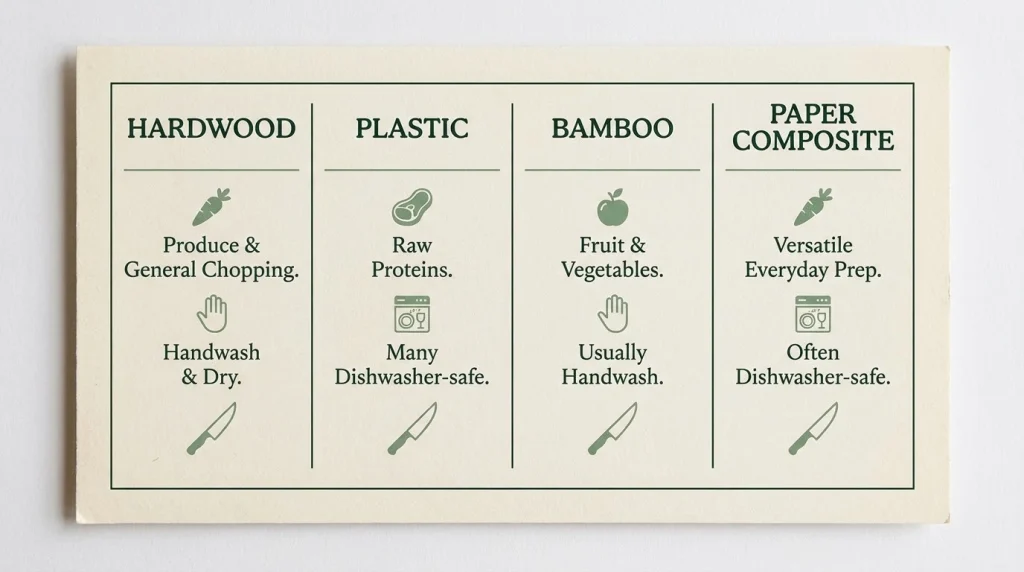
Wood, plastic, bamboo, and paper-composite boards offer different advantages. Your ideal combination depends on maintenance preferences and food preparation needs.
For a detailed material comparison, see my guide to wood vs. plastic cutting boards.
Wooden Cutting Boards
A good hardwood cutting board provides a stable, knife-friendly surface for everyday preparation. Maple and walnut are popular materials for well-made kitchen boards.
Wood requires careful washing and thorough drying. Most traditional wooden boards should not go in the dishwasher unless the manufacturer explicitly permits it.
Plastic Cutting Boards
Plastic boards are practical for raw meat preparation because many models tolerate dishwasher cleaning. They are often lightweight and available in distinct colors.
However, repeated knife contact creates scratches and grooves. Replace plastic boards when damage makes thorough cleaning difficult.
Bamboo Cutting Boards
Bamboo boards offer a firm cutting surface and are available in many sizes. They can work well for fruit, vegetables, and general preparation.
Bamboo may feel harder under a knife than some hardwoods. Follow the manufacturer’s maintenance instructions and avoid prolonged soaking.
Paper-Composite Cutting Boards
Paper-composite boards combine thin construction with convenient cleaning options. Some established products are dishwasher-safe and suitable for frequent use.
Check the manufacturer’s instructions before machine washing. Not every composite product has identical temperature or cleaning limits.
Material Comparison Table
| Material | Practical Use | Typical Care |
|---|---|---|
| Hardwood | Produce and general chopping | Handwash and dry |
| Plastic | Raw proteins | Many are dishwasher-safe |
| Bamboo | Fruit and vegetables | Usually handwash |
| Paper composite | Versatile everyday prep | Often dishwasher-safe |
The University of Maine Cooperative Extension explains how board materials, cleaning practices, and surface condition affect food safety.
What Sizes of Cutting Boards Do You Need?
A useful collection includes different sizes rather than several identical boards. Larger surfaces provide more space, while smaller boards are convenient for quick tasks.
Small Cutting Board
A board around 8 × 10 inches works for small ingredients and quick snacks. It’s convenient when you only need to slice fruit or garnish a meal.
Small boards can become crowded during larger chopping jobs. Avoid using a board that leaves insufficient room for safe knife movement.
Medium Cutting Board
A board around 12 × 16 inches is a practical everyday size. It provides enough room for many vegetables and routine meal-preparation tasks.
For a two-board kitchen, I would prioritize a comfortable medium surface. A second board can be smaller or larger depending on your raw-protein preparation.
Large Cutting Board
A board around 15 × 20 inches offers space for bigger ingredients and larger batches. It’s useful when preparing several portions at once.
Before purchasing, measure your countertop and sink. An oversized board that cannot be washed conveniently may create unnecessary maintenance problems.
How Should You Clean and Sanitize Multiple Cutting Boards?
Wash cutting boards after each food preparation task. Proper cleaning is more important than owning a large collection.
The FoodSafety.gov four-step food safety guide emphasizes cleaning and separating foods to reduce contamination risks.
A Simple Cleaning Routine
- Remove scraps: Clear leftover ingredients from the surface.
- Wash with soap: Scrub using hot, soapy water and a suitable brush or sponge.
- Clean every surface: Include edges, grooves, handles, and the underside.
- Rinse: Remove food residue and detergent thoroughly.
- Sanitize when needed: Use an appropriate food-contact sanitizing method.
- Dry completely: Allow both sides to dry before storage.
For dishwasher-safe products, follow the manufacturer’s cleaning directions. Some boards tolerate high temperatures, while others can warp or deteriorate.
My guide to which cutting boards are dishwasher safe explains how to identify suitable materials.
Cleaning Is Not the Same as Sanitizing
Cleaning removes food debris and grease from a surface. Sanitizing reduces microorganisms using an appropriate method after the board has been cleaned.
Use only products approved for their intended food-contact application. Follow label directions for dilution, contact time, rinsing, and compatible materials.
Never mix chlorine bleach with vinegar, ammonia, or other household cleaners. Dangerous chemical reactions can occur.
How Should You Store Multiple Cutting Boards?
Store cutting boards only after they have dried thoroughly. Trapped moisture can contribute to unpleasant odors, mold, and material damage.
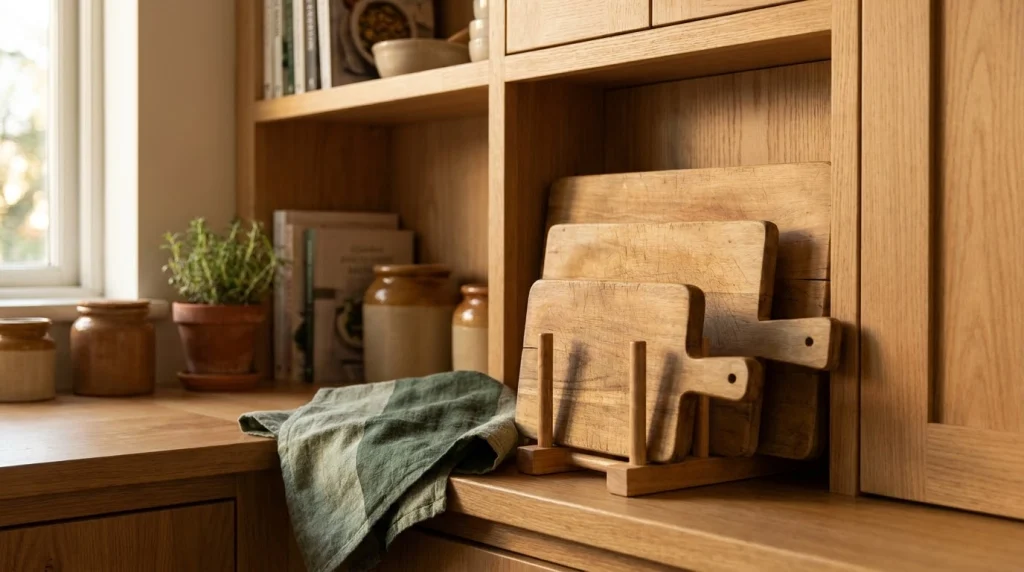
I prefer vertical storage when space allows. It encourages airflow and makes different boards easier to identify.
Practical Storage Options
- Vertical racks: Keep boards separated and accessible.
- Cabinet dividers: Organize boards without crowding countertops.
- Dedicated stands: Work well with matching cutting board sets.
- Wall-mounted storage: Can save counter space when installed securely.
Do not stack wet wooden boards tightly together. Moisture can remain trapped between their surfaces.
For more prevention tips, read my guide on how to prevent mold on cutting boards.
When Should You Replace an Old Cutting Board?
Replace cutting boards when wear or damage prevents safe cleaning. There is no single replacement schedule that applies to every material.
Inspect your boards regularly, especially those used for raw meat. Pay attention to damaged surfaces rather than relying only on their age.
Warning Signs That a Cutting Board Needs Replacement
- Deep knife grooves: Food residue becomes difficult to remove.
- Large cracks: Openings can trap debris and moisture.
- Severe warping: The board rocks or moves during cutting.
- Splintering: Loose wood creates an unsuitable cutting surface.
- Persistent contamination: Damage or unwanted growth cannot be removed safely.
Some wooden cutting boards can be professionally or carefully resurfaced when their construction remains sound. Deeply damaged plastic boards are often better replaced.
If you are considering repairs, review my guide to resurfacing a plastic cutting board safely before attempting any sanding.
How Can You Choose the Right Number of Boards Without Overspending?
Start by reviewing the ingredients you prepare every week. Then purchase boards for distinct tasks rather than buying a large collection immediately.
My Practical Shopping Checklist
- Choose at least two separate boards if you prepare raw animal products.
- Look for non-slip feet or use a suitable clean, damp towel underneath.
- Pick a size that accommodates your most common ingredients.
- Check dishwasher compatibility before purchasing.
- Choose surfaces that are comfortable for your kitchen knives.
- Make sure the boards fit your sink and storage space.
- Consider a third board if you regularly prepare several foods simultaneously.
For my preferred everyday arrangement, I would combine an easy-clean raw-protein board with a larger vegetable board. A smaller ready-to-eat board would be my first addition.
That approach avoids unnecessary purchases while keeping food preparation organized. It also gives each board a clear purpose.
Recommended Cutting Board Sets for Different Kitchens
If you’re building a practical cutting board collection, these established products are worth comparing. The recommendations are based on published product features and suitability, not personal laboratory testing.
Affiliate disclosure: Some product links below are Amazon affiliate search links. Qualifying purchases may earn a commission at no additional cost to you.
🏆 Practical Two-Board Setup
OXO Good Grips 2-Piece Cutting Board Set
★★★★☆ 4.0/5 retailer rating
This set includes 7.25 × 10.75-inch and 9 × 12.9-inch boards with non-slip feet, double-sided surfaces, and dishwasher-safe construction. I like this arrangement for its straightforward two-board setup and easy-clean design, particularly in smaller kitchens.
⭐ Flexible Three-Board Setup
Epicurean Kitchen Series 3-Piece Cutting Board Set
★★★★★ 4.9/5 manufacturer listing rating
The set offers three paper-composite boards measuring approximately 8 × 6, 11.5 × 9, and 14.5 × 11.25 inches. Their thin, dishwasher-safe construction makes this an appealing option for a versatile three-board kitchen. The manufacturer’s published rating may include Kitchen Series variants.
🎨 Best for Organized Food Categories
Joseph Joseph Folio Icon 4-Piece Cutting Board Set
★★★☆☆ 3.4/5 manufacturer customer rating
This set includes four approximately 8 × 12-inch boards with food-category icons, non-slip feet, and a slim storage case. I would consider it when organization matters more than keeping the board count minimal. Its published customer rating is lower than the other rated option, so compare reviews carefully.
Ratings reflect published retailer or manufacturer listings checked in November 2026. They are not CookingFlavour hands-on test scores, and ratings or availability may change.
Frequently Asked Questions
Is Two Cutting Boards Enough for a Family?
Yes, two cutting boards can be enough for a family when one is reserved for raw animal products and another for ready-to-eat foods. However, a third board can reduce interruptions during meal preparation. Proper washing and food separation matter more than household size alone.
Do Vegetables and Meat Need Separate Cutting Boards?
Yes, using separate cutting boards for raw meat and ready-to-eat vegetables is recommended. Raw animal products can carry harmful microorganisms that may transfer to salad ingredients or other uncooked foods. Thorough cleaning between tasks is essential even when dedicated boards are available.
Do You Need a Separate Cutting Board for Bread?
A dedicated bread board is convenient but not essential. Bread can share a clean, ready-to-eat food board with suitable ingredients such as fruit or cheese. Clean the board between tasks when necessary, especially if allergens or food residues could cause a problem.
How Many Cutting Boards Do Professional Chefs Use?
Professional kitchens may use several designated cutting boards for different ingredients and preparation stations. The number varies with kitchen size, menu, workload, and applicable food-safety procedures. Home cooks usually need fewer boards because they prepare smaller quantities and fewer dishes simultaneously.
Is It Better to Buy a Cutting Board Set or Individual Boards?
A cutting board set is convenient when it provides suitable sizes and clearly separated uses. Individual boards offer greater freedom to combine materials and dimensions. Compare cleaning instructions, stability, storage requirements, and actual cooking needs before choosing either approach.
Final Verdict: How Many Cutting Boards Do You Really Need?
For most home cooks, two cutting boards are the sensible starting point, while three offer greater everyday convenience. Four or more can help busy kitchens, but extra boards are not automatically necessary.
My preferred approach is simple: reserve one board for raw animal products, another for vegetables, and add a third for bread or cooked foods when useful.
As of 2026, the central food-safety principle remains unchanged: keep raw animal products away from ready-to-eat foods and clean preparation surfaces properly. The best cutting board collection is one you can maintain consistently.
Start with two reliable boards, give each a clear purpose, and expand only when your cooking routine calls for it.