Titanium vs. Plastic Cutting Boards: Which Is Better for Your Kitchen?
Quick Answer
Plastic cutting boards are the better everyday choice for most home cooks because they’re affordable, lightweight, easy to wash, and gentle on knives. Titanium boards offer a durable, nonporous surface that doesn’t shed plastic, but they’re more expensive and may wear knife edges faster. Neither material eliminates the need for proper cleaning and safe food-handling practices.
Key Differences at a Glance
- Knife friendliness: Plastic generally protects sharp edges better than titanium.
- Durability: Solid titanium resists corrosion and doesn’t develop the same deep plastic grooves.
- Food safety: Both require thorough washing and protection against cross-contamination.
- Plastic particles: Titanium avoids plastic wear particles, while plastic boards can shed particles during cutting.
- Cost: Plastic is typically much cheaper to purchase or replace.
- Best choice: Choose plastic for regular chopping or titanium if avoiding plastic is your main priority.
Choosing between titanium and plastic cutting boards sounds simple until you consider your knives, cleaning routine, and food safety. I’ve found that the most useful way to compare them is to focus on everyday cooking rather than marketing claims.
In this guide, I’ll explain how each material behaves, where the trade-offs matter, and which board makes sense for different kitchens.
What Is the Difference Between Titanium and Plastic Cutting Boards?
A titanium cutting board uses a solid metal surface, while a plastic cutting board usually consists of polyethylene or polypropylene. Their different hardness, construction, and wear characteristics affect how they perform during food preparation.
Both can be practical. However, they solve different problems.
What Is a Titanium Cutting Board?
A titanium cutting board is a food-preparation surface made from titanium metal. Quality products commonly advertise commercially pure titanium, such as Grade 1, rather than a thin decorative coating.
Titanium resists corrosion and doesn’t absorb water like porous materials. Its rigid metal surface also makes it different from traditional plastic and wooden boards.
- Resists rust and corrosion.
- Doesn’t contain plastic in its cutting surface when made from solid titanium.
- Usually has a thin, rigid construction.
- Requires no oiling or wood conditioning.
- May produce more cutting noise than plastic.
Not every product marketed as titanium is solid titanium. Check the material description before buying, especially when the price seems unusually low.
What Is a Plastic Cutting Board?
Plastic cutting boards are commonly manufactured from food-contact polyethylene or polypropylene. They provide a relatively forgiving surface that allows a knife edge to contact the board without striking rigid metal.
This makes plastic particularly convenient for repeated slicing and chopping. It’s one reason plastic remains common in home kitchens.
- Usually lightweight and inexpensive.
- Available in several thicknesses and sizes.
- Many models are dishwasher-safe.
- Generally gentle on kitchen knives.
- Develops scratches and cutting grooves with use.
Plastic boards eventually need replacement when their grooves become excessively worn or difficult to clean.
Titanium vs. Plastic Cutting Boards: Complete Comparison
 Save
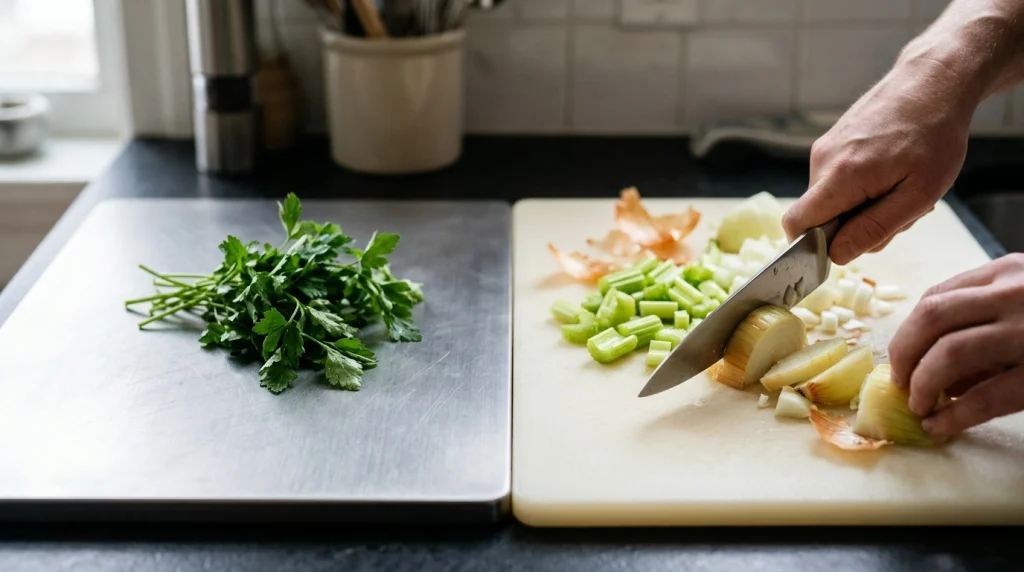
The biggest differences involve knife wear, surface durability, purchase price, and maintenance. Here’s how the materials compare in practical kitchen use.
| Feature | Titanium | Plastic |
|---|---|---|
| Material | Titanium metal | Usually polyethylene or polypropylene |
| Knife friendliness | Less forgiving than plastic | Generally more forgiving |
| Surface wear | Resists deep plastic-like gouges | Can develop grooves and scratches |
| Cleaning | Wash with soap and water | Soap and water; many are dishwasher-safe |
| Plastic particle shedding | None from a solid, uncoated titanium surface | Possible during cutting and wear |
| Food-contact surface | Nonporous | Nonporous when intact |
| Purchase cost | Typically premium-priced | Usually budget-friendly |
| Cutting noise | Often sharper or louder | Generally quieter |
| Best suited for | Plastic-free preparation preference | Daily chopping and knife care |
My practical verdict: Plastic offers the more balanced cutting experience. Titanium becomes appealing when material longevity and avoiding a plastic cutting surface matter more than knife comfort.
Are Titanium Cutting Boards Better for Food Safety?
Titanium is not automatically safer than plastic simply because it’s metal. Food safety depends on cleaning, surface condition, and preventing raw foods from contaminating ready-to-eat ingredients.
A clean plastic board can be a safe option. A dirty titanium board can still spread harmful microorganisms.
Does Titanium Kill Bacteria Automatically?
Some manufacturers promote titanium boards as antibacterial or self-sterilizing. However, those claims should not be treated as proof that a particular board disinfects itself during normal kitchen use.
Specialized titanium-based antimicrobial treatments are not necessarily equivalent to an ordinary titanium sheet. Always follow standard washing and sanitizing procedures.
Can Plastic Cutting Boards Harbor Bacteria?
Plastic boards can become difficult to clean when repeated knife cuts create deep grooves. Those damaged areas may trap food residue and complicate cleaning.
The USDA recommends replacing excessively worn cutting boards with hard-to-clean grooves. That recommendation applies regardless of the material.
For additional guidance, see the USDA Food Safety and Inspection Service.
How Can You Prevent Cross-Contamination?
The safest routine is straightforward: separate raw animal products from foods that won’t receive further cooking. This matters more than choosing titanium over plastic.
- Use a dedicated board for raw meat, poultry, and seafood.
- Use another clean board for vegetables, fruit, and bread.
- Wash boards after each food-preparation task.
- Clean knives and nearby countertops between tasks.
- Replace boards that cannot be cleaned effectively.
A two-board system is a sensible investment for almost every home kitchen.
Do Titanium Cutting Boards Dull Knives Faster Than Plastic?
 Save
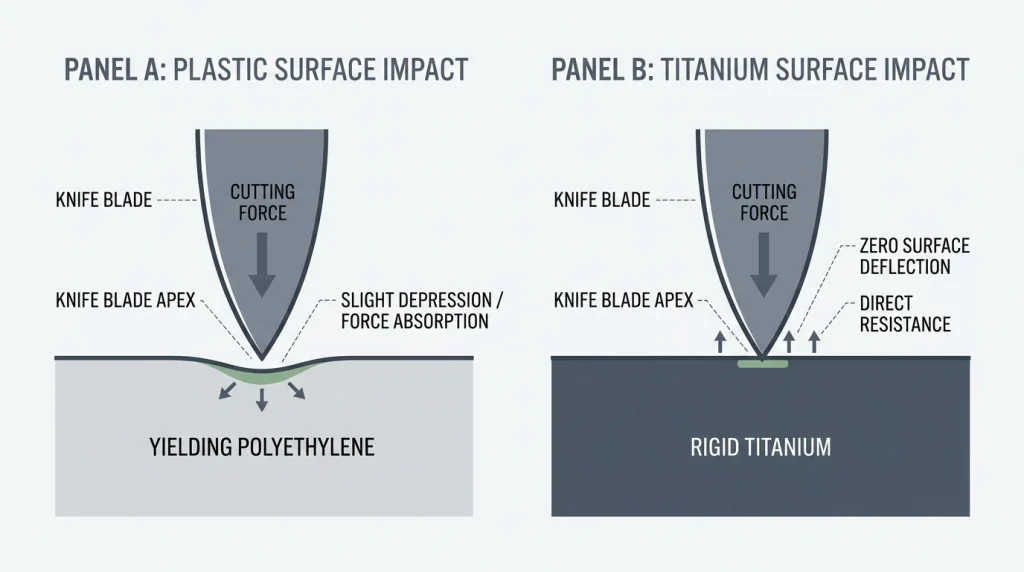
In general, titanium cutting boards are less forgiving to knife edges than plastic boards. Contact with a rigid metal surface can accelerate edge wear, depending on the knife and cutting technique.
This is an important trade-off. A cutting board should protect your knife as well as provide a usable work surface.
Why Is Plastic Gentler on Knives?
Plastic can yield slightly under pressure when a knife makes contact. This reduces the harsh impact that occurs against more rigid surfaces.
The knife still experiences friction and normal wear. However, quality plastic boards generally work well with everyday kitchen knives.
What Happens When You Cut on Titanium?
Titanium is less rigidly brittle than some metals, but it’s still a metal cutting surface. Its behavior doesn’t match the softer contact of polyethylene or polypropylene.
Frequent chopping, forceful impacts, and repeated rocking cuts may increase edge maintenance. The result also depends on blade steel, edge geometry, and surface finish.
Which Board Works Better With Expensive Knives?
For valuable Japanese knives or thin, delicate cutting edges, I’d favor a quality plastic or appropriate wooden board. There’s little reason to expose a delicate edge to unnecessary hard-surface contact.
If you already own titanium, use controlled cuts and monitor your blade’s sharpness.
- Avoid heavy chopping or striking the board.
- Keep your knife properly sharpened.
- Use a stable, nonslip base.
- Consider reserving titanium for lighter preparation tasks.
Are Plastic Cutting Boards Bad Because of Microplastics?
Plastic cutting boards can release small plastic particles when knives abrade their surfaces. However, the presence of particles alone doesn’t establish the level of health risk from ordinary household use.
Research into human exposure and the health implications of microplastics continues to develop. It would be misleading to claim that every plastic cutting board causes a specific disease.
How Do Plastic Particles Enter Food?
A sharp knife repeatedly contacts the plastic surface during chopping. Over time, that mechanical contact can remove tiny amounts of material.
Visible grooves are one sign of surface wear. Not every released particle will be visible to the eye.
Does Titanium Eliminate the Problem?
A solid, uncoated titanium board doesn’t contain plastic in its cutting surface. Therefore, it avoids plastic particles originating from that surface.
That doesn’t mean titanium is completely wear-free or guarantees zero exposure to contaminants. Manufacturing quality, cleaning, and contact with other kitchen materials still matter.
How Can You Reduce Plastic Board Wear?
- Use controlled cutting motions rather than excessive force.
- Replace heavily scratched and gouged boards.
- Choose sturdy boards intended for food preparation.
- Follow the manufacturer’s cleaning and temperature recommendations.
- Avoid using damaged boards that shed visible fragments.
If minimizing contact with plastic is a personal priority, titanium offers one alternative. Wood is another option worth considering.
Which Cutting Board Is Easier to Clean?
Both titanium and plastic cutting boards are relatively easy to wash when their surfaces remain in good condition. The more important difference is how each surface changes with use.
Plastic may accumulate deep knife grooves. Titanium generally retains a more consistent metal surface, although scratches and cosmetic marks can still develop.
How to Clean a Titanium Cutting Board
- Remove loose food scraps after cutting.
- Wash the board with warm water and dish soap.
- Scrub away remaining food residue with a suitable sponge.
- Rinse thoroughly with clean water.
- Dry before storing, following the manufacturer’s care instructions.
Check whether your particular titanium board is dishwasher-safe. Any glued feet, coatings, or attached components may have different care requirements.
How to Clean a Plastic Cutting Board
- Scrape away leftover food particles.
- Wash with hot, soapy water.
- Use the dishwasher if the manufacturer permits it.
- Sanitize when necessary using an appropriate food-contact method.
- Allow the board to dry completely before storage.
Do not assume every plastic board tolerates dishwasher heat. Thin or unsuitable products may warp.
When Should You Sanitize a Cutting Board?
Sanitizing is especially useful after raw meat or poultry preparation. It provides an additional hygiene step beyond removing visible food and grease.
According to USDA guidance, one sanitizing option is a solution containing one tablespoon of unscented liquid chlorine bleach per gallon of water. Follow the product’s instructions and rinse as appropriate.
For broader advice, consult the CDC food safety resources.
Which Cutting Board Lasts Longer?
Solid titanium has strong corrosion resistance and can remain usable for many years. Plastic is usually more vulnerable to accumulated cutting grooves and eventual replacement.
However, overall lifespan depends on manufacturing quality, usage frequency, and care.
How Long Does a Titanium Cutting Board Last?
A well-made solid titanium board can potentially provide long service because its material resists corrosion and moisture damage. It doesn’t require the periodic oiling associated with some wooden boards.
Still, durability claims such as “lasts forever” should be viewed cautiously. Surface condition, deformation, construction, and suitability for food contact remain relevant.
How Long Does a Plastic Cutting Board Last?
There is no universal replacement schedule for plastic cutting boards. A lightly used board might remain serviceable much longer than one used for heavy chopping every day.
Inspect your board instead of relying on an arbitrary number of months.
- Replace boards with deep, difficult-to-clean grooves.
- Discard cracked or severely warped boards.
- Replace boards shedding visible fragments.
- Stop using a board that no longer rests securely on the countertop.
Is Titanium Worth the Extra Money?
Whether titanium is worth buying depends on what you value most. A higher purchase price only makes sense when its advantages align with your cooking habits.
It’s helpful to distinguish long-term material durability from everyday cutting performance.
When Titanium Makes Sense
- You want a food-preparation surface without plastic.
- You value a corrosion-resistant, nonporous material.
- You don’t mind paying more upfront.
- You primarily perform lighter cutting tasks.
- You’re comfortable maintaining knife sharpness more often if needed.
When Plastic Makes More Sense
- You prepare meals daily.
- You want to protect expensive knives.
- You prefer a quieter cutting surface.
- You need multiple boards on a modest budget.
- You want straightforward dishwasher cleaning.
For most households, investing in two good plastic boards and replacing them when worn provides better practical value than purchasing one premium titanium board.
Which Cutting Board Is Better for Different Foods?
Different ingredients create different cutting demands. Matching the board to the job helps improve comfort and food-handling efficiency.
For Raw Meat and Poultry
A dedicated dishwasher-safe plastic board is a convenient option for raw meat. Choose a stable model with enough working space and, ideally, a juice groove.
Titanium can also be used when properly cleaned. Neither material prevents cross-contamination automatically.
For Vegetables and Fruit
Plastic is useful for frequent slicing, mincing, and chopping. It feels more forgiving during repetitive knife work.
Titanium can handle light produce preparation, although its firmer cutting surface may be less comfortable.
For Bread and Sandwiches
Plastic works well for sandwich preparation and ordinary bread slicing. A wood or plastic board may also help reduce the harsh sound of serrated knives contacting the surface.
For Delicate Japanese Knives
I’d choose a suitable plastic board rather than metal. Thin knife edges benefit from forgiving contact during precision cutting.
What Should You Look for Before Buying?
 Save
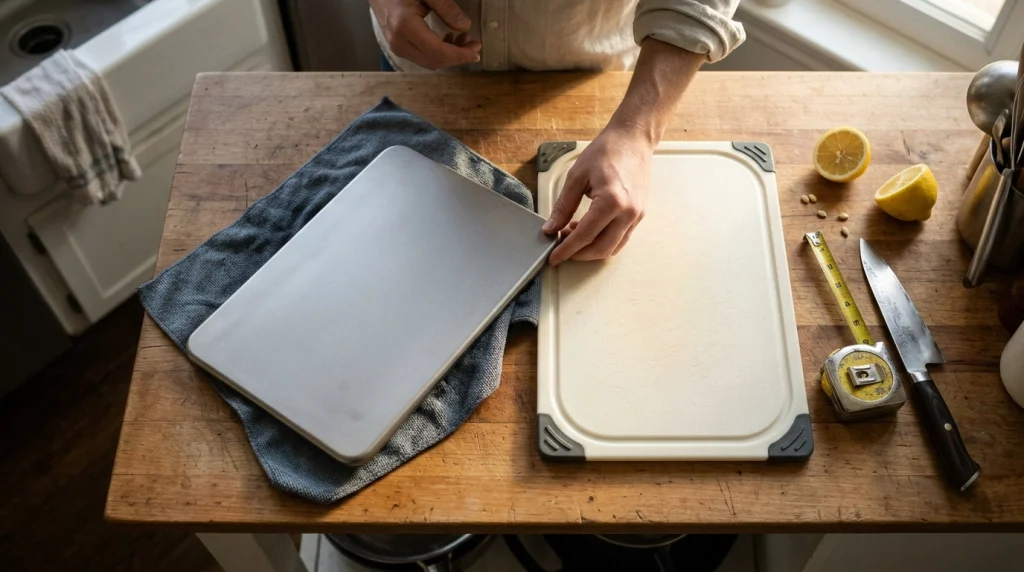
Material alone doesn’t determine whether a cutting board is comfortable and safe to use. Size, stability, surface finish, and cleaning instructions are equally important.
Titanium Cutting Board Buying Checklist
- Material: Look for a clear description of solid titanium versus titanium-coated metal.
- Documentation: Request meaningful material or food-contact testing information when advertised.
- Edges: Check for smooth, rounded corners and safe handling.
- Stability: Use a nonslip mat if the board moves.
- Surface: Avoid questionable coatings or rough finishes.
- Care: Review the manufacturer’s actual washing recommendations.
Plastic Cutting Board Buying Checklist
- Material: Choose plastic intended for food contact.
- Thickness: Select a board that resists unwanted bending.
- Size: Ensure enough room for both ingredients and knife movement.
- Grip: Look for nonslip feet or use a damp towel underneath.
- Cleaning: Confirm dishwasher compatibility if that’s important.
- Replacement: Favor an affordable model you can replace when worn.
Recommended Titanium and Plastic Cutting Boards
If you’re comparing specific products, these three options illustrate the main priorities: a durable metal surface, a practical everyday plastic board, and a coordinated set for separating foods.
These are feature-based recommendations, not hands-on test winners. Confirm specifications, current prices, and independent customer reviews before purchasing.
🏆 Best for Avoiding Plastic
Titanium Wares Grade 1 Titanium Cutting Board
★★★★☆
The manufacturer advertises an uncoated Grade 1 titanium surface, several sizes, and corrosion resistance. I’d consider this style for buyers who prioritize avoiding plastic, while keeping a softer board for demanding knife work. The stars represent an editorial suitability score, not verified customer reviews.
💰 Best for Everyday Chopping
OXO Good Grips Utility Cutting Board
★★★★★
This double-sided plastic board includes nonslip feet and a drip-catching design. Its approximately 38 × 27 cm work surface makes it a practical everyday option. It’s my feature-based pick for frequent chopping and straightforward cleaning.
🍽️ Best for Organized Food Prep
Joseph Joseph Folio 4-Piece Cutting Board Set
★★★★☆
Four color-coded boards, textured cutting surfaces, and a compact storage case make food separation easier to organize. I like the design for busy kitchens that prepare several ingredient categories. The stars are editorial assessments rather than customer-review averages.
Frequently Asked Questions
Are titanium cutting boards safer than plastic?
Not automatically. Both can serve as food-preparation surfaces when properly manufactured and maintained. Titanium avoids particles from plastic cutting-surface wear, but it doesn’t eliminate bacteria or cross-contamination. Cleaning and separating raw animal foods from ready-to-eat foods remain essential for either material.
Do titanium cutting boards damage kitchen knives?
Titanium’s rigid metal surface may increase knife-edge wear compared with softer plastic boards. The exact effect depends on blade hardness, cutting technique, and board finish. For delicate Japanese knives or frequent chopping, a forgiving plastic or suitable wooden board is generally preferable.
Are titanium cutting boards dishwasher-safe?
Many solid titanium boards are marketed as dishwasher-safe, but always check the manufacturer’s directions. Coatings, attached grips, and other components may affect cleaning requirements. Washing with dish soap and water is a straightforward option, followed by thorough rinsing and drying.
Are plastic cutting boards hygienic?
Yes, food-contact plastic boards can be hygienic when cleaned properly and kept in good condition. Their main maintenance concern is deep cutting grooves that become difficult to clean. Wash after food preparation, separate raw meats from ready-to-eat foods, and replace excessively worn boards.
Should I replace my plastic cutting board with titanium?
Replace plastic with titanium if avoiding a plastic cutting surface is a major priority and you accept the potential knife-wear trade-off. Otherwise, a quality plastic board remains a practical choice. For most households, proper cleaning and replacement of damaged boards matter more than switching materials.
Final Verdict: Titanium or Plastic Cutting Board?
For everyday home cooking, I’d choose a well-made plastic cutting board. It offers the best combination of affordability, knife friendliness, easy cleaning, and practical usability.
Titanium is worth considering when you specifically want a solid, plastic-free surface with strong corrosion resistance. Just remember that its material advantages don’t automatically make it better for your knives or food hygiene.
My final recommendation: Keep separate, easily cleaned boards for raw proteins and ready-to-eat foods. Choose the material that fits your cutting habits, inspect it regularly, and replace it when it becomes unsuitable for safe food preparation.
For more general information about materials and consumer safety, visit the FDA food resources.

