How Do You Cut With a Chef’s Knife? A Beginner’s Guide
Quick Answer
To cut with a chef’s knife, hold the knife securely with a pinch grip, curl the fingers of your other hand into a claw, and place the food on a stable cutting board. Move the blade through the ingredient with a controlled slicing or rocking motion instead of forcing it straight down. Start slowly, keep your fingertips behind your knuckles, and let the sharp edge do the work.
How to Cut With a Chef’s Knife
- Prepare your station: Place a sturdy cutting board on a dry counter and keep your knife handle dry.
- Grip the blade: Pinch the blade near the handle with your thumb and index finger while wrapping your other fingers around the handle.
- Protect your fingers: Curl your guide-hand fingertips inward and use your knuckles to guide the blade.
- Stabilize the food: Cut round vegetables in half or trim a flat side before slicing.
- Move smoothly: Use a controlled forward-and-down stroke or a gentle rocking motion suited to your knife and ingredient.
- Practice first: Make slow, even cuts before trying to increase your speed.
One Safety Rule to Remember
- If the ingredient slips, your grip feels unstable, or the blade gets stuck, stop and reposition everything before continuing.
Learning how to cut with a chef’s knife makes everyday cooking easier, from chopping onions to slicing carrots and mincing fresh herbs. I’ll walk through the basic grips, cutting motions, and common mistakes that help beginners build control without rushing.
You don’t need professional speed or complicated techniques to get started. The goal is to make clean, consistent cuts while keeping your fingers safely away from the blade.
What Does Cutting With a Chef’s Knife Mean?
Cutting with a chef’s knife means using a broad, sharp kitchen knife to slice, chop, dice, or mince ingredients with controlled movements. Its curved cutting edge supports rocking motions, while the straighter sections can help with other cutting styles.
A chef’s knife works well for many everyday ingredients, including onions, carrots, potatoes, boneless meat, and fresh herbs. The correct technique depends on the ingredient’s shape, firmness, and the size of the pieces you need.
For a closer look at the tool itself, read this guide to what a chef’s knife is used for.
How Should You Hold a Chef’s Knife?
 Save
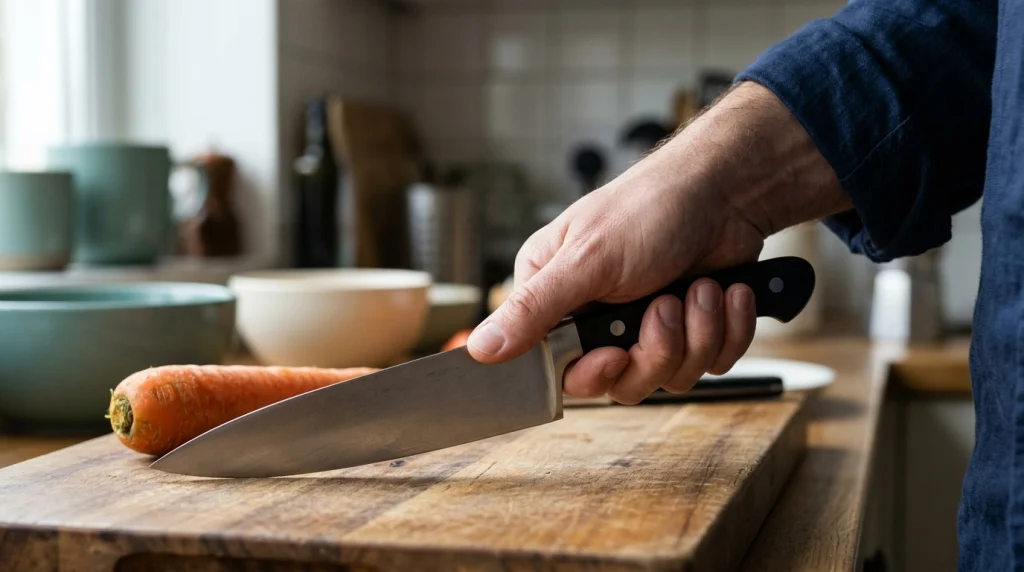
The pinch grip gives you direct control over the blade and helps you guide each cut. It may feel unfamiliar at first, but you can practice it with the knife resting safely on a cutting board before cutting food.
Use the pinch grip
- Hold the knife with your dominant hand.
- Place your thumb against one side of the blade near the handle.
- Place your index finger on the opposite side of the blade.
- Wrap your remaining three fingers comfortably around the handle.
- Keep your wrist relaxed and your grip secure without squeezing excessively.
Your thumb and index finger should grip the blade near the handle, not the sharp cutting edge. Keep your index finger off the top of the blade, where it offers less control than a proper pinch grip.
What if the pinch grip feels uncomfortable?
A conventional handle grip is an alternative if the pinch grip feels awkward or the knife does not fit your hand well. Wrap your fingers around the handle and focus on a secure hold before attempting any cuts.
A shorter, lighter chef’s knife may also feel easier to control. Choose a knife that feels balanced and comfortable rather than assuming a longer blade will make cutting easier.
How Do You Position Your Fingers Safely?
Use a claw grip with your non-knife hand to hold the ingredient while protecting your fingertips. Curl your fingers inward, tuck your thumb behind them, and let your knuckles guide the side of the blade.
Follow these claw-grip steps
- Curl your fingertips: Keep the tips pointed inward rather than extending them toward the blade.
- Hold the ingredient: Apply gentle pressure so the food stays in place.
- Guide with your knuckles: Keep the blade close to the front of your curled fingers without pushing your hand into its path.
- Move back gradually: As you cut, reposition your guide hand in small increments.
Your knuckles help maintain consistent slice thickness while your fingertips remain tucked away. Never spread your fingers flat across the food directly in front of the blade.
For a visual demonstration of the basic grip and cutting method, see North Carolina State University Extension’s chef’s knife guide.
How Do You Prepare a Cutting Board and Food?
A stable cutting surface makes every knife movement more predictable. Before you begin, clear the counter, secure the board, and make sure both your hands and the knife handle are dry.
- Stop the board from sliding: Place a damp, folded kitchen towel underneath a board without nonslip feet.
- Wash the ingredient: Clean produce as appropriate, then remove excess surface water if it makes handling slippery.
- Trim unstable shapes: Cut a small flat surface on round vegetables before placing them flat-side down.
- Clear unnecessary items: Keep bowls, packaging, and scraps away from the knife’s working area.
- Check the knife: Use a sharp, undamaged blade that cuts without excessive force.
A carrot, potato, or onion that rolls across the board is harder to control than one resting on a flat surface. Make stability your first priority, even when preparing just one ingredient.
How Do You Slice With a Chef’s Knife?
Slicing creates pieces that are relatively thin and consistent in thickness. For many vegetables, use a smooth stroke that moves the blade slightly forward as it travels down through the ingredient.
- Place the ingredient securely on the cutting board.
- Position the blade where you want the first slice.
- Hold the ingredient with your claw-grip hand.
- Move the knife forward and down through the food with controlled pressure.
- Lift or draw the blade back as needed, then reposition for the next slice.
Avoid repeatedly smashing the blade straight down when a smooth slicing stroke works better. A controlled motion usually gives you cleaner cuts and reduces unnecessary effort.
Example: Slicing a carrot
Trim the carrot’s ends and cut it into a shorter section if that makes it easier to control. Place the section on a flat side, then slice it into rounds using a steady rhythm.
For long strips, cut the carrot into manageable sections and create flat surfaces before making lengthwise cuts. Keep the guide-hand fingertips curled throughout the process.
How Do You Chop Vegetables With a Chef’s Knife?
Chopping produces pieces that may vary in size, while dicing aims for more uniform cubes. A chef’s knife can handle both, provided you stabilize the food and use a controlled cutting motion.
Use a rocking motion when appropriate
Many chef’s knives have a curved edge that supports rocking: the front portion stays close to the board while the handle rises and falls. The blade moves through the ingredient instead of relying on repeated, forceful impacts.
- Cut the ingredient into stable sections.
- Set the front part of the blade near the cutting board.
- Lower the handle while moving the blade through the food.
- Reposition your guide hand after each controlled cut.
- Pause to gather or rearrange pieces when necessary.
Not every chef’s knife has the same curve, so the ideal motion can vary. If your knife has a relatively flat profile, a forward slicing motion may feel more natural than pronounced rocking.
Example: Chopping an onion
Peel the onion and cut it in half through the root, then place one half flat-side down. Make controlled cuts while keeping your fingertips curled and your guide hand steady.
For evenly diced onion, make parallel cuts and then crosscuts appropriate to the onion’s structure. Keep the root end intact during the initial cuts if it helps hold the layers together, and reposition the onion whenever it becomes unstable.
How Do You Dice, Mince, and Slice Differently?
These three knife skills produce different shapes, so choosing the right one helps you prepare ingredients for the recipe. The main difference is the size and consistency of the finished pieces.
| Technique | Result | Example |
|---|---|---|
| Slicing | Thin pieces or flat sections | Carrot rounds |
| Chopping | Pieces that may vary in size | Roughly chopped vegetables |
| Dicing | Small, relatively uniform cubes | Diced onion |
| Mincing | Very small pieces | Minced garlic |
| Julienning | Thin, matchstick-shaped strips | Carrot strips |
For more uniform cooking, try to keep pieces of the same ingredient similar in size. Smaller pieces often cook faster than larger ones, so consistency matters when ingredients share a pan or pot.
Which Part of a Chef’s Knife Should You Use?
The tip, curved middle, and heel of a chef’s knife serve different purposes during food preparation. Knowing how the blade’s shape works helps you choose a suitable cutting motion instead of forcing the knife through an ingredient.
| Blade section | Common use | Technique note |
|---|---|---|
| Tip | Precise starting cuts and controlled positioning | Use deliberate, gentle movements. |
| Belly or middle | Rocking, chopping, and everyday slicing | Follow the blade’s curve when rocking. |
| Heel | Controlled cuts through firmer ingredients | Use leverage without forcing the edge. |
These are general guidelines, not rigid rules. Blade shape and ingredient size affect which section feels most useful for a particular cut.
For a more detailed explanation of the pointed front section, see what the tip of a chef’s knife is used for.
What Are the Most Common Chef’s Knife Mistakes?
Most beginner problems come from rushing, unstable ingredients, or trying to force a cut. Correcting those habits early makes knife work more predictable and comfortable.
- Using a loose cutting board: Secure it before you start instead of trying to control a sliding surface.
- Holding food with straight fingertips: Curl them inward and use your knuckles as a guide.
- Pressing too hard: Check the blade’s sharpness and use a suitable slicing motion.
- Cutting round food without stabilizing it: Create a flat side before making further cuts.
- Rushing to match professional speed: Build accuracy first, then allow speed to develop naturally.
- Using a chef’s knife for every task: Choose a serrated knife for crusty bread and a suitable specialized knife for work around bones.
- Leaving the blade hidden: Keep knives visible on a safe surface and never cover them with a towel or reach blindly into a sink.
Never try to catch a falling knife. Move clear and let it fall, then pick it up only after it has stopped moving.
For additional guidance, the Virginia Tech knife-skills resource explains basic cutting techniques and safe handling practices.
How Can You Practice Chef’s Knife Skills as a Beginner?
 Save
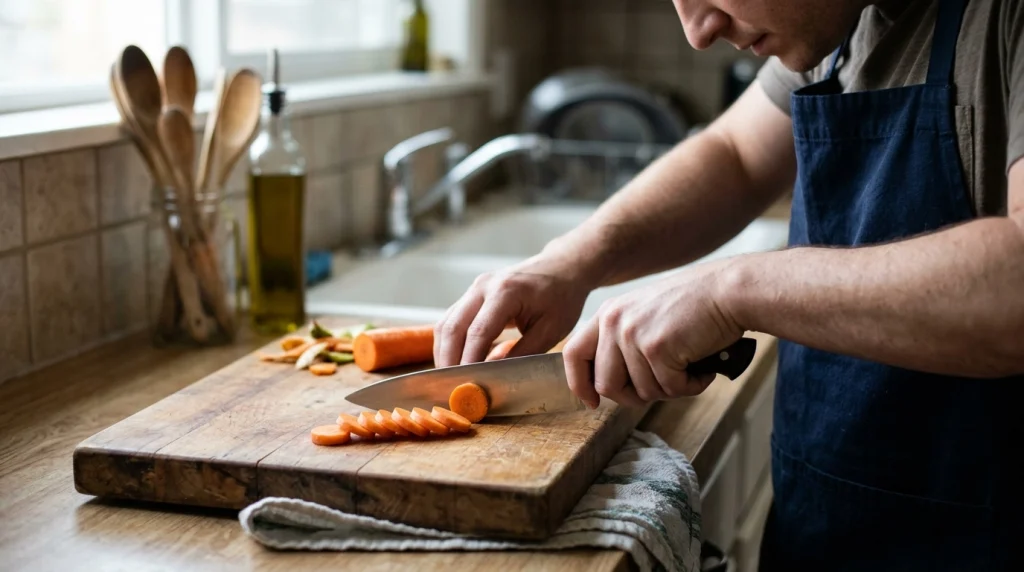
Short, deliberate practice sessions are more useful than trying to master every cut at once. Begin with an ingredient that sits securely on the board and allows you to see how your hands move.
- Practice your grip: Hold the knife correctly while it rests safely on the board.
- Try simple slices: Use a stable ingredient and make slow, controlled cuts.
- Practice consistent pieces: Compare the thickness of your slices without worrying about speed.
- Move to dicing: Cut slices or strips into smaller pieces while keeping the food stable.
- Review your technique: Pause if your wrist feels strained, your hand position changes, or the food starts slipping.
One useful practice exercise is to slice a carrot into rounds and compare the first few pieces with the last few. If the thickness stays consistent while your hands remain relaxed and controlled, you’re building the right habits.
As of 2026, the core advice remains straightforward: learn safe hand positioning and controlled movement before focusing on speed or advanced knife techniques.
How Do You Choose a Chef’s Knife for Easier Cutting?
The right chef’s knife should feel secure in your hand and allow you to cut without excessive force. A comfortable handle, suitable blade length, and well-maintained edge matter more than an impressive-looking design.
- Blade length: Many home cooks prefer a blade around 6 to 8 inches, although comfort and the size of your cutting board should guide your choice.
- Handle comfort: Look for a grip that feels secure and doesn’t force your fingers into an awkward position.
- Balance: Choose a knife that feels controllable when you lift, position, and move it.
- Edge maintenance: Keep the blade sharp and follow the manufacturer’s care instructions.
- Cutting board: Use a stable wood or suitable plastic board that won’t damage the edge unnecessarily.
A sharp knife generally needs less pressure than a dull one, but sharpness doesn’t make poor technique safe. You still need a stable work surface, controlled movement, and properly positioned fingers.
For additional knife-care and handling guidance, consult the University of Kentucky’s knife-skills resource.
Chef’s Knife Recommendations for Beginners
If you’re choosing your first or next chef’s knife, these established models offer different approaches to everyday kitchen prep. Treat the descriptions below as a starting point for comparing fit, handle design, and maintenance needs rather than as a claim that I’ve personally tested each model.
🏆 Everyday option
Victorinox Fibrox Pro Chef’s Knife, 8-Inch
An 8-inch stainless-steel chef’s knife with a textured Fibrox handle. Its practical handle design and general-purpose blade make it worth comparing for everyday slicing, chopping, and dicing.
💰 Practical alternative
Mercer Culinary Millennia, 8-Inch Chef’s Knife
This model features an 8-inch blade and a textured handle designed for a secure grip. Compare its handle shape and overall feel with other knives before deciding which suits your hand.
🔪 Traditional design
WÜSTHOF Classic, 8-Inch Cook’s Knife
A traditional German-style cook’s knife with a forged stainless-steel blade and a full-sized handle. Consider it if you prefer a substantial knife and want to compare its weight and balance with lighter alternatives.
Before purchasing, check the current specifications, price, and care instructions for the exact model. The most useful knife is one you can hold securely and control comfortably during ordinary food preparation.
Frequently Asked Questions
Should you push down or rock a chef’s knife?
Use a controlled slicing or rocking motion that suits the knife’s blade shape and the ingredient. Many curved chef’s knives work well with a rocking motion, while a forward-and-down stroke can be better for certain slices. Avoid forcing the blade straight down when a smooth cut works better.
Is a chef’s knife safe for beginners?
A chef’s knife can be suitable for beginners when it fits the user’s hand and they learn safe handling first. Start with a stable cutting board, a secure grip, curled fingertips, and slow movements. Never rush, and stop whenever the ingredient or knife becomes difficult to control.
How sharp should a chef’s knife be?
A chef’s knife should have a clean, maintained cutting edge that passes through suitable ingredients without excessive pressure. A dull blade can slip when you push harder, while a damaged edge can behave unpredictably. Follow the manufacturer’s sharpening and maintenance guidance.
How do you cut round vegetables without them rolling?
Trim a small section from the side of the vegetable to create a flat base. Place that flat side on the cutting board before slicing or chopping. This gives the ingredient a more stable position and reduces the chance of it rolling into the blade.
How long does it take to learn basic chef’s knife skills?
It depends on how often you practice, your comfort with the knife, and the techniques you want to learn. You can start making simple cuts in one session, but consistent sizing and smooth movements take repeated practice. Build control first instead of setting a deadline for speed.
Final Takeaway: Learn Control Before Speed
Learning how to cut with a chef’s knife starts with three habits: hold the knife securely, keep your guide-hand fingertips curled, and stabilize the ingredient before cutting. These basics make slicing, chopping, dicing, and mincing easier to control.
Start with simple vegetables, make deliberate cuts, and pay attention to your hand position. With steady practice, you’ll build a reliable technique that makes everyday food preparation safer and more consistent.

