How Thick Should a Cutting Board Be?
Quick Answer
A cutting board should generally be 1 to 1.5 inches thick for everyday kitchen use. Wooden cutting boards perform well at 1.5 to 2 inches thick, while plastic boards can be 0.5 to 0.75 inches thick. For heavy-duty chopping or a homemade end grain cutting board, a thickness of 2 to 2.5 inches provides additional stability and material for future resurfacing.
Recommended Cutting Board Thickness:
- Everyday wooden boards: 1 to 1.5 inches.
- End grain boards: 1.5 to 2.5 inches.
- Edge grain boards: 1 to 1.5 inches.
- Plastic cutting boards: 0.5 to 0.75 inches.
- Bamboo cutting boards: 0.75 to 1.25 inches.
- Butcher block boards: 2 to 3 inches.
My Practical Recommendation:
- Choose a 1.5-inch hardwood cutting board if you want a practical balance between stability, durability, and manageable weight.
Choosing the right cutting board thickness can make everyday food preparation more comfortable and efficient. A board that’s too thin may flex or warp, while an unnecessarily thick board can become difficult to lift and clean.
I recommend looking beyond thickness alone and considering the board’s material, dimensions, construction, and intended use. This guide explains how to find the right balance for your kitchen.
What Is Cutting Board Thickness?
Cutting board thickness is the vertical distance between the top cutting surface and the bottom of the board. Manufacturers usually express this measurement in inches or millimeters.
Thickness affects the board’s stiffness, weight, structural strength, and potential for resurfacing. It also influences how high your working surface sits above the countertop.
Common cutting board thickness measurements include:
- 1/4 inch: approximately 6.4 mm.
- 1/2 inch: approximately 12.7 mm.
- 3/4 inch: approximately 19 mm.
- 1 inch: 25.4 mm.
- 1.5 inches: 38.1 mm.
- 2 inches: 50.8 mm.
- 2.5 inches: 63.5 mm.
- 3 inches: 76.2 mm.
When comparing products, check whether the manufacturer includes rubber feet in the overall height measurement. The actual cutting surface may be thinner than the listed product height.
Recommended Cutting Board Thickness by Material
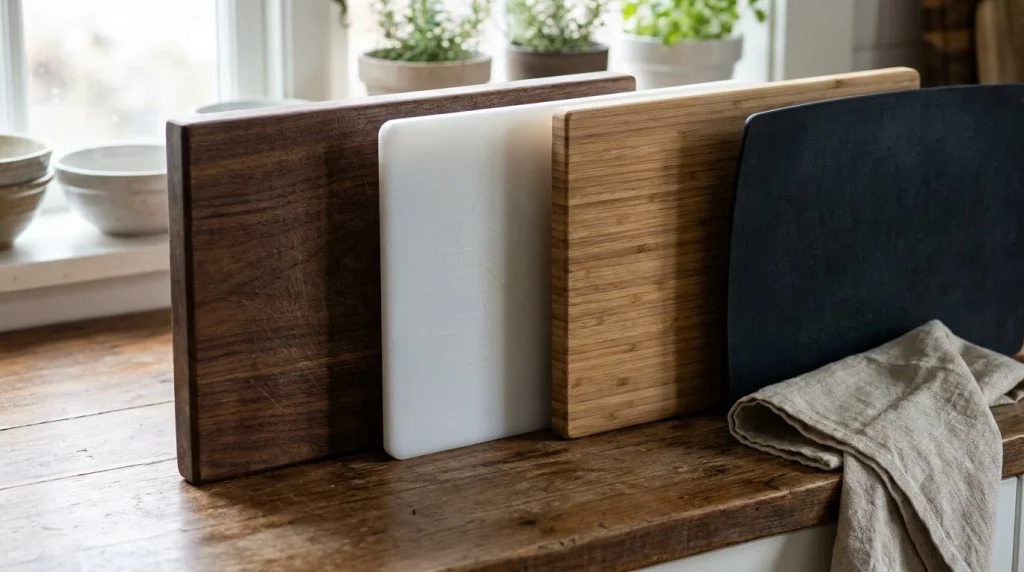
Different cutting board materials require different thicknesses because their structural properties vary. A plastic board doesn’t necessarily need the same thickness as a wooden butcher block.
| Material | Recommended Thickness | Best Use |
|---|---|---|
| Maple | 1–2 inches | Daily preparation |
| Walnut | 1–2 inches | Premium kitchen boards |
| Cherry | 1–1.5 inches | General chopping |
| End grain hardwood | 1.5–2.5 inches | Frequent knife work |
| Bamboo | 0.75–1.25 inches | Light to medium preparation |
| Plastic | 0.5–0.75 inches | Meat and vegetable preparation |
| Rubber | 0.5–1 inch | Precision knife work |
| Paper composite | 0.25–0.5 inches | Lightweight food preparation |
| Butcher block | 2–3 inches | Heavy-duty chopping |
These measurements are practical recommendations rather than mandatory manufacturing standards. Construction quality, dimensions, and material properties can justify thinner or thicker designs.
How Thick Should a Wooden Cutting Board Be?
A wooden cutting board should typically measure between 1 and 2 inches thick. For most home kitchens, 1.5 inches provides a useful balance of strength, weight, and everyday handling.
Wooden boards naturally respond to changes in moisture and humidity. A well-constructed, adequately thick board generally provides better rigidity than a comparable thinner board.
1-Inch Wooden Cutting Boards
A 1-inch cutting board works well for everyday slicing, vegetable preparation, and smaller kitchen tasks. Its lighter construction makes washing and storage easier.
- Suitable for small and medium kitchens.
- Easy to lift and carry.
- Generally more affordable than thicker alternatives.
- Practical for occasional food preparation.
1.5-Inch Wooden Cutting Boards
A 1.5-inch wooden board is my preferred recommendation for regular home cooking. It offers substantial rigidity without automatically becoming too bulky for routine cleaning.
- Suitable for regular chopping and slicing.
- Provides additional weight for stability.
- Works well with maple, walnut, and cherry.
- Allows some future sanding and refinishing.
2-Inch Wooden Cutting Boards
A 2-inch board makes sense for frequent meal preparation and larger cutting surfaces. Its added mass can help keep the board steady during repetitive chopping.
- Suitable for dedicated preparation stations.
- Provides substantial structural support.
- Offers additional resurfacing material.
- Requires more effort when washing and moving.
How Thick Should an End Grain Cutting Board Be?
An end grain cutting board should generally be 1.5 to 2.5 inches thick. A finished thickness of around 2 inches is a practical target for a medium or large end grain board.
End grain construction places the ends of the wood fibers toward the cutting surface. This orientation can allow knife edges to move between fibers during cutting.
Adequate thickness helps support the assembled blocks and provides room for future surface restoration.
- Small end grain board: 1.25 to 1.5 inches.
- Standard end grain board: 1.5 to 2 inches.
- Large end grain board: 2 to 2.5 inches.
- Heavy butcher block: 2.5 to 3 inches or more.
Thickness alone won’t prevent glue-joint failure or cracking. Dry wood, reliable joinery, appropriate adhesive, and consistent maintenance remain important.
How Thick Should an Edge Grain Cutting Board Be?
An edge grain cutting board should generally be 1 to 1.5 inches thick for everyday cooking. Larger boards may benefit from a thickness approaching 2 inches.
Edge grain construction exposes the long sides of wooden strips on the cutting surface. This arrangement creates a practical working surface without requiring the complex assembly of an end grain board.
The main advantages of a moderately thick edge grain board include:
- Good structural rigidity.
- Manageable weight.
- Relatively straightforward maintenance.
- Suitable performance for most kitchen knives.
- Potential for sanding and refinishing.
For home cooks who prepare meals daily, a 1.5-inch maple edge grain board is a sensible starting point.
How Thick Should a Plastic Cutting Board Be?
A rigid plastic cutting board should generally be 0.5 to 0.75 inches thick for everyday use. Commercial preparation stations may use boards measuring 1 inch thick or more.
Plastic boards are available in materials such as high-density polyethylene, commonly called HDPE. These materials can provide adequate structural strength without requiring the thickness of a hardwood butcher block.
| Thickness | Suitable Application |
|---|---|
| Under 0.25 inch | Flexible cutting mats |
| 0.25–0.5 inch | Light household preparation |
| 0.5–0.75 inch | Regular kitchen use |
| 1 inch or more | Heavy commercial preparation |
Check the manufacturer’s cleaning instructions before placing any plastic board in a dishwasher. Heat exposure can distort certain plastic materials, regardless of their thickness.
How Thick Should a Bamboo Cutting Board Be?
A bamboo cutting board should generally be 0.75 to 1.25 inches thick. A well-made 1-inch bamboo board is suitable for many everyday kitchen tasks.
Manufacturers typically assemble bamboo boards by bonding multiple pieces of bamboo together. The quality of these joints influences durability alongside the finished thickness.
Consider the following thickness ranges:
- 0.5 to 0.75 inches for lightweight slicing.
- 0.75 to 1 inch for regular food preparation.
- 1 to 1.25 inches for larger working surfaces.
- 1.5 inches or more for substantial countertop boards.
Avoid soaking bamboo boards or exposing them to prolonged moisture. Excessive water exposure may contribute to swelling, distortion, and joint damage.
Is a Thicker Cutting Board Better?
A thicker cutting board generally provides greater stiffness and weight than an otherwise identical thinner board. However, extra thickness doesn’t automatically make a cutting board better for every kitchen.
The advantages depend on how frequently you cook and whether you need to move the board between preparation sessions.
Advantages of Thick Cutting Boards
- Improved rigidity: Additional thickness helps resist bending during normal food preparation.
- Greater stability: Extra mass can reduce unwanted movement on suitable countertops.
- Resurfacing potential: Wooden boards have more material available for future sanding.
- Heavy-duty performance: Substantial boards are suitable for repeated chopping.
- Permanent workspace: Thick boards work well as dedicated countertop preparation surfaces.
Disadvantages of Thick Cutting Boards
- They usually weigh more.
- Handwashing can become awkward.
- Storage requires additional space.
- Material and shipping costs may increase.
- The higher working surface may affect wrist comfort.
- Large boards may not fit inside smaller sinks.
I would choose the thickest board that remains comfortable to handle rather than automatically selecting the thickest available option.
Thin vs. Thick Cutting Boards
| Feature | Thin Board | Thick Board |
|---|---|---|
| Weight | Lighter | Heavier |
| Rigidity | Generally lower | Generally higher |
| Storage | Easier | Requires more space |
| Cleaning | Easier to handle | More effort |
| Resurfacing wood | Limited material | More available material |
| Best use | Light preparation | Frequent chopping |
| Typical cost | Lower | Higher |
These comparisons assume similar materials, dimensions, and construction quality. A thin professional composite board may outperform a poorly constructed thick wooden board in certain applications.
Does Cutting Board Thickness Prevent Warping?
Additional thickness can help a wooden cutting board resist distortion, but it cannot guarantee protection against warping. Uneven moisture absorption and drying remain major contributing factors.
Wood expands as it absorbs moisture and contracts as it dries. Unequal moisture exposure across the two faces can create internal stresses that cause the board to bend.
To reduce the likelihood of warping:
- Wash both faces when cleaning wooden boards.
- Never leave a wooden board soaking in water.
- Keep wooden boards out of the dishwasher.
- Allow air to circulate around both faces while drying.
- Avoid prolonged exposure to direct sunlight.
- Apply food-grade cutting board oil as needed.
- Keep the board away from hot cooking surfaces.
Regular conditioning helps maintain wooden surfaces, although oil doesn’t make wood waterproof. Research into wood moisture behavior is available through the USDA Forest Products Laboratory.
Does Cutting Board Thickness Affect Knife Sharpness?
Cutting board thickness has less direct influence on knife sharpness than the surface material, grain orientation, and cutting technique. A thick board isn’t necessarily more knife-friendly than a thin one.
Hard surfaces such as glass and stone can dull knife edges regardless of their thickness. Suitable wood, plastic, rubber, and composite surfaces generally provide more practical cutting environments.
When protecting your knife edges, prioritize:
- Appropriate cutting surface hardness.
- Smooth, well-maintained surfaces.
- Suitable grain orientation in wooden boards.
- Controlled chopping and slicing techniques.
- A stable board that doesn’t move during use.
For knife preservation, I would favor a suitable 1-inch wooden board over a 2-inch board made from glass or another excessively hard surface.
How Thick Should a Cutting Board Be for Different Kitchen Tasks?
The right thickness depends partly on the amount of force involved in your food preparation. Light slicing requires less structural support than repetitive heavy chopping.
For Vegetables and Fruits
A wooden board measuring 0.75 to 1.5 inches thick is generally sufficient for preparing vegetables and fruit. Smaller plastic boards can also work well for these tasks.
For Raw Meat and Poultry
A rigid plastic cutting board measuring 0.5 to 1 inch thick offers a practical surface for raw meat preparation. Choose a model that supports the cleaning and sanitizing methods you intend to use.
The USDA Food Safety and Inspection Service recommends separating raw meat preparation from foods that won’t receive further cooking.
For Bread and Sandwiches
A 0.5 to 1-inch cutting board is generally adequate for bread, sandwiches, and other lightweight kitchen tasks. These applications rarely require a heavy chopping block.
For Heavy-Duty Chopping
A substantial hardwood board measuring 2 to 3 inches thick can provide the rigidity needed for repetitive heavy chopping. Use appropriate knives and equipment, particularly when working around bones.
How Does Cutting Board Size Affect Thickness?
Larger wooden cutting boards generally benefit from additional thickness because broader surfaces require greater structural support. However, large dimensions also increase the board’s overall weight.
| Board Dimensions | Suggested Wood Thickness |
|---|---|
| 8 × 10 inches | 0.75–1 inch |
| 10 × 14 inches | 1–1.5 inches |
| 12 × 18 inches | 1.25–1.75 inches |
| 18 × 24 inches | 1.5–2 inches |
| 20 × 30 inches | 2–3 inches |
As a practical example, doubling a wooden board’s thickness from 1 to 2 inches approximately doubles its weight when other dimensions remain unchanged. Keep that relationship in mind when choosing an oversized board.
How Thick Should a Homemade Cutting Board Be?
A homemade edge grain cutting board should generally have a finished thickness of 1 to 1.5 inches. For an end grain project, aim for approximately 1.5 to 2 inches after flattening and sanding.
Starting with additional material allows you to remove imperfections during construction without making the finished board unnecessarily thin.
- Determine the intended finished thickness.
- Select properly dried hardwood suitable for food-contact applications.
- Allow extra material for flattening and sanding.
- Assemble the board using an appropriate woodworking adhesive.
- Flatten the surface using methods suitable for its grain orientation.
- Sand away rough areas and sharp corners.
- Apply a suitable food-contact finish according to its instructions.
If you don’t own specialized woodworking equipment, explore this guide on making a cutting board without a planer or jointer.
Does a Cutting Board Need Extra Thickness for a Juice Groove?
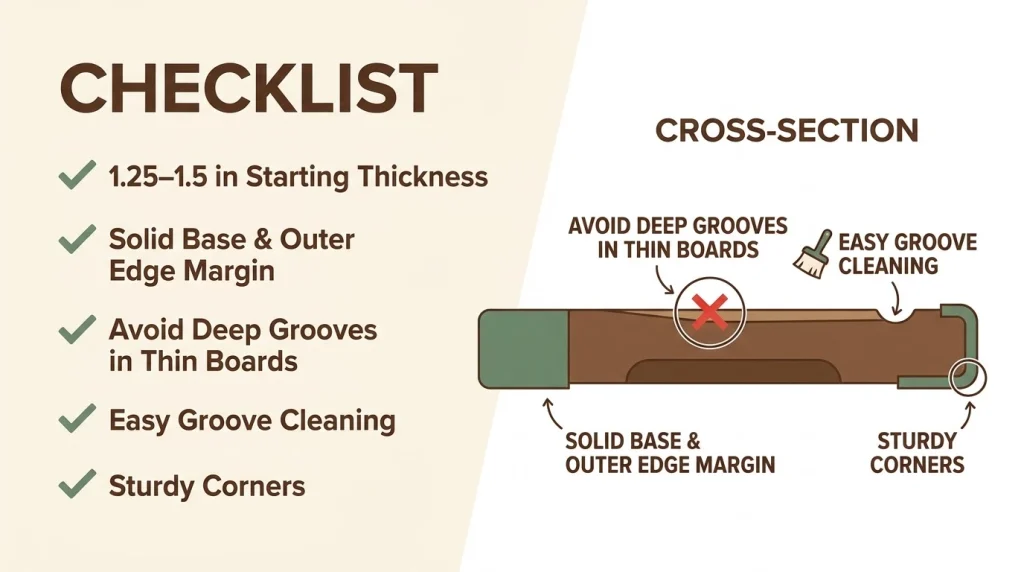
A cutting board with a juice groove needs enough material beneath the groove to maintain structural support. Wooden boards measuring 1.25 to 1.5 inches thick provide a practical starting point for many groove designs.
The correct thickness depends on the groove’s depth, width, position, and the board’s overall construction.
- Avoid cutting an excessively deep groove into a thin board.
- Leave sufficient material around the outer edges.
- Consider the depth of grooves on both faces of reversible boards.
- Keep the groove accessible for thorough cleaning.
- Avoid designs that leave fragile sections near the corners.
Juice grooves are particularly useful when carving cooked meat or preparing juicy fruits. They help contain liquids that might otherwise spread across the countertop.
How Does Cutting Board Thickness Affect Kitchen Ergonomics?
A thick cutting board raises the working surface, which can influence wrist, shoulder, and elbow positioning. This matters when you spend extended periods chopping ingredients.
A 3-inch cutting board on a standard 36-inch countertop creates a cutting surface approximately 39 inches above the floor. That height may be comfortable for some cooks but excessive for others.
Before selecting a thick board, consider:
- Your standing height.
- The height of your kitchen countertop.
- Your preferred knife grip.
- How long you typically prepare ingredients.
- Whether the board includes elevated rubber feet.
Comfort should take priority over unnecessary thickness. A moderately thick board that supports a natural working posture may be the better long-term choice.
How to Measure Cutting Board Thickness Correctly
You can measure cutting board thickness with a ruler, measuring tape, or digital caliper. Measure the solid board rather than including elevated feet or decorative hardware.
- Place the board on a flat countertop.
- Position your measuring tool vertically against an edge.
- Measure from the bottom face to the top cutting surface.
- Repeat the measurement at several locations.
- Record the smallest and largest measurements if they differ.
For wooden boards, a straightedge can also help identify surface distortion. Uneven thickness or noticeable gaps may indicate previous sanding, wear, or warping.
How to Maintain a Thick Cutting Board
Even a premium hardwood cutting board requires regular maintenance. Proper care helps preserve the surface and reduce avoidable moisture-related damage.
- Remove food residue after each use.
- Wash wooden boards with mild dish soap and water.
- Dry the surface promptly with a clean towel.
- Allow the board to air-dry thoroughly.
- Condition dry wooden surfaces with suitable food-grade mineral oil.
- Inspect the board regularly for deep cracks and damaged joints.
- Resurface suitable wooden boards when necessary.
Food-contact surfaces should remain clean, sound, and suitable for their intended purpose. The FDA’s food safety resources provide additional information about hygienic food preparation.
For other wooden kitchen tools, see this guide to using cutting board oil on wooden utensils.
Recommended Cutting Boards for Different Thickness Preferences
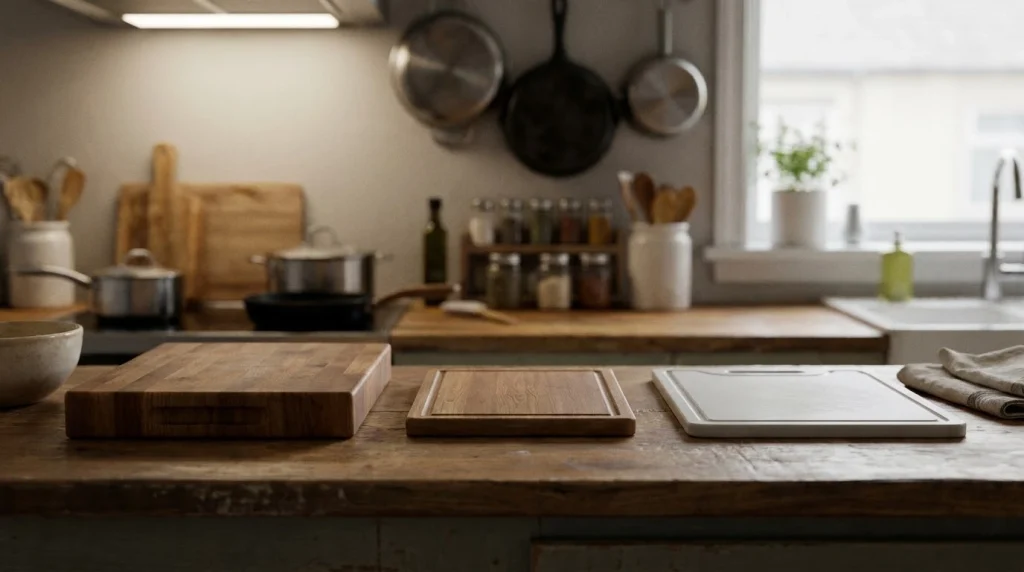
If you’re shopping for a cutting board in 2026, these established product designs illustrate three useful approaches to board thickness. I selected them based on their construction and intended applications rather than personal hands-on testing.
Affiliate disclosure: As an Amazon Associate, I earn from qualifying purchases.
🏆 Best for everyday chopping
John Boos R02 Maple Cutting Board
Thickness: 1.5 inches
This reversible maple board measures 24 × 18 inches and features edge grain construction. I’d recommend this design for frequent cooks who want a substantial preparation surface with recessed hand grips.
💰 Best for smaller kitchens
John Boos Chop-N-Slice Maple Cutting Board
Thickness: 1 inch, selected models
The Chop-N-Slice series offers compact hardwood boards for everyday slicing and chopping. I’d consider a smaller 1-inch model when easy handling and storage are priorities.
🍖 Best for easy cleaning
OXO Good Grips Carving and Cutting Board
Thickness: Approximately 0.7 inch for the large carving model
This plastic board features non-slip edges and a liquid-catching groove. I’d consider it as a dedicated meat preparation board alongside a thicker wooden board.
Frequently Asked Questions
Is a 1-inch cutting board thick enough?
Yes, a well-constructed 1-inch wooden cutting board is thick enough for most light to moderate kitchen tasks, including slicing vegetables and preparing sandwiches. Larger boards and frequent heavy chopping may benefit from a thickness of 1.5 inches or more.
Is a 2-inch cutting board too thick?
A 2-inch cutting board isn’t too thick if you need a substantial surface for frequent chopping or a dedicated preparation station. However, larger 2-inch hardwood boards can become heavy, making routine washing, lifting, and storage more difficult.
What is the minimum thickness for a wooden cutting board?
Approximately 0.75 inch is a practical minimum for many small wooden cutting boards used for light food preparation. Thinner designs can still work, but larger boards generally benefit from additional thickness to improve rigidity and provide material for future maintenance.
How thick should a professional cutting board be?
Professional cutting boards vary by material and application, with wooden models commonly measuring 1.5 to 3 inches and rigid plastic models often measuring 0.5 to 1 inch or more. Commercial kitchens should also consider applicable sanitation requirements, surface condition, and cleaning compatibility.
Can a cutting board be too thick?
Yes, a cutting board can be too thick for a particular kitchen if its weight or height makes preparation uncomfortable. Choose a board that fits your countertop, sink, storage area, and normal working posture rather than assuming maximum thickness guarantees better performance.
Final Thoughts
The ideal cutting board thickness depends on its material, size, construction, and intended purpose. For most home cooks, a 1.5-inch hardwood cutting board offers a practical combination of rigidity, stability, and durability.
Choose a 2-inch board if you prefer a substantial end grain preparation surface. For easy washing and lightweight handling, a rigid plastic board measuring around 0.5 to 0.75 inches may be more convenient.
Before buying or building your next cutting board, measure your available countertop and storage space. Select a thickness that supports your cooking habits without making everyday cleaning unnecessarily difficult.
My recommendation: Start with a quality 1.5-inch wooden cutting board for general preparation and keep a separate, easy-to-clean plastic board for raw meat and poultry.