Hollow Grind Chef Knife: Benefits & How It Works
Quick Answer
A hollow grind chef’s knife features a blade with concave depressions (known as granton edges or hollows) ground into the sides near the edge. These hollows create small air pockets that prevent thin slices of food, such as starchy vegetables, cheese, or meat, from sticking to the blade during cutting.
What Is a Hollow Grind Chef’s Knife?
A hollow grind chef’s knife is a specialized variation of the traditional Western or Japanese kitchen knife. While standard chef’s knives feature a flat or convex grind that tapers smoothly from the spine to the cutting edge, a hollow grind incorporates vertical indentations or scallops along one or both sides of the blade face.
These indentations are often referred to as Granton edges, named after the British company Granton & Sons, which popularized the design in the 1920s. Though traditionally associated with slicing knives and roast slicers, the hollow grind has become increasingly popular on general-purpose chef’s knives to improve cutting efficiency.
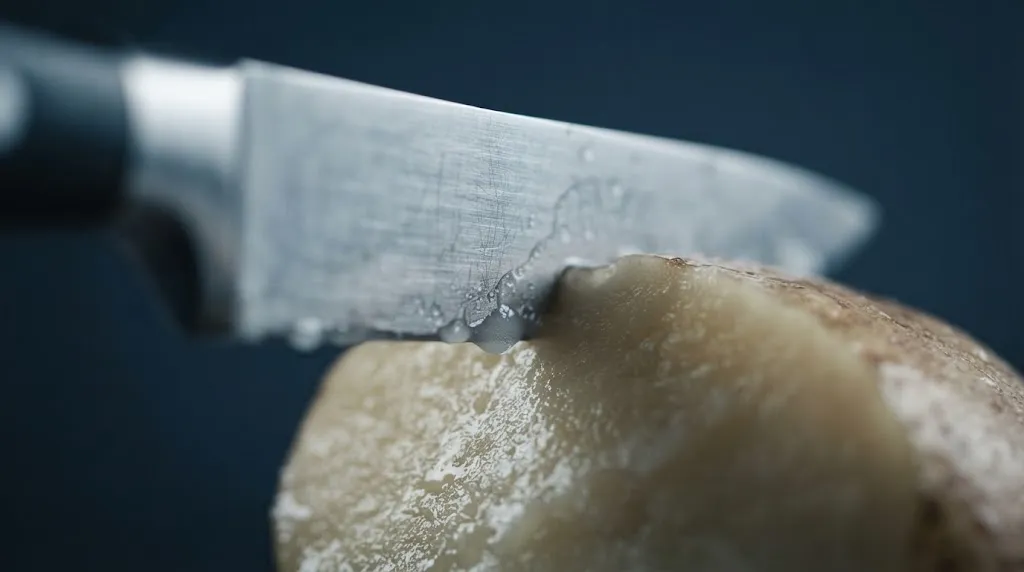
The primary engineering goal of this design is friction reduction. When cutting moist or starchy foods like potatoes, cucumbers, or raw meat, surface tension often causes slices to cling to a flat blade. The recessed pockets of a hollow grind disrupt this suction, allowing ingredients to fall away cleanly with each stroke.
How the Hollow Grind Works
 Save
Understanding the mechanics of a hollow-ground blade requires looking at how surface area affects cutting performance. When a completely flat knife passes through dense food, the entire side of the blade makes contact with the material.
Moisture and starches create a temporary seal against the steel, creating drag that slows down the cutting motion. Cooks often find themselves having to manually wipe or push food off the blade mid-prep.
The Role of Air Pockets
The scalloped depressions on a hollow grind introduce tiny air gaps between the steel and the food being sliced. As the blade descends:
- The cutting edge performs the primary separation of the material.
- The recessed hollows prevent a full vacuum or tight seal from forming against the flat surfaces of the food.
- Friction is significantly reduced, resulting in a smoother, faster stroke.
Key Insight
The hollow grind only reduces friction along the upper portion of the bevel or blade face; the very apex of the edge maintains a standard geometry to ensure structural durability and sharpness.
Key Benefits of Using a Hollow Grind Chef’s Knife
Choosing a hollow grind chef’s knife over a standard profile offers several distinct operational advantages in a busy kitchen environment.
Reduced Food Sticking
The most immediate benefit is clean food release. Thin slices of cucumber, cheese, apple, or raw meat slide off the blade effortlessly rather than adhering to the steel. This keeps prep work moving quickly and maintains uniform slice thickness.
Smoother Cutting Feel
Because drag is minimized, the physical effort required to push the knife through dense or sticky ingredients drops noticeably. Cooks slicing large quantities of root vegetables or proteins often experience less hand and wrist fatigue over extended prep sessions.
Versatility in General Prep
Despite being engineered to prevent sticking, a quality hollow grind chef’s knife retains the robust geometry required for rocking cuts, chopping herbs, and dicing onions. It functions as an everyday chef’s knife with an added performance benefit.
Potential Tradeoffs and Limitations
While the design offers clear advantages, a hollow grind is not universally superior for every kitchen task. Understanding its limitations helps determine if it fits your cooking style.
Warning
Sharpening a hollow-ground knife incorrectly over many years can eventually alter the blade profile near the edge as the steel thins out above the scallops.
Blade Rigidity and Thinness
Grinding away material to create hollows removes steel from the blade body. While high-end manufacturers balance this carefully, extremely deep or poorly executed hollows can marginally reduce the lateral rigidity of the blade compared to a heavy, full-flat-ground chef’s knife.
Maintenance Complexity
Sharpening a knife with scalloped indentations requires consistent technique on whetstones. As the edge wears up into the blade over years of heavy sharpening, the transition line where the hollow begins may shift, requiring thinning maintenance by an experienced sharpener.
Not All Foods Benefit Equally
While sticky ingredients benefit greatly, dry items like hard crusty bread or dry cheeses experience minimal difference in friction reduction compared to a standard blade.
| Feature | Hollow Grind Chef’s Knife | Standard Flat/V-Grind Knife |
|---|---|---|
| Food Sticking | Low (air pockets release food easily) | Higher (moist food clings to flat sides) |
| Cutting Drag | Reduced during dense vegetable prep | Standard resistance based on finish |
| Sharpening Ease | Requires care around the indentation line | Straightforward flat surface contact |
| Best Suited For | Thin slicing, starchy vegetables, meat | General butchery, hard squash, heavy utility |
This comparison highlights that the choice between grinds depends heavily on the specific types of ingredients you process most frequently in your kitchen.
How to Choose Between Hollow Grind and Standard Chef’s Knives
 Save
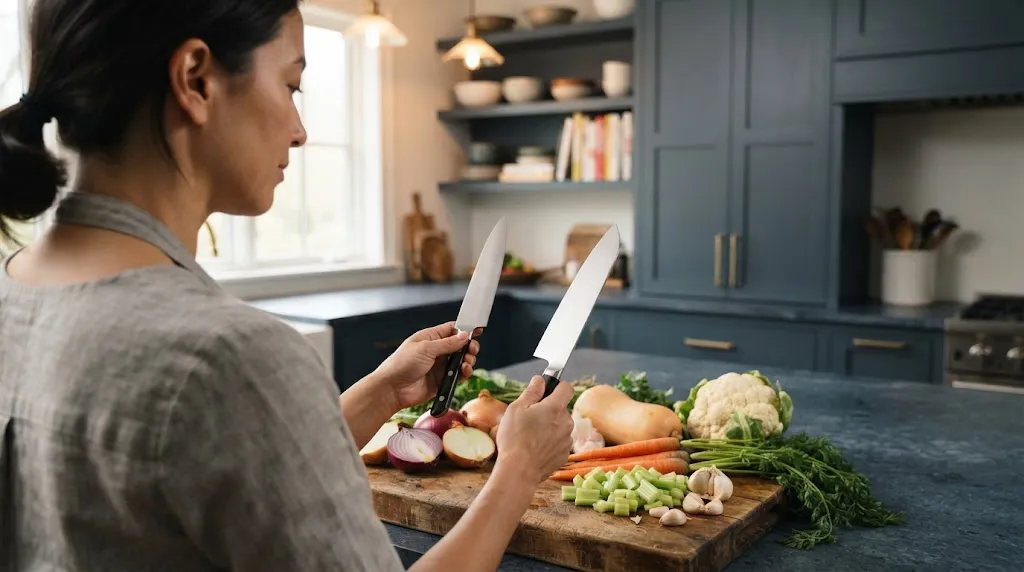
Selecting the right knife profile comes down to evaluating your daily cooking habits and prep volume.
If you regularly process large quantities of produce that tend to cling to blades—such as potatoes, zucchini, cucumbers, or boneless meats—a hollow grind chef’s knife delivers tangible efficiency gains. The reduced friction makes repetitive cutting tasks noticeably smoother.
Conversely, if your routine involves heavy-duty tasks like splitting winter squash, breaking down small poultry bones, or working with extremely abrasive ingredients where maximum spine strength is paramount, a traditional flat or robust convex grind may serve you better.
Tip
When shopping, check whether the hollows alternate on both sides of the blade or appear on only one side; symmetrical granton edges ensure the knife tracks straight without pulling to one side during cuts.
Related Product
Kitchen Knife Sharpening Stones
Maintain the fine cutting edge of your hollow grind chef’s knife with a dual-grit water stone designed for precise angle control.
As an Amazon Associate, we earn from qualifying purchases.
Frequently Asked Questions
Does a hollow grind knife dull faster than a regular knife?
No, the edge retention depends entirely on the steel alloy, heat treatment, and sharpening angle, not the presence of hollow indentations on the upper blade face.
Can I use a pull-through sharpener on a hollow grind chef’s knife?
Pull-through sharpeners are generally discouraged for quality kitchen knives because they remove excessive steel unevenly and can scratch the polished surfaces of the blade, including the hollow indents.
Are hollow grind knives more fragile than standard chef’s knives?
They are not inherently fragile for normal cutting tasks, but the thinner cross-section near the hollows means they should not be used for prying, twisting, or cutting through frozen foods.
What is the difference between a Granton edge and a hollow grind?
Granton is a specific brand name that popularized alternating hollow indentations on knives, while hollow grind is the broader metallurgical term for any concave bevel or recessed pocket ground into a blade face.
Do hollow grinds work on Japanese style chef’s knives?
Yes, many Japanese manufacturers apply hollow grinds (often called ‘grantons’ or ‘kuhn’ styles) to santoku and gyuto knives to enhance food release during fine vegetable prep.
How do I clean food residue out of the hollow indentations?
Standard hand washing with warm soapy water and a non-abrasive sponge easily cleans the scallops. Avoid putting kitchen knives in a dishwasher, which can damage the edge and handle.
Conclusion
A hollow grind chef’s knife offers a practical design solution for cooks seeking to minimize food sticking and reduce cutting friction during meal preparation. By incorporating recessed air pockets along the blade face, this specialized geometry helps starchy vegetables, moist cheeses, and proteins slide away cleanly with every stroke. While proper care is required during long-term sharpening, understanding how the hollow grind functions allows you to choose the ideal knife profile for your kitchen workflow.

