Granton Edge Chef Knife: Uses, Benefits & Care
Quick Answer
A Granton edge chef knife has shallow oval scallops along the sides of its blade, close to the sharpened edge. These hollows help some food slices separate from the blade instead of sticking to its surface. The design can be useful for slicing potatoes, cucumbers, and other moist ingredients, but it does not make the knife automatically sharper or eliminate sticking completely.
The oval indentations on some chef knives can look like decoration. Their intended purpose, however, is practical: to make food release from the blade more easily while cutting.
Whether that feature noticeably improves your kitchen work depends on the ingredients, blade geometry, cutting technique, and condition of the knife. Understanding those differences helps you judge what a Granton edge can realistically do.
What Is a Granton Edge on a Chef Knife?
 Save
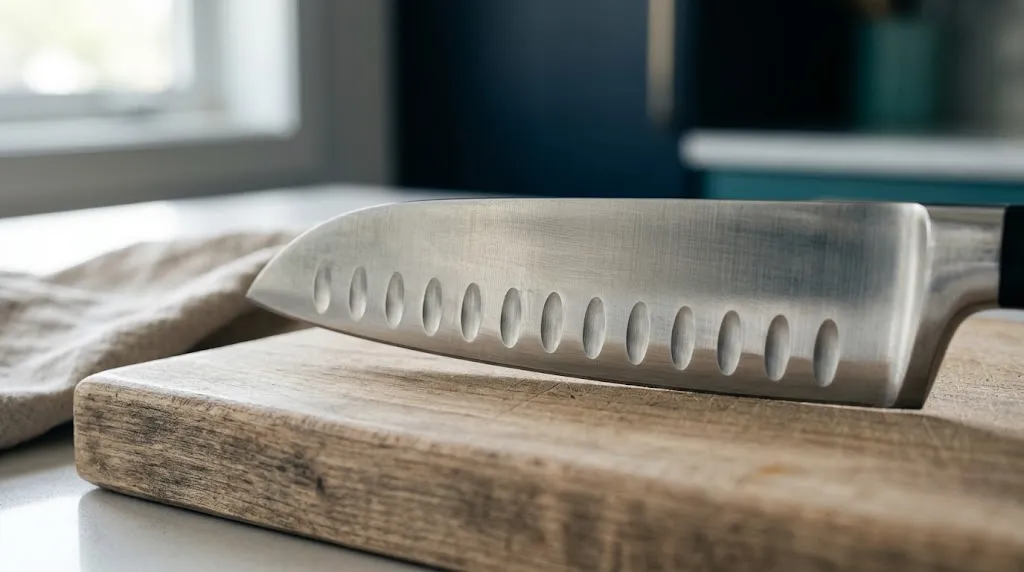
SaveA Granton edge is a blade design featuring a series of shallow hollows or scallops positioned near the cutting edge. These indentations are typically oval or elongated and may appear on one or both sides of a knife.
On many kitchen knives, the hollows form a recognizable row above the actual sharpened edge. They are intended to reduce the amount of continuous contact between sliced food and the blade’s surface.
The term comes from Granton Knives, a British knife manufacturer associated with the original Granton Edge design. The company describes its own design as using scallops ground alternately on opposite sides of the blade. Other manufacturers produce similar hollowed blade patterns, although their geometry may differ.
The manufacturer’s explanation of the original Granton Edge describes how these hollows are intended to help cut food separate from the blade.
Granton Scallops Are Not Serrations
This distinction is important because the word “edge” can be misleading.
A serrated knife has teeth or waves along the cutting edge. A typical dimpled chef knife instead has a continuous sharpened edge, with the scallops positioned above it.
The knife therefore slices through food using its normal sharp edge. The indentations mainly influence what happens as the blade passes through the ingredient.
Some original Granton designs have scallops that influence the cutting-edge profile more directly. Consequently, not every knife advertised as having a Granton edge has identical construction.
How Does a Granton Edge Help Food Release?
The scallops interrupt the broad, smooth contact area between the blade and the food. This can reduce the tendency of thin slices to cling to the metal, particularly when moisture contributes to adhesion.
Imagine slicing a peeled potato with a smooth-sided chef knife. A thin potato slice may remain pressed against the blade rather than falling onto the cutting board.
With a Granton-style blade, the shallow recesses interrupt parts of that contact. The slice may separate more readily as the knife moves through the potato.
Manufacturers commonly describe these recesses as creating small air pockets. The practical effect, however, depends on how the food contacts the blade.
A potato slice can still cover several hollows and remain attached to the surrounding flat metal. The design therefore reduces some sticking under suitable conditions rather than preventing it completely.
Key Insight
A Granton edge mainly changes the contact between food and the blade’s sides. Sharpness, cutting resistance, and food release are related aspects of knife performance, but they are not the same thing.
When Is a Granton Edge Chef Knife Most Useful?
The design is most relevant when slices repeatedly cling to the knife and interrupt your cutting rhythm. Its usefulness varies by ingredient and cutting technique.
Slicing Potatoes and Other Starchy Vegetables
Peeled potatoes can cling to smooth knife blades, especially when cut into thin pieces. The hollows may help some slices fall away rather than stacking against the metal.
This can be useful when preparing potatoes for gratins, roasting, or other dishes requiring repeated slices. However, a thin blade with good cutting geometry may still perform very well without scallops.
Cutting Cucumbers and Zucchini
Moist vegetable slices sometimes adhere to the side of a broad chef knife. A Granton-style pattern may reduce that effect during repetitive slicing.
The advantage becomes less relevant when making large chunks or rough cuts, because food release may not interfere with the task.
Slicing Cooked Meat and Fish
Thin slices of cooked meat and delicate fish can benefit from reduced contact with the blade. This explains why Granton-style scallops also appear on dedicated slicing and carving knives.
For long slices, however, blade length and thickness remain important. A dedicated slicer may provide better results than a broad chef knife, regardless of whether either blade has hollows.
Our guide to slicing knives versus boning knives explains the different jobs these specialized knives perform.
Granton Edge vs Regular Chef Knife: What Changes?
The main difference is the blade-side surface. Both knife designs can perform everyday chopping, dicing, slicing, and mincing when their cutting edges and overall geometry are suitable.
| Feature | Granton-Style Chef Knife | Smooth-Sided Chef Knife |
|---|---|---|
| Blade surface | Has shallow hollows | Usually has continuous blade faces |
| Food release | May reduce sticking | Depends on blade geometry and technique |
| Sharpness | Depends on edge geometry and condition | Depends on edge geometry and condition |
| Everyday chopping | Suitable | Suitable |
| Maintenance | Normal edge care; clean recesses | Normal edge care |
A Granton edge is therefore a secondary design feature rather than a substitute for good blade geometry.
For general cooking, a comfortable handle, appropriate blade profile, dependable cutting edge, and good control are often more meaningful than the presence of dimples.
What Are the Limitations of Granton Edge Knives?
Granton-style hollows can improve food release in certain situations, but several common expectations go beyond what the design can reliably deliver.
- Food can still stick: Thin or moist slices may cover the recesses and adhere to the remaining flat blade surface.
- The hollows do not guarantee greater sharpness: The cutting edge must still have suitable geometry and be maintained properly.
- They cannot compensate for a thick blade: Excessive thickness behind the edge can still make dense vegetables difficult to slice.
- Benefits vary by cutting task: Rough chopping and mincing may show little noticeable difference.
- Different designs perform differently: Scallop size, depth, spacing, and placement are not identical across manufacturers.
The feature also should not be confused with a true hollow-ground blade. Hollow grinding describes a blade cross-section with concave bevel surfaces, while Granton-style dimples are localized recesses.
These differences matter because knife terminology is sometimes used loosely in product descriptions.
How to Use a Granton Edge Chef Knife Effectively
You do not need a special cutting motion simply because your knife has Granton-style hollows. Ordinary controlled chef-knife techniques remain appropriate.
- Stabilize the cutting board. Work on a secure surface that does not slide during slicing.
- Prepare the ingredient. Create a flat resting surface on round vegetables whenever practical.
- Use a controlled grip. Hold the knife securely and keep the fingertips of your guiding hand away from the cutting path.
- Choose the appropriate motion. Use a smooth forward or drawing motion for thin slices. Use controlled chopping or rocking when the blade profile supports it.
- Watch how slices release. If food continues to stick, adjust your technique rather than increasing cutting force.
- Keep the edge sharp. A well-maintained cutting edge is essential even when the blade has food-release hollows.
For broader everyday techniques, see our guide to what a chef knife is used for.
The blade’s curvature also influences cutting motion. Our explanation of the chef knife belly shows why some knives work more naturally with rocking cuts while flatter profiles favor other movements.
Practical Tip
When evaluating food release, use consistent slice thickness and cutting motion. A change in technique or sharpness can affect the result as much as the blade’s scallops.
Can You Sharpen a Granton Edge Chef Knife?
Yes. Most chef knives with dimples positioned above a conventional cutting edge can be sharpened using methods appropriate for their steel and edge geometry.
The key is to sharpen the actual cutting bevel, not the decorative-looking hollows along the blade face.
For ordinary maintenance, follow these principles:
- Maintain the knife’s existing sharpening angle where practical.
- Use a sharpening stone or another compatible sharpening method.
- Work consistently along the full cutting edge.
- Avoid removing unnecessary amounts of steel.
- Do not attempt to flatten or grind away the hollows.
Some original Granton knife designs have a more specialized relationship between the scallops and cutting edge. For those knives, follow the manufacturer’s maintenance instructions rather than assuming every design should be treated identically.
Repeated heavy sharpening may eventually change the relationship between the cutting edge and nearby scallops. Significant blade reshaping is best handled by a sharpener familiar with that construction.
How to Clean and Maintain the Scalloped Blade
 Save
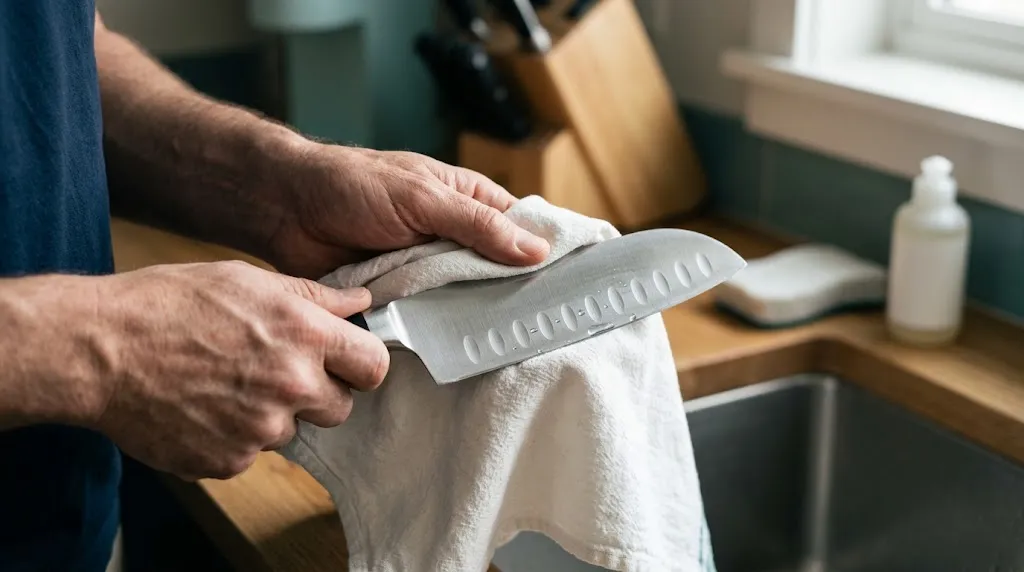
SaveCleaning a Granton-style chef knife is straightforward, but the recesses deserve attention because food residue can collect in them.
After use, carefully wash the blade with mild dish soap and a soft sponge, keeping your movements away from the sharp edge. Check the hollows for remaining starch, oils, or food particles.
Rinse thoroughly and dry the knife promptly, including the areas around the scallops and handle junction.
Hand washing is generally a sensible choice for quality chef knives. Follow the specific manufacturer’s care instructions, since steel composition and handle materials differ.
Store the knife in a suitable block, sheath, or protective storage system that prevents contact with other utensils.
Do not scrape the cutting edge sideways across a hard surface to remove food. This can damage the edge regardless of whether the knife has Granton-style hollows.
Is a Granton Edge Worth Having on a Chef Knife?
A Granton edge can be worthwhile if you regularly make thin slices of ingredients that cling to your knife. It is less important when your main tasks involve rough chopping, mincing herbs, or preparing ingredients where sticking rarely causes a problem.
If comparing two otherwise similar chef knives, the hollowed design may be a useful deciding feature. If the knives differ substantially in sharpness, comfort, thickness, or handling, those fundamental characteristics deserve greater attention.
A Granton-style knife is not automatically superior to a smooth-sided knife. The better tool is the one whose overall design supports your usual ingredients and cutting technique.
Related Tool: Granton Edge Chef Knife
If your usual kitchen work involves slicing moist vegetables or preparing repeated thin cuts, you can explore chef knives featuring hollowed blade faces. Compare blade geometry, handle comfort, and manufacturer care guidance rather than choosing by the scallops alone.
As an Amazon Associate, we may earn from qualifying purchases.
Frequently Asked Questions
Does a Granton edge make a chef knife sharper?
Not necessarily. Sharpness primarily depends on the cutting edge’s geometry and condition. The scallops mainly affect blade-to-food contact, although particular original Granton designs also incorporate specialized edge construction.
Is a Granton edge the same as a serrated edge?
No. Serrations form teeth along the cutting edge, while typical Granton-style chef knives have shallow hollows on the blade faces. The cutting edge itself is usually continuous.
Why do potatoes still stick to my Granton knife?
The hollows cannot completely eliminate adhesion. Potato moisture, starch, slice thickness, blade geometry, and cutting motion can all influence whether a slice remains attached to the knife.
Can I use a Granton edge chef knife for meat?
Yes. A suitable sharp chef knife can slice boneless meat, and the hollows may help some slices release. For long, thin slices of cooked meat, a dedicated slicing knife may offer greater control.
Do Granton scallops wear away over time?
The scallops do not normally disappear during routine washing or ordinary edge maintenance. However, extensive grinding or repeated heavy sharpening can change their position relative to the cutting edge.
Are Granton edge knives suitable for beginners?
Yes. A beginner can use a Granton-style chef knife with normal safe cutting techniques. Handle comfort, manageable size, blade control, and proper sharpness matter more than whether the blade has scallops.
Conclusion
A Granton edge chef knife has shallow blade-side scallops intended to help sliced food release more easily. This can be convenient when preparing potatoes, cucumbers, cooked meat, and other ingredients that tend to cling to smooth metal.
The advantage is conditional rather than guaranteed. The scallops cannot replace a sharp edge, suitable blade geometry, or good cutting technique.
If food sticking regularly interrupts your preparation, a Granton-style design may offer a useful improvement. Otherwise, a well-maintained conventional chef knife can handle the same everyday cooking tasks effectively.

