Does Hemlock Make a Good Cutting Board?
Quick Answer
Hemlock does not make a particularly good cutting board because it is relatively soft, scratches easily, and can develop splinters or deep knife marks. Eastern and western hemlock are considerably softer than traditional cutting board hardwoods. Hard maple, walnut, and cherry are better choices when selecting the best wood for a cutting board.
Why Hemlock Is Not Ideal for Cutting Boards
- Low hardness: Hemlock dents and develops knife marks more easily than maple or walnut.
- Moisture sensitivity: Repeated washing and uneven drying can cause dimensional changes.
- Splintering potential: Damaged or poorly finished wood may develop loose fibers.
- Limited durability: Frequent chopping can shorten its useful lifespan.
- Cleaning challenges: Deep cuts and surface damage can make thorough cleaning more difficult.
- Better alternatives: Maple, cherry, and walnut offer more practical cutting surfaces.
My Recommendation
- Choose untreated, food-contact-appropriate hardwood instead of hemlock for everyday kitchen preparation.
Choosing the right wood for a cutting board matters more than many home cooks realize. Hemlock may look attractive and affordable, but its natural properties make it less suitable for demanding kitchen tasks.
In this guide, I’ll explain how hemlock performs, where its limitations become noticeable, and which alternatives offer better long-term value.
What Is Hemlock Wood?
Hemlock wood is timber obtained from evergreen coniferous trees belonging to the genus Tsuga. It is classified as a softwood and commonly appears in construction, furniture components, interior trim, and general woodworking projects.
Hemlock typically has a pale appearance with a relatively straight grain. Its workability makes it appealing for certain woodworking applications.
Common Types of Hemlock Wood
- Eastern hemlock: A North American softwood commonly used for construction and general lumber.
- Western hemlock: A commercially important softwood used for interior finishing, framing, and millwork.
- Mountain hemlock: A conifer found primarily in mountainous regions of western North America.
Eastern and western hemlock are the varieties most relevant to ordinary lumber purchases. Neither is a particularly practical choice for a frequently used chopping board.
Why Is Hemlock Not Recommended for Cutting Boards?
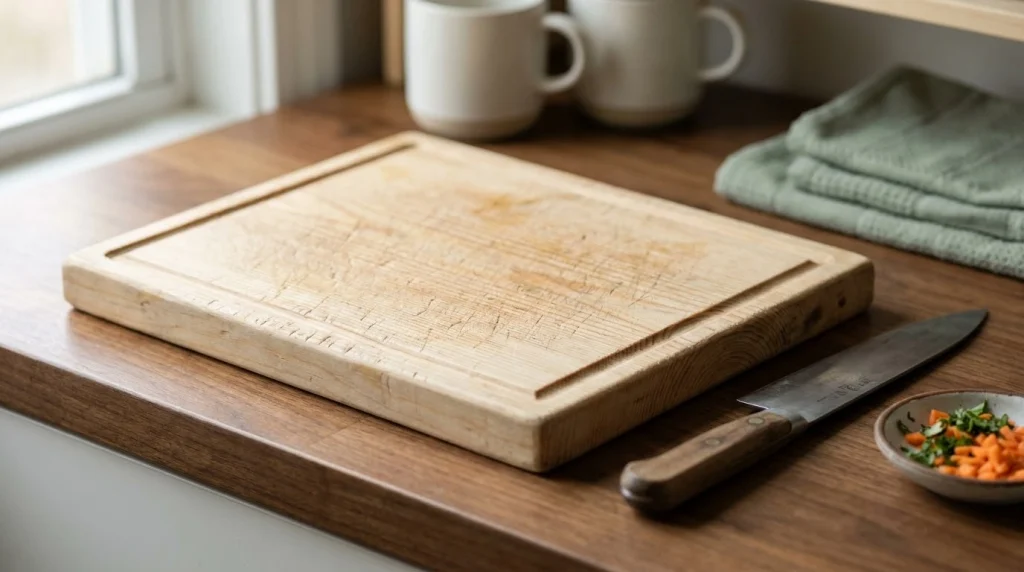
Hemlock is generally unsuitable for heavy kitchen use because its surface lacks the wear resistance of commonly recommended hardwoods. Repeated knife contact can damage its relatively soft wood fibers.
A good cutting board must balance durability, knife compatibility, moisture resistance, and ease of cleaning. Hemlock falls short in several of these areas.
1. Hemlock Has Low Surface Hardness
Wood hardness influences how easily a cutting board develops dents and surface damage. Hemlock has a significantly lower Janka hardness rating than hard maple.
The Janka hardness test measures the force required to press a standardized steel ball halfway into wood. Higher values generally indicate greater resistance to indentation.
- Eastern hemlock: approximately 500 lbf.
- Western hemlock: approximately 540 lbf.
- Black walnut: approximately 1,010 lbf.
- Hard maple: approximately 1,450 lbf.
These differences help explain why hardwood cutting boards generally withstand regular chopping more effectively. Hardness alone, however, does not determine food-contact suitability.
2. Hemlock Can Develop Deep Knife Marks
Repeated slicing and chopping can leave noticeable grooves in softwood surfaces. Hemlock is more vulnerable to this type of wear than commonly used cutting board hardwoods.
Deep grooves are particularly undesirable because they can collect food debris. Once surface damage becomes extensive, effective cleaning becomes more difficult.
3. Hemlock Can Develop Splinters
Hemlock may produce rough fibers or splinters when damaged, poorly machined, or repeatedly exposed to moisture. This creates an undesirable surface for direct food preparation.
Although careful sanding improves the initial finish, it cannot change the underlying hardness of the wood.
4. Repeated Washing Can Affect Its Stability
Like other natural woods, hemlock expands and contracts as its moisture content changes. Repeated soaking and uneven drying can contribute to distortion or cracking.
Common moisture-related problems include:
- Raised wood grain after washing.
- Cupping or warping from uneven drying.
- Small cracks around damaged areas.
- Roughening of the cutting surface.
- Joint failure in poorly constructed laminated boards.
Proper construction and maintenance reduce these risks, but they do not eliminate them.
Is Hemlock Wood Safe for Food Contact?
True hemlock tree wood is not the same as the poisonous herb commonly called poison hemlock. However, this distinction does not automatically establish that every piece of hemlock lumber is suitable for food contact.
The safety of a wooden kitchen surface depends on its species, treatment history, finish, construction, and condition.
Hemlock Tree vs. Poison Hemlock
| Characteristic | Hemlock Tree | Poison Hemlock |
|---|---|---|
| Scientific genus | Tsuga | Conium |
| Plant type | Evergreen conifer | Herbaceous plant |
| Common use | Lumber and woodworking | No culinary use |
| Toxicity concern | Food-contact suitability requires evaluation | Highly poisonous |
| Kitchen recommendation | Prefer established cutting board hardwoods | Never use |
The similar names can cause unnecessary confusion. These plants belong to entirely different botanical groups.
The FDA Food Code identifies hard maple or equivalently hard, close-grained wood as acceptable for specified commercial cutting surfaces. This provides a useful material-selection benchmark, although home kitchen requirements differ.
When Should Hemlock Never Be Used?
- When the wood species cannot be identified confidently.
- When the lumber has received pressure treatment.
- When the wood contains paint or unknown chemical finishes.
- When reclaimed lumber has an uncertain contamination history.
- When the surface contains mold, decay, or loose splinters.
- When adhesives or coatings lack appropriate food-contact suitability.
Applying mineral oil does not make contaminated or chemically treated lumber safe. The underlying material must be appropriate before any finish is applied.
Hemlock vs. Other Cutting Board Woods
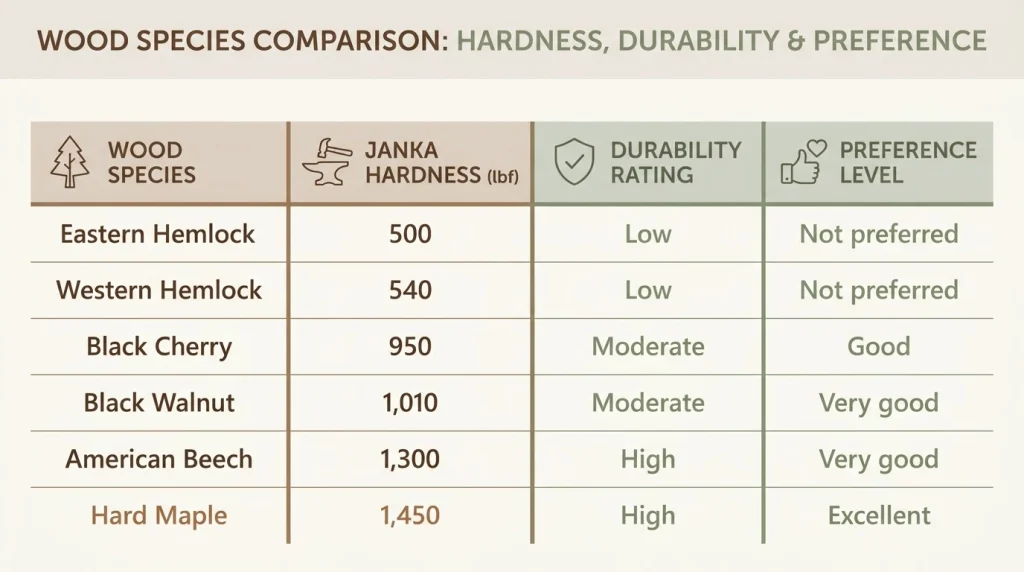
Hemlock performs poorly in surface hardness compared with many traditional cutting board materials. Maple, cherry, walnut, and beech provide more practical combinations of hardness and durability.
The following comparison illustrates the differences between common North American wood species.
| Wood Type | Janka Hardness | Dent Resistance | Kitchen Suitability |
|---|---|---|---|
| Eastern hemlock | 500 lbf | Low | Not preferred |
| Western hemlock | 540 lbf | Low | Not preferred |
| Black cherry | 950 lbf | Moderate | Good |
| Black walnut | 1,010 lbf | Moderate | Very good |
| American beech | 1,300 lbf | High | Very good |
| Hard maple | 1,450 lbf | High | Excellent |
Hardness values are approximate species averages. Individual boards vary with moisture content, grain orientation, and natural wood characteristics. Kitchen suitability represents a practical editorial assessment.
You can explore additional species characteristics through the Wood Database.
Hemlock vs. Maple Cutting Boards
Maple is the stronger choice for everyday cutting and chopping. Its harder surface provides better resistance to indentation while remaining practical for kitchen knife edges.
Hemlock may cost less as raw lumber, but faster surface deterioration can reduce its overall value.
Hemlock vs. Walnut Cutting Boards
Walnut offers an attractive dark appearance and better surface durability than hemlock. It works particularly well for kitchen boards that also serve as presentation pieces.
Both materials require regular maintenance, but walnut is an established choice for quality cutting boards.
Hemlock vs. Cherry Cutting Boards
Cherry offers a warmer appearance and substantially greater hardness than hemlock. Its surface can still develop scratches, but it provides a more practical balance for routine food preparation.
What Are the Advantages and Disadvantages of Hemlock?
Hemlock has several useful woodworking properties despite its limitations as a cutting surface. Understanding these qualities helps determine whether it belongs in a kitchen project.
| Advantages | Disadvantages |
|---|---|
| Relatively easy to work with | Develops dents easily |
| Attractive light appearance | Vulnerable to knife marks |
| Available in some lumber markets | Potential for rough fibers and splinters |
| Generally lighter than hard maple | Less suitable for heavy chopping |
| Can be economical | Potentially shorter cutting surface lifespan |
For a decorative woodworking project, some of these advantages may be useful. For a kitchen cutting board, however, the disadvantages carry more weight.
Can You Make a Cutting Board Out of Hemlock?
Making a board from hemlock is physically possible, but that does not make it a recommended cutting surface. Even careful woodworking cannot overcome the natural softness of the material.
If you’re planning a DIY project, I would select a suitable hardwood from the beginning. The process of making a wooden cutting board requires enough time and effort to justify choosing durable lumber.
What Should You Check Before Selecting Wood?
- Confirm the exact wood species.
- Choose dry, untreated lumber.
- Inspect for knots, cracks, and loose fibers.
- Avoid unknown reclaimed materials.
- Select adhesives intended for the relevant food-contact application.
- Use a suitable food-contact finish.
These precautions matter regardless of which wood species you choose.
Does Mineral Oil Make Hemlock a Better Cutting Board?
Food-grade mineral oil can help reduce moisture exchange and maintain a wooden board’s appearance. However, it cannot significantly improve the natural hardness or structural durability of hemlock.
Oiling also does not disinfect wood or make an unsuitable material safe for food contact.
What Cutting Board Oil Can Do
- Help reduce rapid moisture absorption.
- Maintain the wood’s natural appearance.
- Reduce excessive surface drying.
- Support routine wooden board maintenance.
What Cutting Board Oil Cannot Do
- Turn softwood into hardwood.
- Remove chemical contamination.
- Repair deep cracks or structural damage.
- Prevent all knife marks.
- Replace proper cleaning and sanitation.
For these reasons, I consider oil a maintenance product rather than a solution to poor material selection.
How to Maintain an Existing Wooden Cutting Board
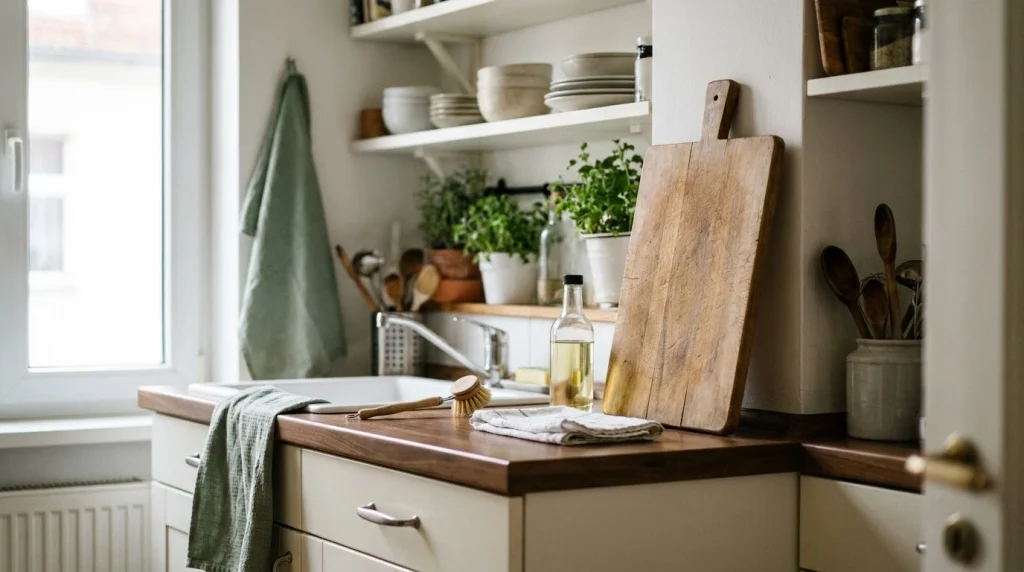
If you already own a wooden board, check whether its manufacturer identifies it as suitable for food preparation. Inspect its condition regularly and follow the recommended cleaning instructions.
The USDA Food Safety and Inspection Service provides useful guidance on safe food preparation and cutting board hygiene.
- Wash promptly: Use warm, soapy water after food preparation.
- Rinse thoroughly: Remove food debris and soap residue.
- Avoid prolonged soaking: Excessive moisture can damage wooden boards.
- Dry completely: Allow air to circulate around the board.
- Sanitize when necessary: Use an appropriate food-contact sanitizer according to its instructions.
- Maintain the finish: Apply food-grade cutting board oil when the surface needs conditioning.
- Replace damaged boards: Stop using boards with deep, difficult-to-clean grooves or loose splinters.
Use separate cutting surfaces for raw animal products and ready-to-eat foods whenever possible. This helps reduce the risk of cross-contamination.
What Is the Best Alternative to a Hemlock Cutting Board?
Hard maple is my preferred alternative for most home kitchens because it combines surface hardness, fine grain, and dependable everyday performance. Walnut and cherry are also practical alternatives.
As of 2026, these established hardwood choices remain sensible starting points for anyone shopping for a wooden cutting board.
Hard Maple
Hard maple provides excellent resistance to everyday indentation. It is particularly suitable for frequently used kitchen work surfaces.
Black Walnut
Black walnut combines useful durability with an attractive, naturally dark appearance. It is a strong candidate for premium chopping and presentation boards.
Black Cherry
Cherry provides moderate hardness and a fine-grained surface. Its warm color makes it appealing for both practical and decorative kitchen products.
American Beech
Beech offers good hardness and a relatively fine texture. Proper drying and regular maintenance are important because it can experience noticeable moisture-related movement.
Before buying lumber, consider whether your project requires an edge-grain or end-grain design. You can also learn why you cannot necessarily use any wood for a cutting board.
Recommended Alternatives to Hemlock Cutting Boards
If you’re replacing a softwood board, the following products offer practical alternatives for kitchen preparation and wooden board maintenance.
As an Amazon Associate, I earn from qualifying purchases. The scores below are editorial suitability ratings, not Amazon customer ratings or hands-on testing results.
🏆 Best Overall
John Boos Maple R-Board
★★★★★ 5/5
A substantial maple cutting board designed for regular kitchen preparation. I’d prioritize this type of board for everyday chopping because maple offers greater surface hardness than hemlock.
⭐ Best Premium Alternative
Virginia Boys Kitchens Walnut Cutting Board
★★★★☆ 4.5/5
A walnut cutting board that combines a rich natural appearance with practical kitchen functionality. I consider walnut a worthwhile choice when both appearance and cutting performance matter.
🛠 Best for Maintenance
Howard Cutting Board Oil
★★★★☆ 4.5/5
A food-grade mineral oil product designed for conditioning wooden kitchen surfaces. I’d use this for maintaining an appropriate hardwood board rather than attempting to improve unsuitable softwood.
Frequently Asked Questions
Is hemlock a hardwood or softwood?
Hemlock is a softwood because it comes from coniferous trees belonging to the genus Tsuga. Eastern and western hemlock also have relatively low Janka hardness ratings, making them less resistant to dents and knife marks than traditional cutting board hardwoods.
Is hemlock wood poisonous?
True hemlock tree wood is botanically different from poison hemlock, a highly toxic herbaceous plant. However, this distinction does not establish that every piece of hemlock lumber is food-safe. Species identification, chemical treatments, finishes, and material condition must all be considered.
Can you use western hemlock for a cutting board?
Western hemlock can physically be shaped into a board, but it is not a preferred cutting surface. Its approximate Janka hardness of 540 lbf makes it considerably softer than maple, walnut, and cherry, increasing its susceptibility to indentation and surface wear.
Is hemlock better than pine for cutting boards?
Western and eastern hemlock are harder than certain soft pine species, such as eastern white pine. However, pine hardness varies considerably by species. Neither hemlock nor ordinary soft pine is my preferred material for a frequently used kitchen cutting board.
Can hemlock be used for an end-grain cutting board?
Hemlock can be arranged in an end-grain construction, but changing the grain orientation does not eliminate its material limitations. A suitable hardwood remains the better starting point when building an end-grain board for frequent cutting, slicing, and chopping.
Final Verdict: Does Hemlock Make a Good Cutting Board?
Hemlock is not a recommended cutting board material for everyday kitchen use. Its relatively low hardness, vulnerability to surface damage, and potential maintenance challenges make it less practical than established cutting board hardwoods.
Although hemlock can be useful for general woodworking, hard maple offers a more dependable balance of durability and kitchen functionality. Walnut, cherry, and beech also deserve consideration.
My recommendation is simple: invest in a properly constructed, food-contact-appropriate hardwood board instead of trying to compensate for the limitations of hemlock.
A quality cutting board that receives proper cleaning, drying, and conditioning can provide dependable service for years.