Chef Knife Ricasso: Purpose, Location & Sharpening
Quick Answer
A chef knife ricasso is the flat, unsharpened section of blade near the handle, between the main blade grind and the handle or bolster. It forms a transition between the cutting portion and the handle assembly. Not every chef knife has a clearly visible ricasso, and it should not be confused with the heel, choil, or bolster.
Look closely at the base of a chef knife blade, just in front of the handle. You may notice a short area of steel that looks different from the cutting portion. This area can be the ricasso, although the feature is more prominent on some knife designs than others.
Recognizing the ricasso helps you understand where the cutting edge ends, why certain blade shapes are easier to sharpen, and how the steel transitions toward the handle.
What Is the Ricasso on a Chef Knife?
 Save
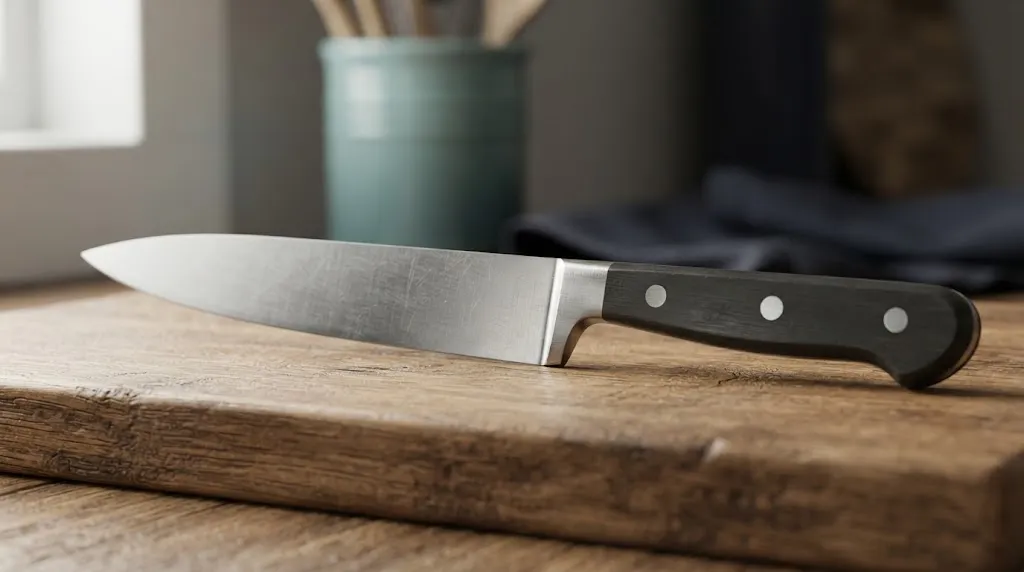
SaveThe ricasso is an unsharpened section of the blade located close to the handle. In conventional knife terminology, it sits between the main blade grind and the guard or handle assembly.
Unlike the cutting edge, the ricasso is not ground to a sharp cutting apex. It may retain more of the original blade thickness, creating a relatively flat area where the blade transitions toward the handle.
The knife manufacturer’s Kershaw knife anatomy glossary identifies the ricasso as the unsharpened portion between the grinds and handle. Although that reference illustrates folding knives, the fundamental terminology also applies to fixed-blade knives.
On kitchen knives, however, the term is less consistently used. Some designs have only a narrow unsharpened transition, while others have no clearly distinguishable ricasso at all.
Where Is the Ricasso Located?
The ricasso is found at the rear of the exposed blade, immediately before the handle or bolster.
To identify it without touching the cutting edge:
- Locate the handle. Look at the point where the exposed blade begins.
- Find the sharpened edge. Follow the lower edge backward toward the handle.
- Look for the grind transition. Some knives have a visible boundary where the thinner ground portion meets a thicker, flatter section.
- Identify the unsharpened blade area. If a distinct flat section lies between that grind and the handle or bolster, it is generally called the ricasso.
A small notch at the end of the cutting edge may be a choil rather than the ricasso. The two features can sit beside each other, but they are not the same.
For a broader view of how blade sections work together, the chef knife uses and grip guide explains the practical roles of the tip, belly, heel, and handle.
What Does a Ricasso Do on a Chef Knife?
The ricasso primarily forms a geometric transition between the ground blade and the handle area. Its practical significance depends on the knife’s construction.
1. Provides a Transition Between Blade and Handle
The cutting portion of a chef knife is ground to create a thinner working edge. Near the handle, the steel may retain more thickness.
A ricasso provides a defined region where the blade grind ends before reaching the handle or bolster. This can help accommodate the knife’s intended construction and blade geometry.
However, the ricasso is not the only way to create this transition. Many kitchen knives connect the blade and handle successfully without a pronounced ricasso.
2. Maintains Material Near the Blade Base
Because the ricasso is often thicker than the ground portion, it retains steel near the handle junction.
This can support the intended geometry of the blade base, but it does not automatically make one chef knife stronger than another. Overall strength depends on steel thickness, heat treatment, tang construction, blade design, and intended use.
A kitchen knife with a minimal ricasso can still be strong enough for normal food preparation.
3. Creates a Defined End to the Main Blade Grind
A visible ricasso helps distinguish the main ground blade from the section near the handle.
On certain knives, the boundary is marked by a plunge line, where the primary grind ends. On other knives, especially thin kitchen blades, this transition may be gradual or difficult to see.
The important point is that a ricasso describes the geometry of the unsharpened blade section, not a separate component attached to the knife.
4. May Affect Available Sharpening Clearance
The shape and position of the ricasso can influence how easily a sharpening stone reaches the heel of the cutting edge.
If a thick shoulder rises immediately beside the edge, it may interfere with the stone. A small sharpening choil can provide clearance, while a different blade design may avoid the obstruction altogether.
This relationship matters more during sharpening than during ordinary slicing and chopping.
Key Insight
A larger ricasso is not necessarily a better ricasso. On a chef knife, the useful cutting-edge length, sharpening access, grip comfort, and overall geometry matter more than the size of the unsharpened section.
Ricasso vs. Choil vs. Bolster vs. Heel
These four terms describe different features around the rear of a knife blade. Distinguishing them is especially helpful when discussing sharpening problems.
| Part | What It Is | Main Distinction |
|---|---|---|
| Ricasso | Flat, unsharpened blade section near the handle | Part of the blade geometry |
| Choil | Notch or recess near the end of the cutting edge | Creates clearance or a defined edge termination |
| Bolster | Thickened area or fitting near the blade-handle junction | Part of the handle transition and structural design |
| Heel | Rear portion of the cutting edge | An actual cutting region |
For example, if the final section of your cutting edge cannot touch the board, a projecting full bolster or an unevenly sharpened heel may be responsible. The presence of a ricasso alone does not establish the cause.
The chef knife belly guide explains another blade region, including how edge curvature affects cutting-board contact.
Do All Chef Knives Have a Ricasso?
No. Not all chef knives have a distinct or readily identifiable ricasso.
Traditional Western-style chef knives may use a substantial bolster at the blade-handle junction. Depending on the construction, this can make the ricasso difficult to distinguish as a separate area.
Many Japanese-style kitchen knives use a comparatively direct transition from the ground blade toward the tang and handle. Some have a small unsharpened section, but others show no pronounced flat ricasso.
Neither arrangement automatically indicates better quality.
A knife’s cooking performance depends more directly on its cutting geometry, edge condition, balance, handle comfort, and suitability for the ingredients being prepared.
When examining a chef knife, focus on how safely and comfortably the blade can be used and maintained rather than requiring a particular ricasso shape.
Should You Sharpen the Ricasso?
Generally, no. The ricasso is intended to remain unsharpened and should not be treated as a continuation of the cutting edge during routine maintenance.
Sharpen the actual cutting edge, stopping at its designed termination near the heel or choil.
Trying to sharpen the ricasso can remove unnecessary material and alter the intended transition. Depending on the construction, this may also create an awkward or unsafe edge close to the handle.
There is an important difference between maintaining the cutting edge and deliberately modifying the blade geometry.
How to Sharpen Safely Near the Ricasso
- Inspect the heel. Identify where the sharpened cutting edge actually ends.
- Check for obstructions. Look for a projecting bolster, raised shoulder, or unusual grind transition.
- Use a controlled sharpening angle. Keep the abrasive in contact with the edge bevel rather than the flat ricasso.
- Work carefully near the termination. Avoid forcing the stone into a thick shoulder.
- Inspect the result. Check for a consistent edge without creating an accidental sharp point beside the handle.
If a full bolster prevents sharpening the rear edge, repeatedly grinding the cutting bevel may not solve the problem. Correcting an uneven bolster-to-edge relationship can require professional reshaping.
For routine techniques and maintenance considerations, see the kitchen knife cleaning and sharpening guide.
Warning
Do not grind away a ricasso or bolster simply to increase cutting-edge length. Removing metal near the handle can permanently change the blade geometry. If substantial reshaping is necessary, use a qualified knife-sharpening professional.
Can the Ricasso Affect Cutting Performance?
The ricasso usually has little direct contact with food during normal chopping because it sits behind the working edge.
However, its size and relationship to the heel can have indirect consequences.
- Usable edge length: A larger unsharpened section may leave less sharpened edge within the same overall blade length.
- Sharpening access: A pronounced shoulder can make the rear edge more difficult to maintain.
- Grip clearance: The transition near the handle may influence how comfortably the user positions a pinch grip.
- Food preparation: A blunt section should not be expected to cut ingredients like the properly sharpened heel.
Consider two chef knives with equal overall blade lengths. If one has a substantial unsharpened section and the other has an edge extending closer to the handle, their usable cutting lengths may differ.
That difference may matter when slicing larger ingredients, but it does not establish that either knife is universally better.
How to Inspect and Care for the Ricasso
 Save
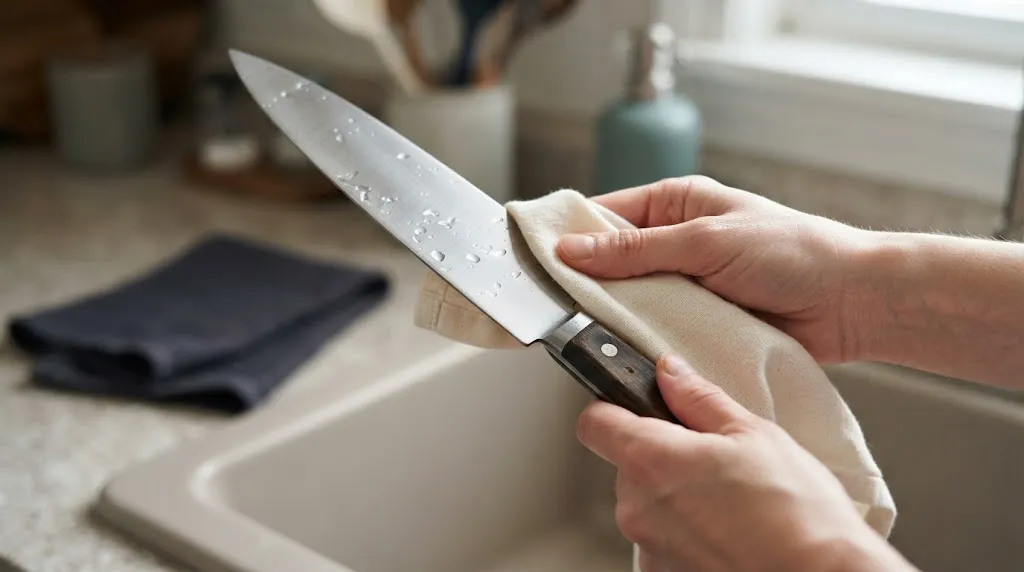
SaveThe ricasso usually requires no specialized maintenance. It should be cleaned and dried as part of the blade’s ordinary care routine.
Pay particular attention to the junction between the exposed steel and the handle, where water and food residue may collect.
- Clean after use: Wash the knife by hand with mild detergent and appropriate care for the handle material.
- Dry thoroughly: Remove moisture from the blade-handle transition.
- Inspect the surface: Watch for corrosion, trapped debris, or unexpected changes to the metal.
- Check the handle: If the handle becomes loose or the junction develops a significant gap, stop using the knife until it is assessed.
- Avoid unnecessary grinding: Minor cosmetic marks do not generally justify removing steel from the ricasso.
Surface discoloration does not always mean structural damage. However, deep pitting, cracking, or movement at the handle junction deserves closer inspection.
The ricasso itself is usually a passive feature. Keeping the entire knife clean, dry, securely assembled, and properly sharpened matters more than treating that small area separately.
Frequently Asked Questions
Is the ricasso part of the blade or handle?
The ricasso is part of the blade, not the handle. It is the unsharpened section near the blade-handle junction. The tang continues into the handle and serves a different structural purpose.
Can you hold a chef knife by the ricasso?
A normal chef knife is generally controlled with a suitable handle grip or pinch grip. Do not assume the ricasso is designed as a finger-resting area. Its dimensions and proximity to the cutting edge vary.
Is a ricasso necessary for knife strength?
No. A pronounced ricasso is not necessary for every strong knife. Strength depends on the complete blade geometry, steel, heat treatment, tang, and construction.
Can a chef knife have both a ricasso and a choil?
Yes. A knife can have a flat ricasso and a separate notch or recess called a choil. The ricasso is an unsharpened blade section, while the choil is a localized cutout or transition.
Why is the metal near my knife handle not sharp?
It may be an intentionally unsharpened ricasso or another part of the blade-handle transition. If a section that was previously sharp has become blunt, inspect the edge for wear or sharpening problems.
Does a ricasso mean a chef knife is high quality?
No. A ricasso is a design feature, not a quality grade. Judge a chef knife by its blade geometry, construction, edge retention, sharpening accessibility, balance, and comfortable handling.
Final Thoughts
The ricasso is the unsharpened blade section near the handle, where the main grind ends. Its appearance varies between knife designs, and some chef knives have no distinct ricasso.
The most practical lesson is to distinguish the ricasso from the cutting heel, choil, and bolster. Maintain the sharpened edge without unnecessarily modifying the unsharpened transition, and evaluate the knife as a complete cutting tool rather than judging it by one small feature.

