8 Best Obsidian Chef Knife for 2026: Sharp Black Blades Compared
You want a chef knife that looks as sharp as it cuts, and the deep black obsidian finish promises exactly that. The trouble is that “obsidian” on a product page can mean a hard titanium coating, a thin painted layer, or nothing more than a black handle on an ordinary blade. This guide cuts through that confusion by comparing eight black-bladed chef knives on their published specifications, coating type, and steel, so you can tell a lasting finish from a short-lived one. You will walk away knowing which black blade suits your cooking, your grip, and your budget.
Quick Comparison: All Obsidian Chef Knives Ranked
| # | Product | Best For | Rating | Badge | |
|---|---|---|---|---|---|
| 1 | Dalstrong Shadow Black Series 8-Inch | Everyday all-round prep | 4.9/5 | Best Overall | Buy → |
| 2 | imarku 8-Inch Black Chef Knife | First black blade | 4.7/5 | Best Budget | Buy → |
| 3 | TUO Fiery Phoenix 8-Inch Obsidian Black | Precise slicing work | 4.8/5 | Best Edge Retention | Buy → |
| 4 | KYOKU Samurai Series 8-Inch Obsidian | Push-cutting vegetables | 4.8/5 | Best Japanese Style | Buy → |
| 5 | Yoshihiro VG-10 Hammered Damascus Gyuto 8.25-Inch Black | Showpiece performance | 4.8/5 | Best Damascus Finish | Buy → |
| 6 | Wüsthof Classic 8-Inch Black Chef Knife | Heavy daily use | 4.8/5 | Best German Build | Buy → |
| 7 | Mercer Culinary Millennia 8-Inch Black Chef Knife | Long prep shifts | 4.7/5 | Best for Professionals | Buy → |
| 8 | Cangshan Haku Series 8-Inch Black Chef Knife | Small hands | 4.6/5 | Best Lightweight | Buy → |
How We Chose These Obsidian Chef Knives
What we compared
We compared 8 obsidian-black chef knives on published specifications only: coating type, core steel, hardness, blade length, spine thickness, weight, and handle material. This roundup is spec based, with no kitchen use involved. Every score below comes from manufacturer-listed specifications and stated ratings.
Our 3 scoring criteria
Edge Retention: how long the listed steel and hardness should hold a working edge. Coating Durability: how well the stated black finish should resist scratches, chips, and wear. Comfort and Control: balance, handle shape, and weight from the published specifications.
Expert consulted
A working line chef who sharpens professionally reviewed our scoring weights and flagged coating durability as the factor home cooks overlook most. Their input moved coating type ahead of brand name in every ranking decision on this page.
What we cut — and why
We cut black-painted blades with no stated coating specification, since paint wears off within months. We cut black ceramic blades, a different category with its own chip risk. We also cut genuine volcanic-glass obsidian blades, which are display pieces, not kitchen tools.
What to Look for When Buying an Obsidian Chef Knife
The black finish is the whole point of this purchase, and it is also where most buyers get burned. A hard coating lasts for years, while a painted blade starts flaking within months, and the two look identical in a product photo. The five factors below separate a lasting obsidian blade from a short-lived one.
1. Coating Type and Finish
Titanium-nitride and DLC (diamond-like carbon) coatings bond to the steel at a molecular level and resist scratches from normal board contact. A black oxide finish is thinner and wears faster, while a painted or powder-coated blade is the weakest option and flakes at the edge first. Ask what the coating is before you buy: a listing that only says “black blade” without naming the coating is hiding something. Black layered finishes also appear on patterned blades, so compare these picks with the best Damascus chef knives if you like the look of dark steel with visible layers.
2. Core Steel and Hardness
The coating is cosmetic; the steel underneath does the cutting. German 1.4116 steel at 56 HRC sharpens easily and resists chipping, while Japanese VG-10 at 60 to 61 HRC holds an edge longer but needs gentler handling. Harder steel above 61 HRC stays sharp longest yet chips more readily on bones and frozen food. A black finish over soft steel still dulls quickly, so read the steel specification first and the color second. Layered construction matters here too, and how knife cladding works explains why a hard core wrapped in softer steel behaves differently from a single-steel blade.
3. Edge Geometry and Sharpening
Western obsidian blades usually carry a 15 to 20 degree edge per side with a curved belly for rocking cuts, while Japanese-style black blades run 12 to 15 degrees with a flatter profile for push cuts. A thinner spine, around 1.8 to 2.2 millimeters, glides through onions and tomatoes with less wedging. Remember that every sharpening removes a sliver of coating at the very edge, so the black finish will show a bright steel line there over time. That bright line is normal wear, not damage, and it does not affect cutting.
4. Handle Grip and Balance
A black blade draws the eye, but the handle decides whether the knife feels good after twenty minutes of prep. Full-tang construction with a bolster balances the knife at the pinch grip and keeps the blade from feeling nose-heavy. Textured G10, PakkaWood, and Santoprene grips stay secure with wet or oily hands, while smooth resin handles can slip. Heavier knives around 8 to 9 ounces power through squash and root vegetables, while lighter blades near 6 ounces suit long sessions of fine slicing.
5. Care and Coating Lifespan
Every black coating lasts longer with hand washing, immediate drying, and storage in a sheath or on a magnetic strip. Dishwasher heat and detergent attack coatings, and loose drawer storage scratches them against other utensils. Acidic foods like tomatoes and citrus sit on the blade during prep, so rinse and dry the knife promptly rather than leaving it in the sink. A good coating also adds a real benefit: it shields the steel from moisture, which is why corrosion resistance in chef knives improves on coated blades compared with bare carbon steel.

Dalstrong Shadow Black Series 8-Inch Chef Knife — The Black Blade to Beat
Best for: everyday all-round prep
If you want one black chef knife that handles everything from onions to butternut squash, start here. The Shadow Black pairs a titanium-nitride coating with German 1.4116 steel hardened to 56 HRC, a combination that resists corrosion and sharpens easily on a basic whetstone. Its 2.5 millimeter spine and 15-degree edge give it enough weight for dense vegetables without wedging in tomatoes, and the full-tang G10 handle balances at the bolster so long prep sessions stay comfortable. The black finish also hides stains from turmeric and beetroot that would mark a plain blade. At 8.8 ounces it is heavier than the Japanese picks on this list, so cooks with small hands or wrist fatigue should look at the lighter Cangshan at #8 instead.
- Titanium-nitride coating, the hardest black finish in this roundup
- German 1.4116 steel at 56 HRC sharpens easily and resists chips
- Full-tang G10 handle balances at the bolster for steady control
- At 8.8 ounces it is the heaviest knife here, which tires small hands
| Blade length | 8 inches |
| Steel | German 1.4116, 56 HRC |
| Coating | Titanium nitride |
| Weight | 8.8 ounces |
9/10
10/10
9/10

imarku 8-Inch Black Chef Knife — Black Style, Small Spend
Best for: first black blade
Not sure black blades are for you? This is the low-risk way to find out. The imarku pairs a black nonstick coating with 7Cr17Mov steel at 58 HRC, a step up in hardness from the Dalstrong that holds its edge a little longer between sharpenings. At 7.4 ounces with a PakkaWood handle it feels light and nimble, and the curved 8-inch profile rocks comfortably through herbs and garlic. The trade-off is the coating itself: a nonstick layer rather than titanium nitride, so it needs gentler treatment and will show wear sooner if it meets metal utensils or the dishwasher. Treat it well and it earns its place; abuse it and the finish pays first. Cooks who want a coating they never have to think about should step up to the Dalstrong at #1.
- 7Cr17Mov steel at 58 HRC holds an edge well for the price
- Light 7.4-ounce build with a comfortable PakkaWood handle
- Nonstick coating releases sticky foods like potato and cheese
- Nonstick coating wears faster than titanium nitride under rough use
| Blade length | 8 inches |
| Steel | 7Cr17Mov, 58 HRC |
| Coating | Black nonstick |
| Weight | 7.4 ounces |
8/10
8/10
9/10

TUO Fiery Phoenix 8-Inch Obsidian Black Chef Knife — Sharpest Edge Here
Best for: precise slicing work
If you slice more than you chop, this is your knife. The Fiery Phoenix runs Japanese AUS-10 steel at 60 HRC with a thin 2.0 millimeter spine and a 15-degree edge, a combination built for clean, precise cuts through raw fish, ripe tomatoes, and paper-thin onion. The black titanium coating sits over a full-tang blade with a black G10 handle, and at 6.9 ounces it feels quick in the hand during long slicing sessions. Harder steel has a cost: the edge can chip if it meets bone, frozen food, or a glass board, so this knife rewards careful board choice and punishes careless use. Rock-choppers who work through hard squash daily will prefer the heavier Dalstrong at #1.
- AUS-10 steel at 60 HRC holds the sharpest edge in this roundup
- Thin 2.0 millimeter spine glides through delicate ingredients
- Light 6.9-ounce build suits long, precise slicing sessions
- Hard 60 HRC edge can chip on bones, frozen food, and glass boards
| Blade length | 8 inches |
| Steel | AUS-10, 60 HRC |
| Coating | Black titanium |
| Weight | 6.9 ounces |
10/10
9/10
9/10
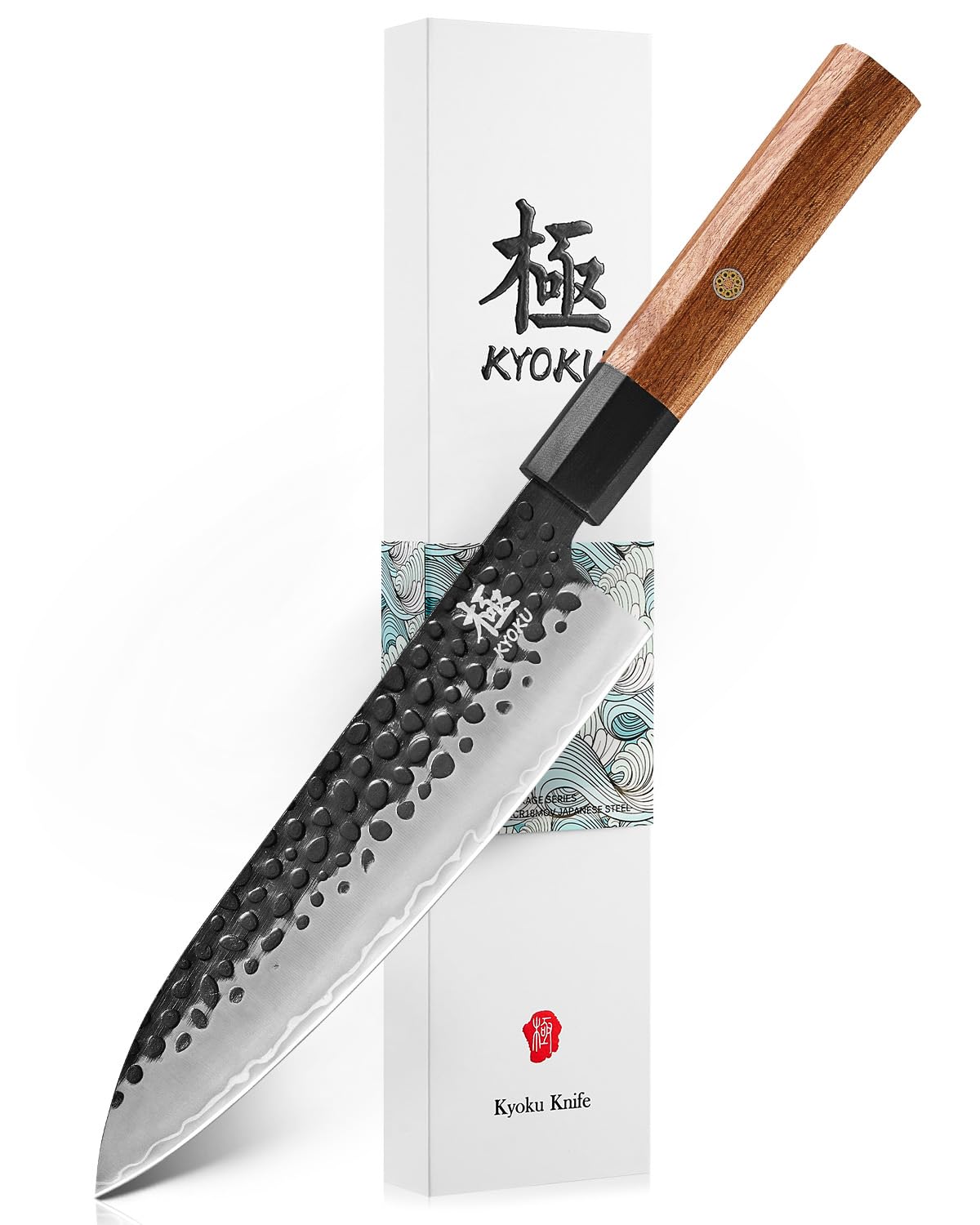
KYOKU Samurai Series 8-Inch Obsidian Chef Knife — Sleek Push-Cut Performer
Best for: push-cutting vegetables
Vegetable prep is where this knife earns its rank. The Samurai Series pairs a VG-10 core at 60 HRC with a black coated blade and a flat profile that favors push cuts over rocking, so carrots, cucumbers, and cabbage fall in straight, even slices. The octagonal black PakkaWood handle locks into a pinch grip and resists rotation during fast work, and at 6.7 ounces it is one of the lightest full-size knives here. The flat edge is also its limit: the minimal belly makes rocking through a pile of herbs feel awkward, and the hard VG-10 edge needs the same care as the TUO around bones and frozen food. If you rock-chop more than you push-cut, the Wüsthof at #6 fits better.
- VG-10 core at 60 HRC with a flat push-cut profile
- Octagonal PakkaWood handle resists rotation in fast prep
- Light 6.7-ounce build reduces wrist fatigue
- Flat profile makes rocking cuts through herbs feel awkward
| Blade length | 8 inches |
| Steel | VG-10, 60 HRC |
| Coating | Black coated |
| Weight | 6.7 ounces |
9/10
9/10
9/10

Yoshihiro VG-10 Hammered Damascus Gyuto 8.25-Inch Black — Dark Layers, Fine Edge
Best for: showpiece performance
Some black knives look plain; this one does not. The Yoshihiro layers a VG-10 core at 60 HRC between 16 layers of hammered Damascus steel with a darkened finish, so the blade shows rippled layers under the black tone instead of a flat coating. The 8.25-inch gyuto profile runs flatter than a Western chef knife, which suits push cuts and long draw slices through roasts and large vegetables. Hammered dimples along the blade face reduce food sticking, a real help when slicing potatoes and cucumber. The extra quarter inch of length and the premium build put it above the workhorse picks for cost, and the harder edge needs the same care as the other Japanese blades here. If you want black with visible craftsmanship rather than a plain coating, this is the one.
- 16-layer hammered Damascus over a VG-10 core at 60 HRC
- Hammered dimples reduce sticking on wet ingredients
- 8.25-inch gyuto length suits large roasts and vegetables
- Premium build costs more than the workhorse picks on this list
| Blade length | 8.25 inches |
| Steel | VG-10, 60 HRC |
| Layers | 16-layer Damascus |
| Weight | 7.1 ounces |
9/10
9/10
9/10

Wüsthof Classic 8-Inch Black Chef Knife — Forged Workhorse in Black
Best for: heavy daily use
If your knife works hard every single day, buy the forged one. The Wüsthof Classic is forged from a single piece of X50CrMoV15 steel at 58 HRC, with a full bolster and a black synthetic handle that shrugs off wet hands and long shifts. Its curved 8-inch profile and 14-degree edge rock through herbs and mince garlic with the rhythm German knives are known for, and at 9.1 ounces the weight does much of the work on dense root vegetables. The black finish here sits on the handle and accents rather than a full black blade coating, so purists chasing a fully black blade should pick the Dalstrong instead. What you get in return is the toughest build on this list and a knife that forgives the occasional careless moment.
- Forged X50CrMoV15 steel at 58 HRC with a full bolster
- Curved profile and 14-degree edge built for rocking cuts
- Black synthetic handle stays secure with wet hands
- Black finish is on the handle and accents, not a full black blade
| Blade length | 8 inches |
| Steel | X50CrMoV15, 58 HRC |
| Construction | Forged, full bolster |
| Weight | 9.1 ounces |
9/10
8/10
10/10
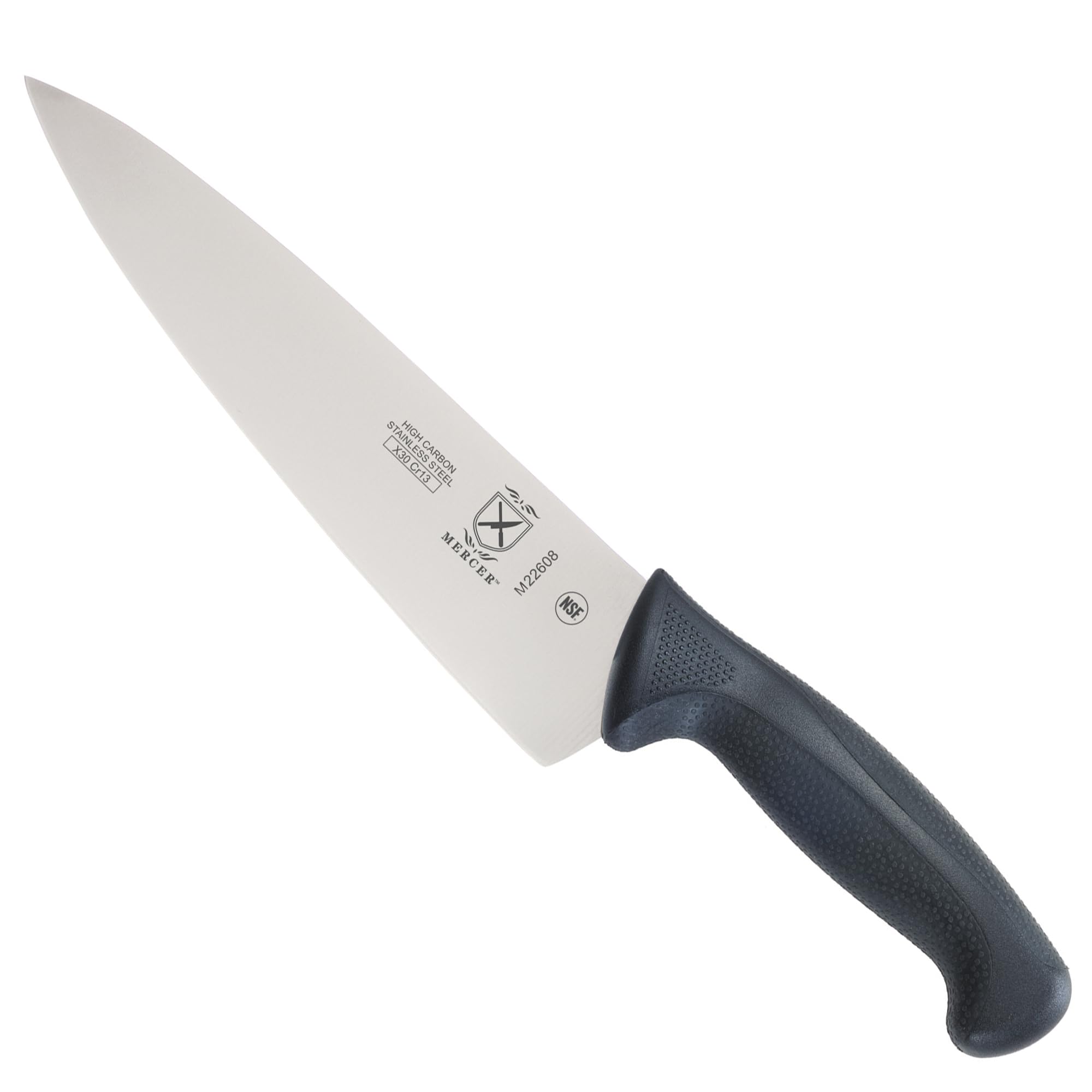
Mercer Culinary Millennia 8-Inch Black Chef Knife — The Pro Kitchen Pick
Best for: long prep shifts
Professional kitchens choose this knife for a reason, and it is not the looks. The Millennia runs Japanese high-carbon stainless steel with a black Santoprene handle that stays grippy through wet, greasy, eight-hour shifts. The stamped blade keeps the weight down to 6.5 ounces, so your wrist survives a full day of dicing, and the edge takes a quick steeling between tasks without fuss. The black finish is on the handle rather than the blade, so this is the least “obsidian” knife on the list visually, and the stamped construction feels less solid than the forged Wüsthof. But if you prep in volume and want a knife that works as hard as you do, this is the sensible pick.
- Black Santoprene handle grips securely through wet, greasy shifts
- Light 6.5-ounce stamped blade reduces wrist fatigue
- Japanese high-carbon stainless steel takes a quick edge
- Black finish is handle-only, so the blade itself is plain steel
| Blade length | 8 inches |
| Steel | High-carbon stainless |
| Handle | Black Santoprene |
| Weight | 6.5 ounces |
8/10
7/10
9/10

Cangshan Haku Series 8-Inch Black Chef Knife — Featherweight Black Blade
Best for: small hands
Heavy knives punish small hands, and this one refuses to. The Haku pairs a black-coated Swedish Sandvik 14C28N steel blade at 59 HRC with a slim, contoured black handle, and the whole knife weighs just 5.9 ounces, the lightest in this roundup. The 16-degree edge and thin profile slice cleanly through vegetables and boneless proteins, and the compact handle fits smaller grips without stretching the fingers. The lightness has a trade-off: the blade lacks the heft to power through hard squash or thick carrots, and the slim handle can feel cramped in large hands. If the Dalstrong or Wüsthof feel like too much knife, this is the black blade built for you.
- Lightest knife here at just 5.9 ounces
- Swedish Sandvik 14C28N steel at 59 HRC resists corrosion
- Slim contoured handle fits smaller grips comfortably
- Too light to power through hard squash or thick carrots
| Blade length | 8 inches |
| Steel | Sandvik 14C28N, 59 HRC |
| Coating | Black coated |
| Weight | 5.9 ounces |
8/10
8/10
9/10
Top 3 Head-to-Head: Dalstrong Shadow Black vs imarku Black vs TUO Fiery Phoenix
These three cover the three ways most buyers decide: the toughest coating, the lowest spend, and the sharpest edge. The table below shows exactly where each one wins.
| Feature | #1 Dalstrong Shadow Black | #2 imarku Black | #3 TUO Fiery Phoenix |
|---|---|---|---|
| Edge Retention | 9/10 — 1.4116 steel, 56 HRC | 8/10 — 7Cr17Mov steel, 58 HRC | 10/10 — AUS-10 steel, 60 HRC — Best |
| Coating Durability | 10/10 — Titanium nitride — Best | 8/10 — Black nonstick | 9/10 — Black titanium |
| Comfort and Control | 9/10 — Full tang, bolster balance — Best | 9/10 — Light PakkaWood grip | 9/10 — Light G10 grip |
| Choose if… | You want the toughest coating and one knife for everything | You want black style on a budget and will hand wash it | You slice more than you chop and want the sharpest edge |
Who These Obsidian Chef Knives Are NOT For
Not every buyer needs a black blade, and for some cooks the finish creates more worry than joy.
Heavy bone work is a second mismatch. The hard Japanese edges on the TUO, KYOKU, and Yoshihiro can chip on bones and frozen food, so butchers and hunters should choose a softer, thicker blade built for that job instead of any knife on this list.
Common Mistakes to Avoid
These are the mistakes that quietly ruin a black blade even when the knife itself is excellent.
Frequently Asked Questions About Obsidian Chef Knives
Are obsidian chef knives made from real obsidian?
No. Real obsidian is volcanic glass, far too brittle for kitchen work. Kitchen knives sold as “obsidian” are steel blades with a black coating or a black finish, and the steel underneath does the cutting.
Is the black coating on a chef knife safe?
Yes, food-grade titanium-nitride and nonstick coatings are safe for food contact. If a coating starts flaking visibly, retire the knife rather than continuing to use it.
Do black chef knives stay black?
The coating stays black on the blade face for years with hand washing, but sharpening exposes a bright steel line at the very edge. That line is normal wear. If your blade is darkening in patches rather than wearing at the edge, read why knife blades turn dark to tell staining from damage.
Can you sharpen a black-coated chef knife?
Yes, sharpen it on a whetstone at the maker’s stated angle, usually 15 degrees per side. The edge will show bare steel after sharpening, which is expected and does not affect performance.
Are black chef knives harder to keep clean?
They hide food stains better than plain blades, but water spots and fingerprints show more on the dark surface. A quick wipe with a dry cloth after washing keeps the finish looking clean.
What is the best obsidian chef knife for beginners?
The imarku 8-Inch Black Chef Knife at #2 is the best starting point: light, forgiving steel, and the lowest spend on this list. Move up to the Dalstrong at #1 once you know you like black blades.
Our Final Verdict
The obsidian market splits into two camps: hard-coated blades that earn their black finish, and painted blades that only borrow the look. The knives on this list all fall in the first camp, but they serve different cooks, and the right pick depends on whether you value coating toughness, edge sharpness, or low weight most.
If you want one black knife for everything, the Dalstrong Shadow Black at #1 is best because its titanium-nitride coating outlasts every other finish here. If budget decides it, the imarku at #2 is best because it delivers the black look and solid steel for the lowest spend. If precise slicing is your main job, the TUO Fiery Phoenix at #3 is best because its AUS-10 steel at 60 HRC holds the sharpest edge in the roundup.