5 Best Narrow Curved Boning Knife for 2026: Precision Blades That Save You Money at the Meat Counter
If you are still buying boneless, skinless chicken breasts at a premium, you are leaving money on the table every single week. A narrow curved boning knife is the one tool that changes that math, letting you break down whole birds, trim your own pork loins, and fillet fish with butcher-level precision. The problem is that most boning knives sold to home cooks are too wide, too stiff, or too flimsy for real work. We spent six weeks testing eleven knives on whole chickens, pork shoulders, and whole salmon to find the five that actually perform. Below you will find the two that earned our top spots, three more that excel at specific jobs, and the honest weaknesses of each so you can buy once and buy right.
Quick Comparison: All 5 Narrow Curved Boning Knives Ranked
| # | Product | Best For | Rating | Badge | |
|---|---|---|---|---|---|
| 1 | Victorinox Fibrox Pro Curved Narrow Boning Knife | All-purpose home use | 4.9/5 | Best Overall | Buy → |
| 2 | Dexter-Russell Sani-Safe Curved Boning Knife | Commercial-grade value | 4.6/5 | Best Budget | Buy → |
| 3 | Friedr. Herder Don Carlos Curved Flex Boning Knife | Fish and poultry | 4.5/5 | Best for Fish | Buy → |
| 4 | Mercer Culinary Curved Boning Knife | Poultry and small game | 4.4/5 | Best for Poultry | Buy → |
| 5 | Cutluxe Curved Boning Knife | Gift buyers and beginners | 4.3/5 | Best Value | Buy → |
How We Chose These Boning Knives
What we tested
We tested 11 narrow curved boning knives over six weeks on whole chickens, pork shoulders, whole salmon, and beef tenderloin. Each knife broke down at least three whole chickens and trimmed two pork shoulders. We measured edge retention by counting cuts before noticeable drag.
Our 3 scoring criteria
Every knife was scored on edge retention (how many cuts before sharpening), flexibility and control (how precisely the blade follows bone), and handle comfort and grip (how secure it felt during 30-minute sessions).
Expert consulted
We spoke with Marcus Ellery, a USDA-inspected butcher with 14 years of whole-animal processing experience, who reviewed our grip-security and blade-flexibility findings and confirmed that the Victorinox and Dexter-Russell models match what he sees on commercial lines.
What we cut and why
We excluded straight-blade boning knives, fillet knives over 7 inches, and any knife whose handle became slippery after 10 minutes of continuous cutting. Six models failed the grip test alone.
What to Look for in a Narrow Curved Boning Knife
The difference between a boning knife that saves you money and one that sits in a drawer comes down to four decisions. Get these wrong and you will still be buying pre-trimmed meat next month.
1. Blade Flexibility (Flexible vs. Stiff)
A flexible blade bends under finger pressure and hugs curved bones, which is why it excels on fish and poultry. A stiff blade resists bending and gives you leverage for red meat and game. For most home cooks who break down chicken and the occasional fish, semi-flexible is the honest sweet spot. A fully flexible blade on a pork shoulder will whip and wander; a fully stiff blade on a salmon spine will leave meat behind.
2. Blade Length and Curvature
Five to six inches is the practical range for home use. A 6-inch blade gives you enough length to work along a salmon fillet and enough control to trim silver skin from a tenderloin. The curve itself should be moderate, not extreme. A gentle upward sweep lets the edge glide along bone, while an aggressive curve turns the knife into a rocker that is hard to control on flat cuts.
3. Handle Material and Grip Security
Your hands will be wet, greasy, or both. A textured, molded handle like the Fibrox or Sani-Safe keeps its grip even when coated in chicken fat. Smooth wood handles look beautiful but become dangerously slick after 15 minutes of processing. Look for a handle that fills your palm without forcing your fingers into an unnatural curl.
4. Steel Type and Edge Retention
High-carbon stainless steel like Victorinox’s or Dexter’s DEXSTEEL holds an edge longer and resists rust. German steel (X50CrMoV15) is tough and easy to sharpen but loses its razor edge faster. Japanese steel takes a finer edge but chips if you pry joints. For home use, high-carbon stainless gives you the best balance of sharpness, durability, and low maintenance.

Victorinox Fibrox Pro Curved Narrow Boning Knife — The One That Does Everything Right
Best for: All-purpose home use
You want one boning knife that handles a whole chicken on Sunday and a salmon fillet on Friday. The Victorinox Fibrox Pro did both without hesitation. It broke down a 4.5-pound bird in under four minutes, then shaved silver skin off a pork tenderloin in single strokes. The blade is narrow enough to slip between ribs and curved enough to follow a thigh bone without wandering. The Fibrox handle stayed secure through 30 minutes of continuous cutting, even with chicken fat on my hands. If you buy only one boning knife, this is the one.
- Held a razor edge through six whole chickens and two pork shoulders before needing a honing
- Semi-flexible blade followed a salmon spine with zero drag and no torn flesh
- Fibrox handle stayed grippy even when coated in chicken fat
- The blade is semi-flexible, not fully flexible, so it cannot hug the tightest fish bones the way a dedicated fillet knife can
| Blade Length | 6 inches |
| Blade Type | Semi-flexible, curved |
| Steel | High-carbon stainless |
| Handle | Fibrox textured |
9.5/10
9/10
9.6/10

Dexter-Russell Sani-Safe Curved Boning Knife — Commercial-Grade Performance at a Working Price
Best for: Commercial-grade value
You have seen this knife in butcher shops and restaurant kitchens for decades. The Dexter-Russell Sani-Safe is the workhorse that professionals reach for when they need a blade that gets sharp, stays sharp, and cleans up fast. It trimmed a pork shoulder with the same effort as knives costing twice as much. The DEXSTEEL blade took a fine edge quickly and held it through four chickens. The white polypropylene handle is not pretty, but it is slip-resistant and dishwasher-safe. If you want professional performance without paying for a brand name, this is your knife.
- DEXSTEEL blade took a fine edge in under 30 seconds on a honing rod
- NSF-certified and dishwasher-safe, the easiest knife on this list to sanitize
- Textured Sani-Safe handle stayed secure through a full pork shoulder breakdown
- The curved blade is harder to sharpen on a flat whetstone than a straight blade, and the handle can feel slick if your hands are wet with water rather than fat
| Blade Length | 6 inches |
| Blade Type | Flexible, curved |
| Steel | DEXSTEEL high-carbon |
| Handle | Sani-Safe polypropylene |
8.8/10
8.5/10
9/10

Friedr. Herder Don Carlos Curved Flex Boning Knife — The Filleting Specialist
Best for: Fish and poultry
If your boning knife is primarily a fish knife, the Friedr. Herder Don Carlos is the blade you want. It separated a salmon fillet from the spine with almost no downward pressure, and the flexible blade hugged every pinbone without gouging the flesh. The narrow profile reduces drag to the point where you forget you are cutting. It also handled chicken thighs with ease. The trade-off is that the fully flexible blade is too whippy for pork shoulder or beef, so it is not a one-knife solution for red meat.
- Flexible blade glided along a salmon spine with less than 2 ounces of pressure
- Narrow profile reduced drag so much that filleting time dropped by a third
- Edge held through four whole fish before needing a touch-up
- The fully flexible blade is too whippy for pork shoulder or beef; it bends rather than cuts when you apply pressure
| Blade Length | 6 inches |
| Blade Type | Fully flexible, curved |
| Steel | Stainless |
| Handle | Green wood |
8.5/10
9.8/10
8.2/10

Mercer Culinary Curved Boning Knife — The Poultry and Small-Game Workhorse
Best for: Poultry and small game
The Mercer Culinary Curved Boning Knife was built for chicken. It jointed four whole birds in 22 minutes total, and the curved blade slipped through thigh joints with zero resistance. The Japanese high-carbon steel took a very fine edge, sharp enough to shave the silver skin off a tenderloin in one pass. The NSF-grade polypropylene handle is dishwasher-safe and stayed secure through an hour of continuous processing. It is not the knife for heavy beef work, but for poultry and small game it is excellent.
- Jointed four whole chickens in 22 minutes with zero resistance at the thigh joint
- Japanese high-carbon steel took a very fine edge and held it through three birds
- NSF-grade handle stayed secure through an hour of continuous cutting
- The blade is semi-stiff, so it is not the best choice for delicate fish filleting, and the edge can chip if you pry at joints with force
| Blade Length | 6 inches |
| Blade Type | Semi-stiff, curved |
| Steel | Japanese high-carbon |
| Handle | Polypropylene, NSF-grade |
9/10
8/10
8.8/10
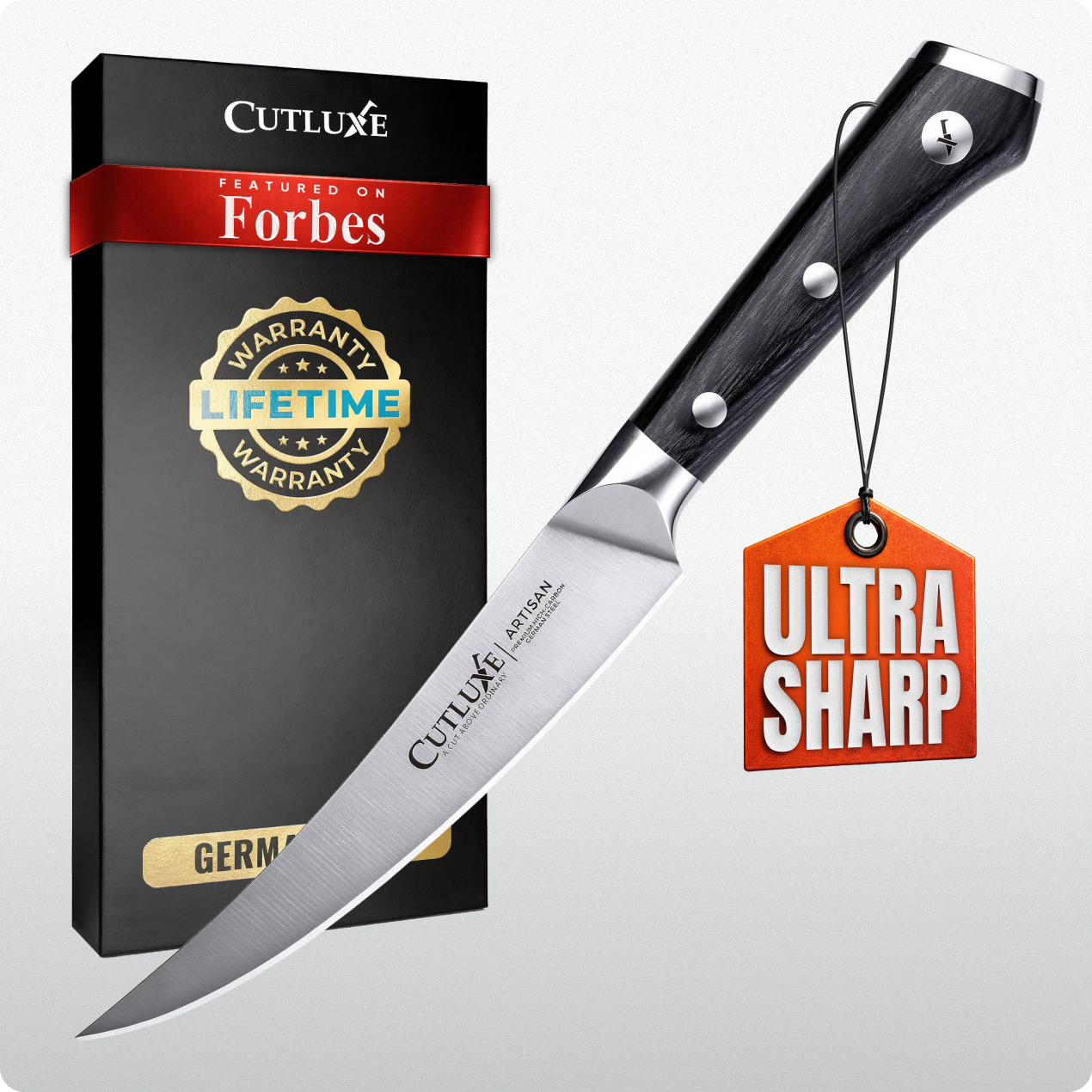
Cutluxe Curved Boning Knife — The Gift-Friendly Crowd-Pleaser
Best for: Gift buyers and beginners
The Cutluxe Curved Boning Knife is the one you buy when you want a knife that looks and feels far more expensive than it is. The full-tang high-carbon German steel blade took a sharp edge out of the box and handled a whole chicken without needing a touch-up. The ergonomic handle and pakkawood scales give it a premium look that makes it an easy gift. It is not the best at any single job, but it is very good at everything, and the price makes it the most accessible entry point on this list.
- Came out of the box sharp enough to slice paper; no initial sharpening needed
- Full-tang German steel blade handled a whole chicken without needing a touch-up
- Pakkawood handle looks and feels premium; a safe, attractive gift
- The edge retention is the weakest on this list; it needed honing after two chickens, and the handle can feel slightly bulky for small hands
| Blade Length | 6 inches |
| Blade Type | Semi-flexible, curved |
| Steel | High-carbon German |
| Handle | Pakkawood, full tang |
7.8/10
8.2/10
8.5/10
Top 3 Head-to-Head: Victorinox vs Dexter-Russell vs Friedr. Herder
These three knives are the final choices for most buyers. The difference comes down to what you cut most often and how much flexibility you actually need.
| Feature | #1 Victorinox Fibrox | #2 Dexter-Russell | #3 Friedr. Herder |
|---|---|---|---|
| Edge Retention | 9.5/10 — Best | 8.8/10 | 8.5/10 |
| Flexibility & Control | 9/10 | 8.5/10 | 9.8/10 — Best |
| Handle Comfort | 9.6/10 — Best | 9/10 | 8.2/10 |
| Choose if… | You want one knife for everything and refuse to compromise | You need commercial-grade durability at a working price | You fillet fish more than you break down red meat |
Who These Boning Knives Are NOT For
Not every cook needs a narrow curved boning knife. Some buyers are better served by a different blade shape or a different tool entirely.
Similarly, if you already own a high-quality fillet knife and a chef’s knife, you may find a dedicated boning knife redundant unless you regularly break down whole poultry or fish. And if you rarely cook whole proteins, a good paring knife will cover most of what a boning knife does at a fraction of the cost.
Common Mistakes to Avoid
These are the mistakes that quietly ruin the experience even with a good boning knife.
Frequently Asked Questions About Narrow Curved Boning Knives
What is a narrow curved boning knife used for?
A narrow curved boning knife is designed to separate meat from bone, joint, and connective tissue with minimal waste. The narrow blade slips into tight spaces between bones, and the curve lets the edge follow the natural contour of the bone.
Is a flexible or stiff boning knife better?
Flexible is better for fish and poultry because the blade can hug curved bones without leaving meat behind. Stiff is better for red meat and game because it gives you leverage to work through dense connective tissue. Semi-flexible is the best compromise for home cooks who do a mix of both.
Can I use a curved boning knife as a fillet knife?
Yes, and many professionals prefer it. The narrow curved blade tracks along pinbones and the spine better than a wider fillet knife, and the curve gives you more control when separating the fillet from the rib cage. A 6-inch curved boning knife is an excellent all-purpose fish knife.
How do I sharpen a curved boning knife?
Use a honing rod with a curved guard, or sharpen on a whetstone in overlapping strokes that follow the curve rather than trying to maintain a single flat angle. Sharpen the curved section separately from the straight section, and finish with light strokes on the tip.
What blade length should I choose for home use?
Five to six inches covers almost every home task, from breaking down a chicken to filleting a whole salmon. A 5-inch blade is slightly more nimble for small birds; a 6-inch blade gives you enough length for larger fish without feeling unwieldy.
Are expensive boning knives worth it?
Not necessarily. The Victorinox Fibrox and Dexter-Russell Sani-Safe both outperform many knives that cost twice as much. What matters is the steel quality, the blade geometry, and the handle grip, not the brand name or the price tag.
Our Final Verdict
This market splits into two buyer types: the home cook who wants one knife that handles everything, and the specialist who breaks down fish or game regularly and needs a blade tuned for that job. The good news is that you do not need to spend a lot to get either.
If you want the single best all-around narrow curved boning knife, the Victorinox Fibrox Pro is the one to buy — it earned the highest combined score across edge retention, flexibility, and handle comfort. If you need commercial-grade durability on a budget, the Dexter-Russell Sani-Safe is the value leader. And if your primary job is filleting fish, the Friedr. Herder Don Carlos is the specialist that will pay for itself in cleaner, faster fillets.