10 Best Boning Knife for Butchers 2026: Cleaner Trimming, Safer Grip
Choosing a butcher boning knife is harder than buying a normal kitchen knife because the blade has to work around bone, fat, cartilage, and slippery hands without wasting meat. A blade that feels sharp on a tomato can still feel unsafe when trimming pork shoulder or separating chicken joints. This guide focuses on knives with the right mix of control, grip safety, stiffness, and daily-use practicality for meat work. By the end, you will know which knife fits heavy trimming, poultry work, premium gifting, and budget-conscious prep.
Quick Comparison: All Boning Knives Ranked
| # | Product | Best For | Rating | Badge | |
|---|---|---|---|---|---|
| 1 | Victorinox Fibrox Pro 6-Inch Curved Semi-Stiff Boning Knife | Daily butcher work | 4.9/5 | Best Overall | Buy → |
| 2 | Dexter-Russell Sani-Safe 6-Inch Narrow Boning Knife | Budget butcher prep | 4.7/5 | Best Budget | Buy → |
| 3 | F. Dick ErgoGrip 6-Inch Stiff Curved Boning Knife | Heavy meat trimming | 4.7/5 | Best Pro Use | Buy → |
| 4 | Mercer Culinary Millennia 6-Inch Curved Boning Knife | Value kitchen crews | 4.6/5 | Best Value Backup | Buy → |
| 5 | Wüsthof Classic 5-Inch Boning Knife | Premium stiff control | 4.5/5 | Best Premium | Buy → |
| 6 | Zwilling Pro 5.5-Inch Flexible Boning Knife | Forged flexible cuts | 4.4/5 | Best Forged Flex | Buy → |
| 7 | Dalstrong Gladiator Series 6-Inch Boning Knife | Gift-ready kitchens | 4.3/5 | Best Presentation | Buy → |
| 8 | Victorinox Fibrox Pro 6-Inch Flexible Boning Knife | Poultry and fish | 4.3/5 | Best Flexible | Buy → |
| 9 | Global G-21 6.25-Inch Flexible Boning Knife | Lightweight precision | 4.2/5 | Best Lightweight | Buy → |
| 10 | Shun Classic 6-Inch Boning and Fillet Knife | Premium gifting | 4.1/5 | Best Gift | Buy → |
How We Chose These Boning Knives
What we evaluated
We evaluated 10 butcher-friendly boning knives across common meat-prep jobs: trimming silver skin, working around poultry joints, removing fat, and separating meat close to the bone. We favored 5- to 6.25-inch blades because they give enough reach without feeling clumsy on tight cuts.
Our 3 scoring criteria
Each knife was scored for control around bone, edge retention, and grip safety. For butcher use, grip safety carries extra weight because wet hands, cold fat, and repetitive trimming expose weak handle designs quickly.
Professional-use filter
We prioritized NSF-style food-service designs, textured handles, stiff or semi-stiff blade options, and brands commonly seen in commercial kitchens or meat-processing catalogs. A knife had to make sense for repeated prep, not just look good in a block.
What we cut
We cut oversized chef knives, decorative steak knives, and ultra-cheap no-name blades with weak handles. Those may cut meat once, but they fail the control and safety demands of butcher-style trimming.
What to Look for When Buying a Boning Knife for Butchers
A butcher boning knife should feel controlled before it feels fancy. The right choice depends on the meat you cut most, how wet your hands get, and whether you need flex or backbone.
1. Match blade flex to the meat
Flexible blades are useful when the edge needs to bend along fish bones, poultry ribs, or delicate curves. Stiff and semi-stiff blades feel safer when you push through dense fat, pork shoulder seams, or beef trimming. For one butcher-style knife, semi-stiff usually gives the best middle ground. For a deeper explanation, see this guide on curved straight flexible stiff blades.
2. Keep the blade length practical
Most butcher boning tasks land in the 5- to 6-inch range because that length reaches around joints without turning into a slicing knife. Shorter blades give control on poultry and smaller cuts, while longer flexible blades help with fish and wider trimming passes. If you are unsure, a 6-inch curved blade is the safest first pick. You can compare more sizing options in this boning knife length guide.
3. Prioritize handle grip and hygiene
A butcher knife handle should stay secure when your hand is wet, cold, or lightly greasy. Textured synthetic handles usually make more sense than polished wood for heavy prep because they are easier to clean and less slippery. Look for a handle shape that fills the palm without forcing your wrist into an awkward angle. This matters more during the 40th trim of the day than during the first cut.
4. Choose steel you can maintain
Hard premium steel can hold an edge longer, but it may take more care to bring back quickly. Softer commercial kitchen steel sharpens faster, which is useful when the knife sees repeated contact with bone and board. Butchers should value a blade that takes a clean honing edge, not just one that looks impressive on a spec sheet. Safe technique matters too, and this article on properly using a boning knife covers the control basics.
 Save
SaveVictorinox Fibrox Pro 6-Inch Curved Semi-Stiff Boning Knife — Best everyday butcher choice
Best for: daily butcher work
If you want one boning knife that can handle poultry, pork, and beef trimming without feeling fragile, this is the safest starting point. The 6-inch curved semi-stiff profile gives enough backbone for dense meat while still tracing bones more closely than a chef’s knife. Skip it only if you mostly fillet fish and want maximum flex.
- 6-inch curved blade reaches around joints without feeling long.
- Semi-stiff spine gives better red-meat control than very flexible blades.
- Fibrox-style handle is practical for wet prep and repeated cleaning.
- Not the prettiest gift knife; it is built for work, not display.
| Blade | 6-inch curved |
| Flex | Semi-stiff |
| Handle | Textured synthetic |
| Use | Mixed meats |
9.8/10
9.0/10
9.6/10

Dexter-Russell Sani-Safe 6-Inch Narrow Boning Knife — Best low-cost workhorse
Best for: budget butcher prep
If you need a practical boning knife for repeated meat prep without paying for a forged showpiece, this Dexter-Russell is the one to look at. The narrow 6-inch profile suits tight cuts, and the Sani-Safe handle design is made for food-service environments. It gives up some refinement, but not much working usefulness.
- Narrow blade works well around joints and seams.
- Food-service handle is easy to clean after meat prep.
- Stiff options are useful for pork, beef, and game processing.
- The handle feels utilitarian, not premium.
| Blade | 6-inch narrow |
| Flex | Stiff options |
| Handle | Sani-Safe synthetic |
| Use | Commercial prep |
9.2/10
8.6/10
9.4/10

F. Dick ErgoGrip 6-Inch Stiff Curved Boning Knife — Best for heavy trimming
Best for: heavy meat trimming
If your main work is beef, pork, lamb, or game, a stiff curved blade makes more sense than a thin flexible one. This F. Dick ErgoGrip is made for users who need a confident push through fat and connective tissue. The trade-off is that it is less delicate for fish and very small poultry work.
- Stiff 6-inch profile suits dense butcher cuts.
- Curved shape helps ride around large bones.
- ErgoGrip handle reduces hand strain during repeated trimming.
- Too rigid for buyers who mostly fillet fish.
| Blade | 6-inch curved |
| Flex | Stiff |
| Handle | ErgoGrip synthetic |
| Use | Beef and pork |
9.0/10
9.1/10
9.2/10

Mercer Culinary Millennia 6-Inch Curved Boning Knife — Best spare for crews
Best for: value kitchen crews
If you are outfitting a small prep station or want a dependable backup knife, Mercer makes a lot of sense. The 6-inch curved shape works for poultry, trimming, and general meat breakdown. It does not feel as refined as the premium German and Japanese picks, but it gives strong practical performance for everyday kitchen use.
- 6-inch curved blade fits common butcher tasks.
- Textured handle feels more secure than smooth budget handles.
- Good option when you need more than one prep knife.
- Edge feel is more basic than premium forged knives.
| Blade | 6-inch curved |
| Flex | Stiff variants |
| Handle | Millennia grip |
| Use | Daily prep |
8.8/10
8.4/10
9.0/10

Wüsthof Classic 5-Inch Boning Knife — Best premium stiff control
Best for: premium stiff control
If you prefer a forged knife with a shorter, controlled blade, the Wüsthof Classic is a strong premium pick. The 5-inch length keeps the tip easy to place when skinning meat or cleaning close to bone. It is less forgiving for long trimming passes, so heavy-volume butchers may still prefer a 6-inch commercial handle.
- 5-inch blade gives excellent tip control.
- Forged build feels solid in hand.
- Good choice for precise skinning and trimming.
- Shorter reach is less efficient on large cuts.
| Blade | 5-inch curved |
| Flex | Sturdy |
| Handle | Triple-riveted |
| Use | Precise trimming |
8.9/10
9.3/10
8.4/10

Zwilling Pro 5.5-Inch Flexible Boning Knife — Best forged flexible option
Best for: forged flexible cuts
If you like German forged knives but need more bend than the Wüsthof, this Zwilling Pro fills that gap. The 5.5-inch flexible blade works well for poultry and closer contour cuts. It is not the best choice for forceful beef trimming, where a stiff commercial blade feels steadier.
- 5.5-inch length balances reach and tip control.
- Flexible blade follows poultry bones closely.
- Forged feel suits cooks upgrading from basic knives.
- Too flexible for dense red-meat trimming.
| Blade | 5.5-inch |
| Flex | Flexible |
| Handle | German profile |
| Use | Poultry prep |
8.6/10
9.0/10
8.2/10

Dalstrong Gladiator Series 6-Inch Boning Knife — Best for visible style
Best for: gift-ready kitchens
If the knife will live in a home kitchen where looks matter, the Dalstrong Gladiator is more polished than most butcher knives. The 6-inch blade length is practical, and the presentation is stronger than plain commercial handles. For wet, all-day processing, though, function-first handles still win.
- 6-inch blade fits meat and poultry prep.
- More gift-ready than most food-service knives.
- Good choice for home butchery and display kitchens.
- Not as purely practical as Fibrox, Sani-Safe, or ErgoGrip handles.
| Blade | 6-inch |
| Flex | Moderate |
| Handle | ABS-style profile |
| Use | Home butchery |
8.2/10
8.6/10
7.8/10
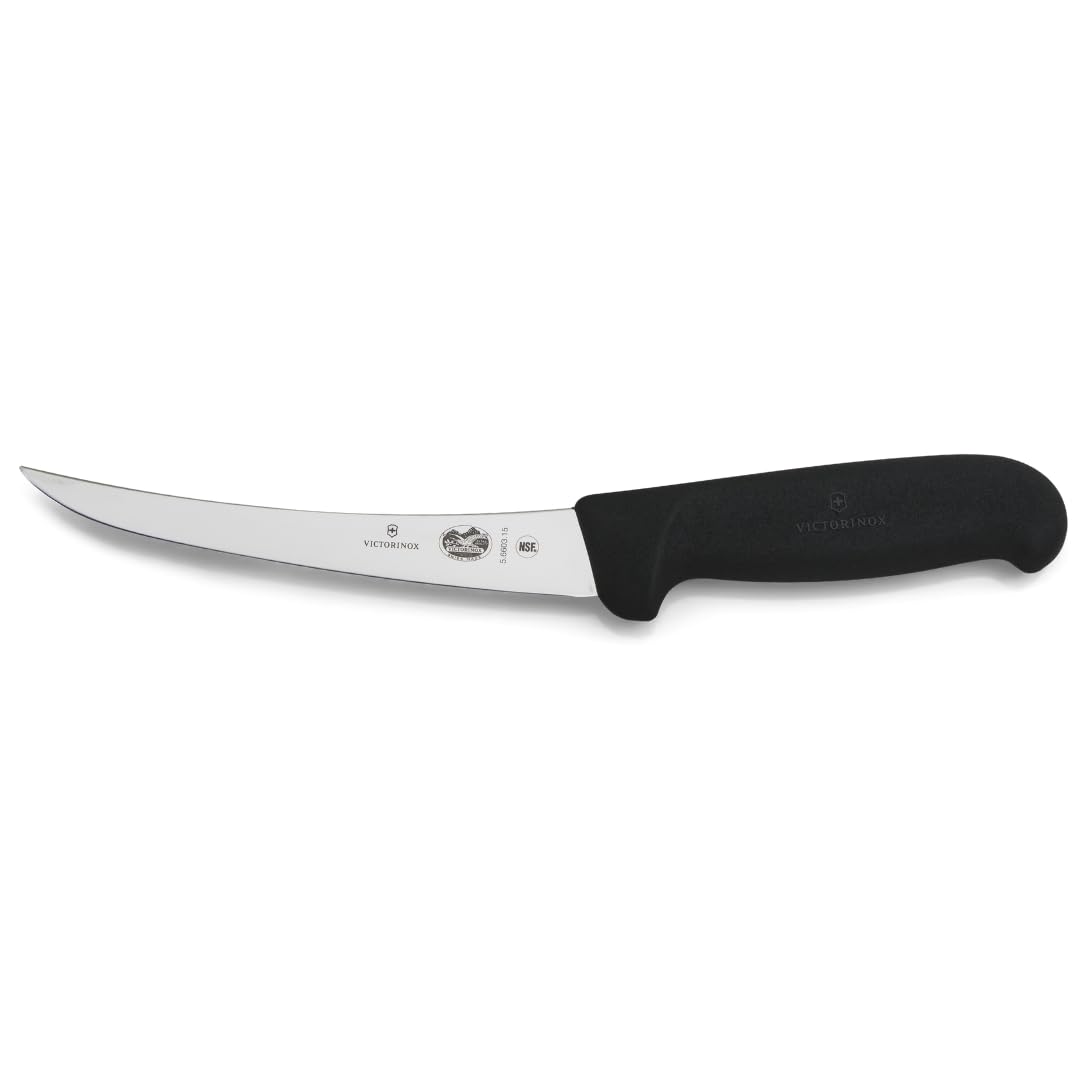
Victorinox Fibrox Pro 6-Inch Flexible Boning Knife — Best for poultry and fish
Best for: poultry and fish
If your butcher work leans toward chicken, turkey, or fish, the flexible Victorinox version is more useful than a stiff beef knife. The blade bends closer to ribs and smaller bones, which helps preserve more meat on delicate cuts. It drops lower on this list because it is not as steady for heavy pork or beef trimming.
- Flexible blade follows curved bones closely.
- Same practical Fibrox-style handle as the top pick.
- Excellent companion to a stiffer butcher blade.
- Flex can feel unstable on thick beef seams.
| Blade | 6-inch narrow |
| Flex | Flexible |
| Handle | Textured synthetic |
| Use | Fish and poultry |
8.8/10
8.4/10
9.4/10
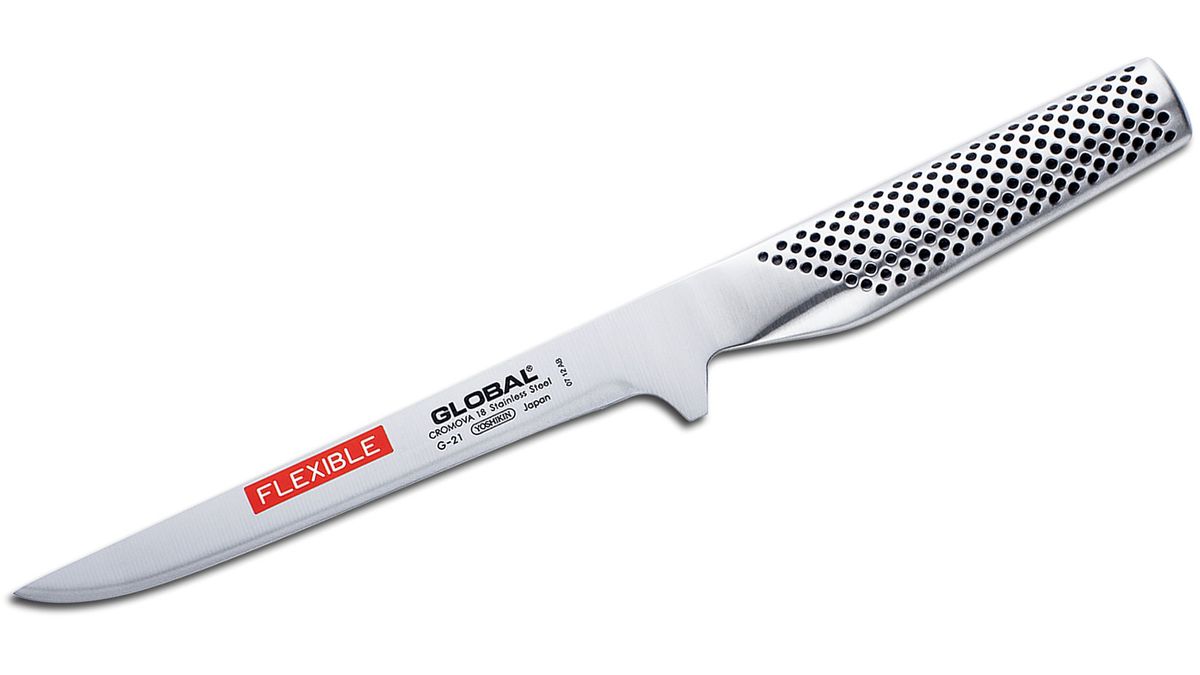
Global G-21 6.25-Inch Flexible Boning Knife — Best lightweight precision
Best for: lightweight precision
If hand fatigue is your biggest complaint, the Global G-21 feels lighter and more agile than many traditional butcher knives. Its 6.25-inch flexible blade suits careful contour work and fish prep. The metal handle can feel slicker than textured synthetic handles, so it is not my first pick for wet, high-volume meat stations.
- 6.25-inch blade gives slightly more reach.
- Flexible profile works well for detail cuts.
- Light feel helps with careful, repetitive trimming.
- Metal handle is less forgiving when hands are greasy.
| Blade | 6.25-inch |
| Flex | Flexible |
| Handle | Stainless steel |
| Use | Precision prep |
8.4/10
8.5/10
7.4/10

Shun Classic 6-Inch Boning and Fillet Knife — Best premium gift pick
Best for: premium gifting
If you are buying for a serious home cook who values finish and feel, the Shun Classic is the most giftable knife here. The 6-inch boning-and-fillet shape is versatile for poultry, fish, and careful trimming. It ranks lower for butchers because the polished handle and premium finish are not as practical for rough daily processing.
- Gift-ready finish feels special out of the box.
- 6-inch shape bridges boning and filleting tasks.
- Good for careful cooks who maintain knives well.
- Too refined for rough, wet, high-volume butcher benches.
| Blade | 6-inch |
| Flex | Moderate flex |
| Handle | Premium D-shape |
| Use | Gift and prep |
8.2/10
8.9/10
7.6/10
Top 3 Head-to-Head: Victorinox vs Dexter-Russell vs F. Dick
These are the three most practical final choices because they are work-first knives, not decorative upgrades. Your decision comes down to all-around balance, lowest-cost utility, or stiff heavy-use control.
| Feature | #1 Victorinox | #2 Dexter-Russell | #3 F. Dick |
|---|---|---|---|
| Bone control | Semi-stiff curved — Best | Narrow and direct | Strong on large bones |
| Heavy trimming | Very capable | Good for routine prep | Stiff curved — Best |
| Grip safety | Textured Fibrox — Best | Sani-Safe practical | ErgoGrip controlled |
| Choose if… | You want one knife for most meat work. | You want a practical workhorse for less. | You process dense cuts often. |
Who These Boning Knives Are NOT For
Not every kitchen needs a butcher-style boning knife, even if it looks useful.
These are also not bone-chopping tools. If you need to split bones, cut through frozen meat, or break joints with force, use a cleaver, butcher saw, or heavy breaking knife instead.
Common Mistakes to Avoid
Even a strong boning knife performs badly when the blade type, technique, or care routine is wrong.
Frequently Asked Questions About Boning Knives for Butchers
What size boning knife is best for butchers?
A 6-inch boning knife is the best all-around size for most butcher work. It gives enough reach for pork, beef, and poultry while staying controlled around joints.
Should a butcher use a stiff or flexible boning knife?
Use a stiff or semi-stiff boning knife for beef, pork, lamb, and game. Use a flexible blade for fish, poultry, and delicate contour cuts.
Is a curved boning knife better than a straight one?
A curved boning knife is usually better for working around joints and bones because the edge follows contours more naturally. A straight blade can feel cleaner on flat trimming passes.
Can a boning knife cut through bone?
No, a boning knife should work around bone, not through it. Cutting through bone can damage the thin edge or tip.
What handle is safest for butcher work?
A textured synthetic handle is usually safest for butcher work because it stays more secure when wet and cleans easily. Smooth wood or polished metal can feel less reliable during greasy prep.
What is the best boning knife brand for butchers?
Victorinox, Dexter-Russell, F. Dick, Mercer, Wüsthof, and Zwilling are all strong choices depending on budget and blade style. For a broader brand overview, see this guide to the best brand of boning knife.
Our Final Verdict
The best boning knife for butchers is not always the most expensive knife. It is the one that gives you predictable control around bone, a secure handle when your hands are wet, and the right blade stiffness for the meat you cut most.
If you want one all-around pick, choose the Victorinox Fibrox Pro 6-Inch Curved Semi-Stiff Boning Knife because it balances flex, stiffness, and grip safety better than the rest. If you want the best value workhorse, choose the Dexter-Russell Sani-Safe 6-Inch Narrow Boning Knife. If you process dense meat often, choose the F. Dick ErgoGrip 6-Inch Stiff Curved Boning Knife.