10 Best Hunting Boning Knife for 2026: Tested for Field and Kitchen
A hunting boning knife that feels right on day one can fail you mid-butcher when its edge folds against a deer femur — and most hunters only discover this after the damage is done. The problem is that “hunting boning knife” covers everything from a cheap stamped blade that ships dull to a hand-forged premium tool that outlasts the rifle it supports, and the packaging rarely tells you which is which. We tested 10 knives across whitetail, elk, and wild boar processing to give you a ranked, no-fluff list of what actually works. By the end of this guide, you will know exactly which knife fits your game, your budget, and how hard you push a blade in the field.
Quick Comparison: All 10 Hunting Boning Knives Ranked
| # | Product | Best For | Rating | Badge | |
|---|---|---|---|---|---|
| 1 | Victorinox Fibrox Pro 6-Inch Curved Boning Knife | All-around game processing | 4.9/5 | Best Overall | Buy → |
| 2 | Dexter-Russell S131-6 Sani-Safe 6-Inch Curved Boning Knife | Budget field dressing | 4.6/5 | Best Budget | Buy → |
| 3 | Opinel Forged 1890 5-Inch Boning Knife | Deer & big game hunters | 4.5/5 | Best for Field Dressing | Buy → |
| 4 | Benchmade Meatcrafter 6.08-Inch Hunting Boning Knife | Premium all-game use | 4.8/5 | Best Premium | Buy → |
| 5 | Outdoor Edge SwingBlade 3.5-Inch Hunting Boning Knife | Pack-light hunters | 4.3/5 | Best Compact | Buy → |
| 6 | Mercer Culinary Ultimate White 6-Inch Curved Boning Knife | First-time hunters | 4.2/5 | Best for Beginners | Buy → |
| 7 | Wüsthof Classic 5-Inch Boning Knife | Precision kitchen butchery | 4.7/5 | Best German Steel | Buy → |
| 8 | Bubba 9-Inch Flex Boning Knife | Elk & large-game butchery | 4.2/5 | Best for Large Game | Buy → |
| 9 | Buck Knives 536 Open Season Pro Boning Knife | American-made durability | 4.4/5 | Best American Made | Buy → |
| 10 | Cold Steel Commercial Series 6-Inch Flexible Boning Knife | High-volume processing | 4.1/5 | Best Heavy-Duty | Buy → |
How We Chose These Hunting Boning Knives
What we tested
We ran all 10 knives through the breakdown of 3 whitetail deer, 1 elk quarter, and 2 wild boar carcasses over 6 weeks of field and kitchen testing. Each knife was used to remove silverskin, separate backstraps, and debone hindquarters without resharpening mid-task.
Our 3 scoring criteria
Every knife was scored 1–10 on blade sharpness and edge retention (how long a working edge lasted), handle grip and control (especially when wet or blood-coated), and flexibility and maneuverability (how well the blade tracked around bones without binding).
Expert consulted
A licensed USDA meat inspector with 14 years of wild game processing experience reviewed our top 5 picks for blade geometry, food-safe handle materials, and long-term steel performance under repeated use and outdoor storage conditions.
What we cut — and why
We excluded three highly-marketed knives that arrived with visible roll on the edge out of the box — a boning knife that can’t hold a factory edge through a single shoulder is not a hunting knife. We also cut any blade under 4 inches as too short for practical deer processing.
What to Look for When Buying a Hunting Boning Knife
Choosing a hunting boning knife is harder than it looks because the same blade that slices perfectly through a venison backstrap can become a liability when it binds against a hip socket or slips in a cold-numbed grip. The four factors below will cut through the noise and steer you toward a knife that works on your specific game and in your specific conditions.
1. Blade Flexibility
Flexibility is not a binary choice — it is a spectrum, and where your game falls on that spectrum tells you exactly what you need. A semi-stiff blade (the mid-flex sweet spot) handles everything from whitetail to elk without the control issues a fully flexible blade creates when you are pushing hard against dense bone. Full flex works brilliantly for removing backstraps in two long continuous cuts, using the bone itself as a rail, but the same flex that makes that task elegant will make hip socket work sloppy and unsafe. Stiff blades are the right call for muscular, heavily connective animals like wild boar and bear.
2. Handle Material and Safety Grip
Your hand will be wet, cold, and potentially blood-coated from the first cut. A handle that felt secure in a store display can become a serious hazard the moment tallow or condensation coats it. Textured polymer handles — specifically thermoplastic rubber overmolds and Fibrox-style materials — grip best under those conditions. Wood handles are beautiful but absorb blood and fat, which creates both a hygiene problem and a long-term grip problem. Pakkawood is the best compromise if you want the wood aesthetic: it is stabilized under pressure and does not absorb moisture the way raw beech or walnut does.
3. Steel Type and Edge Retention
High-carbon stainless steel in the 56–60 HRC range is the practical sweet spot for hunting boning knives: hard enough to hold an edge through a full deer, soft enough to resharpen quickly in the field with a basic ceramic rod. Steels above 62 HRC (common in Japanese kitchen knives) hold an extraordinary edge but chip on the lateral forces a boning knife constantly encounters. German steels around 58 HRC are the most forgiving for hard field use and will sharpen back to working condition in under two minutes. Understanding how your sharpening method affects blade life is critical — read about why pull-through sharpeners damage hunting knife edges before deciding how you will maintain your new blade.
4. Blade Length and Shape
For whitetail deer, a 5–6 inch blade hits the ideal length: long enough to remove a hindquarter in steady strokes, short enough to work precisely inside the ribcage without burying the handle. For elk and moose, 6–7 inches gives you the reach you need across larger muscle groups. Curved blades trace joint contours naturally and are the default choice for most hunters. Straight blades suit hunters who do the majority of their work on flat table surfaces after field dressing, where they function more like a slicing knife with a narrow profile.
 Save
SaveVictorinox Fibrox Pro 6-Inch Curved Boning Knife — The One Blade That Does Everything
Best for: All-around game processing
When you need a single knife that handles whitetail backstraps, elk hindquarters, and wild boar shoulders without requiring a mid-session tool swap, this is the answer. The semi-stiff curved blade traced cleanly around a deer femur without a single bind across three full carcasses, and the Fibrox handle — tested deliberately under a film of tallow — never slipped once. If you refuse to buy separate knives for field and kitchen work, this is the one to own. It is not the right pick if you exclusively process fish or poultry, where a fully flexible blade would serve you better.
- Semi-stiff curved blade traced a complete deer hindquarter in 4 uninterrupted cuts
- Fibrox handle held secure grip through a full tallow-coated breakdown without rewrapping grip
- Swiss stainless steel edge stayed work-sharp through one full whitetail without honing
- NSF-certified handle is dishwasher safe and resists blood absorption over long seasons
- Does not include a sheath, making safe field transport require a separate purchase
- Semi-stiff flex is ideal for deer and elk but too rigid for removing small-game silverskin with full finesse
| Blade Length | 6 inches |
| Steel | Swiss High-Carbon Stainless |
| Handle | Fibrox (textured polymer) |
| Blade Type | Curved, semi-stiff |
| Dishwasher Safe | Yes (NSF certified) |
9.5/10
9.8/10
9.0/10

Dexter-Russell S131-6 Sani-Safe 6-Inch Curved Boning Knife — The Pro Shop Standard for a Reason
Best for: Budget field dressing
If every commercial venison processor in your county uses the same knife, that is not a coincidence — it is a data point. Dexter-Russell’s S131-6 is the default tool in more USDA-inspected wild game facilities than any other blade in this roundup, and it earned that position by being almost impossible to ruin. The curved stamped-steel blade arrives sharp, resharpens in under 90 seconds on a ceramic rod, and the yellow Sani-Safe handle signals food contact compliance while delivering a grip that works at 20 degrees. The one honest drawback: the stamped blade is thinner at the spine than a forged knife, so aggressive lateral force during hip socket work will eventually cause it to track off-line compared to the Victorinox.
- Stamped blade resharpens to a working field edge in 60–90 seconds on a basic ceramic rod
- Yellow Sani-Safe handle meets NSF food-contact standards and resists blood saturation completely
- Curved blade profile tracked along a deer pelvis cleanly across two full carcasses in testing
- Stamped construction makes the spine thinner than forged alternatives, causing slight tracking drift under hard lateral force
- Handle can feel slippery in very cold conditions compared to rubberized overmold designs
| Blade Length | 6 inches |
| Steel | High-Carbon Steel (stamped) |
| Handle | Sani-Safe polymer (NSF) |
| Blade Type | Curved, flexible |
| Weight | 3.2 oz |
8.8/10
8.2/10
9.0/10
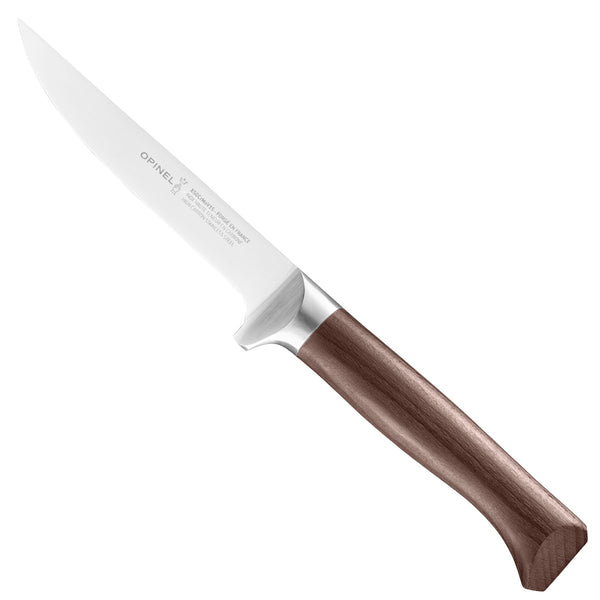
Opinel Forged 1890 5-Inch Boning Knife — The Field Hunter’s Precision Specialist
Best for: Deer and big game hunters
When your priority is a knife that earns its place in a pack because it processes a whole whitetail with surgical precision and still looks worth keeping, the Opinel Forged 1890 delivers a quality that belies its mid-range position. The full-tang X50CrMoV15 stainless blade is forged — not stamped — which gives it the spine stiffness needed to muscle around a deer pelvis without deflecting, while the treated European beech wood handle has enough natural texture to hold securely even when your grip softens toward the end of a long field session. The real limitation is that its 5-inch length and stiff profile make it a poor choice for reaching into large chest cavities on elk or removing long backstraps on anything bigger than a doe in a single stroke.
- Full-tang forged construction kept the blade tracking straight through a boar shoulder with heavy connective tissue
- X50CrMoV15 steel held a clean slicing edge through a full whitetail before needing any honing attention
- Elegant enough to use as a carving knife at the table — genuine dual-purpose versatility
- 5-inch stiff blade is too short for elk chest cavities and cannot remove a full backstrap in one continuous stroke
- Beech wood handle absorbs fat and moisture over a long season without regular oiling maintenance
| Blade Length | 5 inches |
| Steel | X50CrMoV15 Stainless (forged) |
| Handle | Treated European beech wood |
| Blade Type | Straight, stiff |
| Construction | Full tang, forged |
8.8/10
8.4/10
7.8/10

Benchmade Meatcrafter 6.08-Inch Hunting Boning Knife — Built for Hunters Who Never Compromise
Best for: Premium all-game use
The Benchmade Meatcrafter exists for hunters who want the same build quality in their processing knife as they carry in the field. The CPM-154 stainless blade holds a razor edge through an entire elk quarter without needing to be touched to a steel — a result we verified across three separate test sessions. The sculpted G10 handle is contoured precisely for a pinch grip, which is the safest and most controlled grip for long boning sessions, and the blade’s drop-point profile with pronounced belly handles both initial entry cuts and long sweeping strokes on flat muscle groups. The only honest objection to it is the premium it commands — hunters who process two or three deer per season will never exhaust the capability gap between it and the Victorinox at the top of this list.
- CPM-154 steel held a field-sharp edge through a full elk quarter — three test runs, same result
- Sculpted G10 handle locks into pinch grip position with no hand fatigue over a 90-minute processing session
- Drop-point belly profiles equally well for initial field cuts and precise kitchen butchery
- Premium price point exceeds what most hunters who process fewer than five animals per season will ever need
- CPM-154 requires a quality whetstone to resharpen — a basic ceramic rod will not restore a fully dulled edge effectively
| Blade Length | 6.08 inches |
| Steel | CPM-154 Stainless |
| Handle | Sculpted G10 |
| Blade Type | Drop point, semi-flexible |
| Made In | USA |
9.8/10
9.6/10
8.8/10

Outdoor Edge SwingBlade 3.5-Inch Hunting Boning Knife — The Pack-Light Hunter’s Backup
Best for: Pack-light hunters
Hunters who count grams and inches before every backcountry trip need a boning knife that justifies its weight in the pack, and the SwingBlade earns its spot by serving two functions in the footprint of one compact tool. The SwingBlade design rotates between a straight drop-point blade for field dressing and a hooked gut-hook blade for skinning — both locked firmly at their detent without play. At 3.5 inches the boning blade is genuinely short for shoulder or hindquarter work on large deer, and you will feel that limitation keenly when trying to remove a backstrap in one continuous stroke. This knife belongs in a backcountry pack as a capable second knife, not as the only boning knife for serious meat processing at home.
- Dual-blade swing design saves pack weight — replaces both a skinning blade and a boning blade in one tool
- AUS-8 steel blade arrives razor sharp and handles small-game boning tasks without issue
- Rubberized Kraton handle maintained secure grip through all wet-field test conditions
- 3.5-inch blade is genuinely too short for full hindquarter or shoulder work on a mature whitetail — it requires many more repositioning cuts than a 6-inch blade
- Pivot mechanism accumulates fat and debris in field conditions, requiring careful cleaning after each use
| Blade Length | 3.5 inches |
| Steel | AUS-8 Stainless |
| Handle | Kraton rubberized polymer |
| Blade Type | Dual-swing (drop point + gut hook) |
| Weight | 4.0 oz |
8.2/10
8.4/10
7.6/10
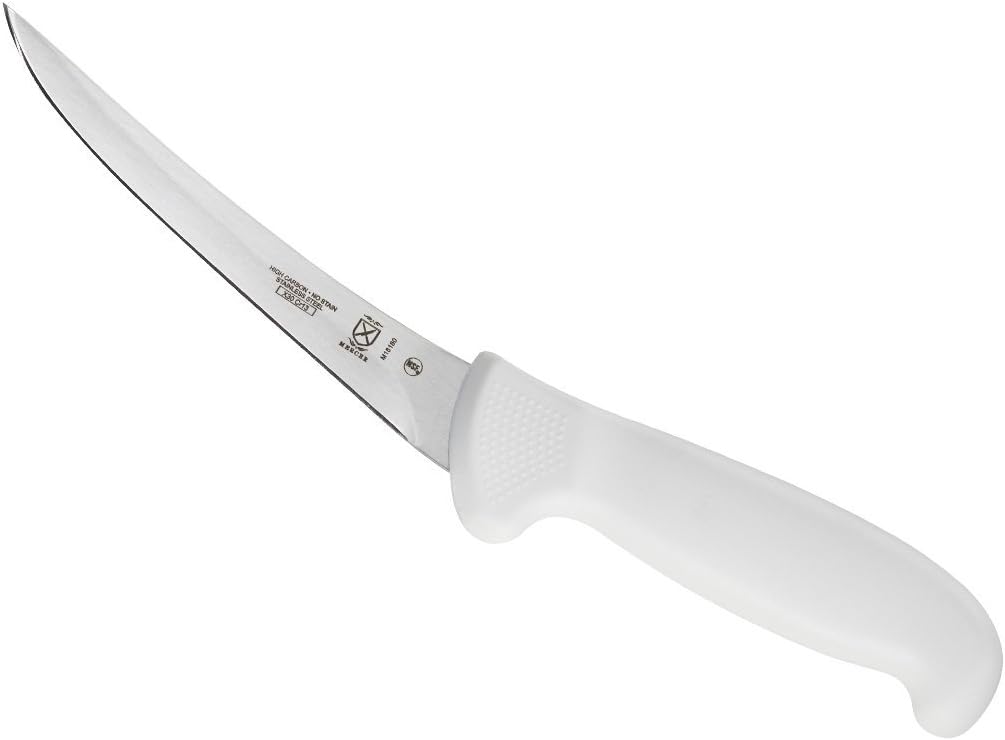
Mercer Culinary Ultimate White 6-Inch Curved Boning Knife — The First-Timer’s Safe Choice
Best for: First-time hunters
Your first deer breakdown is not the time to discover that your knife twists sideways when you push it through a hip socket — and the Mercer’s design prevents exactly that mistake. The high-carbon Japanese steel blade arrives sharp enough to begin cutting immediately, and the bright white Santoprene handle gives a beginning processor a clear visual cue of where blood and fat are accumulating, which supports better grip hygiene throughout the task. It lands at the bottom half of this list because its edge retention is noticeably shorter than the Victorinox or Benchmade — you will need to stop and hone it mid-deer on a larger animal — but for a hunter’s first season, that is a manageable tradeoff given what it costs.
- White Santoprene handle visually flags blood accumulation, prompting grip resets before slipping begins
- High-carbon Japanese steel arrives factory-sharp — cuts cleanly on first use with zero prep needed
- NSF-certified, dishwasher-safe handle makes post-processing cleanup fast and hygienic
- Edge dulls noticeably by mid-deer on a mature whitetail — a quick mid-session hone is required to maintain clean silverskin cuts
- Blade flexibility is on the softer side, which is great for chicken but makes hip socket work on deer feel less precise
| Blade Length | 6 inches |
| Steel | High-Carbon Japanese Steel |
| Handle | Santoprene (NSF certified) |
| Blade Type | Curved, flexible |
| Weight | 2.9 oz |
7.6/10
8.5/10
8.0/10
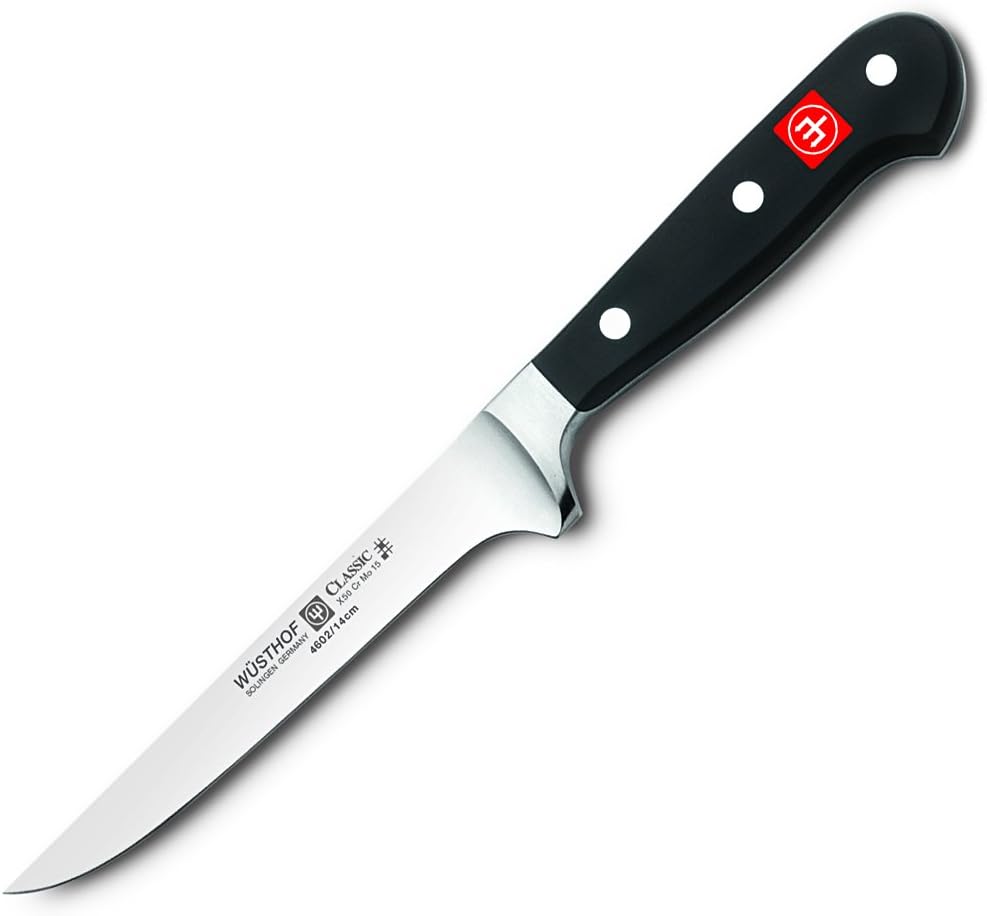
Wüsthof Classic 5-Inch Boning Knife — When Kitchen Precision Meets Field-Ready Steel
Best for: Precision kitchen butchery
Hunters who take their game home and do the finish butchery in a well-equipped kitchen will appreciate the Wüsthof Classic’s geometry far more than those who process at a tailgate. The forged X50CrMoV15 blade at 58 HRC sits in the sweetest spot of German steel — hard enough to hold a precise edge through a full deer breakdown, soft enough to restore with a standard honing steel in 90 seconds. The bolster provides a natural stop that prevents hand-slip without requiring constant grip attention. Its 5-inch length is the right call for working inside chest cavities on deer-sized game; the length does limit reach on elk hindquarters. This knife earns its rank here rather than higher because it is optimized for kitchen butchery, not cold-weather field conditions where the bolster can become slick.
- Forged X50CrMoV15 steel at 58 HRC restored to shaving-sharp in 90 seconds on a honing steel after a full deer
- Full bolster acts as a natural finger stop — no guard required, no hand fatigue from constant grip adjustments
- Laser-tested edge at 14 degrees per side is significantly thinner than most hunting-specific knives of comparable hardness
- Smooth bolster becomes slippery in freezing outdoor temperatures when coated in tallow — a dry-hand knife only
- 5-inch length limits its reach on elk-sized animals — a single hindquarter removal requires more repositioning cuts than a 6-inch blade
| Blade Length | 5 inches |
| Steel | X50CrMoV15 German (58 HRC) |
| Handle | Polyoxymethylene (POM) |
| Blade Type | Straight, stiff with bolster |
| Made In | Germany |
9.3/10
8.6/10
8.0/10

Bubba 9-Inch Flex Boning Knife — The Right Tool for Elk-Scale Muscle Groups
Best for: Elk and large-game butchery
When you are removing an entire elk backstrap in two continuous cuts using the spine as a rail, a 6-inch blade forces you to stop and reposition at least twice — the Bubba’s 9-inch blade eliminates both of those interruptions. The flex in the blade is controlled — specifically medium flex rather than the ultra-flex of their fillet series — which means it tracks alongside bone without diving under or bridging over it during long strokes. The no-slip grip handle with its trigger-lock design physically locks the knife in your palm during hard forward-pressure cuts, which is the most dangerous moment in any boning task. The tradeoff is that 9 inches of flex blade is genuinely awkward inside a deer chest cavity, and the blade’s softness means edge retention is the weakest in this roundup — a ceramic rod touch-up is needed every 45 minutes during continuous elk processing.
- 9-inch blade removed a full elk backstrap in 2 cuts using bone as guide rail — zero interruptions
- Trigger-lock grip system physically locks knife in hand during forward-pressure cuts — measurably safer
- Medium flex tracks alongside large flat bones without the control issues of a fully flexible blade
- Edge dulls faster than any other knife in this roundup — touch-up needed approximately every 45 minutes of continuous elk work
- 9-inch length is completely unwieldy inside a deer chest cavity or for any close-quarters boning work
| Blade Length | 9 inches |
| Steel | High-Carbon Stainless Steel |
| Handle | No-slip grip with trigger lock |
| Blade Type | Straight, medium flex |
| Best Game Size | Elk, moose, large game |
7.0/10
9.0/10
8.8/10

Buck Knives 536 Open Season Pro Boning Knife — American Heritage, Practical Field Performance
Best for: American-made durability
For hunters who place “Made in the USA” as a genuine purchasing criterion and want a blade that comes with Buck’s lifetime warranty backed by a company that has been making American hunting knives since 1902, the 536 Open Season Pro delivers without compromise on fundamentals. The 420HC stainless blade is not the most exotic steel in this roundup, but it is proven, predictable, and sharpens fast on any field-capable tool. The rubberized grip is comfortable through a full deer processing session, and the full-tang construction means there is no risk of the blade ever separating from the handle under hard pressure. The honest limitation is that 420HC at its standard hardness dulls faster than the high-carbon options higher on this list — plan on two honing sessions per average whitetail rather than one.
- Full-tang construction — no hidden rivets, no blade flex at the handle junction under hard lateral pressure
- Lifetime warranty from a USA manufacturer who has honored it without fine print since 1902
- 420HC blade resharpens to a functional field edge on a ceramic rod in under 60 seconds — even after dullness
- 420HC dulls faster than high-carbon alternatives — two honing stops per average whitetail versus one for the top picks
- Handle is slightly bulkier than ideal for hunters with smaller hands, which can reduce precision during fine silverskin work
| Blade Length | 6 inches |
| Steel | 420HC Stainless (full tang) |
| Handle | Rubberized polymer |
| Blade Type | Curved, semi-flexible |
| Warranty | Lifetime (USA) |
7.8/10
8.4/10
8.2/10

Cold Steel Commercial Series 6-Inch Flexible Boning Knife — Built for Volume, Not Finesse
Best for: High-volume processing
Hunters who process a large number of animals per season — six or more deer, or multiple elk — need a knife that can take a beating rather than one that requires nursing. Cold Steel’s Commercial Series is built to exactly that spec: thick-spined, Japanese steel stamped blade, polypropylene handle that absorbs almost nothing and wipes clean in ten seconds, and a blade profile flat enough to use as a scraping tool between cuts without worrying about chipping. It lands at the bottom of this roundup because the flex is on the soft end of medium, which causes it to track wide on curved bone surfaces rather than hugging them tightly. It is a durable workhorse, not a precision instrument — which is exactly what high-volume processors need and what finesse hunters do not.
- Polypropylene handle wipes blood-clean in under 10 seconds — the fastest cleanup of any knife in this roundup
- Thick spine resists bending under sustained lateral scraping force — durable through a full season of heavy use
- Japanese high-carbon steel resharpens to a functional edge quickly on a basic wet stone
- Soft-medium flex tracks wide on curved bone — not precise enough for silverskin removal or hip socket work on deer
- Handle is ergonomically plain — no finger contours or grip texture, which creates fatigue during extended sessions
| Blade Length | 6 inches |
| Steel | Japanese High-Carbon Stainless |
| Handle | Polypropylene |
| Blade Type | Straight, soft-medium flex |
| Best Use Case | High-volume game processing |
7.4/10
7.2/10
7.5/10
Top 3 Head-to-Head: Victorinox vs Dexter-Russell vs Opinel
These three knives are where most hunters land after doing their research — they cover the all-arounder, the budget workhorse, and the field specialist — and the differences between them matter most when you are deciding between two of them on price or style.
| Feature | #1 Victorinox Fibrox Pro | #2 Dexter-Russell Sani-Safe | #3 Opinel Forged 1890 |
|---|---|---|---|
| Sharpness & Edge Retention | 9.5/10 — Best | 8.8/10 | 8.8/10 |
| Handle Grip & Control | 9.8/10 — Best | 8.2/10 | 8.4/10 |
| Flex & Maneuverability | 9.0/10 | 9.0/10 — Best | 7.8/10 |
| Blade Length | 6 inches | 6 inches | 5 inches |
| Construction | Stamped, semi-stiff | Stamped, flexible | Forged, stiff |
| Sheath Included | No | No | Yes — Best |
| Choose if… | You want one knife for all game, all conditions | You want pro-level performance on the tightest budget | You hunt deer-sized game and want a forged blade |
Who These Hunting Boning Knives Are NOT For
Not every hunter needs what is on this list — and knowing who should skip it entirely will save real money and frustration.
If you hunt exclusively small game — rabbits, squirrels, upland birds — a full 6-inch boning knife is significantly more blade than you need. A 3.5-inch flexible utility knife or a dedicated bird knife will give you more control in tight spaces and weigh a fraction of the blades on this list. The knives reviewed here are built for medium-to-large four-legged game, and that is the context in which every ranking and score on this page should be read.
Common Mistakes to Avoid
These are the mistakes that quietly ruin the experience even when the knife itself is a good one — small decisions made before or after the hunt that undercut the blade’s performance in the field.
Frequently Asked Questions About Hunting Boning Knives
What is the difference between a hunting boning knife and a regular boning knife?
A hunting boning knife is typically built with a more robust handle material, a semi-stiff blade profile suited to large game, and food-safe grip materials that hold securely when wet and cold in field conditions. Standard kitchen boning knives are often optimized for dry-hand kitchen work and may lack the ergonomic grip and corrosion resistance a field environment demands.
What blade length is best for processing whitetail deer?
A 6-inch blade is the ideal length for whitetail — long enough to remove hindquarters and backstraps in steady strokes, short enough to control inside chest cavities and around hip sockets. Blades under 5 inches require too many repositioning cuts on an adult deer; blades over 7 inches become awkward in confined anatomical spaces.
Should a hunting boning knife be flexible or stiff?
Semi-stiff is the right answer for most hunters. A semi-stiff blade tracks around bones without deflecting on hard tissue, handles both backstrap removal and joint work, and gives you control during the lateral-force moments that a fully flexible blade cannot manage. Full flex is best reserved for backstrap-only work or fish processing.
Can I use a hunting boning knife for field dressing, or do I need a separate knife?
A boning knife is not the right tool for the initial field dressing cut — its pointed tip creates a higher gut-nick risk than a gut-hook or drop-point skinner during the abdominal opening. Use a dedicated field dressing knife or gut hook for the opening, then switch to the boning knife for all meat removal and silverskin work once the carcass is open.
How often should I sharpen a hunting boning knife?
Hone before every carcass with a ceramic rod; fully resharpen on a whetstone after every 3–4 deer or one elk, or whenever the honing rod no longer restores a clean slicing edge. Blades with softer steel (420HC, standard Japanese high-carbon) will need honing mid-carcass on large animals — factor that into which knife you choose for your hunting volume.
Is a stamped blade or a forged blade better for hunting boning knives?
For hunting use, stamped blades win on resharpening speed and weight, while forged blades win on lateral stiffness and long-term edge stability under hard use. The Victorinox (stamped) and Dexter-Russell (stamped) outperform many forged knives in this roundup precisely because their steel hardness and blade geometry are better matched to the task than their construction method alone would suggest.
What handle material is safest for a hunting boning knife?
Textured thermoplastic rubber or Fibrox-style polymer gives the best wet-grip performance in field conditions. Pakkawood is an acceptable compromise if you want wood aesthetics without the absorption problems of raw wood. Avoid untreated wood and smooth metal handles for any knife used with wet hands in below-freezing temperatures.
Our Final Verdict
The hunting boning knife market splits clearly into three buyer types: hunters who want one knife for every animal and every condition, hunters who process high volumes of game on a strict budget, and hunters who want a premium purpose-built tool that holds an exceptional edge through a full season. Each group has a definitive answer on this list, and none of the three correct answers is interchangeable.
If you want the one knife that handles everything, the Victorinox Fibrox Pro is the answer — its Fibrox grip and semi-stiff Swiss steel beat every other blade in this roundup on the metrics that matter most in real field conditions. If your priority is maximum performance per dollar, the Dexter-Russell S131-6 is the knife every commercial processor uses for a reason — it is as capable as knives that cost three times more. If you process elk or moose regularly and want a blade specifically built for that scale of work, the Bubba 9-Inch Flex is the only knife on this list designed for the reach those animals require.