10 Best Game Boning Knife Picks for 2026: Cleaner Cuts and Safer Field Work
Breaking down game is harder than simply finding a sharp knife: hide, joints, slippery hands, and changing cuts punish the wrong blade profile. A flexible scalpel can excel at caping but feel fragile around cartilage, while a stiff boner can waste meat if it cannot follow a contour. This roundup compares ten current wild-game and meat-processing tools using published specifications and independent review evidence, without claiming personal hands-on testing. You will leave with a clear fixed-blade, replaceable-blade, or budget pick matched to the animal and the work.
Quick Comparison: All 10 Game Boning Knives Ranked
| # | Product | Best For | Rating | Badge | |
|---|---|---|---|---|---|
| 1 | Benchmade Meatcrafter 15500-04 (6-inch trailing point) | large-game processing | 4.3/5 | Best Overall | Buy → |
| 2 | Havalon Piranta-Edge | skinny, precise field work | 4.2/5 | Best Field Replaceable | Buy → |
| 3 | Outdoor Edge RazorPro G | hide opening and quartering | 4.3/5 | Best Field-Dressing System | Buy → |
| 4 | Victorinox Fibrox 6-inch Curved Boning Knife (5.6603.15) | value-minded meat trimming | 4.3/5 | Best Budget | Buy → |
| 5 | Dexter-Russell Sani-Safe ST131S-6 6-inch Curved Stiff Boning Knife | stiff close-to-bone cuts | 4.1/5 | Best Stiff Curved Blade | Buy → |
| 6 | Outdoor Edge WildGame 5.0-inch Boning Knife | lightweight game trimming | 4.0/5 | Best Dedicated Game Value | Buy → |
| 7 | Bubba 7-inch Tapered Flex Fillet Knife | fish and detail cuts | 3.5/5 | Best Large Game Cuts | Buy → |
| 8 | Misono Molybdenum Hankotsu 5.7-inch Boning Knife (No. 542, 145 mm) | precise right-hand butchery | 3.8/5 | Best Traditional Butchery Knife | Buy → |
| 9 | Global Classic 6.25-inch Flexible Boning Knife (G-21) | precise flexible trimming | 4.0/5 | Best Flexible Premium | Buy → |
| 10 | Gerber Vital Pocket Folder | packable backup work | 4.0/5 | Best Compact Backup | Buy → |
How We Chose These Game Boning Knives
What we evaluated
We evaluated exactly ten current models across fixed blades, replaceable-blade systems, a traditional hankotsu, and a compact folder. The evidence set covers manufacturer dimensions, steel, handles, sheaths, warranties, and independent reviews where available; no personal hands-on testing is claimed.
Our 3 scoring criteria
Each knife receives a 1–10 score for cutting precision and meat yield, edge reliability and maintenance burden, and grip, control, and field safety. Scores synthesize the packet’s specifications and published test or field evidence, not a lab ranking.
Evidence checked
Manufacturer pages from Benchmade, Havalon, Outdoor Edge, Victorinox, Dexter-Russell, Bubba, Global, and Gerber were cross-checked with Outdoor Life, Serious Eats, OutdoorGearLab, Knife Informer, GearJunkie, Field & Stream, and independent listings.
What we excluded
We excluded unsupported models and unverified performance claims. Where a source tested a related family variant rather than the exact SKU, that limitation is stated; no price figures or invented availability claims are used.
What to Look for When Buying a Game Boning Knife
Game processing is not one cut: the right blade for caping and skinning may be too delicate for joints, while a rigid butcher knife can remove more meat than it saves. These five factors help you match geometry, maintenance, and safety to the animal and the way you actually work. For a broader primer, see boning knife buying guide.
1. Blade profile and flex
Flexible blades follow contours and suit fish, poultry, and delicate trimming; stiff blades resist bending around tough meat and joints. Semi-flexible curved blades are the useful middle ground for mixed deer work. Check the actual geometry rather than trusting a “boning and fillet” label, because those words do not guarantee a particular flex. A rigid hankotsu is precise for seam work but is not a sweeping carcass tool.
2. Blade length and point
A 5-inch blade favors controlled field work and small animals, while 6 to 6.25 inches gives more reach for quarters and long drawn cuts. A 7-inch flexible blade can be excellent for fish but awkward around compact joints. Point shape matters too: a fine trailing or drop point helps enter seams and work around bone, while a blunt gutting blade is safer for opening hide.
3. Steel and edge system
Weigh corrosion resistance, edge retention, sharpening effort, and whether replacement blades are readily available. CPM-154, CROMOVA 18, DEXSTEEL, high-carbon stainless, and 420J2 represent different maintenance trade-offs; the packet does not establish a universal winner. Replaceable systems minimize field sharpening but add channels, spare-blade handling, and waste. A published hardness or edge test is useful evidence, but it is not a guarantee for every production run.
4. Handle ergonomics and hygiene
A wet-grip handle and finger protection matter because blood, water, and fat reduce friction. Textured TPR, Santoprene, polypropylene, and dimpled stainless can all work, but cleaning access differs. Sealed or seamless construction reduces places for residue to collect; folding mechanisms require more attention. Hand washing and immediate drying are the conservative care routine even when a manufacturer lists dishwasher compatibility.
5. Carry and support ecosystem
A sheath, visible handle, locking mechanism, spare blades, warranty, service program, and current U.S. availability can matter as much as the steel. Fixed blades are straightforward to rinse and inspect; folders are compact but can trap hair, blood, and fat. Confirm what is actually in the package, especially with blade counts and sheaths, because listings can describe different configurations. Availability should be rechecked for Gerber and other models before publication.

Benchmade Meatcrafter 15500-04 (6-inch trailing point) — Best Overall
When you want one fixed blade to move from a deer quarter to trimming at camp, a thin trailing point is more useful than a bulky general-purpose knife. Benchmade specifies a 6-inch CPM-154 blade at 58–61 HRC, and an independent review of the Meatcrafter family measured 6.08 inches and reported a stiff-but-flexible feel while slicing venison. That combination puts it first for controlled drawn cuts, deboning, and portioning large game. It is not the right tool for batoning, prying, or a minimalist kit, and its premium positioning makes the trade-off clear.
- CPM-154 stainless steel is specified at 58–61 HRC, with a 6-inch trailing-point profile for long cuts around joints.
- Santoprene is intended for wet, messy hands and is easier to clean than porous handle materials.
- The molded Boltaron sheath provides retention and can be cleaned after field use.
- Benchmade lists meat processing, trimming, boning, warranty support, and free sharpening.
- The roughly 6-inch blade can feel oversized for fine work on small deer, and the thin edge is not for hard-use chores.
| Blade | 6-inch trailing point |
| Steel | CPM-154, 58–61 HRC |
| Handle | Dark-olive Santoprene |
| Sheath | Molded Boltaron |
9/10
9/10
8/10

Havalon Piranta-Edge — Best Field Replaceable
If your priority is a fresh edge rather than field sharpening, a replaceable-blade folder solves the problem quickly. Havalon specifies a 2-3/4-inch 60A stainless blade, an open-back polymer handle, and compatibility with the Piranta blade platform; the current official package lists six additional blades. Independent Piranta-platform testing found a very precise edge and strong portability, but also a narrow handle and risky bare-hand blade changes. This is a skinning and caping specialist, not a pry bar or a primary knife for cartilage and joints.
- A factory-sharp 60A blade can be swapped in the field instead of sharpened.
- The short scalpel profile gives precise control for caping and hide work.
- Open-back construction is designed to make cleaning easier, while the clip and holster support carry.
- Havalon says the 60A is stronger and thicker than the earlier 60XT and fits Piranta handles.
- The short folding format is poorly suited to large carcasses, prolonged heavy use, prying, or cutting cartilage.
| Blade | 2-3/4-inch 60A replaceable scalpel |
| Overall | 7-1/4 inches |
| Lock | Liner lock |
| Carry | Nylon holster and clip |
9/10
7/10
9/10
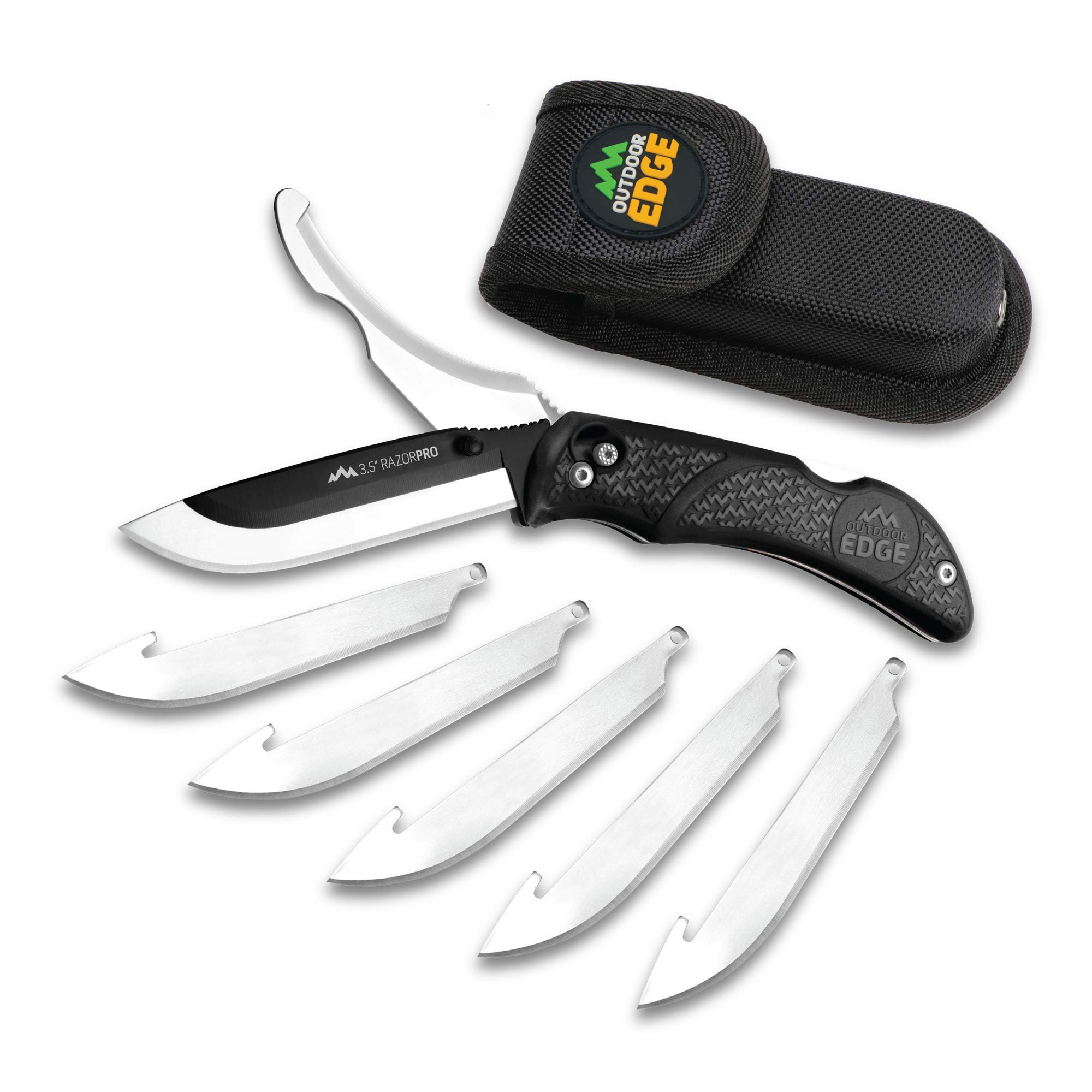
Outdoor Edge RazorPro G — Best Field-Dressing System
When one field job includes opening hide, gutting, skinning, and quartering, carrying two purpose-built blades is more practical than forcing one blade to do everything. The RazorPro G pairs a 3.5-inch replaceable drop point with a 3.1-inch blunt-tip gutting blade, and Outdoor Edge lists an 8.3-ounce weight. An independent field review reported the gutting blade opening tough elk hide and typically used two replacement blades while quartering an elk. The system is heavier and less solid than a one-piece fixed blade, but it is the most complete dressing setup here.
- Dual blades separate hide-opening work from meat and skinning cuts.
- Push-button RazorSafe changes require no tool, and the sheath stores spare blades.
- Rubberized TPR and lock-back/liner-lock security support wet field control.
- The current package includes thirty 3.5-inch drop-point blades and a Service-for-Life guarantee.
- Blood and fat can dry in the blade channel, making removal harder unless the knife is cleaned promptly.
| Main blade | 3.5-inch drop point |
| Gutting blade | 3.1-inch blunt tip |
| Weight | 8.3 ounces official |
| Steel | 420J2 / 7Cr17 stainless |
9/10
8/10
9/10

Victorinox Fibrox 6-inch Curved Boning Knife (5.6603.15) — Best Budget
For a first game-boning knife, a semi-stiff curve gives you more control than an ultra-flexible fillet blade without feeling like a rigid butcher’s tool. Victorinox lists the exact 5.6603.15 at a manufacturer-measured 5.9 inches, with high-carbon stainless steel and a non-slip Fibrox handle; independent sharpness testing of the Fibrox Pro 6-inch family found excellent sharpness and a secure grip under chicken fat. It is the best value-oriented conventional pick in this set. Documentation is imperfect: the official page calls it curved but also lists a straight edge, and no sheath is listed.
- The 5.9-inch curved, semi-stiff profile suits controlled deboning and close trimming.
- Textured Fibrox/TPE is designed to stay secure when hands are wet or greasy.
- Victorinox lists Swiss manufacture, durability, dishwasher care, and lifetime warranty support.
- Independent testing measured 102 g before and 125 g after testing on a Fibrox Pro 6-inch model, where lower force is sharper.
- No sheath is listed, and the exact alloy, hardness, and exact-model game test are not published.
| Blade | 5.9-inch curved, semi-stiff |
| Steel | High-carbon stainless |
| Handle | Black Fibrox/TPE |
| Care | Dishwasher listed by maker |
9/10
8/10
9/10

Dexter-Russell Sani-Safe ST131S-6 6-inch Curved Stiff Boning Knife — Best Stiff Curved Blade
When tough meat and close bone work demand a blade that will not fold, a curved stiff boner is the safer match than a flexible fillet knife. Dexter-Russell specifies a 6-inch DEXSTEEL blade, individually ground and honed, with a sealed SANI-SAFE handle and protective finger guard. Retail listings place its listed weight around a quarter pound and identify U.S. manufacture. There is no credible controlled game-processing test for this exact model, so its scores are specification-based. It is a focused workhorse for large-game and red-meat trimming, not a delicate poultry or fish specialist.
- The curved, rigid profile gives a favorable angle around bone and tough meat.
- DEXSTEEL is marketed as stain and corrosion resistant and is individually ground and honed.
- The textured polypropylene handle and finger guard support wet-hand control.
- The impervious blade-to-handle seal supports sanitation and durability.
- Its rigidity gives up contour-following ability, and the maker does not list a sheath or standardized edge test.
| Blade | 6-inch curved, stiff |
| Steel | DEXSTEEL high-carbon stainless |
| Handle | Textured polypropylene |
| Hygiene | Sealed blade-to-handle joint |
8.5/10
8.5/10
7.5/10

Outdoor Edge WildGame 5.0-inch Boning Knife — Best Dedicated Game Value
For hunters who want a light, dedicated game knife instead of a multi-blade system, a 5-inch profile keeps close cuts controlled and easy to place. Outdoor Edge lists a 5-inch 420J2 stainless blade, 9.4-inch overall length, and 2.6-ounce weight, with a rubberized TPR handle intended to stay non-slip when wet. Those measurements make it maneuverable for venison, boar, elk, and hog processing. The maker does not publish a flex rating, hardness, sheath, or formal edge-retention test, so this is a practical value pick rather than a documented performance benchmark.
- The long, thin 5-inch profile is suited to controlled cuts close to bone.
- At 2.6 ounces, it is easy to carry and maneuver during extended breakdown work.
- Rubberized TPR is specified for wet or slippery conditions.
- 420J2 resists corrosion and is comparatively straightforward to sharpen in the field.
- The entry-level steel and missing flex, hardness, and sheath details limit confidence for heavy or extended work.
| Blade | 5-inch long, thin profile |
| Steel | 420J2 stainless |
| Overall | 9.4 inches |
| Weight | 2.6 ounces |
9/10
7/10
8/10

Bubba 7-inch Tapered Flex Fillet Knife — Best Large Game Cuts
If your game knife also needs to fillet fish or make delicate detail cuts, a flexible blade can be useful, but extreme flex changes the assignment. Bubba lists a 7-inch blade, 5.7-ounce weight, 56–58 HRC hardness, and an extreme-flex rating, while its manufacturer categorizes the knife for small and medium fish. Field & Stream praised its wet grip, safety features, corrosion resistance, factory edge, and easy sharpening. That evidence supports it as a fillet and detail tool, not a dedicated deer joint knife, and user reports include rapid dulling, bent tips, and breakage.
- The 7-inch blade and extreme flex suit fish filleting and fine cleaning cuts.
- Trigger-style grip, thumb and finger pads, and guards support wet-condition control.
- A synthetic sheath is included for storage and transport.
- Published hardness is 56–58 HRC and weight is 5.7 ounces.
- Extreme flex and relatively modest 8Cr13MoV steel are poor matches for large-game joints, hard connective tissue, and forceful cuts.
| Blade | 7-inch extreme-flex |
| Steel | 8Cr13MoV with coating |
| Hardness | 56–58 HRC |
| Sheath | Custom synthetic |
7/10
6/10
8/10

Misono Molybdenum Hankotsu 5.7-inch Boning Knife (No. 542, 145 mm) — Best Traditional Butchery Knife
For seam work, poultry, and precise trimming, a short sturdy hankotsu gives more deliberate control than a flexible Western boner. Retail specifications agree on a 145 mm blade and HRC 57-class steel, while JCK lists a 3 mm thickness and 172 g weight; the model uses a right-hand asymmetric edge. It is a serious traditional butchery shape, not a sweeping large-carcass knife. No credible independent hands-on test of this exact model was found, and retailers differ on 70/30 versus 80/20 bevel notation, so treat those figures as listing measurements.
- The pointed 145 mm profile gives precise control around joints and connective tissue.
- AUS-8 or high-carbon 13Cr molybdenum stainless balances stain resistance and sharpening ease.
- The pakkawood/composite handle with bolster is substantial and water-resistant.
- Published listings document Japan manufacture, approximately 2.5–3 mm thickness, and HRC 56–58.
- It is right-hand oriented, needs hand washing and specialized sharpening, and must not be used on bone or frozen food.
| Blade | 145 mm / 5.7 inches |
| Steel | AUS-8 molybdenum stainless |
| Hardness | HRC 56–58 |
| Edge | Right-hand asymmetric |
8/10
8/10
7/10

Global Classic 6.25-inch Flexible Boning Knife (G-21) — Best Flexible Premium
If following contours around joints is your main goal, a long narrow flexible blade gives you more finesse than a stiff game knife. Global specifies a 6.25-inch CROMOVA 18 blade, an acute 15-degree edge, Rockwell C56–58 hardness, and a one-piece seamless stainless construction with a dimpled handle. Those are strong published specifications for hygiene and control. The exact-model independent evidence is limited to a single customer review rather than controlled field testing, and no sheath is listed, so it is better for a clean processing station than loose pack carry.
- The 6.25-inch narrow flexible blade tapers to a fine point for contour work.
- CROMOVA 18 is ice-tempered to Rockwell C56–58 with a stated 15-degree edge.
- Seamless stainless construction reduces food traps and the sand-filled handle supports balance.
- The dimpled grip and bolster are designed for slip resistance and control.
- Hand-wash-only care, premium positioning, and no listed sheath reduce its field practicality.
| Blade | 6.25-inch / 16 cm flexible |
| Steel | CROMOVA 18 stainless |
| Hardness | Rockwell C56–58 |
| Care | Hand wash only |
9/10
8/10
7/10

Gerber Vital Pocket Folder — Best Compact Backup
When you need a highly visible backup that disappears into a kit, a short exchange-a-blade folder is easier to justify than a second full-size knife. Gerber lists a 2.9-inch blade, 1.3-ounce weight, 4-inch closed length, orange rubber over-mold, and tool-less Split Sec release; six #60 blades are included. An independent field review rated it 8/10 and used it for most field dressing while excluding bone and joint cuts, with two to three blade swaps per animal. That makes it a strong precision backup, not a complete primary boning knife.
- At 1.3 ounces, it is exceptionally packable and the orange handle is easy to see.
- Tool-less blade changes, a lock-back, finger choil, and lanyard hole support field control.
- Gerber supplies six #60 blades and sells a replacement pack with twelve blades.
- The exchange system avoids sharpening during a short field job.
- Hair, blood, fat, and flesh can pack the folding mechanism, and the 2.9-inch blade is not for joints, bone, or skull work.
| Blade | 2.9-inch exchange-a-blade |
| Weight | 1.3 ounces |
| Closed length | 4.0 inches |
| System | Tool-less Split Sec |
8/10
7/10
9/10
Top 3 Head-to-Head: Benchmade Meatcrafter vs Havalon Piranta-Edge vs Victorinox Fibrox
These three represent the common final choices: a premium fixed blade, a fresh-edge replaceable folder, and the strongest value-oriented conventional boner.
| Feature | #1 Benchmade | #2 Havalon | #4 Victorinox |
|---|---|---|---|
| Cutting precision and meat yield | 9/10 — Best | 9/10 | 9/10 |
| Edge reliability and maintenance burden | 9/10 | 7/10 | 8/10 — Best |
| Grip, control, and field safety | 8/10 — Best | 9/10 — Best | 9/10 — Best |
| Choose if… | You want one premium fixed blade | You value fresh blades in the field | You want the best conventional value |
Who These Game Boning Knives Are NOT For
Not every buyer needs a specialized game-boning tool, and forcing one into the wrong job creates safety and performance problems.
They are also a poor fit for anyone who will leave a wet knife unwashed, carry a fixed blade without edge protection, or expect a compact folder to replace a full-size primary knife. Fish-first users should prioritize a dedicated fillet profile rather than assuming every flexible boner is interchangeable.
Common Mistakes to Avoid
These are the mistakes that quietly ruin the experience even when the knife itself is well chosen.
Frequently Asked Questions About Game Boning Knives
What blade flex is best for deer boning?
A semi-stiff or stiff blade is the safest general match for deer, especially around joints and connective tissue; flexible blades are better for contour work and fish.
Is a replaceable-blade knife better for field dressing?
It is better when carrying a fresh edge and avoiding field sharpening are the priorities, but the trade-off is blade waste, careful handling, and more cleaning around channels or pivots.
What blade length works for game boning?
A 5-inch blade favors controlled work on smaller animals, while 6 to 6.25 inches adds reach for quarters and long drawn cuts; choose 7 inches mainly when filleting is also central.
Can a boning knife cut through bone?
No. Boning knives are for separating meat from bone and working around joints, not chopping or splitting bone; use a saw or suitable heavy tool for those tasks.
How should I clean a game boning knife?
Wash it by hand with mild soap, rinse all blood and fat away, and dry it immediately; folding and replaceable-blade mechanisms need extra attention to hidden residue.
Do I need a sheath for a game knife?
Yes for a fixed blade carried in a pack or on a belt, because a sheath protects both the edge and your hands; verify whether the model actually includes one.
Are flexible boning knives good for fish too?
Often yes, but a dedicated fillet knife can be more precise for fish because it is designed around a longer, thinner flex profile.
Our Final Verdict
The field splits into three clear camps: premium fixed blades for versatility, replaceable systems for fresh edges and compact field work, and conventional boners for value and straightforward maintenance. The best game boning knife is the one whose geometry matches the animal and whose handle, sheath, and cleaning routine you will actually use. When you need a practical cutting sequence, debone meat step by step is the natural next reference.
If you process deer and larger game from quarter to kitchen, pick #1. If you want a fresh edge while caping or field dressing, pick #2 or #3. If you need the most accessible conventional knife for mixed home and game work, pick #4.