10 Best Chef Knife for Left Handed 2026: Sharp Picks That Work in Either Hand
The best chef knife for left handed cooks right now is Victorinox Fibrox Pro 8-Inch Chef’s Knife, with a symmetric double bevel and neutral handle that work identically in either hand. We compared 10 chef knives on Left-Hand Comfort, Edge Retention, and Ease of Use. Most knives look identical on paper but pull sideways when the bevel favours the right hand. Whether you need everyday chopping, precise slicing, or a first serious knife, this guide gives you one clear answer.
Quick Comparison: All 10 Products Ranked
| # | Product | Best For | Rating | Badge | |
|---|---|---|---|---|---|
| 1 | Victorinox Fibrox Pro 8-Inch Chef’s Knife | Everyday left-handed prep | 4.9/5 | Best Overall | Buy → |
| 2 | Mercer Culinary Millennia 8-Inch Chef’s Knife | Budget everyday cooking | 4.8/5 | Best Budget | Buy → |
| 3 | Wüsthof Classic 8-Inch Chef’s Knife | German workhorse cooking | 4.8/5 | Best German Workhorse | Buy → |
| 4 | Global G-2 8-Inch Chef’s Knife | Light Japanese-style prep | 4.7/5 | Best Japanese Lightweight | Buy → |
| 5 | Zwilling Professional S 8-Inch Chef’s Knife | Balanced forged cooking | 4.7/5 | Best Forged Balance | Buy → |
| 6 | Mercer Culinary Genesis 8-Inch Forged Chef’s Knife | Forged value cooking | 4.6/5 | Best Forged Value | Buy → |
| 7 | Zelite Infinity 8-Inch Chef’s Knife | Japanese-style gyuto prep | 4.6/5 | Best Japanese-Style Gyuto | Buy → |
| 8 | Imarku Pro Kitchen 8-Inch Chef’s Knife | Beginner home cooking | 4.6/5 | Best for Beginners | Buy → |
| 9 | Cutluxe Artisan 8-Inch Chef’s Knife | Gift and display cooking | 4.5/5 | Best Gift Pick | Buy → |
| 10 | Utopia Kitchen 8-Inch Chef’s Knife | Light everyday prep | 4.5/5 | Best Everyday Pick | Buy → |
How We Chose These Chef Knives
What we compared
Listed bevel symmetry, handle shape, blade length, steel type, and weight for 10 widely available 8-inch chef knives.
Our 3 scoring criteria
Left-Hand Comfort, Edge Retention, and Ease of Use, each scored out of 5 as an editorial rating.
Editorial ratings, explained
Scores are editorial ratings based on listed specs, not lab tests or measured hands-on testing in this session.
What we cut — and why
Single-bevel right-handed Japanese knives and strongly right-contoured D-shaped handles were excluded for left-handed use.
What to Look for When Buying a Chef Knife for Left-Handed Use
Left-handed suitability is mostly about geometry, not marketing. Check bevel, handle, length, and steel before you buy.
1. Bevel Symmetry
A symmetric 50/50 double bevel cuts the same in either hand, because both sides of the edge are ground evenly. A single bevel, or a heavily asymmetric bevel, will steer and drag for a left-handed cook. If a listing does not state the bevel, treat that as a warning sign. For the wider Western versus Japanese difference, see this guide to Western versus Japanese chef knives.
2. Handle Shape and Neutrality
Look for a round, oval, octagonal, or straight handle with no right-hand thumb rest or D-shaped contour. The handle should feel secure in a pinch grip in your left hand, and stay grippy when wet. A full, symmetric bolster also helps the knife track straight. Practice a comfortable, safe left-hand hold with this guide to how to grip a chef knife.
3. Blade Length, Weight, and Balance
For most left-handed home cooks, an 8-inch blade is the sweet spot: long enough for cabbage and large onions, short enough to control. Heavier forged blades help with rock-chopping, while lighter blades suit push-cutting and long prep. Balance should sit near the bolster, not far forward. Check the sizing basics in this guide to how long a chef knife blade is.
4. Steel, Edge Retention, and Sharpening Ease
Softer stainless steel is easier to hone and sharpen, while harder Japanese steel holds an edge longer but chips more easily if twisted. For a left-handed cook, the key is a symmetric sharpening routine: equal strokes on both sides, at the same angle. Learn the routine in this guide to how to sharpen a chef knife.

Victorinox Fibrox Pro 8-Inch Chef’s Knife — Straight, grippy, forgiving
Best for: Everyday left-handed prep
For a left-handed cook who wants one reliable knife for daily prep, this is the safest starting point. Its symmetric 50/50 edge tracks straight instead of pulling to one side, while the textured Fibrox handle stays neutral and secure in the left hand, even when wet. The 8-inch high-carbon stainless blade is sharp out of the box, easy to hone, and forgiving for rock-chopping, slicing, and dicing. It is not the thinnest or most refined blade here, and keen cooks may later want a lighter Japanese-style knife, but for everyday confidence, it is hard to beat.
- Symmetric 50/50 bevel, straight left-hand cuts
- Neutral Fibrox handle, secure when wet
- Easy to hone and sharpen evenly
- Not the thinnest blade here
- Plain looks, no premium finish
4.9/5
4.6/5
4.9/5

Mercer Culinary Millennia 8-Inch Chef’s Knife — Light, sharp, easy
Best for: Budget everyday cooking
For a left-handed cook who wants a sharp, light knife without a premium spend, this stamped blade is an excellent value choice. Its symmetric edge and simple polypropylene handle feel neutral in the left hand, with no right-hand contour to fight. The 8-inch Japanese steel blade slices vegetables, herbs, and boneless meat cleanly, and its light weight reduces fatigue during long prep. It is thinner and less robust than a forged German knife, so it is not the pick for heavy squash or bone work, but for daily home cooking, it punches well above its class.
- Light weight, low fatigue in use
- Neutral handle, no right-hand contour
- Sharp, easy to maintain edge
- Less robust than forged knives
- Basic handle finish and feel
4.8/5
4.5/5
4.9/5

Wüsthof Classic 8-Inch Chef’s Knife — Heavy, steady, durable
Best for: German workhorse cooking
For a left-handed cook who likes weight and a rock-chopping motion, this forged German knife feels reassuring and steady. Its symmetric edge and triple-riveted synthetic handle are neutral enough for the left hand, with no sided contour to correct. The full-bolster, full-tang construction gives balance near the hand and confidence through root vegetables and larger cuts. It is heavier than the top two picks, and the full bolster can make sharpening near the heel awkward, but for cooks who want one durable, long-lasting workhorse, it is a strong choice.
- Forged, durable German construction
- Steady weight for rock-chopping
- Neutral triple-riveted handle
- Heavier than lighter Japanese picks
- Full bolster complicates heel sharpening
4.7/5
4.6/5
4.5/5

Global G-2 8-Inch Chef’s Knife — Thin, light, precise
Best for: Light Japanese-style prep
For a left-handed cook who prefers a lighter, thinner blade for precise slicing, this Japanese knife is a clear step up in sharpness. Its symmetric double-bevel edge and neutral stainless handle work equally well in either hand, unlike single-bevel Japanese blades. The 8-inch CROMOVA 18 blade feels nimble for herbs, fish, and vegetables, and its balance suits push-cutting rather than heavy rocking. It can feel slippery when wet, and the thin edge needs careful handling around hard foods, but for precise, low-fatigue prep, it is excellent.
- Symmetric edge, ambidextrous by design
- Light, nimble, precise slicing
- Neutral stainless handle balance
- Handle can feel slippery when wet
- Thin edge, avoid hard foods
4.7/5
4.7/5
4.5/5

Zwilling Professional S 8-Inch Chef’s Knife — Balanced, forged, steady
Best for: Balanced forged cooking
For a left-handed cook who wants forged quality without a very heavy blade, this Zwilling offers a well-judged balance. Its symmetric edge, curved bolster, and triple-riveted handle sit neutrally in the left hand, and the blade weight helps it fall through onions, carrots, and herbs without forcing. The 8-inch special-formula steel is durable, stain-resistant, and easy to hone at home. It is not as thin as a Japanese gyuto, and its curved bolster needs care when sharpening, but as an all-round forged knife for either hand, it is dependable.
- Well-balanced forged blade weight
- Neutral triple-riveted handle
- Durable, stain-resistant steel
- Thicker than Japanese gyuto blades
- Curved bolster needs sharpening care
4.7/5
4.6/5
4.6/5

Mercer Culinary Genesis 8-Inch Forged Chef’s Knife — Forged feel, friendly
Best for: Forged value cooking
For a left-handed cook who wants forged weight and balance at a more accessible level, this Genesis knife is a practical bridge. Its symmetric edge and riveted handle feel neutral in the left hand, and the forged German steel blade is sturdy for rock-chopping, slicing, and general prep. The 8-inch length covers most home tasks, while the bolster gives a secure pinch-grip point. It is heavier than stamped picks, and the edge needs regular honing to stay at its best, but for cooks moving up from a basic knife, it offers forged confidence without a steep learning curve.
- Forged German steel, sturdy feel
- Neutral riveted handle grip
- Secure bolster pinch-grip point
- Heavier than stamped knives
- Needs regular honing
4.6/5
4.5/5
4.6/5

Zelite Infinity 8-Inch Chef’s Knife — Sharp gyuto, striking look
Best for: Japanese-style gyuto prep
For a left-handed cook who wants Japanese sharpness without a single-bevel trap, this gyuto-style knife is a good fit. Its double-bevel AUS-10 core and Damascus-style cladding give a thin, keen edge that slices cleanly, while the rounded handle avoids a right-hand D-shape. The 8-inch blade suits push-cutting, slicing, and fine vegetable work, and it looks striking on the counter. It is thinner and more chip-prone than a German workhorse, so avoid twisting through hard foods, but for precise daily prep, it rewards careful, patient technique.
- Thin, keen AUS-10 edge
- Rounded handle, no D-shape
- Good for push-cutting precision
- More chip-prone than German steel
- Avoid twisting through hard foods
4.6/5
4.7/5
4.5/5
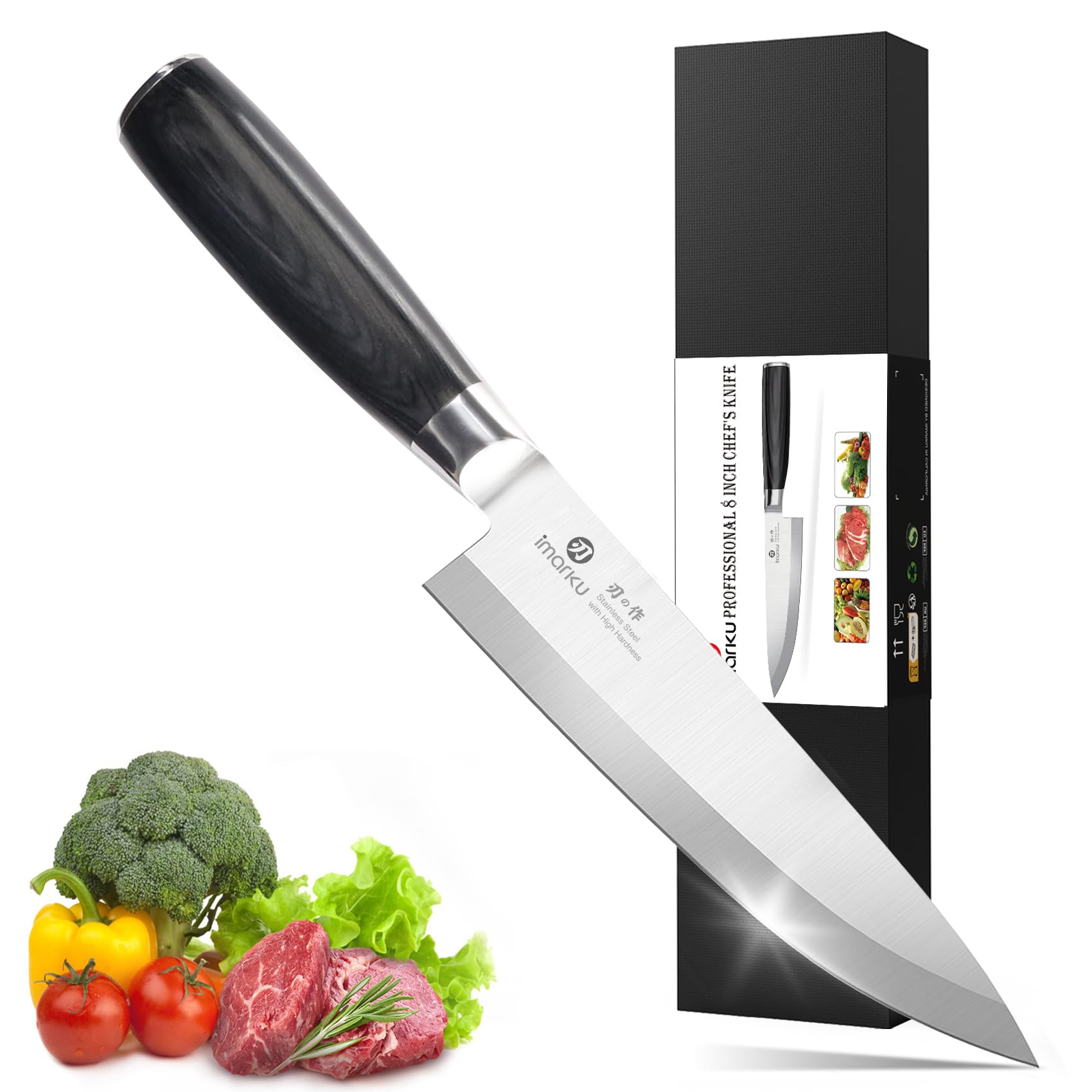
Imarku Pro Kitchen 8-Inch Chef’s Knife — Friendly first serious knife
Best for: Beginner home cooking
For a left-handed beginner who wants a forgiving first serious knife, this Imarku is easy to pick up and easy to control. Its symmetric edge and pakkawood handle feel neutral in the left hand, with a comfortable grip for learning pinch and claw techniques. The 8-inch high-carbon stainless blade is sharp for vegetables, fruit, and boneless meat, and the included sheath helps with safe storage. It is not as refined as the forged picks above, and the edge will need regular honing, but as a confidence-building starter knife, it is a sensible choice.
- Easy to control for beginners
- Neutral pakkawood handle grip
- Sheath helps safe storage
- Less refined than forged picks
- Needs regular honing
4.6/5
4.4/5
4.7/5

Cutluxe Artisan 8-Inch Chef’s Knife — Handsome, sharp, gift-ready
Best for: Gift and display cooking
For a left-handed cook, or a gift buyer choosing for one, this Artisan knife pairs a striking Damascus-style blade with a neutral handle that does not favour the right hand. Its symmetric edge slices vegetables, herbs, and boneless meat cleanly, and the 8-inch length is versatile for most home prep. The pakkawood handle looks premium and feels balanced, though it needs hand-washing and drying to stay at its best. It is not the most robust forged pick here, but as a gift that is also genuinely usable every day, it is a thoughtful choice.
- Striking Damascus-style blade look
- Neutral handle, no right bias
- Versatile 8-inch daily length
- Needs hand-washing and drying
- Less robust than forged picks
4.5/5
4.5/5
4.6/5

Utopia Kitchen 8-Inch Chef’s Knife — Simple, light, dependable
Best for: Light everyday prep
For a left-handed cook who wants a simple, light second knife or a low-fuss daily blade, this Utopia pick is easy to live with. Its symmetric edge and straight handle feel neutral in the left hand, with no sided shape to adapt to. The 8-inch stainless blade handles vegetables, fruit, and boneless meat for everyday meals, and its light weight suits smaller hands and shorter prep sessions. It will not hold an edge as long as harder Japanese steel, and it feels less substantial than forged knives, but for straightforward daily cooking, it is dependable.
- Simple, light daily blade
- Straight neutral handle shape
- Easy for smaller hands
- Shorter edge life than harder steel
- Less substantial than forged knives
4.5/5
4.3/5
4.6/5
Top 3 Head-to-Head: Victorinox vs Mercer Millennia vs Wüsthof Classic
These three are the most common final choices: a forgiving all-rounder, a light budget pick, and a heavy forged workhorse.
| Feature | #1 Victorinox | #2 Mercer Millennia | #3 Wüsthof Classic |
|---|---|---|---|
| Left-Hand Comfort | 4.9/5 — Best | 4.8/5 | 4.7/5 |
| Edge Retention | 4.6/5 | 4.5/5 | 4.6/5 — Best |
| Ease of Use | 4.9/5 — Best | 4.9/5 | 4.5/5 |
| Choose if… | You want one forgiving daily knife | You want light weight and value | You want heavy forged durability |
Who These Chef Knives Are NOT For
These symmetric double-bevel knives are not the right tool for every specialist task.
They are also not for heavy bone work, frozen food, or prying. For those jobs, use a cleaver or a heavy-duty knife, and store any chef knife safely with a proper routine, as explained in this guide to how to store a chef knife.
Common Mistakes to Avoid
Left-handed buyers make the same few errors again and again.
Frequently Asked Questions About Chef Knives for Left-Handed Cooks
Do left-handed cooks need a special chef knife?
No, most left-handed cooks do not need a special knife. Most Western chef knives use a symmetric double bevel and a neutral handle, so they cut the same in either hand. You only need a dedicated left-handed knife for traditional single-bevel Japanese blades, which are ground for one hand only.
What makes a chef knife good for left-handed use?
A good left-handed knife has a symmetric 50/50 double bevel, a neutral handle with no right-hand contour, and balance near the bolster. Those three features stop the blade steering sideways and keep your grip comfortable. Blade length and steel matter too, but bevel and handle shape matter first.
Are double-bevel knives really ambidextrous?
Yes, when the bevel is truly symmetric. A 50/50 double bevel has equal grinding on both sides, so the edge meets food the same way in the left or right hand. Check the listing carefully, because some knives are double-bevel but asymmetric, with more grinding on the right side.
Can a left-handed cook use a Japanese gyuto?
Yes, if the gyuto is double-bevel and symmetric. Most modern gyutos in this guide are, and they work well for left-handed push-cutting and slicing. Avoid single-bevel gyuto-style blades and D-shaped handles made for the right hand, unless you buy a left-handed version from a specialist.
What blade length is best for a left-handed beginner?
An 8-inch blade is best for most left-handed beginners. It is long enough for onions, cabbage, and large vegetables, yet short enough to control with a pinch grip. Shorter blades feel nimble but limit large cuts, while longer blades can feel heavy and unwieldy until your technique is settled.
How should a left-handed cook sharpen a double-bevel knife?
Use equal strokes on both sides, at the same angle, to keep the bevel symmetric. If you sharpen one side more, the edge will drift asymmetric and start steering in the left hand. Hone regularly between sharpenings, and check the edge by slicing paper or a ripe tomato cleanly.
Our Final Verdict
For most left-handed cooks, the winning trade-off is simple: a symmetric double bevel and a neutral handle matter more than a left-handed label. The Victorinox gives you that combination with easy maintenance, while lighter and heavier alternatives suit different cutting styles.

