Western vs Japanese Chef Knife: Key Differences and Which Is Better?
Quick Answer
Western chef knives generally offer a tougher, more forgiving edge and a curved blade suited to rocking cuts. Japanese chef knives, especially gyutos, often feature thinner blades and harder steel for precise slicing with less cutting resistance. For everyday versatility and easier maintenance, consider a Western knife; for fine cutting and a lighter feel, consider a Japanese knife.
What separates the two styles?
- Blade shape: Western knives often have a more pronounced curve, while gyutos tend to have a flatter profile.
- Steel and hardness: Japanese models often use harder steel, while many Western models favor toughness.
- Cutting style: Western designs commonly suit rocking motions; Japanese designs often excel at push-cutting and slicing.
- Edge durability: Thin Japanese edges can chip if twisted or used on hard materials.
- Maintenance: Both need sharpening, but the correct method depends on the knife’s steel and edge geometry.
- Best choice: Match the knife to your cutting habits, preferred weight, and willingness to maintain it.
Choosing between a Western and Japanese chef knife can feel confusing when both styles promise excellent cutting performance. The difference becomes clearer when you look beyond sharpness and consider blade shape, steel, handling, and everyday care.
In this guide, I’ll compare both styles for common kitchen tasks, explain where each has an advantage, and show you what to consider before choosing your next knife.
What Is the Difference Between Western and Japanese Chef Knives?
A Western chef knife is a general-purpose kitchen knife traditionally associated with European designs, particularly German and French cutlery. A Japanese chef knife, such as a gyuto, combines all-purpose versatility with blade geometry often designed for precise, low-resistance cutting.
Neither style is automatically better. The right choice depends on your ingredients, cutting technique, maintenance habits, and preference for blade weight.
| Feature | Western chef knife | Japanese chef knife |
|---|---|---|
| Blade profile | Often more curved | Often flatter, especially near the heel |
| Steel | Frequently tough stainless steel | Often harder stainless or carbon steel |
| Edge geometry | Often more forgiving | Often thinner and more acute |
| Typical feel | Substantial and stable | Light and precise, depending on model |
| Cutting motion | Rocking and chopping | Push-cutting and slicing |
| Edge maintenance | Often more forgiving | May require greater care |
| Best fit | General-purpose kitchen work | Precise slicing and controlled prep |
These are general tendencies, not strict rules. Modern Western knives can be thin and precise, while some Japanese knives have thicker, more durable edges.
How Does the Blade Shape Affect Cutting Performance?
 Save
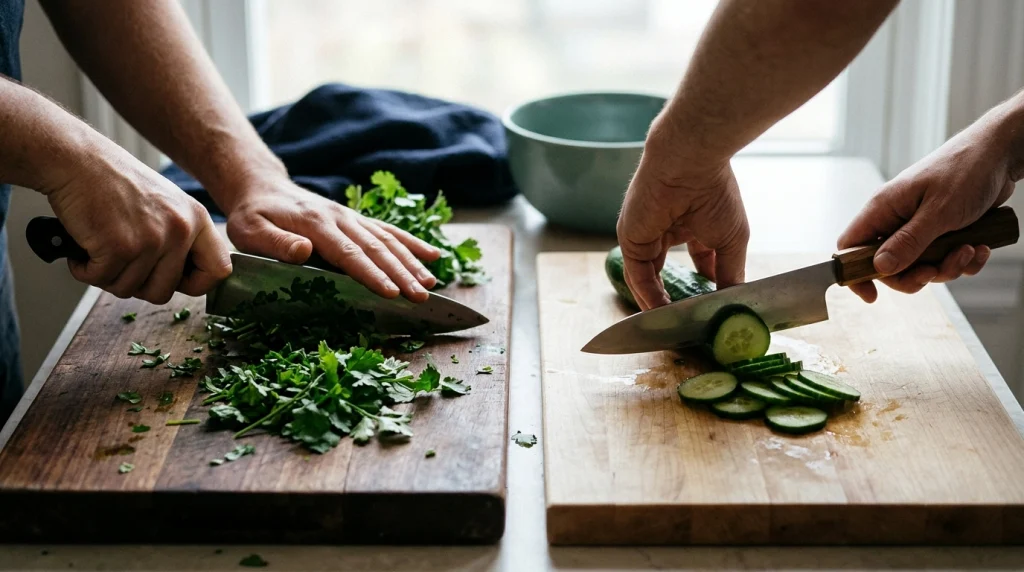
Blade shape determines how the cutting edge meets the board and moves through food. This difference often matters more in daily use than the knife’s country of origin.
Western chef knife blade shape
Many Western chef knives have a pronounced belly, the curved section of the cutting edge near the tip. This shape supports rocking cuts, where the tip stays close to the board as the handle rises and falls.
The curved edge also works well for mincing herbs, chopping onions, and handling a wide range of ingredients. However, a strongly curved blade may require a different technique if you prefer straight downward cuts.
Japanese gyuto blade shape
A gyuto is a Japanese all-purpose chef knife with a pointed tip and a profile that is often flatter than a traditional German chef knife. Its geometry commonly supports push-cutting, slicing, and controlled chopping.
The flatter section near the heel can make it easier to cut vegetables cleanly with an up-and-down or forward-moving stroke. Some gyutos also have a curved tip section, so they can accommodate limited rocking when needed.
- Prefer rocking: A curved Western profile may feel more natural.
- Prefer push-cutting: A flatter gyuto may suit your technique.
- Use both methods: Try a hybrid profile before committing to either extreme.
For a closer look at these differences, see this guide to chef knife blade profiles.
Is a Japanese Chef Knife Sharper Than a Western Knife?
A Japanese chef knife often cuts with less resistance because its edge and blade geometry may be thinner. However, a well-sharpened Western knife can also be extremely sharp, so country of origin alone does not determine sharpness.
Three factors help explain the difference:
- Edge angle: A more acute edge can reduce cutting resistance but may be less tolerant of rough use.
- Blade thickness: A thin blade can pass through dense ingredients with less wedging.
- Edge condition: A properly maintained edge generally performs better than a dull one, regardless of style.
Many Japanese double-bevel knives use relatively acute edges, while Western knives often have somewhat wider edge angles. Exact angles vary by model, and the manufacturer’s recommendation should take priority over general guidelines.
Here’s a useful distinction: sharpness describes how effectively the edge cuts, while cutting feel also depends on friction, blade thickness, and how the blade moves through the ingredient.
Which Knife Has Better Steel and Edge Retention?
Japanese chef knives often use harder steel that supports a fine edge and can retain it well. Many Western knives use steel and heat treatments that prioritize toughness and resistance to damage during everyday use.
Hardness is commonly measured on the Rockwell C scale, written as HRC. A higher HRC value indicates harder steel, but it does not automatically mean the knife is better or will stay sharp longer in every situation.
Japanese knife steel
Japanese knives may use stainless steels such as VG-10 or powdered steels such as SG2, alongside traditional carbon steels. Harder steel and thin edge geometry can support precise slicing, although a fine edge may chip if it hits bone or gets twisted in food.
Some Japanese carbon-steel blades also react to moisture and acidic foods. They need prompt cleaning and drying to reduce the risk of rust.
Western knife steel
Many Western chef knives use stainless steels selected for a balance of toughness, corrosion resistance, and manageable maintenance. Their edges may tolerate everyday knocks better, although steel choice and heat treatment vary considerably between manufacturers.
A tougher edge can be practical in a busy kitchen where different people use the same knife. Still, no chef knife should be treated as a tool for hacking through hard bones or frozen food.
For more background, read this guide to chef knife heat treatment and durability.
Which Is Better for Vegetables, Meat, and Herbs?
Both styles can handle most everyday preparation, but their geometry can make certain tasks feel easier. The ingredient, cutting motion, and individual knife design all influence the result.
| Kitchen task | Often suits | Why |
|---|---|---|
| Dicing onions | Both | Both provide good control with the right technique. |
| Thin vegetable slices | Japanese gyuto | Thin geometry can reduce resistance. |
| Rock-chopping herbs | Western | A pronounced belly supports rocking motions. |
| Slicing boneless meat | Both | A sharp edge and suitable blade length matter most. |
| Hard squash | A suitable robust knife | Thick, dense ingredients can put stress on thin edges. |
| Fine, precise cuts | Japanese gyuto | Many models offer a thin blade and responsive tip. |
When preparing vegetables, a thin Japanese blade may glide through carrots, cucumbers, and onions with less wedging. A Western knife can do the same jobs well, especially when it has a thin grind and a sharp edge.
For boneless meat, either style works for trimming, portioning, and slicing. Use a dedicated boning knife for detailed work around joints, and never use a fine chef knife to cut through hard bones.
Are Japanese Chef Knives Harder to Maintain?
Japanese knives can require more careful handling when they have hard steel and thin edges, but maintenance depends on the specific model. Stainless Japanese knives can be relatively straightforward to care for, while some Western knives also need careful sharpening and cleaning.
Follow these habits with either style:
- Wash by hand: Use mild dish soap rather than relying on the dishwasher.
- Dry promptly: Wipe the blade after washing, especially if it contains reactive carbon steel.
- Choose a suitable board: Wood and suitable plastic are generally kinder to edges than glass or stone.
- Sharpen correctly: Match the sharpening method and angle to the knife’s existing edge and manufacturer guidance.
- Store safely: Use a blade guard, suitable block, or magnetic holder that protects the edge.
A honing rod can help maintain some Western knives, but aggressive honing can damage a delicate Japanese edge. A suitable whetstone or carefully chosen sharpening service may be a better option for many Japanese models.
For further guidance, consult Sakai Ichimonji’s knife-care guidance and Korin’s knife-care instructions.
Which Knife Is Better for Beginners?
A Western chef knife is often a practical starting point for beginners who want a versatile tool with a relatively forgiving edge. However, a Japanese knife can also be an excellent first knife if you prefer lighter handling and are willing to use it carefully.
Think about how you cook rather than choosing based on reputation.
- Choose Western if: You prefer a substantial knife, frequently rock-chop, and want a forgiving everyday tool.
- Choose Japanese if: You value precise slicing, prefer push-cutting, and can avoid twisting or striking the edge against hard materials.
- Choose a hybrid if: You want a Japanese-inspired cutting feel with a Western-style handle or a more durable edge design.
One practical test is to hold the knife in a safe, controlled position and imagine your normal cutting motion. The handle should feel secure, the blade should clear your knuckles, and the knife should feel manageable without excessive wrist effort.
What Should You Look for When Choosing a Chef Knife?
Before buying, compare the complete knife rather than focusing only on its steel name or country of manufacture. A well-designed knife should fit your hand, cutting board, and regular cooking tasks.
- Blade length: An 8-inch blade is a useful all-purpose size for many home kitchens.
- Blade profile: Match the curve to your preferred cutting motion.
- Steel and hardness: Consider edge retention alongside toughness and corrosion resistance.
- Handle comfort: Check grip security, balance, and wrist comfort.
- Sharpening needs: Make sure you can maintain the edge with your available tools or service.
- Budget: A dependable midrange knife can be more useful than an expensive model that does not suit your technique.
As of 2026, both Japanese and Western makers offer stainless, carbon-steel, lightweight, and hybrid designs. The traditional categories remain useful, but modern knife design increasingly blurs the boundary between them.
Recommended Western and Japanese Chef Knives
 Save
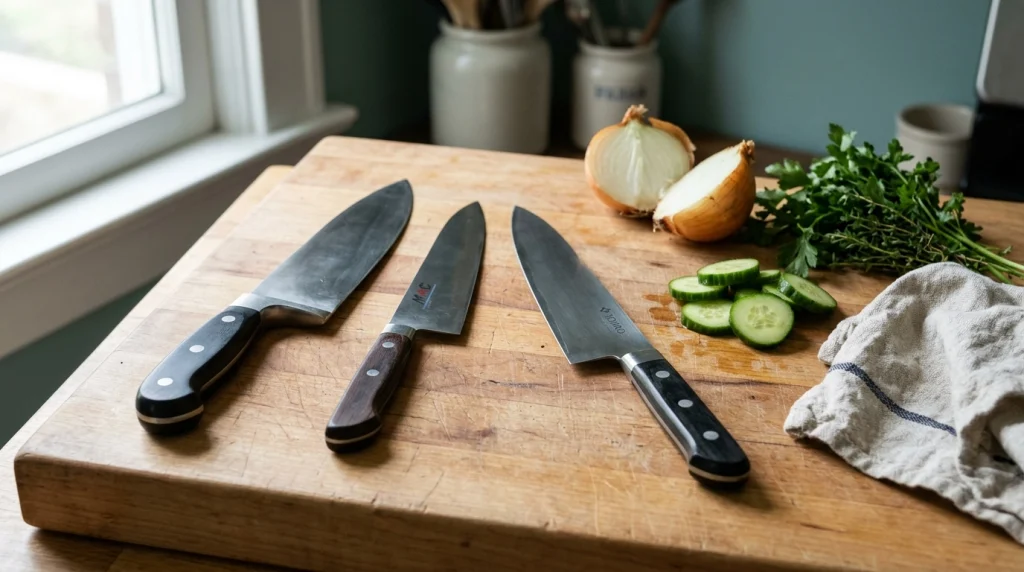
If you’re ready to choose one, these established models illustrate three different priorities: everyday Western durability, Japanese cutting precision, and a Japanese-style knife with broad general-purpose appeal. Check current specifications and availability before ordering.
🏆 WESTERN-STYLE PICK
Wüsthof Classic 8-Inch Cook’s Knife
A traditional German-style chef knife with a curved profile and a substantial feel. Consider it if you prefer rocking cuts and a versatile everyday blade; compare the handle and bolster design with your sharpening preferences.
🎯 PRECISION-FOCUSED PICK
MAC Professional MTH-80
This Japanese-made 8-inch chef knife is known for its relatively thin cutting profile and versatile shape. It is worth considering if you want efficient vegetable prep and fine slicing without choosing an extremely specialized blade.
💡 JAPANESE-STYLE VALUE PICK
Tojiro DP Gyuto
The Tojiro DP gyuto offers an accessible way to explore Japanese-style blade geometry. Compare the available blade length, steel specifications, handle fit, and maintenance requirements before selecting a version.
Note: These are editorial suggestions, not independently verified live ratings or hands-on test results. Prices, stock, specifications, and model variants can change.
Frequently Asked Questions
Is a Western chef knife better than a Japanese chef knife?
Neither style is universally better. Western knives often suit rocking cuts and everyday use, while Japanese gyutos frequently excel at precise slicing and push-cutting. Your cutting technique, preferred blade weight, maintenance habits, and the specific knife’s design matter more than its origin.
Do Japanese chef knives stay sharp longer?
Some Japanese knives use harder steel and thin edge geometry that can support excellent edge retention. However, the result depends on steel composition, heat treatment, edge design, ingredients, and handling. A well-made Western knife can also maintain a useful edge for a long time.
Can beginners use Japanese chef knives?
Yes. Beginners can use Japanese chef knives safely with proper cutting technique and care. Avoid twisting the blade, cutting through bones, or using it on frozen food. If you prefer a more forgiving edge and heavier handling, a Western knife may be an easier starting point.
Are Japanese chef knives harder to sharpen?
Not necessarily. Many Japanese knives sharpen well on a suitable whetstone, but thin edges and harder steels can require careful technique. Some Western knives are also challenging to sharpen, especially when their edge geometry or bolster design complicates access to the heel.
Can I use a Japanese chef knife for everyday cooking?
Yes. A Japanese gyuto is designed for general kitchen preparation and can handle vegetables, herbs, boneless meat, and many other ingredients. Choose a model with suitable edge durability, maintain it properly, and avoid tasks that place excessive force on the cutting edge.
Final Verdict: Western vs Japanese Chef Knife
Choose a Western chef knife if you value a curved blade, comfortable rocking cuts, and an edge that often tolerates everyday handling well. Choose a Japanese gyuto if you prioritize precise slicing, low cutting resistance, and a lighter, more controlled feel.
For most cooks, the smartest choice is the knife that fits their technique and maintenance routine. Try the grip and blade profile when possible, check the manufacturer’s care guidance, and prioritize reliable cutting performance over country-of-origin labels.
If you are still deciding, start with an 8-inch all-purpose model from a reputable maker. A suitable knife that you maintain consistently will serve you better than a premium blade that doesn’t match your cooking style.

