Chef Knife Blade Profile Explained: Geometry & Cuts
Quick Answer
A chef knife blade profile refers to the overall shape, curvature (belly), and tip geometry of the knife. The profile dictates how the blade interacts with the cutting board—determining whether it excels at rocking motions, push-cuts, or slicing delicate ingredients.
What Is a Chef Knife Blade Profile?
 Save
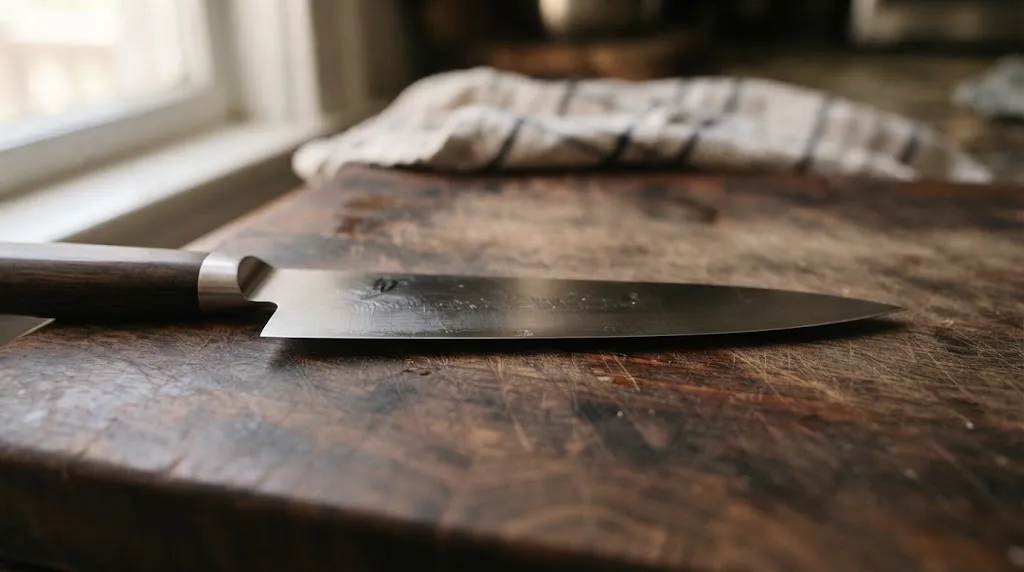
When you look at a chef knife from the side, the outline you see is its blade profile. This shape is not merely aesthetic; it is engineered to serve specific culinary techniques and cutting styles.
The profile encompasses several key geometric elements:
- The Belly: The curved portion of the cutting edge toward the front half of the blade.
- The Tip (or Point): How sharply the spine and edge converge for piercing and detailed work.
- The Heel: The rear part of the blade near the handle, used for heavy-duty cuts and leverage.
- The Profile Sweep: The gradual transition from the heel to the point.
Understanding these elements helps explain why two knives of the exact same length can feel completely different on a cutting board.
How Blade Curvature Affects Cutting Technique
The amount of curve on a blade’s edge directly dictates how the knife moves across the board. Different culinary traditions prioritize different motion styles.
The Rocking Motion (Western Profile)
Knives with a pronounced belly feature a continuous, sweeping curve from heel to tip. This shape is designed for a rocking motion, where the tip stays relatively close to the board while the user rocks the blade up and down over herbs, garlic, and vegetables.
This style is common in traditional Western kitchen knives, offering a forgiving cutting edge that distributes impact evenly along the curve.
The Push-Cut and Chop (Japanese Profile)
Knives with flatter profiles—such as traditional Japanese shapes—minimize or eliminate the belly curve. Instead of rocking, these blades are designed for push-cuts, pull-cuts, and straight vertical chopping.
Because more of the edge makes contact with the cutting board simultaneously, these profiles produce clean, precise slices without requiring excessive forward-and-backward motion.
Key Insight
A flatter profile offers maximum efficiency on straight downward cuts, while a curved belly provides smooth transitions for rocking techniques.
Major Blade Profile Categories
Kitchen knife profiles generally fall into distinct categories based on their regional heritage and intended application.
| Profile Type | Curve / Belly | Primary Cutting Style | Best Suited For |
|---|---|---|---|
| German / Western | Deep, continuous belly | Rocking motion | General prep, heavy herbs, root veg |
| French Style | Slightly flatter, angled tip | Combination rocking and slicing | Versatile all-purpose kitchen tasks |
| Gyuto (Japanese) | Flatter with subtle curve at tip | Push-cut, slicing, light rocking | Precise protein and vegetable prep |
| Santoku | Very flat edge, sheep’s foot tip | Downward chopping, push-cut | Quick vegetable dicing and slicing |
Evaluating these styles helps match your personal cooking habits with the physical geometry of the tool.
How Profile Geometry Influences Tip Control
The transition from the belly to the point dictates how much precision you have during fine work, such as mincing shallots or scoring meat.
A knife with a gradual taper and a low tip allows the user to bring the point down precisely without lifting the entire blade off the board. Conversely, a high tip requires a steeper angle to engage the point, which changes hand posture and wrist comfort during intricate tasks.
Furthermore, the height of the blade near the heel provides crucial knuckle clearance. Taller profiles prevent your knuckles from striking the cutting board, which is especially important for cooks with larger hands or when processing bulky ingredients like heads of cabbage.
Common Misconceptions About Blade Profiles
Several persistent myths surround knife shapes and how they perform in everyday cooking environments.
One common belief is that a heavier, deeply curved Western blade is always superior for tough items like squash or pumpkins. In practice, wedge thickness and grind geometry play a larger role in splitting hard foods than the curve of the edge alone.
Another misconception is that flatter blades cannot rock at all. While specialized flat-edged knives like vegetable cleavers are strictly for chopping, standard Japanese-style chef knives (Gyutos) maintain enough subtle curvature near the tip to accommodate light rocking motions when necessary.
Warning
Do not attempt heavy-duty rocking techniques on extremely flat Japanese knife profiles. Twisting or lateral stress on a thin, hard edge can cause chipping.
How to Choose the Right Profile for Your Cooking Style
 Save
Selecting a knife profile comes down to analyzing your physical cutting technique.
- Observe your natural movement: Notice whether you lift the knife entirely off the board or keep the tip anchored while rocking the handle.
- Assess your ingredients: If you frequently prep leafy herbs, garlic, and root vegetables using a rolling motion, a curved Western profile will feel most natural.
- Consider precision tasks: If you prefer clean vertical slices, push-cuts, and precise brunoise cuts, a flatter Japanese-inspired profile offers superior feedback and control.
Matching the geometry to your technique reduces fatigue and improves consistency across all kitchen prep work.
Related Product
Kitchen Knife Sharpening Stone Set
Maintain your blade’s precise edge geometry and profile curves with a quality dual-grit whetstone.
As an Amazon Associate, we earn from qualifying purchases.
Frequently Asked Questions
What is the main difference between a German and Japanese blade profile?
German profiles feature a deep, continuous belly designed for a rocking cutting motion, while Japanese profiles are typically flatter and optimized for push-cuts and vertical chopping.
Can you sharpen a knife profile into a different shape?
Yes, reshaping a blade profile is possible through aggressive sharpening and thinning, but it requires substantial skill and specialized abrasive stones to avoid ruining the temper of the steel.
Why do some chef knives have a curved tip while others are pointed?
A curved tip accommodates a rolling motion without digging into the cutting board, whereas a sharper, lower tip provides high precision for piercing and delicate slicing tasks.
Does blade length affect the profile curve?
Longer blades generally require a more gradual curve to maintain usability across the entire edge, while shorter blades concentrate the curve over a compact distance.
How does blade height relate to the profile?
Blade height (the distance from spine to edge) influences knuckle clearance and food release. Taller profiles provide more room for your fingers above the cutting board.
Which profile is best for beginners?
A classic Western or hybrid French profile with a moderate belly is often recommended for beginners because the curved edge is forgiving during rocking motions.
Conclusion
The blade profile of a chef knife dictates how the tool performs in daily food preparation. By understanding the relationship between edge curvature, belly shape, and your own cutting technique, you can select a knife that optimizes comfort and precision. Whether you prefer the fluid rocking motion of a Western blade or the clean push-cuts of a Japanese profile, matching geometry to function ensures an efficient and enjoyable cooking experience.

