Standard Chef Knife Size: Which Length Is Right?
Quick Answer
The standard chef knife size is 8 inches (about 20 cm), measured along the blade rather than the entire knife. It is a versatile length for most home cooks, handling everyday chopping, slicing, dicing, and mincing. A 6-inch knife offers greater maneuverability in small spaces, while a 10-inch knife provides extra reach for larger ingredients and high-volume preparation.
An 8-inch chef knife is a familiar sight in home kitchens, but that does not mean every cook needs exactly the same blade length. The size that feels comfortable depends on the cutting board, the foods being prepared, and how the knife handles in your hand.
The distinction matters because a knife can have the right listed length yet still feel too heavy, tall, or awkward. Understanding the dimensions makes it easier to choose a useful everyday tool rather than relying on the number printed on its packaging.
What Is the Standard Size of a Chef Knife?
 Save
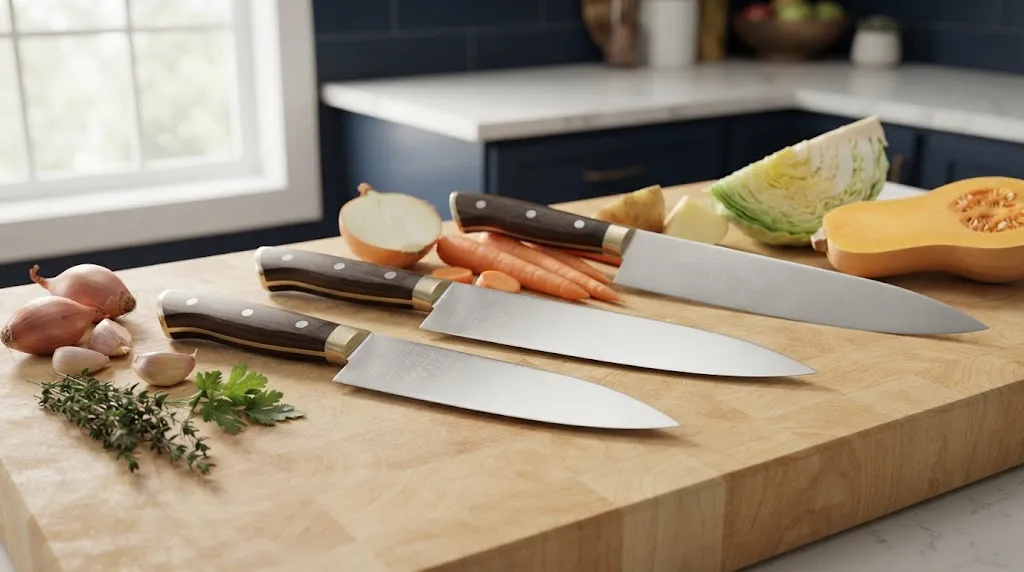
SaveThe most widely recognized standard is an 8-inch blade, commonly labeled 20 cm. It provides enough cutting edge for many vegetables, fruits, herbs, and boneless cuts of meat without requiring an unusually large working surface.
There is no single mandatory length that every manufacturer must follow. Chef knives are sold in multiple sizes, and the term “standard” describes a common general-purpose choice rather than a universal manufacturing specification.
For example, WÜSTHOF’s official Classic Chef’s Knife specifications identify the model as a 20 cm, 8-inch knife. This reflects the common practice of rounding 20 cm and 8 inches into the same size category.
In exact measurements, 8 inches equals 20.32 cm. The small difference between 20 cm and 20.32 cm is normally insignificant for everyday cooking.
Common Chef Knife Sizes Compared
The three familiar size categories are 6, 8, and 10 inches. Each offers a different balance of reach, working space, and maneuverability.
| Blade Size | Approximate Length | Practical Use |
|---|---|---|
| 6 inches | 15 cm | Small boards, compact preparation, detailed work |
| 7 inches | 18 cm | Middle ground between compactness and reach |
| 8 inches | 20 cm | General-purpose home cooking |
| 9 inches | 23 cm | More reach without moving to a full 10-inch blade |
| 10 inches | 25 cm | Larger ingredients, longer slicing strokes, batch preparation |
| 12 inches | 30 cm | Specialized large-volume preparation |
These measurements are rounded size categories. A knife described as 8 inches may not match another manufacturer’s 8-inch model exactly, especially when their measurement conventions differ.
6-inch chef knife: compact and manageable
A 6-inch chef knife is useful for preparing smaller amounts of food on a limited cutting surface. Its shorter blade is generally easier to move around small ingredients and crowded preparation areas.
The compromise is reach. Cutting through a large cabbage, melon, or roast may require additional strokes. Some short chef knives also have relatively shallow blades, which can reduce knuckle clearance above the cutting board.
8-inch chef knife: the everyday middle ground
An 8-inch chef knife works well for ordinary vegetable preparation, chopping herbs, mincing garlic, and slicing boneless meat. It offers a useful cutting length while remaining manageable on many home cutting boards.
For a cook who wants one multipurpose chef knife, this is usually the most practical size to consider first. However, blade weight and handle design can make one 8-inch model feel substantially different from another.
10-inch chef knife: more reach for larger work
A 10-inch chef knife offers a longer cutting stroke, which can be helpful when preparing large vegetables, portioning sizable boneless cuts, or chopping ingredients in quantity.
The tradeoff is physical space. A long knife needs enough clear board area to move safely, and its additional length may feel cumbersome during small, detailed tasks. It is an option for cooks who actually benefit from that reach, not an automatic upgrade in cutting quality.
How Is Chef Knife Size Measured?
Chef knife size normally refers to the blade length from the tip toward the heel, without including the handle. The heel is the rear portion of the blade near the handle.
To check the approximate length of a knife you already own:
- Place the knife flat on a stable surface with the cutting edge facing safely away from your hand.
- Position a ruler beside the blade, without touching the sharpened edge.
- Measure from the tip back toward the heel or blade-to-handle transition.
- Compare the result with the manufacturer’s published dimensions if you need the exact model specification.
Manufacturers may use slightly different starting or ending points, particularly on knives with unusual bolsters or curved blade profiles. That is why a stated size should be understood alongside the manufacturer’s measurement method.
Blade length versus overall length
An 8-inch chef knife is not only 8 inches long from end to end. The complete knife also includes its handle, so its overall length is considerably greater.
For instance, an 8-inch blade combined with a handle approximately 4.5 to 5 inches long may produce an overall length around 12.5 to 13 inches. This is an illustrative estimate, not a specification for every model.
Overall length becomes especially important when checking whether a knife will fit in a drawer organizer, knife block, or protective storage case.
Why Is an 8-Inch Chef Knife Considered Standard?
The 8-inch format provides a practical balance between cutting reach and maneuverability. Its blade is sufficiently long for many everyday ingredients while staying relatively convenient for common home-kitchen tasks.
This does not mean the size is objectively ideal for every person. The advantage comes from its versatility across different cutting jobs.
The ZWILLING chef knife guide similarly describes the 8-to-10-inch range as suitable for a broad variety of preparation tasks, with longer blades offering advantages for larger ingredients.
Consider an ordinary dinner involving onions, carrots, potatoes, and chicken breast. An 8-inch blade can handle these ingredients without constantly switching between knives. A much longer blade may not provide a meaningful advantage for these relatively small quantities.
Key Insight
The standard size is a starting point, not a fitting rule. Two chef knives with identical blade lengths can feel different because of their weight, balance, blade height, and handle shape.
How to Choose the Right Chef Knife Size
Start with the foods you prepare and the space where you cut them. Hand comfort matters too, but hand size alone should not determine blade length.
Match the blade to your cutting board
A larger blade needs more unobstructed room. If a knife nearly spans the usable length of your board, routine cutting can become awkward because the handle, tip, and ingredients compete for space.
Choose a board that gives the blade plenty of clearance and leaves room for prepared food. Keep it stable with a suitable nonslip mat or damp towel underneath when necessary.
Check your grip and wrist comfort
Hold the knife in a normal working grip and notice how it balances. With a pinch grip, the thumb and side of the index finger rest near the base of the blade while the remaining fingers support the handle.
A knife should not require excessive wrist effort to lift, guide, or reposition. A relatively light 8-inch knife may feel more comfortable than a heavier 6-inch model, so comparing lengths without considering construction can be misleading.
Consider your most frequent ingredients
- Mostly herbs, small vegetables, and individual meals: A 6- or 7-inch blade may be sufficient.
- Mixed daily cooking: An 8-inch blade is a practical starting point.
- Large produce, long slicing cuts, and batch preparation: A 9- or 10-inch blade may offer useful reach.
- Very limited counter space: A compact knife may be more convenient than a longer general-purpose model.
If possible, compare knives in person using safe handling demonstrations rather than judging only by their listed measurements.
Blade Height, Weight, and Balance Also Matter
Length is only one part of chef knife sizing. Blade height, weight, and balance often explain why one knife feels comfortable while another of the same length does not.
Blade height is the distance from the cutting edge to the spine, commonly considered near the heel. A taller blade can provide more room for your guiding hand’s knuckles while chopping on a board.
Weight affects how much effort is required to lift and move the knife repeatedly. Weight is influenced by blade thickness, steel distribution, handle construction, and other design features.
Balance describes how the knife’s mass is distributed between the blade and handle. A knife that feels strongly blade-heavy may suit one cutting technique but feel uncomfortable to someone accustomed to a different balance.
Bolster design can also affect the way weight is distributed near the blade-handle junction. A heavy bolster does not automatically make a knife better, and a bolster-free design is not necessarily inferior.
Are Japanese and Western Chef Knife Sizes Different?
 Save
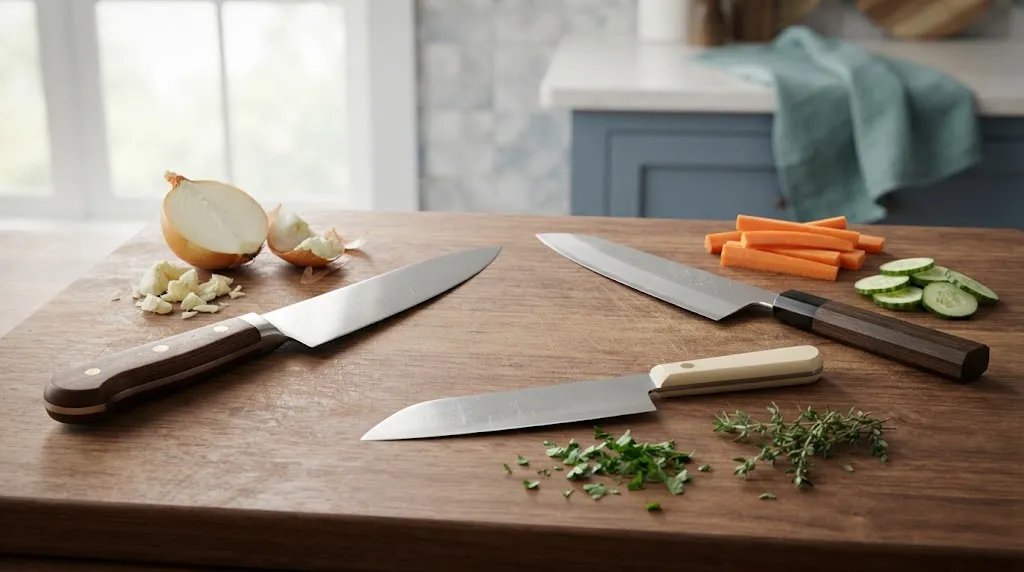
SaveBoth styles offer multipurpose chef knives, but their size labels and common proportions can differ.
Western chef knives are frequently described in inches, such as 6, 8, or 10 inches. Japanese gyuto knives are commonly described in millimeters, with 180 mm, 210 mm, and 240 mm among the available sizes.
A 210 mm gyuto has a nominal blade length of about 8.3 inches, making it close in length to a Western 8-inch chef knife. A 240 mm gyuto measures approximately 9.4 inches.
Length does not reveal the entire difference between these styles. Blade profile, thickness, weight distribution, and cutting geometry also influence performance.
A santoku is another general-purpose Japanese-style knife, often found around 165 to 180 mm. Its shorter length and frequently flatter cutting profile may appeal to cooks who prefer compact chopping movements.
Neither naming convention determines quality. Compare actual dimensions and intended cutting technique rather than assuming that one tradition always produces a better blade.
Common Mistakes When Judging Chef Knife Size
The biggest mistake is treating blade length as a complete description of how a knife will perform.
- Confusing blade length with total length: A listed 8-inch knife usually refers to its blade, not its entire body.
- Assuming longer always means better: Extra reach helps only when the work and available space justify it.
- Ignoring blade height: Two equally long knives may provide noticeably different knuckle clearance.
- Choosing solely by hand size: Handle fit, grip style, weight, and balance all contribute to comfort.
- Overlooking the cutting board: A long knife can become inconvenient when there is insufficient working space.
Also avoid using a standard chef knife as a substitute for a heavy-duty cleaver when cutting through hard bones or other materials beyond the knife’s intended use. The correct blade type matters more than adding inches.
Practical Tip
If you are unsure between two lengths, compare the same cutting motion with both using a safe store demonstration. Pay attention to wrist comfort, board clearance, and how naturally the blade follows your hand.
Related Kitchen Tool: 8-Inch Chef Knife
If you are comparing the standard blade length with actual knife designs, browsing 8-inch chef knives can help you see different handle shapes, blade profiles, and construction styles. Compare the specifications rather than assuming all models handle alike.
As an Amazon Associate, we earn from qualifying purchases.
Frequently Asked Questions
Is an 8-inch chef knife too big for a beginner?
No. An 8-inch chef knife is a common starting choice for beginners because it covers many basic preparation tasks. A shorter knife may be preferable if the 8-inch model feels cumbersome or the available cutting board is small.
Is a 7-inch chef knife considered a standard size?
A 7-inch chef knife is a recognized intermediate size, although 8 inches is the more familiar general-purpose reference. It may suit cooks who want something shorter without reducing blade reach as much as a 6-inch knife.
What is the standard chef knife size in millimeters?
An 8-inch blade equals approximately 203 mm. Many manufacturers label comparable chef knives as 200 mm or 20 cm, while 210 mm is a common Japanese gyuto length.
Do professional chefs always use 10-inch knives?
No. Professional cooks use different sizes based on their tasks, preferences, available space, and working methods. A longer blade can help with large quantities of food, but it is not mandatory for professional cooking.
Can a 6-inch chef knife replace an 8-inch knife?
Yes, for many smaller preparation tasks. However, a 6-inch blade offers less reach for large vegetables, long slices, and substantial ingredients. Whether that limitation matters depends on what you cook most often.
Does a longer chef knife stay sharp longer?
Not inherently. Edge retention depends on factors such as steel properties, heat treatment, edge geometry, cutting surfaces, and maintenance. A longer blade provides additional cutting length, but length alone does not determine how long its edge stays sharp.
Final Thoughts
The standard chef knife size is 8 inches, or approximately 20 cm of blade length. For many home kitchens, it provides a sensible combination of reach and control.
Choose a shorter knife when compactness is important, or a longer one when you regularly prepare large ingredients and have enough room to use it comfortably. The most useful size is the one that fits your routine, your board, and your grip—not simply the most common number on the label.

