How to Grip a Chef’s Knife: A Beginner’s Guide to Better Control
Quick Answer
To grip a chef’s knife, place your thumb on one flat side of the blade near the handle and the side of your bent index finger on the opposite side. Wrap your middle, ring, and little fingers around the handle, keeping your wrist relaxed. Pair this pinch grip with a claw grip on your guiding hand for better control and safer cutting.
How to Position Your Hands
- Find the balance point: Hold the knife near the junction between the blade and handle.
- Pinch the blade: Use your thumb and bent index finger on opposite flat sides, away from the cutting edge.
- Wrap the handle: Let your remaining three fingers support the knife without squeezing too hard.
- Form a guiding claw: Curl the fingertips of your other hand inward while holding the food.
- Keep the board steady: Place a damp towel underneath a cutting board that tends to slide.
- Start slowly: Practice controlled slices before trying faster chopping movements.
One Important Safety Tip
- Keep your fingertips tucked behind your guiding knuckles, and never try to catch a falling knife.
Learning how to grip a chef’s knife can make everyday food preparation feel more controlled and less awkward. Whether you’re slicing onions for dinner or chopping carrots for soup, the way you hold the knife affects how accurately you cut.
In this guide, I’ll explain the pinch grip, show how your other hand should guide ingredients, and compare common holding styles. You’ll also learn how to correct uncomfortable habits and choose a knife that fits your hand.
What Is the Correct Way to Grip a Chef’s Knife?
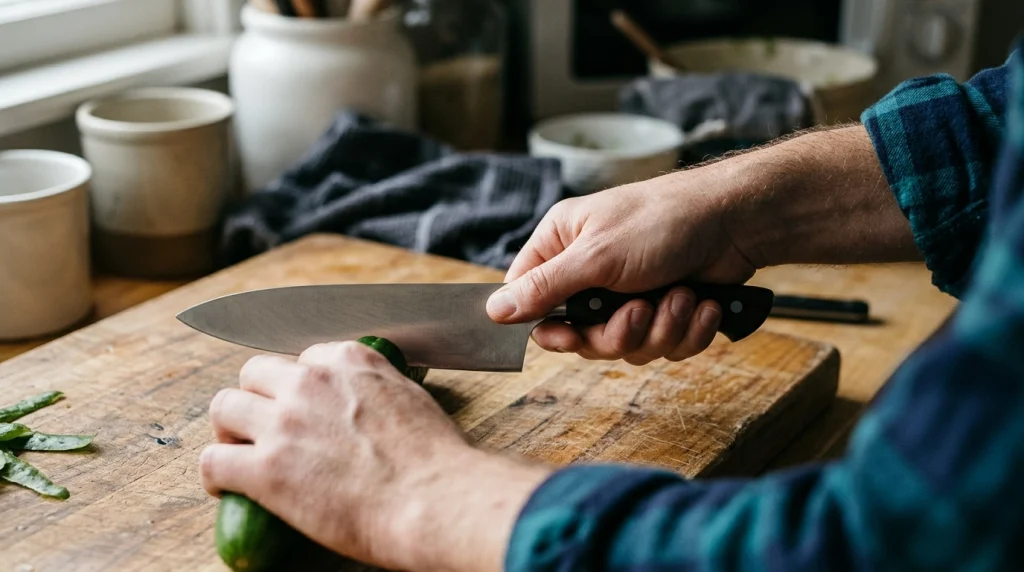
The standard chef’s knife grip is called the pinch grip, a technique in which your thumb and index finger hold the flat sides of the blade near the handle while your other three fingers wrap around the handle. This position helps you guide the blade without relying entirely on the handle.
The goal is a secure, balanced hold rather than a tight squeeze. You should be able to guide the knife smoothly without your hand feeling tense.
Why the pinch grip works
- Better control: Your hand sits closer to the blade’s balance point.
- More precise cuts: Small adjustments become easier when your hand and blade move together.
- Less unnecessary squeezing: The fingers share the work instead of forcing your palm to clamp down on the handle.
- Steadier movement: A balanced grip can help reduce unwanted blade wobble during routine chopping.
The pinch grip may feel unfamiliar if you have always held a knife like a hammer. Give yourself time to adjust rather than trying to master it at full speed.
How Do You Grip a Chef’s Knife Step by Step?
 Save
Start with a clean, dry knife and a stable cutting board. Build the grip while the knife rests securely on the board, with its cutting edge facing away from your fingers.
- Hold the handle naturally. Start with your dominant hand around the handle, as if you were shaking someone’s hand.
- Move your thumb forward. Place the pad of your thumb against one flat side of the blade near the heel, just ahead of the handle.
- Position your index finger. Bend it comfortably and place its side against the opposite flat side of the blade.
- Wrap your remaining fingers. Curl your middle, ring, and little fingers around the handle.
- Relax your wrist. Keep your wrist in a comfortable, mostly neutral position instead of bending it sharply.
- Check your hold. The blade and handle should move together without a death grip or obvious wobbling.
Keep your thumb and index finger on the blade’s flat sides, not on the cutting edge. Your fingertips should never cross underneath the blade or reach toward its sharp edge.
For a useful visual reference, see the knife-handling guidance from NC State Extension’s chef’s knife guide.
Where Should Your Fingers Go on a Chef’s Knife?
Each finger has a specific job in a comfortable pinch grip. Your thumb and index finger control the blade, while the remaining fingers support the handle.
| Finger | Position | Main job |
|---|---|---|
| Thumb | One flat side of the blade near the heel | Helps stabilize the blade |
| Index finger | Opposite flat side, slightly bent | Works with the thumb to control direction |
| Middle finger | Around the handle near the blade junction | Supports the grip |
| Ring finger | Curled around the handle | Helps maintain a steady hold |
| Little finger | Curled around the end of the handle | Helps secure the handle in your palm |
Finger placement varies slightly with the knife’s shape, bolster, and handle size. Keep your grip comfortable and secure without putting your fingers in the path of the cutting edge.
How Should You Hold Food With Your Other Hand?
Your guiding hand holds the ingredient steady while your knife hand makes the cut. The claw grip keeps your fingertips curled inward and lets your knuckles help guide the side of the blade.
- Place the ingredient flat on the cutting board whenever possible.
- Curl your fingertips inward so they do not extend toward the blade.
- Keep your thumb tucked behind your fingers rather than sticking out beside the food.
- Position your knuckles toward the blade, allowing the broad side to follow them gently when appropriate.
- Move your guiding hand backward gradually as you cut, keeping your fingertips curled.
Think of your knuckles as a guide, not a target for the blade. Keep the movement controlled, and never force the knife against your hand.
For round ingredients such as onions, potatoes, and carrots, create a stable flat surface before cutting when practical. A wobbling ingredient is harder to control, even with a good grip.
Pinch Grip vs. Handle Grip: Which Is Better?
The pinch grip generally offers better blade control and precision for everyday chef’s knife work. A full handle grip can still feel more natural to beginners or cooks who find pinching uncomfortable.
| Feature | Pinch grip | Full handle grip |
|---|---|---|
| Hand position | Thumb and index finger touch the blade’s flat sides | All fingers hold the handle |
| Blade control | Typically more direct | Can feel less precise |
| Learning curve | May feel awkward at first | Often feels familiar to beginners |
| Fine slicing | Usually a strong choice | May require more adjustment |
| Best use | General chopping, slicing, and dicing | A comfortable alternative when the pinch grip does not suit your hand |
Neither grip should involve squeezing so hard that your hand becomes tense. Choose a hold that gives you reliable control, and adjust your technique to the knife and task.
How Do You Grip a Chef’s Knife for Different Cutting Tasks?
The pinch grip works for many common kitchen tasks, but your cutting movement should match the ingredient. Keep the same basic control principles while adjusting how the blade travels.
Chopping onions and vegetables
Use the pinch grip with your guiding hand in a claw position. Make deliberate cuts and move the guiding hand back as the ingredient becomes smaller.
Slicing herbs and garlic
Use controlled, short movements rather than pressing down aggressively. For repeated rocking cuts, let the curved blade move smoothly over the board without forcing the tip into an awkward angle.
Slicing meat
Stabilize the meat on the board and use a deliberate slicing motion. Keep your guiding fingers curled and use a knife suited to the size and type of cut.
Cutting firm vegetables
Maintain a stable grip and let the sharp edge do the work. If you must push excessively, stop and check the knife’s sharpness, the ingredient’s stability, and your cutting direction.
For beginners, slow and repeatable movements are more useful than trying to copy a professional chef’s speed. Speed should come only after you can keep both hands controlled throughout each cut.
What Are the Most Common Chef’s Knife Grip Mistakes?
Small changes in hand position can make a knife feel more stable. Watch for these common habits when practicing.
- Holding only the handle: Try the pinch grip if you want more direct control over the blade.
- Squeezing too tightly: Relax your fingers while keeping the knife secure.
- Pointing your index finger along the spine: Use the pinch grip instead for ordinary chef’s knife work.
- Leaving fingertips extended: Curl them inward and keep them behind your guiding knuckles.
- Cutting on a slippery board: Stabilize the board with a damp towel underneath.
- Using a dull knife: Maintain the edge so you do not need to force the blade through food.
- Moving too quickly: Slow down until your hands and blade move predictably.
A grip cannot eliminate every accident, so treat the knife as sharp even when it is not cutting. Never try to catch a falling knife; step away and let it fall.
For more guidance on safe food preparation, consult the USDA National Institute of Food and Agriculture or a reputable culinary training resource.
How Can You Practice the Correct Knife Grip?
You can practice the basic hand position before attempting fast cuts. Begin with an empty cutting board, a securely positioned knife, and enough clear counter space to work comfortably.
- Practice the hold: Form the pinch grip while the blade rests on the board.
- Check your fingers: Confirm that your thumb and index finger contact only the flat sides of the blade.
- Practice the claw: Curl your guiding fingers inward without holding an ingredient.
- Try a soft ingredient: Start with a stable food that cuts easily, such as a cucumber placed flat-side down.
- Repeat slowly: Focus on even cuts and consistent hand placement rather than speed.
In my view, the most useful practice habit is to pause after a few cuts and check your hand position. That brief reset can help you notice when your grip tightens or your fingertips drift forward.
If you experience pain, numbness, or persistent discomfort, stop and reassess the knife’s size, handle shape, and your hand position. A smaller knife or a different handle may suit you better.
What Should You Look for in a Chef’s Knife if Grip Comfort Matters?
A knife should feel secure in your hand, not simply look impressive. Blade length, handle shape, weight, balance, and surface texture can all affect how comfortable the pinch grip feels.
- Handle comfort: Choose a handle that fits your hand without forcing your fingers into an awkward position.
- Manageable weight: A lighter knife may feel easier to control during longer preparation sessions.
- Suitable length: A 6- or 7-inch chef’s knife can be easier to manage if a traditional 8-inch model feels unwieldy.
- Secure materials: Look for a handle that feels stable when your hands are clean and dry.
- Good balance: The knife should feel controllable rather than strongly pulling your wrist forward or backward.
As of 2026, there is no single knife size or handle shape that suits every cook. Try a few options if possible, and prioritize a secure, comfortable hold over price or appearance.
Remember that a well-designed knife still needs correct handling. Even an expensive blade cannot compensate for an unstable cutting board or fingers placed in the cutting path.
Which Chef’s Knife Accessories Help You Maintain a Secure Grip?
 Save
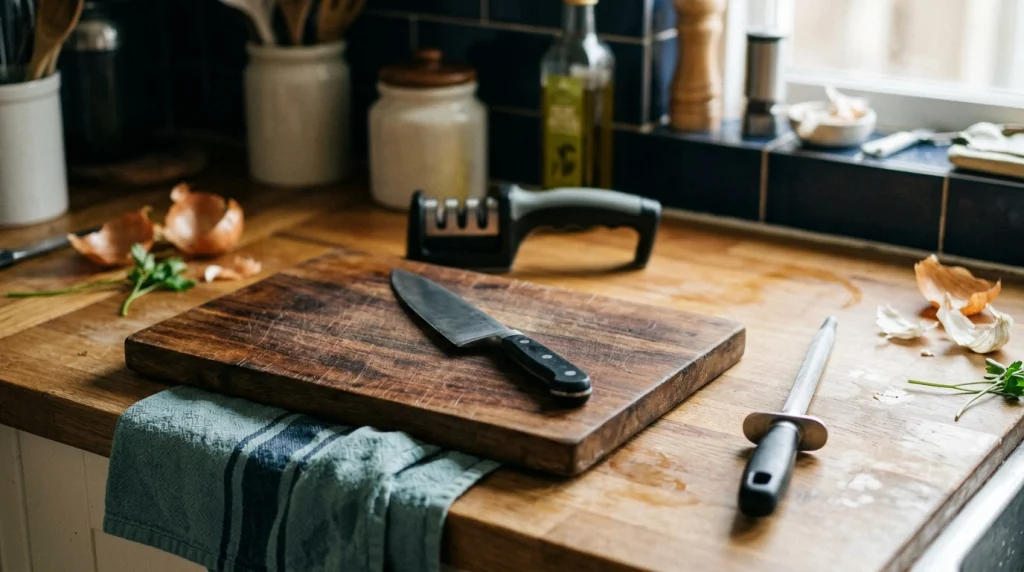
You do not need a large collection of accessories to practice safely. A stable cutting board and a properly maintained knife are the most useful starting points.
- Non-slip cutting board: Helps prevent the cutting surface from moving during preparation.
- Honing steel: Helps realign an edge between sharpenings when used correctly and when appropriate for the knife.
- Knife sharpener: Can restore a worn edge when used according to the knife and sharpener manufacturers’ instructions.
Keep your hands and handle dry before cutting, and clean and store the knife safely after use. Avoid adding bulky grip accessories unless they are compatible with the knife and do not interfere with secure handling.
The right equipment supports good technique, but regular practice remains essential. A comfortable grip, a stable board, and controlled movements are the foundation of reliable knife skills.
Recommended Chef’s Knives and Knife-Care Tools
If you are still getting comfortable with the pinch grip, choose equipment that supports control rather than buying the most expensive knife available. These established options are worth comparing for different needs; the ratings below are editorial assessments, not verified customer-review scores.
🏆 BEST EVERYDAY VALUE
Victorinox Fibrox Pro 8-Inch Chef’s Knife
★★★★☆
Its textured handle and versatile blade make it a practical option for everyday preparation. I would consider it for a beginner who wants a functional knife without paying for premium finishes.
🔪 BEST FOR BEGINNERS
Mercer Culinary Millennia 8-Inch Chef’s Knife
★★★★☆
This budget-friendly model has a textured handle intended to support a secure hold. I would compare its handle shape and weight with other knives before deciding whether it suits your hand.
👌 BEST FOR SMALLER HANDS
Victorinox Fibrox Pro 6-Inch Chef’s Knife
★★★★☆
A shorter blade may feel more manageable if a full-size chef’s knife seems cumbersome. I would consider this option for everyday vegetable preparation when reach and blade size are the main concerns.
These are options to compare, not a claim that one knife works for every hand. Check the current specifications, price, and handle dimensions before purchasing, especially if grip comfort is your main concern.
Frequently Asked Questions
Should you grip a chef’s knife by the blade or the handle?
For the standard pinch grip, your thumb and bent index finger contact the flat sides of the blade near the handle, while your other three fingers wrap around the handle. Keep both fingers away from the cutting edge. If this grip causes discomfort, try a different knife or a comfortable alternative hold.
Is the pinch grip safer than holding the handle?
The pinch grip can improve control and reduce unwanted blade movement, which may help you cut more predictably. However, no grip guarantees safety. Keep your guiding fingertips curled, use a stable cutting board, maintain the knife’s edge, and work at a speed you can control.
Should your index finger rest on top of the knife blade?
For ordinary chef’s knife work, avoid pointing your index finger along the top spine of the blade. Instead, bend it slightly and place its side against one flat side of the blade, opposite your thumb. This pinch position is a common starting point for general chopping and slicing.
How tightly should you hold a chef’s knife?
Hold the knife firmly enough that it cannot slip from your hand, but avoid squeezing until your fingers or forearm become tense. Your thumb and index finger should stabilize the blade while the other three fingers support the handle. Stop and readjust if you feel pain or fatigue.
What if a pinch grip feels uncomfortable?
Check whether the handle is too large, the blade is too heavy, or your wrist is bent awkwardly. Try a smaller chef’s knife or a different handle shape, and practice slowly. Persistent pain, numbness, or reduced hand function is a reason to stop and seek appropriate professional advice.
Final Takeaway: Build Control Before Speed
Learning how to grip a chef’s knife starts with the pinch grip: thumb and index finger on opposite flat sides of the blade, with the other three fingers around the handle. Pair it with a claw grip on your guiding hand and keep your cutting surface stable.
Practice a few slow, controlled cuts whenever you prepare food. Once your grip feels natural and both hands stay in safe positions, you can gradually develop smoother, more consistent knife skills.

