Chef Knife Finger Guard: Types, Uses & Safety
Quick Answer
A chef knife finger guard is either a built-in feature near the handle that helps prevent the gripping hand from sliding toward the edge, or a separate shield worn on the food-holding hand while chopping. Neither replaces a secure grip, a curled-finger claw technique, and a stable cutting board.
Understanding that distinction makes it easier to recognize what your knife already offers, whether a separate guard is useful, and what precautions still matter when you cook.
Where Is the Finger Guard on a Chef Knife?
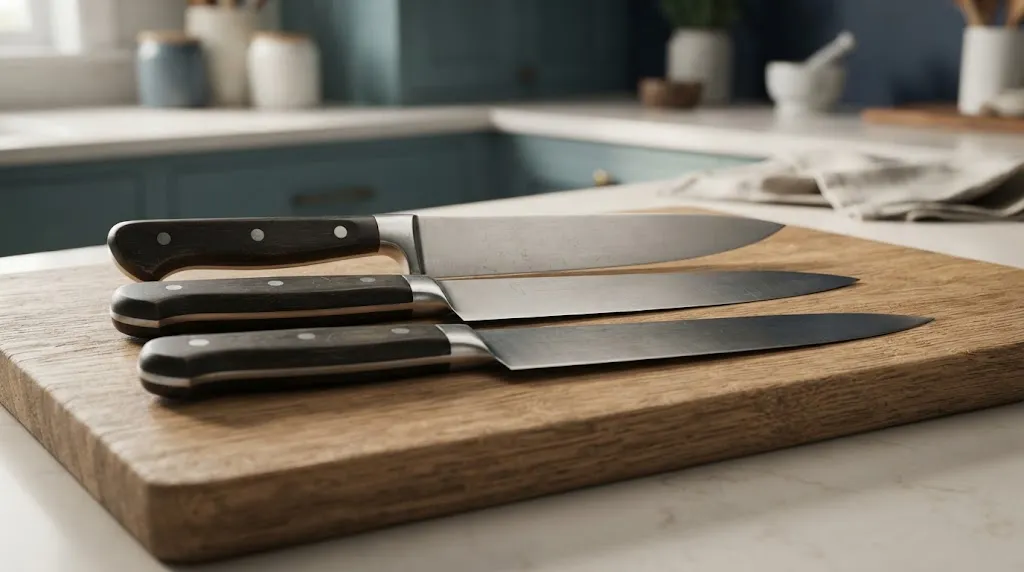
On knives with a built-in finger guard, look immediately in front of the handle, at the rear of the blade. A raised or thickened piece of metal may create a physical stop between the gripping hand and the sharpened edge. On many traditional Western chef knives, that protective area is associated with the bolster.
Not every bolster provides the same degree of separation. A full bolster may extend down toward the heel of the edge, whereas a half bolster stops higher up. Some chef knives have no pronounced bolster or guard at all.
The heel is the rear portion of the cutting edge. The choil is the small transition or notch at the rear of the edge on certain knives. These neighboring features are easy to confuse, but none should be assumed to provide a complete barrier to accidental contact.
For a broader explanation of how the blade, handle, and grip work together, see our guide to chef knife uses and safe handling.
What Does a Built-In Finger Guard Actually Do?
 Save
SaveIts main purpose is to provide a stop or boundary for the hand holding the handle. If that hand shifts toward the blade, a pronounced guard can help interrupt the movement before the fingers reach the sharp heel.
That is a limited mechanical safeguard, not a promise that the hand cannot reach the edge. Protection depends on the guard’s height and shape, the size of the user’s hand, the grip position, and the direction of any slip.
Full, half, and minimal guards
A full bolster commonly extends from the blade’s upper junction toward the bottom of the heel. It presents a more substantial barrier, but its lower section can interfere with access to the heel during sharpening. If the edge wears back over time while the bolster remains proud, the rear edge may no longer contact the cutting board cleanly.
A half bolster leaves more of the heel accessible for sharpening and can feel less restrictive in a pinch grip. However, it offers less of a physical stop at the bottom of the blade. On bolsterless designs, safety relies even more on handle fit, control, and disciplined technique.
How Is a Separate Finger Protector Different?
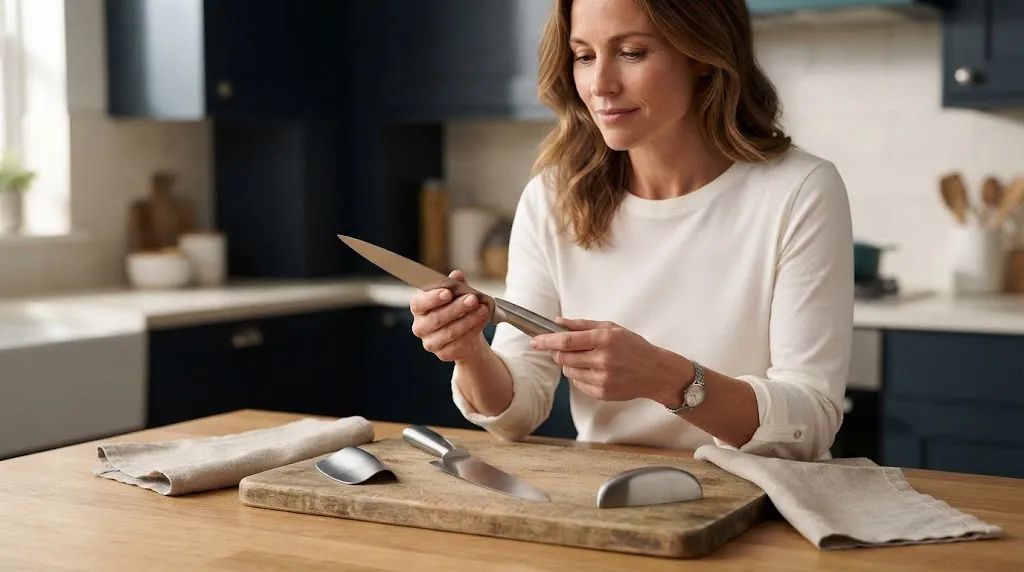
A removable finger protector, sometimes marketed as a chopping finger guard, is worn on the hand holding the food rather than the hand holding the knife. Some are curved stainless-steel shields; others are molded plastic pieces. The accessory places a surface in front of the fingers while slicing.
It may help a beginner become more aware of fingertip position, especially during repetitive vegetable prep. But it can also alter how the food is held and how accurately the guiding hand moves. Poor fit or a loose attachment can make the accessory awkward rather than helpful.
A third item, the cut-resistant glove, covers part or all of a hand using protective fabric. That is different again: protection varies by the glove’s tested rating, coverage, condition, and intended use. A glove is not cut-proof and may not protect against a pointed knife tip.
| Type | Where it goes | Main limitation |
|---|---|---|
| Built-in guard / bolster | Blade-handle junction | Does not shield the food-holding fingers |
| Removable fingertip shield | Guiding hand | Can shift or interfere with grip |
| Cut-resistant glove | Covered hand | Protection varies; not cut-proof |
Choose according to the hand and task you actually want to protect rather than treating all three products as interchangeable.
How to Use a Chef Knife Safely With or Without a Guard
The most useful protection comes from controlling the knife and keeping the guiding fingertips out of the cutting path. NC State Extension’s chef knife guidance teaches the pinch grip, claw grip, and stable cutting surface as fundamental techniques.
- Stabilize the board. Use a sturdy cutting board on a nonslip surface or a damp towel. Clear away clutter and dry your hands.
- Hold the knife near the blade. For a pinch grip, rest the thumb and bent index finger against opposite flats of the blade near the handle, away from the sharp edge. Wrap the remaining fingers around the handle.
- Shape the guiding hand into a claw. Curl fingertips inward and keep the thumb tucked behind them. Keep the knuckles ahead of the fingertips as the knife moves.
- Steady the ingredient. Give round foods a flat resting side when possible. Position the food so it will not roll as pressure is applied.
- Cut slowly and deliberately. Watch the edge and the guiding hand. Move the guiding hand back in small increments instead of reaching forward into the blade path.
- Stop before adjusting anything. Set the knife down before moving a shield, repositioning the food, or clearing scraps.
Warning
Never test a guard by intentionally sliding your fingers toward a sharpened edge. A guard may reduce one kind of contact while leaving other cut paths exposed.
How to Wear a Removable Chopping Finger Guard
Follow the accessory manufacturer’s fitting instructions because shield shapes and fastening methods vary. A basic fitting check is useful before bringing a knife near the food.
- Inspect the accessory. Look for sharp burrs, cracked plastic, damaged straps, or loose hinges. Do not use a damaged guard.
- Fit it to your guiding hand. Put the shield where the manufacturer specifies, with the protective face toward the direction the knife will approach.
- Check the coverage. Curl your fingers normally and confirm the guard covers the intended area without pushing fingertips into the blade path.
- Test your food grip without a knife. Make sure you can hold the ingredient steady without the shield slipping or obstructing your view.
- Begin with slow cuts. Keep the blade controlled and stop if the shield catches, rotates, or makes the food difficult to stabilize.
Do not assume that a metal shield should routinely be used as a surface for the sharp edge to strike. Repeated hard contact may chip an edge, damage the guard, or destabilize the movement. The accessory should help position the hand rather than encourage deliberate knife-to-shield impacts.
Is a Finger Guard Necessary for Beginners?
No separate finger guard is required to learn ordinary knife skills. Beginners can start with an appropriately sized, controllable knife, a stable board, and slow practice using the claw grip. A removable shield can be a supplementary aid if it fits well and does not interfere with safe hand positioning.
If the knife already includes a pronounced guard, treat it as one design feature rather than permission to grip loosely. If it has no guard, focus on a comfortable handle, adequate knuckle clearance, and a smooth, secure pinch grip.
Our beginner knife skills guide covers the gripping and cutting motions in more detail; it complements, rather than duplicates, the distinctions between guard types explained here.
When an accessory may help
A finger shield may be worth considering when someone wants a visible reminder of hand placement during slow, repetitive slicing. A correctly fitted protective glove may suit particular prep or handling tasks, provided it is used according to its intended protection rating. Neither should reduce awareness of the sharp edge.
An accessory is a poor choice when it prevents the guiding hand from stabilizing food or makes a user rely on the barrier instead of watching finger placement.
Common Finger Guard Mistakes
- Confusing the hands. A built-in guard mainly addresses the knife-gripping hand; a removable shield is designed for the food-holding hand.
- Assuming every bolster is a barrier. A compact half bolster and a full-height guard do not offer identical separation from the edge.
- Letting a shield control the blade. The knife should follow deliberate cutting movements, not bounce against a metal accessory.
- Ignoring the board. A slipping cutting board or rolling ingredient can defeat the benefit of any guard.
- Working too quickly. Speed increases the consequences of poor finger placement and is not necessary for effective home cooking.
- Using a damaged accessory. A loose ring, rough metal edge, or cracked attachment may create a new handling hazard.
What to Check Before Choosing a Guard or Knife
First decide whether your concern is the hand gripping the handle or the hand steadying the ingredient. That answer determines whether you should examine the knife’s built-in shape or a separate protective accessory.
For a knife, check whether your fingers remain comfortably positioned behind the edge in your preferred grip. Notice the bolster shape, handle traction, and whether the heel is exposed. Also consider maintenance: a full bolster can complicate sharpening at the rear of the edge, while a half bolster may allow easier access.
For a removable shield, check sizing, secure fit, smooth edges, easy cleaning, and whether it still allows the food to be held steadily. Avoid choosing by appearance alone. A large protective plate is not useful if it blocks your view of the cut or makes the food rotate.
The University of Illinois Extension’s cutting-tool safety advice emphasizes steady knife control, tucked guiding fingers, and a secure cutting board. Those fundamentals remain relevant regardless of the guard selected.
Practical Tip
Before each chopping session, check three things in order: the board does not slide, the food will not roll, and both hands can keep a controlled position throughout the cut.
Related accessory
Removable Chopping Finger Guard
If you want an extra hand-positioning aid for vegetable prep, compare simple fingertip shields for secure fit and easy cleaning. Continue using the claw grip.
As an Amazon Associate, we earn from qualifying purchases.
Frequently Asked Questions
Does every chef knife have a finger guard?
No. Some chef knives have a full bolster, some have a partial bolster, and others have no pronounced guard. Safe handling does not depend on a full bolster alone.
Is a finger guard the same as a bolster?
 Save
SaveNot exactly. A bolster is the thickened junction between blade and handle. The finger-guard function comes from any portion shaped to help stop the gripping hand from moving toward the edge.
Can a knife finger guard prevent all cuts?
No. It protects only certain contact paths and cannot compensate for exposed guiding fingers, unstable ingredients, or uncontrolled blade movement.
Can I use a finger shield while cutting onions?
Yes, if the shield is designed for food preparation, fits securely, and allows a stable grip on the onion. Begin slowly and stop if it shifts or obstructs the cut.
Are cut-resistant gloves better than fingertip shields?
They serve different purposes. A rated glove covers more of the hand, while a fingertip shield provides a rigid local barrier. Neither is cut-proof or a substitute for safe technique.
Does a full finger guard make sharpening harder?
A full bolster extending to the heel can obstruct sharpening access to the rear edge. A half-bolster design generally leaves that area more accessible.
Conclusion
A chef knife finger guard may refer to a built-in stop at the blade-handle junction or a removable shield for the guiding hand. Their locations, benefits, and limitations differ. The built-in version may help keep the gripping hand from moving forward; the removable version may help position fingertips during slow chopping. Neither creates a completely protected cutting zone.
For everyday prep, start with a steady cutting board, food that will not roll, a secure grip, and tucked guiding fingertips. Consider an accessory only when its fit and handling genuinely support those habits.

