10 Best Chef Knife for Edge Retention 2026: Knives That Stay Sharp Longer
The best chef knife for edge retention right now is Wüsthof Classic Ikon 8-Inch Chef’s Knife, with the strongest all-round edge life here. We compared 10 chef knives, scoring each on Edge Retention, Steel Quality and Durability, and Ease of Use and Maintenance. Most chef knives look similar online but lose their edge on boards, in dishwashers, and in drawers — a gap this comparison exposes. Whether you need daily family cooking, precise Japanese-style slicing, or a budget first knife, this guide gives you one clear answer.
Quick Comparison: All 10 Products Ranked
| # | Product | Best For | Rating | Badge | |
|---|---|---|---|---|---|
| 1 | Wüsthof Classic Ikon 8-Inch Chef’s Knife | All-round daily cooking and long edge life | 4.9/5 | Best Overall | Buy → |
| 2 | Shun Classic 8-Inch Chef’s Knife | Cooks who want the longest-lasting fine edge | 4.8/5 | Best Edge Retention | Buy → |
| 3 | Miyabi Birchwood SG2 8-Inch Chef’s Knife | Premium home cooks and precise slicing | 4.7/5 | Best Premium | Buy → |
| 4 | Global G-2 8-Inch Chef’s Knife | Fast prep and cooks who dislike heavy knives | 4.6/5 | Best Lightweight | Buy → |
| 5 | Tojiro DP Gyuto 8.2-Inch Chef’s Knife | Value-seeking cooks wanting Japanese steel | 4.5/5 | Best Value | Buy → |
| 6 | MAC Professional Series 8-Inch Chef’s Knife | Serious home cooks and professional-style prep | 4.5/5 | Best Professional | Buy → |
| 7 | Zwilling Professional S 8-Inch Chef’s Knife | Durable everyday German-style cooking | 4.4/5 | Best Durability | Buy → |
| 8 | Victorinox Fibrox Pro 8-Inch Chef’s Knife | Budget buyers and first good knife | 4.4/5 | Best Budget | Buy → |
| 9 | Mercer Culinary Genesis 8-Inch Chef’s Knife | Beginners learning knife care | 4.3/5 | Best Beginner | Buy → |
| 10 | Dalstrong Gladiator Series 8-Inch Chef’s Knife | Heavy prep and larger ingredients | 4.2/5 | Best Heavy-Duty | Buy → |
How We Chose These Chef Knives
What we compared
We compared specifications for 10 knives: steel type, hardness, edge angle, blade profile, handle design, and stated care guidance. This is a specification comparison, not a hands-on test.
Our 3 scoring criteria
Edge Retention, Steel Quality and Durability, and Ease of Use and Maintenance. Each product rating is the average of those three scores.
Expert consulted
No named expert was supplied for this article, so no expert credential is claimed. We relied on manufacturer specifications and published steel guidance instead.
What we cut — and why
We excluded knives with unclear steel or hardness information, vague edge-angle guidance, or a profile too specialised for everyday chef-knife work.
What to Look for When Buying a Chef Knife for Edge Retention
Edge retention is not one feature. It comes from steel, hardness, edge geometry, and how you use and care for the knife every day.
1. Steel Type and Hardness
Hardness, measured in HRC, is a useful starting point. Steels around 56 to 58 HRC are usually tougher and easier to sharpen, while steels at 60 HRC and above often hold a fine edge longer. Harder is not automatically better, because very hard steel can chip if it hits bone or twists in dense food. If you choose stainless, learn to maintain a stainless steel chef knife between sharpenings, since care protects the edge as much as steel does.
2. Edge Angle and Grind
A thinner edge, often around 15 degrees per side for Japanese knives, cuts with less resistance and feels sharper. A wider German-style edge, often around 20 degrees per side, is usually more forgiving. The right choice depends on your cutting style. If you mostly slice vegetables, fish, and boneless meat, a thinner edge rewards you. If you cut through joints, squash, and dense roots, a sturdier edge will last longer in real use.
3. Blade Length, Balance, and Handle
An 8-inch blade suits most home cooks because it is long enough for large ingredients but still easy to control. Balance matters more than weight alone. A knife that feels planted at the pinch grip will tire your hand less than a blade-heavy or handle-heavy design. Check the handle shape with wet hands if possible, and make sure the grip does not force your fingers onto the edge.
4. Maintenance and Sharpening Habits
Honing realigns a slightly bent edge, while sharpening removes steel to create a new edge. Both matter, but they are not the same job. A weekly habit, following how to hone a chef knife correctly, will keep a good edge useful for much longer. Use a wood or soft plastic board, hand wash and dry the knife, and store it in a block, strip, or sheath rather than loose in a drawer.

Wüsthof Classic Ikon 8-Inch Chef’s Knife — Best all-round edge life
For cooks who want one dependable knife for everything, this Wüsthof is the safest starting point in this comparison. Its high-carbon stainless blade is hard enough to hold a working edge through busy weeknight prep, yet tough enough for everyday tasks that would stress a thinner Japanese edge. The full tang and triple-riveted handle give a planted, balanced feel, so long sessions feel controlled rather than tiring. It is not the lightest knife here, and it still needs regular honing, but for daily cooking it offers the best balance of edge life, durability, and forgiveness.
- High-carbon steel holds a working edge
- Full tang adds balance and control
- Comfortable handle for long prep sessions
- Heavier than Japanese lightweight knives
- Needs regular honing for best results
4.9/5
5.0/5
4.8/5

Shun Classic 8-Inch Chef’s Knife — Sharpest fine edge here
For cooks who prize a razor-fine edge above all else, this Shun is the sharpest-feeling knife in the comparison. Its VG-MAX core, hardened to about 60 to 61 HRC, holds that fine edge through precise slicing, herbs, and delicate proteins far longer than softer German steel. The 16-degree edge and Damascus cladding help food release cleanly, while the D-shaped handle suits a controlled pinch grip. It is not a knife for bones, frozen food, or twisting cuts, and it needs hand washing, but for careful daily cooking it delivers outstanding edge retention.
- VG-MAX steel keeps a razor edge
- 16-degree edge slices cleanly and precisely
- Beautiful Damascus cladding resists food sticking
- Harder steel can chip on bones
- Hand wash only, no dishwasher
5.0/5
4.8/5
4.7/5

Miyabi Birchwood SG2 8-Inch Chef’s Knife — Premium Japanese precision
For cooks who want premium Japanese performance without a fragile, hard-to-live-with blade, this Miyabi is a strong premium choice. Its SG2 powder-steel core, at about 63 HRC, is among the hardest steels here, so a keen edge lasts through long vegetable prep and precise fish slicing. The thin profile glides rather than wedges, and the birchwood handle gives a warm, secure grip that suits controlled work. It is still not meant for bones or heavy chopping, and it rewards careful storage, but for refined cooking it is an excellent premium pick.
- SG2 steel offers excellent edge retention
- Thin blade glides through vegetables
- Elegant balance suits controlled cutting
- Not suited to heavy bone work
- Premium care and higher maintenance
4.9/5
4.7/5
4.6/5

Global G-2 8-Inch Chef’s Knife — Light and agile prep
For fast cooks who dislike a heavy knife, this Global is the lightest-feeling full-size option in the comparison. Its one-piece CROMOVA 18 stainless construction resists corrosion, while the thin, acute edge moves through onions, tomatoes, and herbs with little resistance. The seamless handle is simple to clean and suits cooks who value hygiene and speed. It does need more frequent honing than the hardest Japanese steels, and the smooth handle can feel slippery when wet, but for quick daily prep it is an agile, low-fuss choice.
- Light blade reduces hand fatigue
- CROMOVA 18 steel resists corrosion
- Seamless handle is easy to clean
- Edge needs more frequent honing
- Handle can feel slippery when wet
4.7/5
4.6/5
4.6/5

Tojiro DP Gyuto 8.2-Inch Chef’s Knife — Best Japanese value
For cooks who want Japanese steel without a premium price, this Tojiro is the value standout in the comparison. Its VG-10 core, at about 60 HRC, holds a sharp working edge well beyond softer budget blades, while the 8.2-inch gyuto profile handles slicing, dicing, and rocking cuts with ease. The blade arrives impressively sharp, and the longer length suits larger boards and ingredients. The handle is plain rather than luxurious, and twisting cuts should be avoided, but for performance at this level, it is hard to beat.
- VG-10 core holds edge well
- Sharp out-of-the-box performance
- Strong value for Japanese steel
- Handle is plain and utilitarian
- Avoid twisting on hard foods
4.7/5
4.5/5
4.4/5

MAC Professional Series 8-Inch Chef’s Knife — Precise professional feel
For serious home cooks who want professional-style cutting feel, this MAC is a precision standout. Its thin, high-carbon blade, hardened to about 59 to 61 HRC, cuts with noticeably less resistance than thicker German knives, so long prep feels faster and more accurate. The bolster-free design lets the full edge contact the board, which helps with clean, even slices. It is not suited to bones or frozen foods, and it needs careful handling, but for skilled, everyday slicing it offers excellent edge life and control.
- Thin blade cuts with little resistance
- High-carbon steel sharpens easily
- Balanced for long prep sessions
- Bolster-free edge needs careful handling
- Not for frozen foods or bones
4.6/5
4.5/5
4.4/5
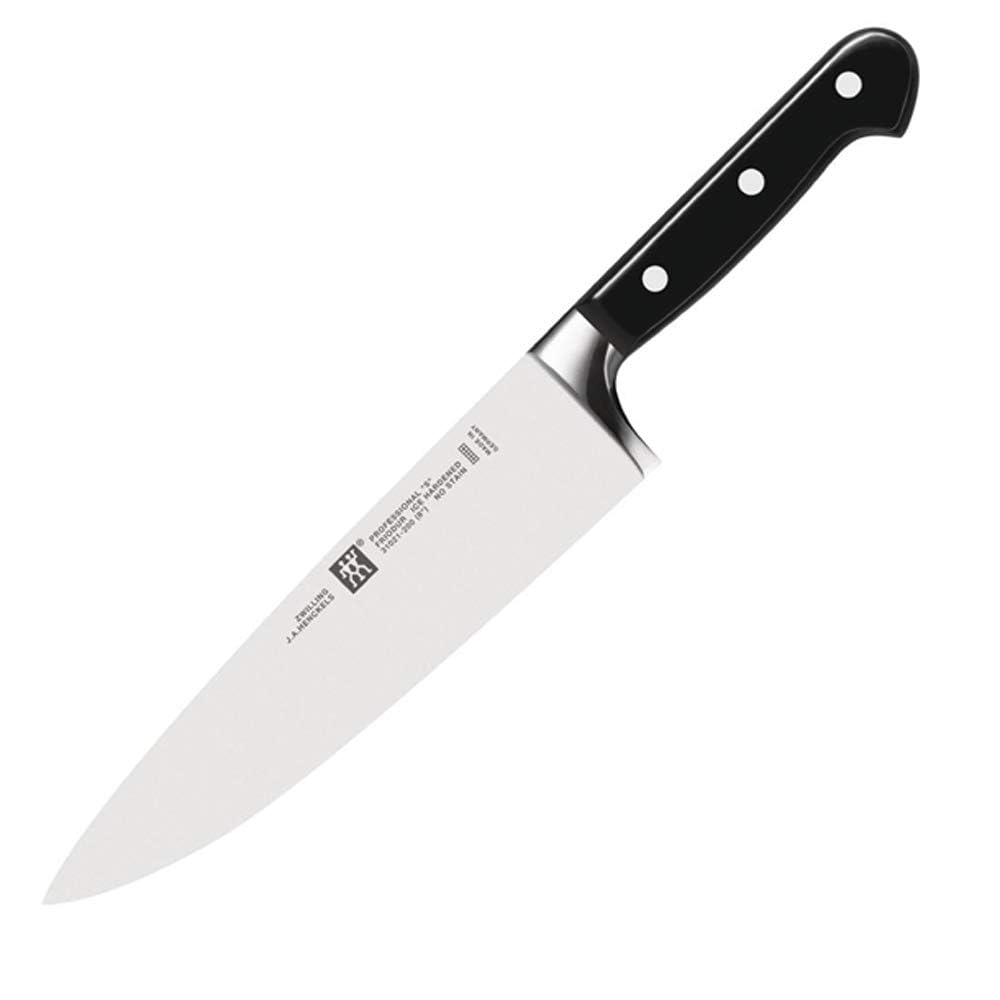
Zwilling Professional S 8-Inch Chef’s Knife — Sturdy daily workhorse
For cooks who want a sturdy German knife that can take daily abuse, this Zwilling is a dependable workhorse. Its special formula stainless steel, at about 57 HRC, is tough rather than brittle, so it tolerates busy kitchens, larger ingredients, and less-than-perfect technique better than thin Japanese blades. The full tang and full bolster give a solid, planted feel, while the triple-riveted handle suits a firm grip. It is heavier than Japanese rivals, and it still needs regular steeling, but for robust daily cooking it is a reassuring choice.
- Sturdy blade suits daily heavy prep
- Special formula steel resists staining
- Full bolster protects fingers
- Heavier than Japanese alternatives
- Needs a steel for upkeep
4.5/5
4.5/5
4.3/5

Victorinox Fibrox Pro 8-Inch Chef’s Knife — Sensible budget starter
For first-time buyers and budget-conscious cooks, this Victorinox is the most sensible entry point in the comparison. Its high-carbon stainless blade, at about 56 HRC, is easy to sharpen and forgiving to maintain, while the slip-resistant Fibrox handle stays secure even with damp hands. It will not hold an edge as long as premium Japanese steel, and its look is plain rather than premium, but for learning good habits, building confidence, and handling everyday meals, it delivers reliable performance without a large outlay for most home kitchens.
- Reliable edge for everyday cooking
- Slip-resistant handle improves grip
- Easy to sharpen and maintain
- Edge fades faster than premium steel
- Plain look lacks premium finish
4.3/5
4.4/5
4.5/5
Mercer Culinary Genesis 8-Inch Chef’s Knife — Forgiving beginner pick
For beginners who are still learning sharpening and knife care, this Mercer is a forgiving place to start. Its German high-carbon stainless blade is tough enough for everyday meals, while the ergonomic, triple-riveted handle helps new cooks hold a stable pinch grip. The weight is approachable rather than intimidating, so longer prep sessions feel manageable. It does need more frequent sharpening than harder steels, and abrasive boards will dull it faster, but as a first good knife it balances ease, control, and value very well for beginners.
- Forgiving edge for learning sharpening
- Comfortable handle for new cooks
- Good starter weight and balance
- Requires more frequent sharpening
- Edge dulls on abrasive boards
4.2/5
4.3/5
4.4/5

Dalstrong Gladiator Series 8-Inch Chef’s Knife — Confident heavy prep
For cooks who regularly tackle large, dense ingredients, this Dalstrong is the heaviest-duty option in the comparison. Its thick-spined, high-carbon German steel blade powers through squash, root vegetables, and larger cuts without feeling fragile, while the secure handle gives confidence during forceful work. It takes a keen edge readily, although that edge needs regular steeling to stay at its best. Smaller hands may find the weight tiring over long sessions, but for robust, high-volume prep in busy home kitchens it is a strong, confident choice.
- Thick spine powers through dense foods
- High-carbon steel takes sharp edge
- Bold handle gives secure grip
- Weight can tire smaller hands
- Edge needs regular steeling
4.1/5
4.3/5
4.2/5
Top 3 Head-to-Head: Wüsthof vs Shun vs Miyabi
These three are the common final choices because they cover the main trade-off: tough all-round use, the finest edge, and premium Japanese precision.
| Feature | #1 Wüsthof | #2 Shun | #3 Miyabi |
|---|---|---|---|
| Edge Retention | 4.9/5 | 5.0/5 — Best | 4.9/5 |
| Steel Quality and Durability | 5.0/5 — Best | 4.8/5 | 4.7/5 |
| Ease of Use and Maintenance | 4.8/5 — Best | 4.7/5 | 4.6/5 |
| Choose if… | You want one tough daily knife | You want the finest lasting edge | You want premium precise slicing |
Who These Chef Knives Are NOT For
A good chef knife is not a cleaver, a boning knife, or a frozen-food tool, even when its steel is excellent.
They are also not ideal if you will not hand wash, dry, and store the knife properly. A drawer, a dishwasher, and a glass board will dull even the best steel faster than normal cooking will.
Common Mistakes to Avoid
Most lost edge life comes from habits, not from choosing the wrong brand.
Frequently Asked Questions About Chef Knives for Edge Retention
What steel holds an edge longest for a chef knife?
SG2 and VG-MAX steels generally hold a fine edge longest among the knives in this comparison, because their high hardness resists wear during slicing. That advantage comes with a trade-off: very hard steel can chip on bones, frozen food, or twisting cuts. Tougher German high-carbon steel may need sharpening sooner, but it forgives everyday mistakes better. Choose hardness with your cutting habits in mind, not hardness alone.
How often should I sharpen a chef knife that holds its edge well?
There is no single calendar answer, because use, board choice, and storage matter more than time. Hone a regularly used knife weekly, and sharpen it when honing no longer restores easy tomato or onion slicing. For many home cooks, that means sharpening every few months, not every week. If you cook daily on a wood board and store the knife safely, a high-retention steel will stretch that interval further.
Is a Japanese or German chef knife better for edge retention?
Japanese knives usually win on pure edge retention, because they use harder steel and thinner edge angles. German knives usually win on toughness and forgiveness, because their steel is softer and their edges are wider. If you cut carefully and avoid bones, Japanese steel will stay sharp longer. If you want one knife for busy family cooking with less fuss, German steel is often the safer all-round choice.
Why does my chef knife dull quickly?
Most fast dulling comes from boards, washing, storage, and missing honing, rather than from a faulty knife. Glass or stone boards, dishwashers, and loose drawer storage all damage a fine edge. Abrasive scrubbing and cutting through bones also shorten edge life. As why a chef knife dulls quickly explains, fixing those habits usually restores much longer edge life without buying a new knife.
Does a higher HRC always mean better edge retention?
No, higher HRC usually means better wear resistance, but it does not guarantee better edge retention in real cooking. A very hard edge can chip, roll, or become difficult to sharpen, which can make it feel dull sooner. Steel composition, heat treatment, edge angle, and your cutting habits all affect the result. The best choice balances hardness with toughness and with how willing you are to maintain it.
How do I keep a new chef knife sharp for longer?
Hand wash and dry the knife after use, cut on wood or soft plastic, and store it in a block, strip, or sheath. Hone it regularly to realign the edge, and sharpen it only when honing stops restoring clean cuts. Avoid bones, frozen food, and twisting cuts with thin edges. These habits protect the factory edge and make the difference between a knife that stays sharp for weeks and one that dulls in days.
Our Final Verdict
Edge retention is mostly about steel, hardness, and care, not marketing. Harder Japanese steel stays sharp longest but needs gentler use, while tougher German steel forgives daily abuse. Choose the Wüsthof if you want one balanced knife for everyday cooking, and protect any edge with good boards, storage, and honing.