Why Your Chef Knife Dulls Quickly: Causes and Fixes
Quick Answer
A chef knife usually dulls quickly because of a damaging cutting surface, sideways pressure on the edge, an incomplete sharpening job, or steel that does not suit the task. Use a wood or suitable plastic cutting board, avoid scraping with the blade edge, maintain the knife correctly, and check whether sharpening actually removes the burr and restores a durable cutting edge.
If your chef knife cuts well immediately after sharpening but struggles with tomatoes or onions a short time later, the problem may be how the edge was sharpened or how it is used. Repeatedly sharpening the knife without identifying the cause can waste steel without solving the problem.
The most useful approach is to check the cutting surface and handling habits first, then examine the sharpening method and the knife’s steel. These checks help distinguish ordinary edge wear from a knife that never developed a stable, sharp edge in the first place.
Why Does a Chef Knife Lose Its Sharpness So Quickly?
A chef knife dulls when its thin cutting edge wears away, bends, rolls over, or develops tiny chips. The edge encounters resistance every time it cuts food and contacts the cutting board, so some deterioration is normal.
However, a knife that becomes noticeably dull after preparing just a few ingredients may have a maintenance or sharpening problem. The main causes are:
- Hard cutting surfaces: Glass, ceramic, stone, and metal can wear or damage the cutting edge rapidly.
- Sideways force: Twisting the blade, prying, or scraping food with the sharp edge can roll or chip it.
- Incomplete sharpening: A leftover wire burr can create temporary sharpness that disappears quickly.
- Unsuitable maintenance: An incompatible honing rod or overly aggressive sharpening technique may damage the edge.
- Steel and edge geometry: Some blades prioritize toughness, while others prioritize edge retention or fine cutting performance.
- Poor storage or cleaning: Contact with other utensils, corrosion, and dishwasher movement can damage the blade.
These causes can overlap. For example, a knife with a fragile edge may perform reasonably well on a forgiving wooden board but deteriorate rapidly when used on glass or ceramic.
1. Check Whether Your Cutting Board Is Damaging the Edge
 Save
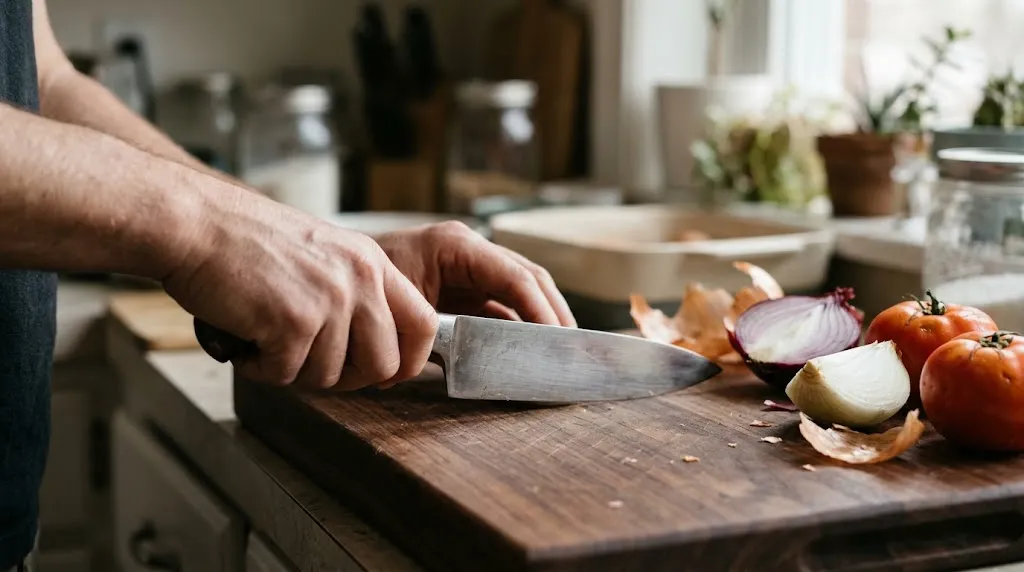
Your cutting board is one of the first things to investigate because the knife contacts it repeatedly during chopping. A hard, unyielding surface can accelerate edge wear even when your cutting technique is otherwise sound.
Choose wood or a suitable plastic board for routine food preparation. Both are generally more forgiving than glass, ceramic, marble, granite, or metal surfaces.
- Wood: A well-maintained hardwood board is a practical everyday choice for many chef knives.
- Plastic: A suitable food-grade plastic board is easy to clean and works well for everyday preparation, including raw meat when handled hygienically.
- Glass, stone, and ceramic: Avoid these for cutting because their hard surfaces can quickly damage a fine edge.
- Bamboo: Bamboo boards vary in construction and hardness. Some are harder on edges than softer wood boards, so they may not be the best choice if edge retention is your priority.
If your knife becomes dull after chopping on a glass board, switching to wood or suitable plastic is a more useful first step than buying another knife.
For a more detailed comparison, see our guide to which cutting board keeps knives sharp longer.
2. Stop Scraping, Twisting, and Forcing the Blade
Cutting technique affects how much stress reaches the edge. A chef knife is designed to slice and chop, not to pry objects apart or withstand repeated sideways force.
Scraping chopped food off the board
After chopping vegetables, it is tempting to drag the sharp edge sideways across the board to collect the pieces. This creates lateral stress that can roll or damage the edge over time.
Instead, turn the knife over and use its spine, or use a separate bench scraper, to move the ingredients. This small habit reduces unnecessary contact between the cutting edge and the board.
Twisting through hard ingredients
Cutting through dense food with a twisting motion can put more stress on a thin edge than a straight cut. For ingredients that resist the blade, use controlled strokes and an appropriate tool rather than forcing or rotating the knife inside the food.
Chopping with excessive impact
Repeatedly striking the board with unnecessary force increases edge impact. A controlled cutting motion is usually sufficient for ordinary vegetables, herbs, and boneless meat.
Do not use a chef knife to cut through bones, pry open containers, or perform tasks for which its blade was not designed. Those actions can damage the edge even if the knife has good steel and was sharpened correctly.
3. Find Out Whether Sharpening Is the Real Problem
If the knife becomes dull shortly after sharpening, pay close attention to the sharpening process. A blade can feel extremely sharp immediately afterward yet have an unstable edge that fails during normal cutting.
A leftover burr can create temporary sharpness
A burr is a thin lip of metal that forms along the edge during sharpening. If it is not properly removed, the knife may initially cut well because the burr is extremely thin. As it bends, breaks away, or folds over during use, the knife can suddenly feel dull.
This is different from normal wear on a properly finished edge. If the knife repeatedly loses its sharpness soon after sharpening, ask whether the process is removing the burr completely rather than simply creating an edge that feels sharp at first.
The sharpening angle may not suit the knife
An edge angle influences both cutting performance and durability. A very acute edge may cut with little resistance but can be less durable under demanding use. A more robust edge may withstand rougher handling but require slightly more force for some cuts.
There is no single angle that suits every chef knife. Follow the manufacturer’s recommendations when available instead of copying an angle intended for a different knife or steel type.
The sharpener may be too aggressive
Pull-through sharpeners can restore a cutting edge quickly, but abrasive designs and fixed angles differ. Excessive pressure or repeated unnecessary passes can remove more steel than needed and may leave an edge that performs poorly.
For a useful overview of tool selection and technique, read our guide on how to sharpen a chef knife.
Tip
If a freshly sharpened knife becomes dull unusually quickly, do not immediately repeat the same sharpening process. First check the cutting board, edge condition, sharpening angle, and whether a burr remains.
4. Understand the Difference Between Honing and Sharpening
Honing and sharpening solve different problems. Confusing the two can make a chef knife seem impossible to maintain.
- Honing: Helps maintain an edge that has become slightly misaligned. Depending on the tool, it may also remove a small amount of metal.
- Sharpening: Uses an abrasive to remove metal and recreate a functional cutting edge.
If the knife is only slightly less responsive than usual, appropriate honing may restore its performance. If the edge is worn, rounded, or damaged, honing alone will not restore its original cutting ability.
The maintenance tool must also suit the blade. A traditional grooved steel rod is not the right choice for every hard or brittle knife. Some knives are better maintained with a fine ceramic rod or whetstone, depending on the manufacturer’s guidance.
Use light, controlled strokes rather than forcefully striking the blade against a honing rod. If honing no longer improves cutting, sharpen the knife properly instead of continuing to hone it.
The official Victorinox guide to sharpening and honing explains how the two processes differ and why the appropriate maintenance method depends on the knife.
5. Check Whether the Knife’s Steel and Edge Design Suit Your Cooking
Some knives retain a sharp edge longer than others under similar conditions. Steel composition, heat treatment, hardness, blade thickness, and edge geometry all influence how a knife performs and how it responds to wear.
A knife made with relatively softer steel may be easier to maintain but can need more frequent edge maintenance. A harder blade may retain a fine edge well but can be less forgiving of twisting, impacts, or unsuitable honing tools.
Hardness alone does not determine edge retention. Two knives with similar hardness ratings can behave differently because their steel composition, heat treatment, and edge geometry are not identical.
Consider your normal workload, too. A chef knife used daily for large batches of vegetables experiences more cutting contact than one used occasionally for small meals. The same maintenance interval will not suit both users.
If your knife is new and repeatedly becomes dull after only a small amount of ordinary cutting, first rule out sharpening and handling problems. If those are addressed and the edge still fails unusually quickly, the knife’s edge geometry, steel condition, or manufacturing quality may deserve closer inspection.
6. Protect the Edge During Washing and Storage
 Save
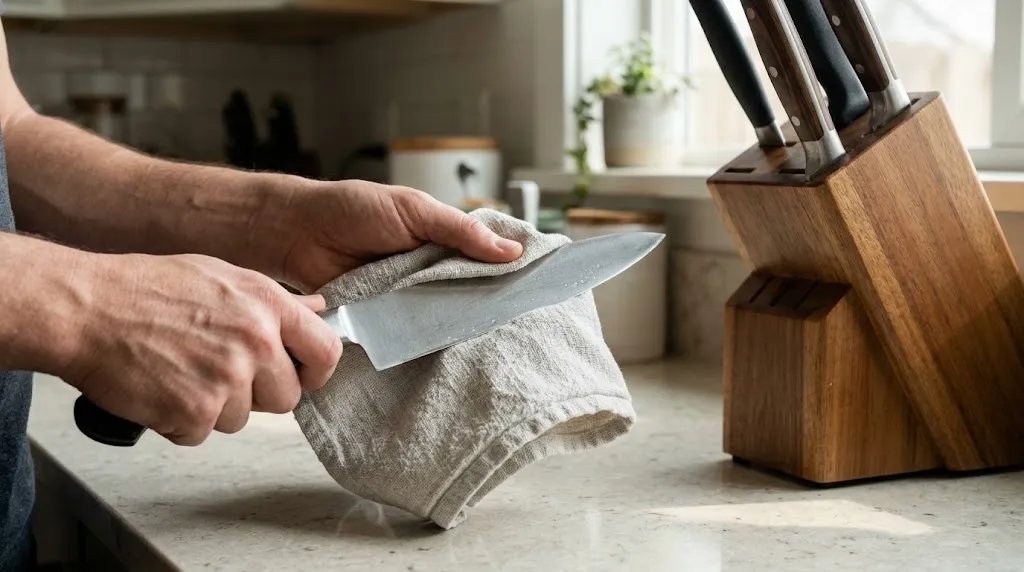
Cleaning and storage can damage an edge even when the knife is used carefully. A blade left loose in a drawer may strike other utensils, while a knife in a crowded sink can knock against cookware or other tools.
- Hand-wash the knife: Use ordinary dish soap and a non-abrasive sponge, keeping your fingers away from the cutting edge.
- Dry it promptly: This reduces corrosion, especially on carbon-steel blades.
- Store it securely: Use a suitable knife block, protective sheath, blade guard, or correctly installed magnetic strip.
- Avoid the dishwasher: Heat, detergent, moisture, and movement against other items can damage the blade or handle.
- Keep the edge away from other utensils: Do not toss a knife into a drawer where it can collide with metal tools.
These habits protect both the cutting edge and the person handling the knife. They are particularly important when a blade is sharp enough to cut cleanly with little pressure.
How to Troubleshoot a Chef Knife That Keeps Going Dull
Use the symptoms below to narrow down the likely cause before changing your maintenance routine.
| What you notice | Likely explanation | What to do |
|---|---|---|
| Dulls after chopping on glass | Hard board damages the edge | Switch to wood or suitable plastic |
| Sharp immediately after sharpening, dull soon afterward | Possible leftover burr or unstable edge | Review sharpening and deburring |
| Honing briefly improves cutting | Minor edge misalignment or wear | Use suitable honing; sharpen when needed |
| Visible chips or rough spots | Edge damage or excessive force | Stop forcing cuts and assess the damage |
| Blade deteriorates while stored | Contact damage or corrosion | Clean, dry, and protect the blade |
These are diagnostic clues rather than definitive tests. Several problems can produce similar symptoms, so change one variable at a time when possible.
A Simple Routine to Help Your Chef Knife Stay Sharp
You do not need to sharpen a knife after every meal. A consistent routine is more useful than repeatedly grinding the edge whenever cutting performance changes.
- Before cutting: Check that the board is stable and made from a suitable material.
- During preparation: Use controlled cuts, avoid twisting the blade, and move food with the spine or a bench scraper.
- After use: Wash by hand, dry promptly, and store the knife so its edge cannot strike other objects.
- When performance declines: Try suitable honing if the edge only needs maintenance.
- When honing stops helping: Sharpen using a method compatible with the blade, or use a qualified sharpening service.
- If the problem returns quickly: Recheck the cutting surface and sharpening result before repeating the process.
For further guidance on avoiding common mistakes, see our article on how to clean, sharpen, and maintain kitchen knives.
Related Product
Whetstone for Kitchen Knife Sharpening
A suitable whetstone can help restore a worn cutting edge with controlled sharpening. Choose a stone and technique appropriate for your knife’s steel and edge geometry.
As an Amazon Associate, we earn from qualifying purchases.
Frequently Asked Questions
How often should a chef knife need sharpening?
It depends on how frequently you cook, what you cut, the blade’s steel, and how you maintain it. A home cook may need full sharpening only occasionally, while frequent use can require it more often. Sharpen when appropriate honing no longer restores cutting performance.
Why does my knife cut tomatoes poorly after sharpening?
A possible cause is an incomplete sharpening job or a burr that folds over during use. The edge may also have been damaged by a hard board or unsuitable technique. Check the sharpening process and cutting surface before repeating the same sharpening method.
Does honing make a chef knife sharper?
Honing can improve cutting performance by correcting minor edge misalignment, and some honing tools also remove a small amount of metal. It cannot fully restore an edge that has become significantly worn or chipped; that generally requires sharpening or repair.
Is a wooden cutting board better for keeping knives sharp?
Wood is generally a knife-friendly cutting surface, particularly compared with glass, ceramic, or stone. A suitable plastic board is also a practical choice. The best option depends on the board’s construction, condition, cleaning needs, and your kitchen routine.
Can a chef knife be too sharp to last?
A very acute edge can be less durable under demanding use, depending on the steel and edge geometry. However, sharpness itself is not the problem. The goal is an edge that cuts effectively while remaining durable enough for your normal cutting tasks.
Should I replace a chef knife that dulls quickly?
Not immediately. First check the cutting board, handling habits, sharpening technique, and storage. If the knife still loses its edge unusually quickly after these problems are addressed, consider having its edge inspected before deciding whether replacement makes sense.
Conclusion
A chef knife that dulls quickly does not necessarily need replacing. Hard cutting surfaces, sideways pressure, poor sharpening technique, and an unstable edge can all shorten the time between sharpening sessions.
Start with the easiest changes: use a suitable cutting board, stop scraping with the sharp edge, wash and store the knife carefully, and distinguish honing from sharpening. If the blade becomes dull soon after a fresh sharpening, investigate the edge quality instead of repeatedly removing more metal.
Once you identify the actual cause, consistent maintenance should help your chef knife retain useful cutting performance for longer.

