Do Stainless Steel Cutting Boards Dull Knives? What You Should Know
Quick Answer
Yes, stainless steel cutting boards dull knives faster than most wooden or plastic boards. Their rigid surface doesn’t cushion the blade’s delicate cutting edge, which can cause faster edge wear, rolling, or occasional chipping. For everyday chopping, a knife-friendly wood or plastic board is usually the better option. The University of Maine’s cutting board guidance also explains why board materials affect knife performance.
What You Need to Know
- Faster dulling: Repeated contact with rigid steel puts extra stress on the knife’s thin edge.
- Possible edge damage: Thin, brittle blades may experience microscopic chips after repeated hard impacts.
- Easy cleaning: Smooth stainless steel is nonporous and generally simple to wash.
- Better alternatives: Maple, suitable plastic, and knife-friendly rubber boards reduce impact on the blade.
- Practical compromise: Use steel for suitable food-handling tasks and softer boards for frequent chopping.
My Recommendation
- Protect your knives: Choose a stable wooden or plastic cutting board for daily meal preparation.
- Keep surfaces clean: Wash boards thoroughly and separate raw meat preparation from ready-to-eat foods.
Stainless steel cutting boards look sleek, feel durable, and promise convenient cleaning. But I’ve found that choosing a cutting surface requires thinking about the knife, not just the board.
If you’re wondering whether stainless steel cutting boards dull knives, the answer deserves more than a simple yes. I’ll explain what happens to your blade, compare common materials, and help you choose a better cutting surface.
Why Do Stainless Steel Cutting Boards Dull Knives?
Stainless steel cutting boards can dull knives because they provide almost no cushioning when the blade strikes their surface. Each chopping motion places pressure on the extremely thin cutting edge.
Over time, that repeated pressure can bend, flatten, or damage the edge. Your knife may then struggle with foods it previously sliced easily.
What Happens When a Knife Hits Stainless Steel?
 Save
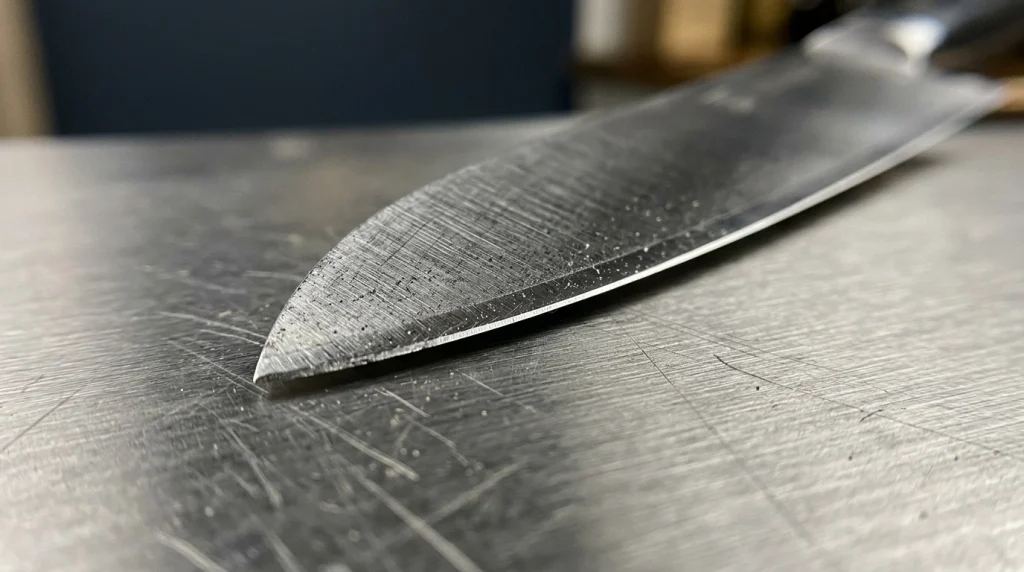
A sharp kitchen knife has a narrow edge called the edge apex. This is the tiny point where the two sides of the blade meet.
The apex does most of the cutting. Its thin structure also makes it vulnerable to impact and sideways force.
- Edge rolling: Part of the thin edge bends sideways, reducing cutting efficiency.
- Edge flattening: Repeated impacts can gradually round the sharpest part of the blade.
- Microchipping: A small fragment may break from a hard, thin, brittle edge.
- Abrasive wear: Contact and friction gradually change the edge’s shape.
These effects don’t necessarily appear after one meal. They become more noticeable when the same knife repeatedly strikes a hard cutting surface.
Is Stainless Steel Harder Than a Kitchen Knife?
Not necessarily. Many hardened kitchen knives are harder than the stainless steel used in cutting boards.
However, hardness alone doesn’t determine whether a surface dulls a blade. The amount a surface yields under impact matters too.
Wood fibers and suitable plastics can deform slightly during cutting. Stainless steel offers much less cushioning.
Think of tapping a thin metal edge against a wooden block versus another rigid metal object. The second contact generally creates a more concentrated impact.
Does Knife Steel Hardness Make a Difference?
Yes, a knife’s steel, hardness, edge angle, and thickness influence how it responds to cutting-board contact. Different knives may show different types of damage.
- Softer knife edges: May roll or lose sharpness under repeated impact.
- Harder knife edges: Often resist deformation but may be more vulnerable to chipping.
- Thin cutting edges: Can experience greater localized stress.
- Thicker edges: Generally tolerate rougher contact but still experience wear.
A premium knife isn’t automatically protected from a metal board. In fact, some finely ground blades deserve extra care.
Stainless Steel vs. Wood vs. Plastic: Which Cutting Board Is Better for Knives?
 Save
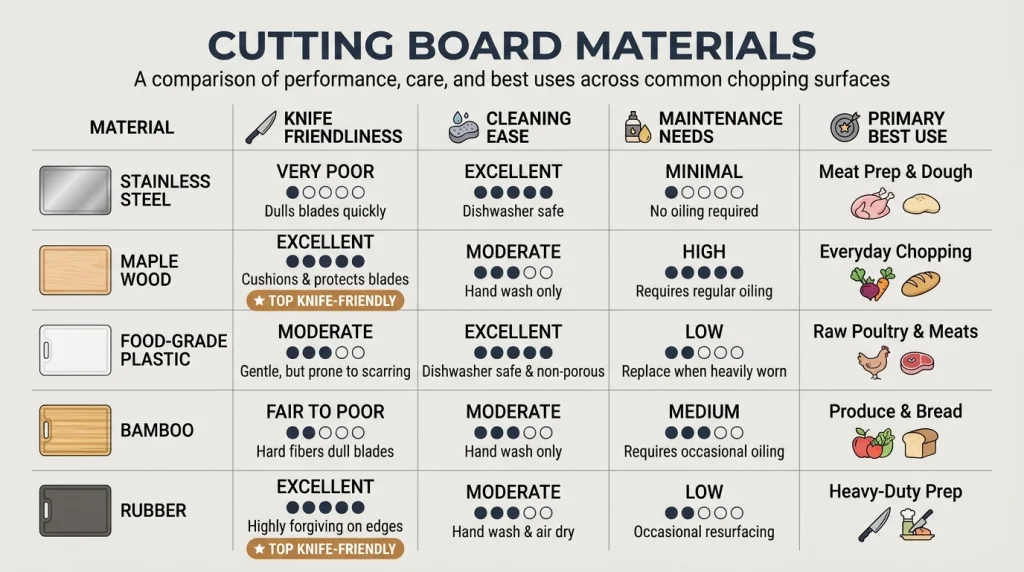
For preserving knife sharpness, wood and suitable plastic generally outperform stainless steel. Rubber boards designed for knife work are another strong choice.
Each material has different strengths. The best decision balances edge protection, cleaning, maintenance, and daily convenience.
| Board Material | Knife Friendliness | Cleaning | Best Use |
|---|---|---|---|
| Stainless steel | Poor for repeated chopping | Easy to wash; check dishwasher instructions | Limited cutting and washable prep surfaces |
| Maple wood | Very good | Hand washing and periodic care | Daily chopping and slicing |
| Food-grade plastic | Good | Many models are dishwasher safe | Everyday prep and raw meat handling |
| Bamboo | Fair to good; varies by construction | Usually hand wash | General kitchen preparation |
| Knife-friendly rubber | Excellent | Follow manufacturer instructions | Precision knife work |
| Glass or marble | Poor | Generally easy to clean | Serving rather than repeated knife work |
Comparison note: Knife friendliness is a qualitative assessment, not a measured dulling-rate test. Individual products and cutting techniques can change the outcome.
Why Wooden Cutting Boards Are Better for Sharp Knives
Wood provides a more forgiving surface during chopping. Common hardwood choices include maple, walnut, and cherry.
Maple is especially popular because it balances durability with useful cutting performance. A well-maintained board can serve as an everyday kitchen work surface.
- Offers some cushioning during blade contact.
- Provides a comfortable chopping feel.
- Works well for vegetables, herbs, and general slicing.
- Can last many years with suitable care.
Wood requires regular cleaning and thorough drying. Some boards also benefit from occasional treatment with food-grade mineral oil.
Are Plastic Cutting Boards Easier on Knives?
Most quality kitchen plastic boards are gentler on knives than stainless steel. Their cutting surfaces allow some deformation when the blade makes contact.
Plastic also offers a practical advantage for raw food preparation. Many models can go into the dishwasher, according to their manufacturers.
However, plastic boards eventually collect scratches and grooves. Replace them when damage becomes difficult to clean.
What About Bamboo, Glass, and Marble?
Bamboo boards can work for ordinary kitchen tasks, although their hardness and construction vary. Some feel less forgiving than traditional wooden boards.
Glass and marble are poor choices for frequent chopping. These rigid surfaces provide little cushioning and can accelerate knife-edge wear.
I prefer using decorative stone or glass surfaces for serving. They’re not my first choice for knife-intensive meal preparation.
Can Stainless Steel Cutting Boards Damage Expensive Knives?
Yes. Stainless steel cutting boards can contribute to edge damage on expensive knives, particularly thin blades designed for precision slicing.
The risk depends on the knife and how it’s used. A single light cut isn’t equivalent to repeated forceful chopping.
Are Japanese Knives More Vulnerable?
Some Japanese-style kitchen knives use hard steel and very thin cutting geometry. Those features can produce excellent cutting performance but may increase sensitivity to hard impacts.
Repeated contact with steel can raise the risk of microchipping. I would choose a suitable wood or rubber surface for delicate Japanese blades.
What About German Chef’s Knives?
Many German-style chef’s knives have comparatively sturdy cutting geometry. They may tolerate occasional hard contact better than extremely thin blades.
That doesn’t make stainless steel an ideal cutting surface. A forgiving board still offers a better environment for routine chopping.
Can Stainless Steel Boards Ruin Ceramic Knives?
Ceramic knife edges are hard but brittle. Contact with rigid cutting surfaces may increase the risk of chips, especially with twisting or sideways pressure.
Use an appropriate wooden or plastic board instead. Avoid chopping bones, frozen foods, or other hard objects with ceramic knives.
How Quickly Does a Stainless Steel Cutting Board Dull a Knife?
There’s no reliable universal number of cuts or days before a knife becomes dull on stainless steel. Wear depends on the blade, cutting technique, food, and frequency of use.
A person making a few gentle cuts will experience different wear from someone chopping vegetables for an hour. Published knife-edge durability comparisons also don’t justify one fixed sharpening schedule for every home cook.
What Affects the Rate of Dulling?
- Knife steel: Steel composition and heat treatment affect wear resistance and toughness.
- Edge geometry: Thin edges may respond differently from thick, sturdy edges.
- Cutting force: Heavy chopping produces stronger impacts.
- Cutting technique: Twisting, dragging, and scraping can stress the edge.
- Usage frequency: Daily cooking creates more contact cycles than occasional preparation.
- Board condition: Rough, scratched, or uneven surfaces may increase undesirable contact.
Signs Your Knife Is Losing Sharpness
You don’t need a laboratory instrument to notice declining cutting performance. Common changes become visible during familiar kitchen tasks.
- A knife slides across tomato skin instead of cutting smoothly.
- Chopping onions requires more downward pressure.
- Herbs become bruised or crushed instead of cleanly sliced.
- The edge catches or feels uneven during careful inspection.
- Thin ingredients tear more often than before.
These signs don’t prove the board caused the wear. They indicate that your knife may need inspection, honing, or sharpening.
Are Stainless Steel Cutting Boards More Hygienic Than Wood?
Stainless steel has a nonporous surface that’s relatively easy to wash and sanitize. However, that doesn’t automatically make every steel board safer than every wooden or plastic board.
Effective cleaning, food separation, and proper drying matter more than appearance alone. A neglected nonporous surface can still transfer harmful microorganisms.
Advantages of Stainless Steel for Cleaning
- Its smooth surface doesn’t absorb food juices like porous materials can.
- It generally resists lingering food odors.
- It can tolerate regular washing when properly manufactured.
- Food residue is often easy to see and remove.
- Many solid stainless steel products are compatible with thorough sanitizing procedures.
For dishwasher use, check the product instructions. Hybrid boards with rubber, adhesives, or other components may have different care requirements.
Does Nonporous Mean Bacteria-Free?
No. Nonporous surfaces can still carry bacteria after contact with raw meat, poultry, or seafood.
The USDA Food Safety and Inspection Service recommends cleaning cutting boards thoroughly and separating foods to reduce cross-contamination.
For food safety, maintain at least two dedicated cutting surfaces. Reserve one for raw animal products and another for produce or ready-to-eat foods.
How Should You Clean a Stainless Steel Cutting Board?
- Remove food debris: Clear away scraps immediately after preparation.
- Wash thoroughly: Use warm or hot water and dish soap.
- Rinse: Remove soap and remaining food residue.
- Sanitize when needed: Follow a food-contact-safe sanitizer’s instructions, particularly after raw animal products.
- Dry completely: Prevent standing water and keep the surface ready for storage.
- Inspect regularly: Check for rough edges, deep damage, or deteriorating attachments.
The Academy of Nutrition and Dietetics’ cutting board safety guidance provides more information about cleaning and preventing cross-contamination.
How Can You Prevent Knife Damage When Using a Stainless Steel Board?
The most effective way is to perform frequent cutting on a softer, knife-friendly surface. If you still use stainless steel, limit impact and avoid aggressive techniques.
These precautions reduce unnecessary stress, although they can’t make a metal surface as forgiving as wood.
1. Use Gentle Cutting Movements
Choose controlled slicing instead of forceful chopping. Keep the movement smooth and avoid slamming the blade into the board.
2. Avoid Scraping with the Cutting Edge
Dragging a sharp edge sideways across steel adds unnecessary stress. Turn the knife and use its spine to move chopped food, when safe.
A separate food scraper works even better. It also keeps your fingers away from the cutting edge.
3. Protect Thin or Delicate Blades
Reserve high-performance slicing knives for wooden or suitable rubber boards. Avoid using delicate blades for heavy chopping on metal.
4. Keep the Board Stable
Make sure the cutting surface doesn’t slide while you work. Choose a board with effective non-slip feet or use an appropriate stable mat underneath.
Board movement creates an immediate safety concern. Fix that problem before cutting anything.
5. Maintain Your Knife Properly
Inspect your knife regularly and sharpen it when cutting performance declines. Use a sharpening method suitable for the blade’s steel and edge geometry.
Honing may help straighten some rolled edges. It won’t reliably repair chips or restore a heavily worn bevel.
Is a Stainless Steel Cutting Board Worth Buying?
A stainless steel cutting board can be useful if you prioritize a durable, nonporous prep surface. But I wouldn’t choose it as my only cutting board.
The main compromise is simple: convenient cleaning comes with a less forgiving cutting surface. That trade-off matters when you regularly use sharp kitchen knives.
Reasons You Might Want One
- You prefer a nonporous food preparation surface.
- You want a board that doesn’t absorb liquids.
- You need a washable surface for selected kitchen tasks.
- You appreciate stainless steel’s resistance to ordinary moisture and staining.
- You already own a knife-friendly board for regular chopping.
Reasons to Choose Something Else
- You use expensive or thin-bladed knives.
- You chop vegetables and herbs frequently.
- You want to minimize sharpening and edge maintenance.
- You prefer a quieter cutting experience.
- You want a forgiving surface for long preparation sessions.
Stainless steel can also produce noticeable noise during chopping. Depending on its design, the board may feel slippery compared with textured wood or plastic.
What Is the Best Cutting Board Setup for a Home Kitchen?
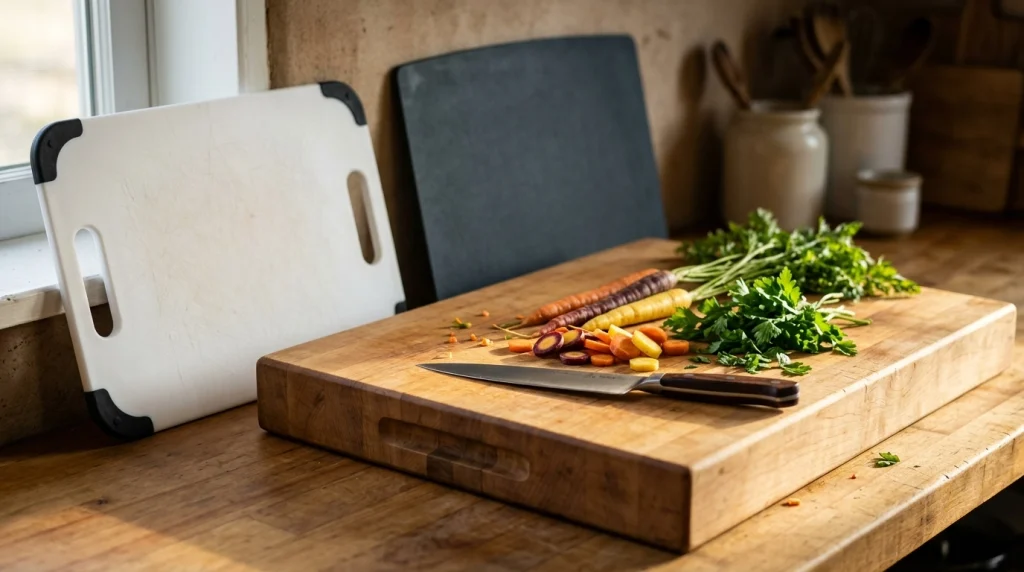
For many households, combining a wooden board with a washable plastic board offers a practical balance. This setup protects knives while making food separation easier.
I would build a basic kitchen arrangement around these two roles:
- Wooden board: Use for vegetables, herbs, bread, and regular knife work.
- Plastic board: Reserve for raw meat, poultry, or seafood, and clean thoroughly afterward.
- Optional steel board: Use for selected prep or serving tasks rather than constant chopping.
Dedicated boards reduce opportunities for cross-contamination. However, each board still needs cleaning and sanitizing when appropriate.
What Features Matter Most When Shopping?
Before buying, focus on the details that affect comfort, hygiene, and knife performance. A board should fit your work area and remain stable.
- Surface material: Choose wood, suitable plastic, or knife-friendly rubber for frequent cutting.
- Board size: Allow enough room for safe knife movements and food separation.
- Stability: Look for non-slip feet or a secure base.
- Maintenance: Match washing requirements to your routine.
- Construction: Inspect joints, surfaces, and edges for easy cleaning.
- Replacement needs: Consider how the material handles wear over time.
Recommended Cutting Boards That Are Gentler on Knives
 Save
If you’re replacing a stainless steel cutting board, these three established models offer alternatives for different kitchen needs. I’ve selected them based on their materials, practical features, and manufacturer information rather than claiming personal hands-on testing.
Affiliate disclosure: I may earn a commission from qualifying purchases made through the Amazon links below, at no additional cost to you.
🏆 Best for Everyday Chopping
John Boos Reversible Maple Cutting Board
★★★★☆ 4.8/5
This solid maple board provides a traditional wooden cutting surface for everyday meal preparation. Its reversible construction makes it a versatile option for vegetable and general knife work.
It’s my preferred category for protecting a quality chef’s knife, provided you’re comfortable with hand washing and wood maintenance.
💰 Best Easy-Clean Option
OXO Good Grips Utility Cutting Board
★★★★☆ 4.7/5
This double-sided plastic board features non-slip feet, a drip-catching groove, and dishwasher-safe construction. Its forgiving surface makes it a practical alternative to stainless steel.
I like this option for households that prioritize simple cleaning. Its stable design and washable material are especially useful for daily food preparation.
🍳 Best Lightweight Composite
Epicurean Kitchen Series Cutting Board
★★★★☆ 4.5/5
Epicurean’s Kitchen Series uses a durable paper-composite material with a thin, lightweight profile. The manufacturer describes it as knife-friendly and dishwasher safe.
I’d consider this board when storage space and convenient cleaning matter most. Its firmer feel may be less appealing than traditional wood for some knife users.
Rating note: The scores above are editorial suitability assessments for this article, not verified customer ratings or laboratory test results. Product specifications and availability may change.
Frequently Asked Questions
Do stainless steel cutting boards dull knives faster than wooden boards?
Yes. Stainless steel cutting boards generally dull knives faster than suitable wooden boards because steel doesn’t cushion the cutting edge as effectively. Repeated impacts can cause rolling, flattening, or microchipping. Maple and other appropriate hardwood boards are usually better choices for everyday chopping and preserving knife sharpness.
Can I use a stainless steel cutting board with a Japanese knife?
You can, but it isn’t recommended for regular cutting. Many Japanese-style knives have thin, hard edges that may be more susceptible to microchipping against rigid surfaces. A suitable wooden or rubber cutting board offers a more forgiving contact surface and better protection for delicate blades.
Are stainless steel cutting boards safe for food preparation?
Food-grade stainless steel cutting boards can be suitable for food preparation when properly manufactured, cleaned, and maintained. Their nonporous surfaces make washing convenient. However, bacteria can still remain on contaminated surfaces, so thorough cleaning, appropriate sanitizing, and separation of raw and ready-to-eat foods remain essential.
What cutting board material keeps knives sharp the longest?
Knife-friendly rubber and suitable hardwood boards are strong options for preserving sharp edges. Maple is a popular everyday choice because it offers a forgiving surface and good durability. Actual edge retention still depends on knife steel, blade geometry, cutting technique, board construction, and maintenance.
Is a stainless steel cutting board better than plastic?
Stainless steel offers a durable, nonporous surface, while suitable plastic is generally gentler on knife edges. Many plastic boards are also dishwasher safe, although worn boards need replacement. For frequent chopping, plastic usually offers the better balance of blade protection, cleaning convenience, and affordability.
Final Verdict: Should You Avoid Stainless Steel Cutting Boards?
Stainless steel cutting boards aren’t necessarily bad kitchen products, but they aren’t ideal for preserving knife sharpness. Their rigid surfaces can accelerate edge wear compared with more forgiving alternatives.
For daily chopping, I’d choose a well-made wooden or plastic board. Both offer a better balance of knife protection and practical food preparation.
If you already own a stainless steel board, there’s no need to throw it away. Use it for suitable preparation tasks and keep a softer board available for your sharp knives.
My final recommendation: Prioritize a stable, easy-to-clean cutting surface that protects your knife’s edge. Your board should make cooking easier without creating unnecessary sharpening work.
Before your next cutting board purchase, compare the material, maintenance requirements, and how often you use your knives. A thoughtful choice can improve both everyday cooking comfort and long-term blade care.

