Chef Knife vs Gyuto: Key Differences and Which One Should You Choose?
Quick Answer
A gyuto is the Japanese version of a chef’s knife, designed for the same everyday jobs: slicing vegetables, preparing boneless meat, cutting fish, and mincing herbs. Compared with many Western chef’s knives, a gyuto has a thinner blade, harder steel, and a somewhat flatter cutting profile. Choose a gyuto for precise cutting and edge retention, or a Western chef’s knife for a familiar rocking motion and forgiving everyday handling.
Which knife suits your cooking style?
- Precision cutting: A thin gyuto can move through vegetables and boneless proteins with less wedging.
- Rock chopping: A more curved Western chef’s knife suits cooks who pivot the blade across the board.
- Low maintenance: A stainless-steel knife is convenient, although its construction still determines proper care.
- Long edge life: Many gyutos use harder steel that holds a fine edge well but needs careful handling.
- Best starting size: An approximately 200–210 mm blade is a practical starting point for many home cooks.
One important safety rule
- Use either knife on a suitable cutting board, and never chop bones or frozen food with a thin gyuto unless the maker specifically permits that use.
Choosing between a chef knife and a gyuto can feel confusing because both are designed to handle most everyday kitchen preparation.
I’ll explain where these knives differ, which cutting techniques suit each shape, and what to consider before spending money on either one. The goal is to match the knife to your cooking habits, not simply choose the one with the more impressive name.
What Is the Difference Between a Chef Knife and a Gyuto?
A gyuto is a Japanese-style chef’s knife, so the comparison usually means a gyuto versus a Western-style chef’s knife. The biggest differences involve blade thickness, edge geometry, steel hardness, and the amount of curve along the cutting edge.
Neither category guarantees a particular performance level. Individual models can differ considerably, and a well-designed knife matters more than its country of origin alone.
| Feature | Gyuto | Western chef’s knife |
|---|---|---|
| Origin and style | Japanese chef’s knife tradition | Western chef’s knife tradition |
| Blade profile | Often flatter through the middle | Often has a more pronounced curve |
| Blade construction | Frequently thin behind the edge | May have a thicker, more substantial profile |
| Steel | Often harder Japanese stainless or carbon steel | Commonly stainless steel, with hardness varying by model |
| Cutting technique | Push cuts, slicing, and controlled rocking | Rock chopping, slicing, and general chopping |
| Edge durability | Thin, hard edges may chip under lateral stress | Many softer, thicker models better tolerate rough handling |
| Maintenance | Often benefits from careful whetstone sharpening | Sharpening method depends on its steel and edge |
These are general design tendencies, not universal specifications. Some Western knives are thin and hard, while some gyutos are heavier or use relatively forgiving steels.
What Is a Gyuto Knife?
A gyuto is a Japanese all-purpose kitchen knife used to cut meat, fish, vegetables, and herbs. Its name is commonly translated as “beef sword,” reflecting its association with cutting meat.
The design developed as Japanese cooks adopted and adapted Western-style chef’s knives. Today, gyutos come in different blade lengths, steel types, grinds, and handle styles.
What makes a gyuto different?
- Pointed tip: Useful for detailed cuts, trimming, and working around smaller ingredients.
- Relatively thin blade: Helps reduce resistance when cutting through many foods.
- Moderate curve: Supports slicing and some rocking motions without making the entire edge highly curved.
- Harder steel in many models: Can help the edge remain sharp longer, depending on the steel and geometry.
- Different handle options: Traditional Japanese-style handles and Western-style handles are both available.
A gyuto is not limited to Japanese cooking. It works well for preparing onions, carrots, potatoes, boneless chicken, fish fillets, and many other everyday ingredients.
How Does a Western Chef’s Knife Differ From a Gyuto?
A Western chef’s knife often emphasizes a familiar curved cutting edge and a durable, versatile construction. Many traditional German-style models use relatively tough steel and a substantial blade, although French-style and modern Western knives can have very different profiles.
These characteristics make a conventional Western chef’s knife appealing to cooks who prefer rocking motions or want a knife that tolerates ordinary kitchen mistakes better.
Key features of a Western chef’s knife
- Curved cutting edge: Helps the blade pivot against the board during rock chopping.
- Substantial construction: Some models provide extra blade mass for a solid cutting feel.
- Familiar balance: Many cooks find a Western handle and bolster comfortable to use.
- Versatile steel options: Stainless and carbon-steel versions are available.
- Broad availability: You can find Western chef’s knives across many price ranges and sizes.
However, a Western knife is not automatically heavier, duller, or less precise than a gyuto. Thin Western knives can cut exceptionally well, and the actual model should guide your decision.
Which Knife Cuts Better: a Gyuto or a Chef’s Knife?
 Save
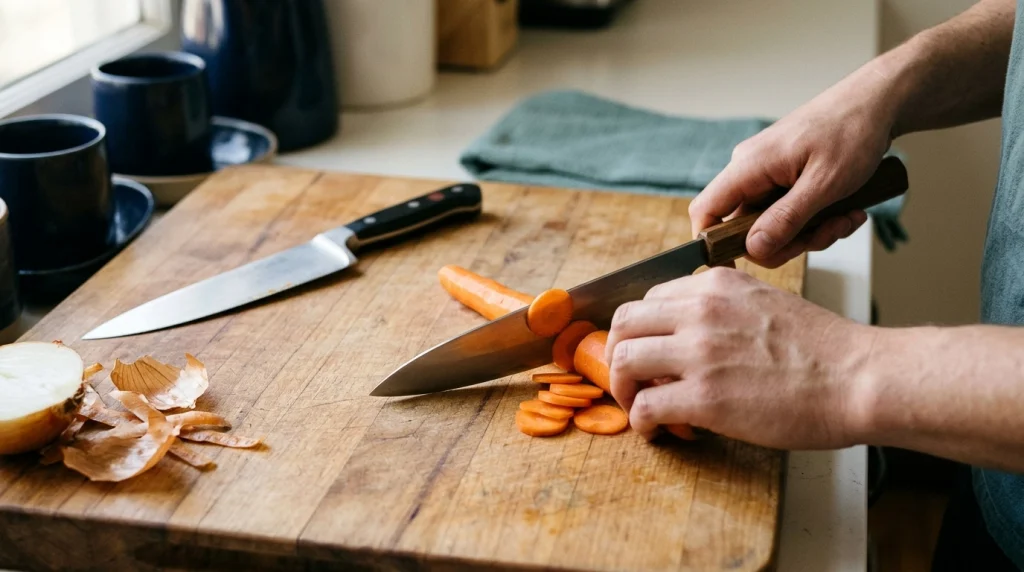
A thin, well-sharpened gyuto often cuts with less resistance than a thicker Western chef’s knife. However, sharpness alone doesn’t determine cutting performance; blade geometry, edge condition, and technique also matter.
Consider cutting a firm carrot into thin rounds. A thin blade can pass through the carrot with less wedging, while a thicker blade may push the cut surfaces apart more noticeably.
That difference becomes especially relevant when preparing large quantities of vegetables or making precise slices. Still, a sharp Western knife with good geometry can deliver excellent results.
Why blade geometry matters
Blade geometry describes the shape and thickness of the blade as it approaches the cutting edge. Two knives can have equally sharp edges but feel very different because one blade is much thicker behind its edge.
A thin blade generally creates less resistance as it travels through food. The trade-off is that a very thin edge may tolerate twisting, hard impacts, and lateral pressure less effectively.
- For thin vegetable slices: A thin gyuto can make controlled cuts with less wedging.
- For boneless meat: Both knife types work well when sharp and properly maintained.
- For herbs: Either knife can mince efficiently with suitable technique.
- For dense ingredients: Blade thickness and wedging matter, but neither knife should be forced through food.
Don’t assume that a higher price or a harder steel automatically means better cutting. A well-ground, sharp, appropriately maintained knife can outperform a more expensive knife with unsuitable geometry.
Is a Gyuto Better for Push Cutting or Rock Chopping?
A gyuto’s relatively flat middle section often suits push cutting, where you move the blade forward and down through an ingredient. A Western chef’s knife with a more pronounced curve often feels more natural for rock chopping.
Both knives can handle more than one technique. The shape simply influences which motion feels comfortable and keeps more of the edge in contact with the board.
Push cutting with a gyuto
During a push cut, the knife moves forward and downward rather than pivoting repeatedly on a single section of its edge. This motion works particularly well for many vegetables and boneless proteins.
A flatter profile can provide useful board contact during this movement. It also helps cooks who prefer straight, controlled strokes.
Rock chopping with a chef’s knife
Rock chopping uses the curved belly of the blade as a pivot point. The tip or front portion stays close to the board while the heel rises and falls during the cut.
This method can be comfortable for mincing herbs, garlic, and other ingredients. A strongly curved blade usually makes the motion easier, but practice and personal preference still matter.
Which technique should you choose?
- Choose a gyuto if you prefer forward slicing and controlled push cuts.
- Choose a more curved chef’s knife if rocking is your natural cutting motion.
- Try both techniques safely if you’re unsure which feels better.
- Keep your fingertips tucked away from the cutting edge and use a stable board.
Your technique matters more than following a particular knife trend. The right knife should support the way you work rather than force you to relearn every cutting motion.
Does a Gyuto Hold Its Edge Longer Than a Chef’s Knife?
Many gyutos use harder steel and relatively fine edges, which can provide good edge retention during ordinary food preparation. However, the result depends on the specific steel, heat treatment, edge geometry, ingredients, and cutting surface.
Steel hardness is commonly expressed using the Rockwell C hardness scale, abbreviated as HRC. A higher HRC value indicates greater resistance to indentation, but it does not measure every aspect of knife performance.
Hardness versus toughness
Hardness and toughness describe different properties. Hardness relates to resistance to indentation and deformation, while toughness describes the ability to withstand impacts without cracking or chipping.
A harder edge can resist rolling and retain a fine cutting profile, but some hard, thin edges are less tolerant of misuse. Softer steel may deform more readily instead of chipping, although its exact behavior depends on the blade’s construction.
| Property | What it means | Why it matters |
|---|---|---|
| Hardness | Resistance to indentation | Can support a stable, fine edge |
| Toughness | Resistance to cracking and chipping under impact | Matters when the knife experiences accidental stress |
| Edge retention | How well the edge maintains useful sharpness | Affects how often you need to sharpen |
| Corrosion resistance | Resistance to rust and corrosion | Influences cleaning, drying, and storage needs |
These properties are related, but none should be used as a substitute for the others. A knife’s steel, grind, and intended use must work together.
Which Knife Is Easier to Maintain?
A Western chef’s knife can be easier to maintain if its steel tolerates your preferred sharpening method and everyday handling. A gyuto can also be straightforward to care for, especially when it uses stainless steel and you follow the maker’s recommendations.
The biggest difference is often the care you’re willing to provide. A thin, hard gyuto rewards controlled cutting and careful sharpening, while many traditional Western knives tolerate rougher use.
How to care for a gyuto
- Wash by hand: Use mild dish soap and water after food preparation.
- Dry immediately: Don’t leave the blade wet, even if it’s stainless steel.
- Use a suitable board: Wood and suitable soft synthetic boards are generally gentler on edges than glass, stone, or ceramic.
- Sharpen appropriately: Use a whetstone or a qualified sharpening service suited to the knife’s geometry.
- Store safely: Protect the edge with a knife guard, suitable block, sheath, or secure magnetic storage.
Carbon-steel gyutos need extra attention because they can rust when left wet or exposed to acidic ingredients. Stainless-steel models resist corrosion better, but they’re not completely immune to damage.
How to care for a Western chef’s knife
- Clean the blade after use and dry it before storage.
- Sharpen it when cutting performance declines.
- Use a honing tool only when it suits the steel and edge construction.
- Keep the cutting edge away from other utensils and hard surfaces.
- Follow the manufacturer’s instructions for cleaning and storage.
Some Western knives are dishwasher-safe according to their manufacturers, but hand washing and immediate drying remain sensible habits for preserving the edge and handle. Never assume that every knife can safely go into a dishwasher.
Can You Use a Gyuto for Everyday Cooking?
Yes. A gyuto is designed as an all-purpose kitchen knife, so it can handle many of the same tasks as a Western chef’s knife.
Its versatility makes it useful for home cooks who prepare varied meals and want one primary knife rather than a large collection of specialized blades.
- Vegetables: Slice onions, dice peppers, chop cabbage, and prepare carrots.
- Boneless meat: Portion chicken, trim tender meat, and slice cooked roasts.
- Fish: Cut boneless fillets and portion suitable pieces.
- Herbs: Mince parsley, cilantro, and other fresh herbs.
- Fruit: Slice apples, pears, and other firm fruit on a stable board.
A gyuto is not a replacement for every kitchen knife. A serrated bread knife, paring knife, boning knife, or heavy cleaver may be more appropriate for specific jobs.
Never use a thin gyuto to split bones, cut through frozen food, or force its edge through hard pits. Those tasks can damage the blade and create a safety risk.
What Size Gyuto or Chef’s Knife Should You Choose?
Blade length affects reach, control, and how much cutting-board space you need. Many home cooks start with a knife around 200–210 mm, while shorter and longer options suit different kitchens and preferences.
| Approximate blade length | Potential advantage | Consideration |
|---|---|---|
| 180 mm | Compact and easier to maneuver in smaller workspaces | Less reach for large ingredients |
| 200–210 mm | A versatile everyday size | Requires enough board space for comfortable strokes |
| 240 mm | Longer slicing strokes and greater reach | May feel cumbersome on a small board |
These are practical size categories rather than strict rules. Hand size, cutting technique, counter space, and comfort all influence the best choice.
If possible, hold the knife before purchasing it. A balanced 180 mm blade may suit you better than a 240 mm model, even if the longer knife offers more reach.
What Should You Look for When Buying a Gyuto or Chef’s Knife?
Focus on the features that affect daily use instead of paying extra for appearance alone. Steel, blade geometry, handle comfort, and ease of sharpening are more important than decorative finishes.
1. Choose stainless or carbon steel
Stainless steel is a sensible starting point for many home cooks because it requires less attention to corrosion. Carbon steel can offer excellent cutting performance and straightforward sharpening, but it needs more careful cleaning and drying.
Neither type guarantees superior performance. Heat treatment, blade design, and maintenance matter just as much.
2. Check the blade profile
Look at the cutting edge rather than relying solely on the product description. A flatter profile may suit push cutting, while a more curved edge may feel better for rocking motions.
3. Consider the handle
Japanese-style handles often differ in shape and weight from familiar Western handles. Choose the one that feels secure and comfortable with your preferred grip.
4. Evaluate sharpening requirements
Before buying a hard-steel gyuto, consider whether you’ll maintain it yourself or use a professional sharpening service. A knife that stays sharp but is difficult for you to maintain may not be the most practical choice.
5. Match the knife to your budget
A premium knife can offer refined finishing, a particular steel, or a preferred balance. It doesn’t automatically cut better than every affordable alternative.
Set a budget that includes a suitable cutting board and a way to maintain the edge. Those supporting choices can make a meaningful difference to everyday performance.
Which Knife Is Better for Beginners?
A Western chef’s knife is often the easier starting point for someone who wants a versatile, forgiving kitchen tool with familiar handling. A stainless-steel gyuto can also suit beginners who are comfortable using controlled cutting techniques and learning basic knife care.
There’s no need to master Japanese knife techniques before using a gyuto. Start with simple cuts, keep the blade sharp, and avoid twisting the edge inside food.
- Choose a Western chef’s knife if you want familiar handling and tend to use a rocking motion.
- Choose a stainless gyuto if you value a thin cutting profile and are willing to handle the knife carefully.
- Choose a shorter blade if you have limited board space or feel uncomfortable controlling a longer knife.
- Choose by comfort if two models have similar specifications and meet your needs.
The best beginner knife is one you can control safely and maintain consistently. Expensive steel and specialist features aren’t prerequisites for preparing good meals.
Which Knife Should You Buy in 2026?
 Save
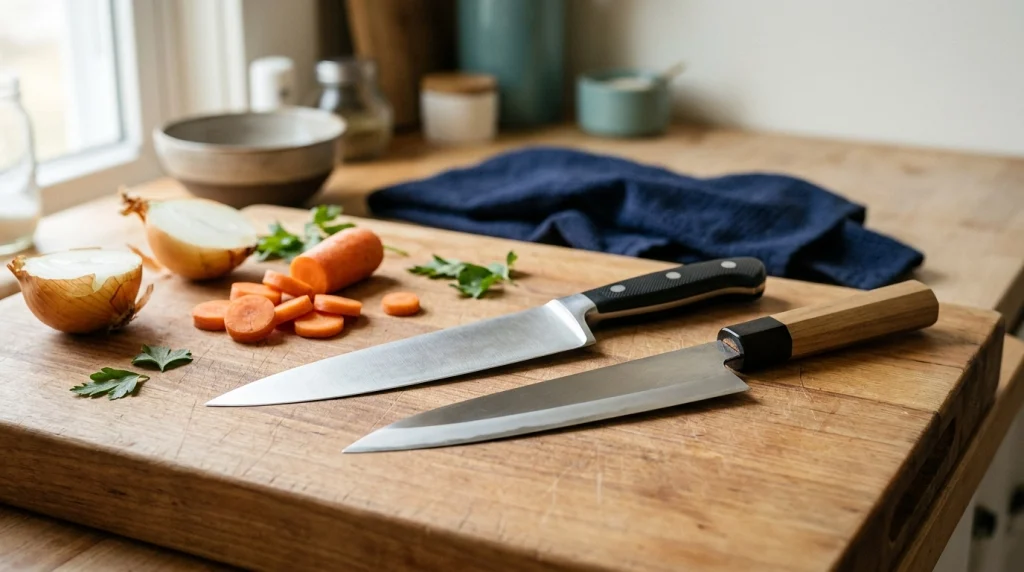
For most home cooks, the choice comes down to cutting style, maintenance habits, and budget rather than a universal winner. Both knife types can handle everyday preparation when their design suits the task.
For a Japanese-style option, the Tojiro CLASSIC 210 mm chef’s knife, model F-808, is a concrete example of a gyuto-style knife with a VG10 core and stainless-steel cladding. The maker lists a 210 mm blade, a 200 g weight, and a double-bevel edge.
For a Western-style option, the Victorinox Fibrox chef’s knife is worth considering if you want a practical, nonspecialist kitchen knife. The maker describes its range as suitable for slicing, dicing, and chopping, with an ergonomic, non-slip handle.
These are examples to compare, not claims of personal hands-on testing. Check the exact model, dimensions, current price, and care instructions before ordering.
If you’re ready to compare options, these three starting points cover different priorities:
Precision-focused gyuto
Tojiro CLASSIC F-808, 210 mm
★★★★☆
Features a VG10 core, stainless cladding, and a double-bevel edge. A useful option to investigate if you want a Japanese-style all-purpose knife and can provide appropriate care.
Practical Western option
Victorinox Fibrox Chef’s Knife
★★★★☆
The Fibrox range emphasizes a non-slip handle and everyday cutting versatility. Check the blade length and exact model because specifications differ across the range.
Compare before choosing
Gyuto and Western Chef Knives
★★★★☆
Compare blade length, handle shape, steel, and sharpening requirements across several models. This approach helps you prioritize practical features over decorative finishes.
Editorial note: The stars above are illustrative editorial-fit indicators, not verified customer ratings or results from hands-on testing. Product availability, specifications, and prices can change.
Frequently Asked Questions
Is a gyuto the same as a chef’s knife?
A gyuto is the Japanese version of a chef’s knife. Both are all-purpose kitchen knives designed for preparing vegetables, meat, fish, and herbs. Their main differences usually involve blade geometry, steel, edge profile, and handling rather than the basic tasks they perform.
Is a gyuto sharper than a Western chef’s knife?
A gyuto often has a thin blade and a fine cutting edge, which can make it feel exceptionally sharp. However, a Western chef’s knife can also be extremely sharp. Edge condition, sharpening quality, and blade geometry matter more than the knife’s name alone.
Can a gyuto replace a Western chef’s knife?
Yes. A gyuto can perform most everyday tasks handled by a Western chef’s knife, including chopping vegetables, slicing boneless meat, and mincing herbs. You may need time to adjust to its profile and maintenance requirements, but it can serve as your primary kitchen knife.
Is a gyuto harder to maintain?
Some gyutos require more careful handling because their thin edges and harder steels can be vulnerable to chipping. Stainless models simplify corrosion care, while carbon-steel models need more attention. A suitable sharpening method and good cutting habits help either knife last longer.
Should I buy a gyuto or a chef’s knife first?
Choose a Western chef’s knife if you prefer familiar rocking motions and forgiving handling. Choose a stainless-steel gyuto if you value a thinner cutting profile and will maintain it carefully. If possible, compare both styles in person before deciding.
Final Takeaway: Chef Knife vs Gyuto
The gyuto and Western chef’s knife are two approaches to the same essential kitchen tool. A gyuto often prioritizes thin geometry, precise cutting, and edge retention, while many Western models emphasize familiar handling and greater tolerance for rough use.
For a first knife, prioritize a comfortable handle, suitable blade length, reliable construction, and manageable maintenance. A well-chosen knife that fits your technique will serve you better than one selected solely for its label or reputation.

