Chef Knife Terminology: 16 Essential Blade & Handle Terms
Quick Answer
Essential chef knife anatomy splits into two core assemblies: the blade and the handle. On the blade, beginners must recognize the tip and point (detailed work), the curved belly (rock-chopping), the cutting edge and bevel (the sharp interface), the flat spine (stability), and the heel (heavy-duty cutting). Connecting them is the bolster and tang, which determine balance, hand safety, and long-term durability.
Stepping into kitchen prep without knowing the parts of a knife makes cutting technique and maintenance far harder than necessary. Cookbooks and sharpening guides frequently reference parts like the bolster, heel, or tang assuming you already know where they sit and what job they perform.
A standard 8-inch chef knife is not just a uniform slab of sharpened steel. Every curve, transition, and taper serves a mechanical function designed to transfer hand force efficiently while protecting your fingers.
Core Blade Anatomy: From Tip to Heel
 Save
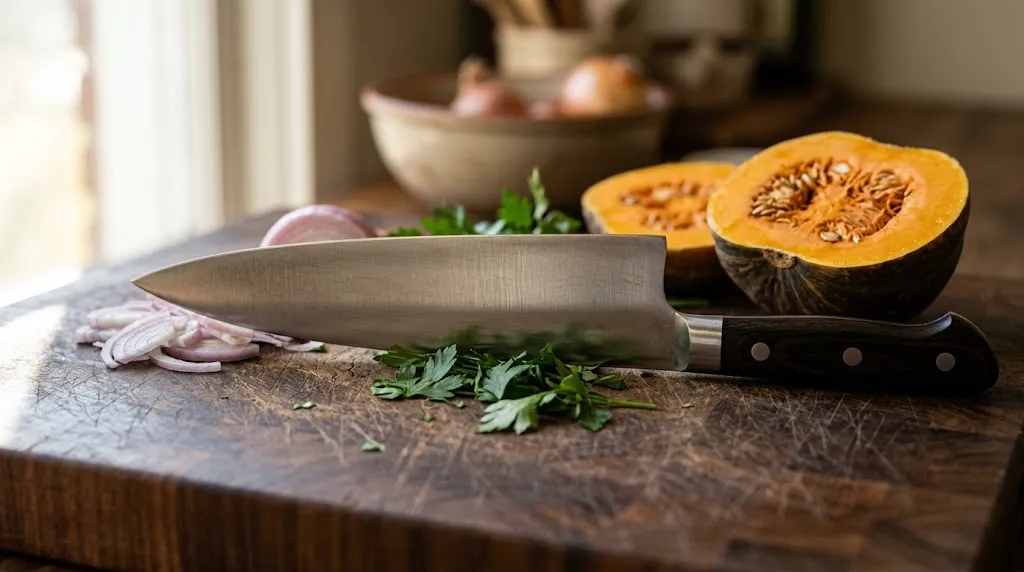
SaveThe blade does all the active cutting, but different sections handle completely different kitchen tasks. Misusing these zones causes unnecessary dulling and increases your slipping risk on the cutting board.
Point and Tip
The point is the sharp junction where the spine and cutting edge converge at the extreme forward end of the knife. It pierces skins, scores meat, or starts horizontal cuts in onions.
The tip refers to the forward third of the blade directly behind the point. Because this section is thinnest and easiest to steer, you use it for delicate, high-precision tasks such as mincing shallots, trimming silver skin, or slicing garlic cloves.
The Cutting Edge and Bevel
The cutting edge is the sharpened, honed perimeter running along the bottom of the blade from the tip down to the heel. It does the physical work of separating food fibers.
Directly above the edge sits the bevel, the angled grind that transitions the thicker blade steel down to the microscopic cutting point. Knives can feature a double bevel (ground evenly on both sides, standard on Western and most hybrid cutlery) or a single bevel (sharpened on only one face, traditional on specialized Japanese cutlery).
Belly
The belly is the curved middle section of the cutting edge. On Western-style chef knives (particularly German profiles), the belly features a pronounced, circular sweep.
This curve enables the classic rocking cut, where the tip stays resting against the board while the belly rolls smoothly up and down across herbs, celery, or nuts. Japanese chef knives (gyutos or santokus) tend to have flatter bellies optimized for push-cutting rather than rocking.
Spine
The spine is the thick, unsharpened top border of the blade running opposite the cutting edge. It gives the knife its structural rigidity and provides weight for downward cuts.
During two-handed prep work or steadying cuts, your non-dominant palm can safely rest against the spine. Higher-end knives smooth or round the spine shoulders so the steel does not irritate your skin during long prep sessions.
Heel
The heel is the rear portion of the cutting edge located closest to your hand. It is the widest, thickest, and heaviest part of the blade.
Because the heel sits directly beneath your hand’s leverage point, it handles dense, hard produce that demands maximum force, such as butternut squash, carrots, and sweet potatoes. Never use the delicate tip for produce that requires substantial downward pressure.
Key Insight
Match the food density to the blade zone: delicate shallots and herbs belong on the tip and belly, while rigid roots and thick-rinded squashes belong exclusively on the heel.
The Transition Zone: Bolsters and Choils
Where the blade meets the handle determines how the knife feels in your hand, how safe your grip is, and whether the knife can be easily sharpened down the line.
A full culinary breakdown from established food science authority Serious Eats Knife Skills confirms that the interface between handle and steel directly affects your wrist stability and grip safety during daily kitchen work.
Bolster: Full vs. Semi Bolster
The bolster is the thick band of steel forged between the blade face and the handle. It serves as a counterweight, shifts balance toward the center of your palm, and protects your fingers from slipping onto the edge.
- Full Bolster: Extends all the way down to flush with the heel. While extremely protective for novice hands, it prevents you from sharpening the entire length of the heel over time, eventually causing a concave gap on your cutting board.
- Semi-Bolster (or No Bolster): Tapers off before reaching the heel edge. This design provides structural reinforcement while leaving the entire cutting edge exposed for effortless edge-to-heel whetstone maintenance.
Choil
The choil is the unsharpened vertical drop running from the bottom of the handle or bolster down to the start of the cutting heel. Looking directly down the choil gives you a cross-sectional view of the blade’s grind thickness.
A well-finished choil is rounded and deburred. If the factory leaves the choil edges sharp, it can chafe your index finger or middle knuckle when you choke up into a professional pinch grip.
Warning
Knives with full bolsters cannot be sharpened evenly to the base of the heel on standard stones. Over multiple sharpenings, the blade edge recedes while the bolster does not, preventing the heel from touching the cutting board.
Handle Construction and Structural Terms
A knife can have exceptional blade steel, but poor handle construction causes fatigue, balance issues, and structural failure over time.
| Component | Location | Primary Function |
|---|---|---|
| Tang | Interior of handle | Extends blade steel through handle for leverage and durability |
| Scales | Handle exterior | Flanks the tang to provide grip ergonomics and comfort |
| Rivets | Across handle body | Pins the scales tightly to the steel tang |
| Butt | Terminal rear end | Counters forward blade mass and prevents hand slipping backward |
The table above outlines how the handle components work together to counterbalance blade mass and maintain ergonomic stability during repetitive tasks.
Tang: Full vs. Partial
The tang is the unsharpened extension of the blade steel that travels back into the handle grip. How far this steel travels defines the knife’s structural integrity.
In a full tang knife, a solid piece of steel runs continuously from the point all the way to the butt, visible as a continuous metal spine sandwiched between handle scales. This provides maximum strength, preventing the blade from snapping out of the handle under load.
A partial tang (such as a rat-tail or stick tang) extends only partway into the handle or narrows to a thin rod secured with epoxy. While lighter and common in traditional Japanese wa-handles, cheaply made partial-tang knives can loosen or snap at the junction under heavy leverage.
Scales and Rivets
The scales are the two slabs of handle material—crafted from stabilized wood, resin composites (like G10 or Micarta), or synthetic polymers—mounted to each side of the tang.
The rivets are the circular metal studs driven through the scales and tang to lock the assembly into a single rigid piece. Well-made rivets are ground completely flush with the scales so they never create hot spots or pinch points on your skin.
Butt
The butt is the terminal rear base of the handle. Many Western knives feature a slightly curved, hooked butt or an exposed steel end cap that prevents your hand from sliding backward during wet or oily kitchen tasks.
Blade Profile and Geometry Terminology
Beyond the named parts, several geometry terms describe how knife steel moves through food. Understanding these terms prevents you from buying a knife ill-suited to your cutting style.
Distal Taper
Distal taper describes a blade that gradually thins from the bolster along the spine out toward the point, as well as from the spine down to the cutting edge. High-quality forged knives always feature a distal taper.
This design creates a sturdy, rigid spine at the heel for tough slicing, paired with an ultra-thin, flexible tip that glides through onions without wedging or cracking dense cell walls.
Grind and Cross Section
The grind indicates how the sides of the blade are shaped between the spine and the edge. Common grinds include:
- Flat Grind: The blade faces taper in a direct straight line from spine to edge, providing low resistance in shallow cuts.
- Convex Grind (Hamaguri): The blade faces curve outward gently like a clamshell, helping slices release cleanly from the steel instead of sticking.
- Hollow Grind: The sides curve inward concavely, producing an exceptionally thin edge that requires gentle handling.
Granton Edge
A Granton edge (often called scalloped or fluted) features shallow oval divots ground alternately along both sides of the blade face above the edge. These depressions create tiny air pockets between moist foods—like potatoes or raw proteins—and the steel, breaking surface tension to prevent stubborn sticking.
Tip
To check if a knife has distal taper, look straight down the spine from handle to tip. The steel should progressively narrow to a needle-like thickness rather than maintaining a uniform blocky width.
Knife Steel and Maintenance Vocabulary
 Save
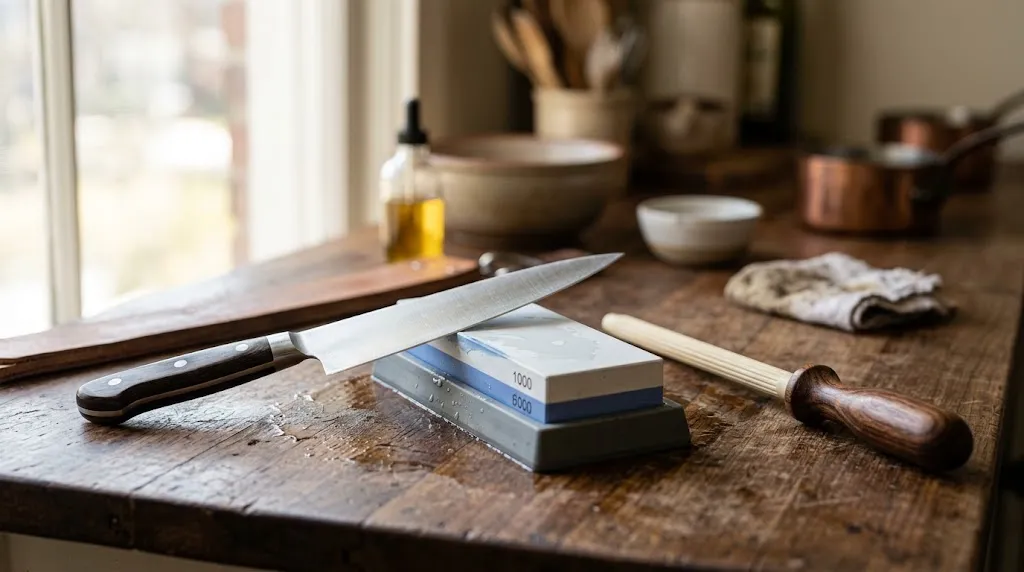
SaveMaintaining an edge requires separating marketing claims from the mechanical properties of steel alloys.
Honing vs. Sharpening
Beginners constantly conflate these two processes, but they accomplish opposite mechanical tasks:
- Honing: Done frequently using a ceramic or steel rod. Honing does not remove meaningful amounts of metal. Instead, it pushes a rolled, microscopic burr back into straight alignment so the existing edge bites cleanly.
- Sharpening: Done periodically using abrasive whetstones or guided systems. Sharpening grinds away worn metal to establish a brand-new, fresh apex bevel.
Rockwell Hardness (HRC)
The hardness of knife steel is measured on the Rockwell C scale (HRC). Most kitchen knives fall between 54 HRC and 64 HRC, establishing a direct trade-off between edge retention and toughness.
German knives generally sit around 56–58 HRC. This softer steel resists chipping against bones or hard boards, but requires frequent honing. Japanese knives often range between 60–63 HRC; their harder steel holds an acute, razor-sharp edge longer, but is more brittle and prone to micro-chipping if twisted.
Forged vs. Stamped
Forged knives begin as a single heated steel bar pounded into shape under immense pressure, followed by heat treating. They typically feature a bolster, integrated tang, and thicker spine.
Stamped knives are cut directly from continuous sheets of rolled steel. They lack an integrated bolster, feel significantly lighter in hand, and offer uniform thickness unless custom-ground with secondary distal tapers.
Related Product
Kitchen Knife Sharpening Stones & Honing Rods
Maintain your knife’s edge geometry and realign bent blade bevels safely with dual-grit whetstones and ceramic honing rods.
As an Amazon Associate, we earn from qualifying purchases.
Frequently Asked Questions
What is the most important part of a chef knife for safety?
The bolster and choil area are the most critical safety junctions. A properly shaped bolster stops your fingers from sliding forward onto the sharp heel, while a rounded choil prevents blisters and chafing during a professional pinch grip.
Why does full tang matter on kitchen knives?
A full tang ensures structural durability and optimal weight distribution. Because the steel runs the entire length and profile of the handle, the knife is far less likely to snap at the handle junction during heavy leverage cuts.
What is the difference between the point and the tip?
The point is the single sharp convergence where spine meets edge at the very front of the knife. The tip refers to the entire forward third of the cutting edge and blade face directly behind that point.
What does a Granton edge do on a chef knife?
A Granton edge consists of alternating scalloped indentations along the blade sides. These indentations trap pockets of air between the steel and the item being cut, reducing surface tension so wet slices release cleanly instead of sticking.
Is a softer or harder steel better for beginners?
Moderate hardness (56–58 HRC, standard in German knives) is generally better for beginners. While softer steel dulls faster and requires regular honing, it is remarkably durable, forgiving of minor twisting, and resists catastrophic chipping on hard boards or bones.
What is the difference between single bevel and double bevel knives?
A double bevel blade is ground on both sides to form a centered, symmetrical cutting V, which cuts straight and suits both left- and right-handed cooks. A single bevel blade is ground on only one side, producing extreme sharpness tailored for directional, razor-thin Japanese slicing.
Conclusion
Learning chef knife anatomy transforms how you handle prep work, troubleshoot sharpening issues, and evaluate new cutlery. Recognizing the mechanical distinction between zones like the delicate tip and the sturdy heel protects your blade from premature damage while making cutting motions intuitive. When shopping for or maintaining your primary kitchen workhorse, prioritize structural indicators like a full tang, a comfort-rounded choil, and a semi-bolster that permits complete edge sharpening from tip to heel.