Chef Knife Thickness Behind the Edge: What BTE Means
Quick Answer
Thickness behind the edge (BTE)—typically measured right at the shoulder of the sharpening bevel or 1mm to 5mm above the apex—dictates how a chef’s knife slices. High-performing kitchen knives generally feature a BTE measurement between 0.2mm and 0.5mm (roughly 0.008 to 0.020 inches), allowing the blade to glide through produce without wedging.
What Is Thickness Behind the Edge (BTE)?
When evaluating a kitchen knife, many cooks focus entirely on spine thickness or how polished the final apex appears. However, cutting performance is largely controlled by thickness behind the edge (BTE). BTE refers to how thick the steel is just above the primary cutting edge—usually measured at the shoulder where the bevel transitions into the main grind, or at a fixed reference point like 1mm or 5mm up from the tip.
While spine thickness determines overall blade rigidity near the handle, BTE dictates how much physical resistance the knife encounters as it moves deeper into dense ingredients like carrots, potatoes, or onions. Two chef’s knives can share an identical spine thickness and identical 15-degree edge angles, but if one has a thick BTE and the other has a thin BTE, they will feel completely different on the cutting board.
Thin vs. Thick BTE: How Geometry Affects Performance
 Save
Blade geometry always involves a trade-off between cutting efficiency and structural durability. Understanding how different BTE measurements affect real-world kitchen tasks helps clarify why knife makers grind blades to varying specifications.
| BTE Profile | Typical Measurement | Cutting Behavior | Best Suited For |
|---|---|---|---|
| Thin BTE (Laser) | 0.15mm – 0.3mm | Glides effortlessly with minimal resistance; virtually zero wedging. | Fine vegetable prep, boneless proteins, precision slicing. |
| Medium BTE (All-Purpose) | 0.3mm – 0.5mm | Balanced performance; handles general kitchen prep with good durability. | Western chef’s knives, everyday home cooking, mixed tasks. |
| Thick BTE (Workhorse) | 0.6mm – 1.0mm+ | Tends to wedge or crack hard foods; requires more downward force. | Heavy-duty utility, butchery, commercial environments. |
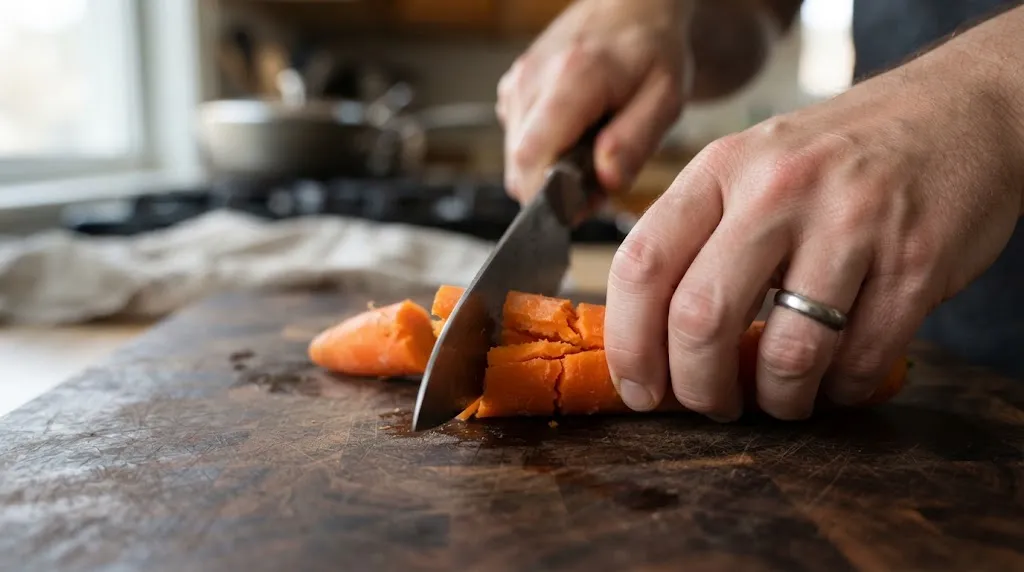
When a knife has a thick BTE, foods like hard squash or large onions will crack apart rather than slice smoothly because the thick steel shoulders push the ingredients aside. A thin BTE minimizes this wedging effect, allowing the cutting edge to slip through cellular structures cleanly.
Standard BTE Benchmarks for Chef’s Knives
Different culinary traditions approach blade geometry with distinct priorities. Japanese gyutos and laser-style chef’s knives are engineered for absolute slicing performance, often featuring a BTE between 0.15mm and 0.3mm. This fine geometry provides exceptional agility, though it requires careful cutting technique to prevent micro-chipping on hard ingredients.
Western chef’s knives, such as traditional German styles, typically feature a thicker BTE ranging from 0.4mm to 0.7mm. Manufacturers intentionally design these blades with more steel behind the edge to withstand twisting, impacts against cutting boards, and heavy-duty tasks like cutting through small joints or dense root vegetables.
Key Insight
A knife can feel exceptionally sharp on paper or test media because of a polished apex, but if the BTE is too thick, it will still struggle during real-world kitchen food prep.
Why Chef’s Knives Become Thicker Over Time
Many home cooks notice that a well-maintained knife gradually begins to perform worse over the years, even when it is sharpened regularly. This occurs because knife blades taper upward from the edge toward the spine.
Every time you sharpen a knife, you grind away steel at the apex, causing the cutting edge to migrate upward into a thicker cross-section of the blade. As the apex moves higher up the taper, the actual thickness behind the edge increases. Eventually, routine sharpening cannot restore the original cutting performance because the steel behind the edge has become too thick. Restoring optimal performance requires a maintenance process known as thinning.
How to Thin a Knife and Reduce BTE
 Save
When BTE increases due to long-term sharpening, standard edge-bevel maintenance is no longer sufficient. Lowering the sharpening angle on stones only alters the very tip of the apex without addressing the thick shoulders behind it.
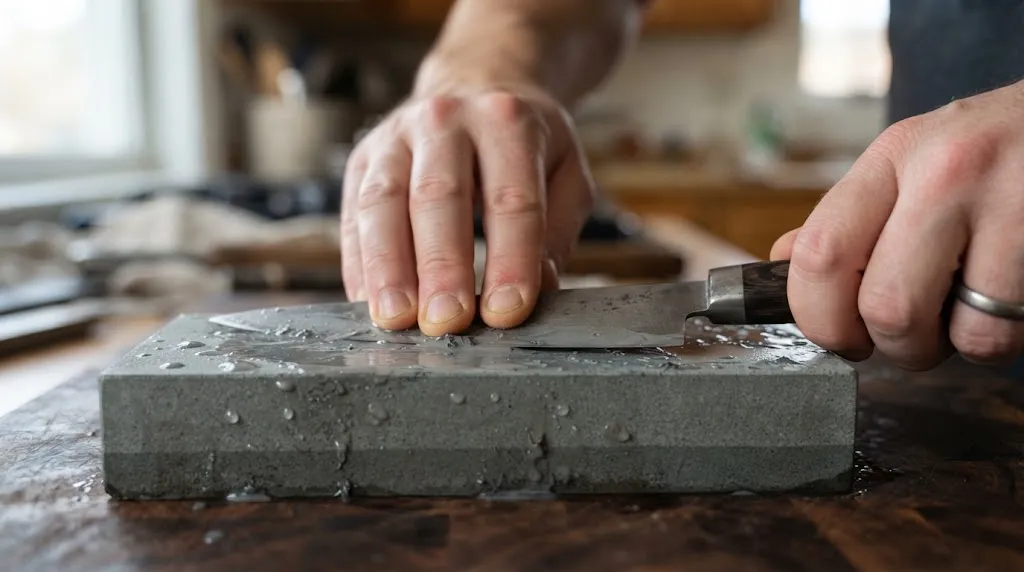
To restore proper geometry, the primary grind of the blade must be thinned. This involves laying the flat side of the blade against a coarse sharpening stone or belt grinder to remove steel from the cheeks above the edge, recreating a smooth taper.
Warning
Grinding away too much steel behind the edge can make a knife too flexible or structurally fragile. Always taper the blade gradually and maintain adequate spine support near the heel.
Frequently Asked Questions
What is the ideal thickness behind the edge for a chef’s knife?
For general home cooking, a BTE between 0.3mm and 0.5mm provides an optimal balance of clean slicing efficiency and robust edge stability. Dedicated vegetable lasers often measure closer to 0.15mm to 0.25mm.
How do you measure thickness behind the edge?
BTE is measured using digital calipers. Measurements are typically taken right at the shoulder of the secondary edge bevel or at a standardized height—such as 1mm or 5mm—perpendicularly up from the cutting apex.
Does a thicker spine mean a thicker BTE?
Not necessarily. Spine thickness and BTE are controlled by the blade grind. A knife can feature a thick, rigid spine for strength near the handle while utilizing a hollow, flat, or convex grind to taper down into a very thin BTE at the edge.
Why does my sharp knife feel like it is crushing food?
If a knife feels sharp on paper but wedges or splits carrots and potatoes, the problem is almost always an excessively thick BTE. The sharp apex cuts the initial surface, but the thick steel behind it creates heavy friction and pushes the food apart.
Can I fix a knife that has become too thick behind the edge?
Yes. You can restore performance by thinning the primary bevels on sharpening stones or a grinding belt, which reduces the cross-sectional thickness and recreates smooth cutting geometry.
Does sharpening a knife make it thicker?
Yes. Because kitchen knife blades taper upward from edge to spine, removing steel during routine sharpening gradually exposes thicker portions of the blade geometry over time.
Conclusion
Understanding thickness behind the edge shifts the focus of knife maintenance from simple apex sharpness to overall blade geometry. While edge angles and steel alloys receive significant attention, the measurement of steel directly behind the cutting edge dictates how effortlessly a chef’s knife moves through ingredients. Recognizing how BTE influences cutting resistance and how repeated sharpening alters this geometry helps home cooks select better tools, evaluate knife performance accurately, and maintain long-term cutting efficiency in the kitchen.

