Chef Knife Bevel Guide: Understanding Angles, Types & Maintenance
When you look closely at a kitchen knife, the edge is not just a flat sheet of steel tapering into a point. Instead, the final cutting edge is shaped by grinding one or both sides of the blade to a specific angle. This ground portion is known as the bevel.
The bevel determines how the knife interacts with food, how much resistance you feel when slicing, and how durable the edge remains over time. Understanding the bevel is essential for anyone looking to maintain their kitchen tools, choose the right knife for specific culinary tasks, or improve their cutting technique.
Every knife bevel consists of two primary components: the angle of the grind and the profile or shape of the grind itself. Even a fraction of a degree can change how a knife performs on hard vegetables, raw meats, or delicate herbs.
Single Bevel vs. Double Bevel Knives
 Save
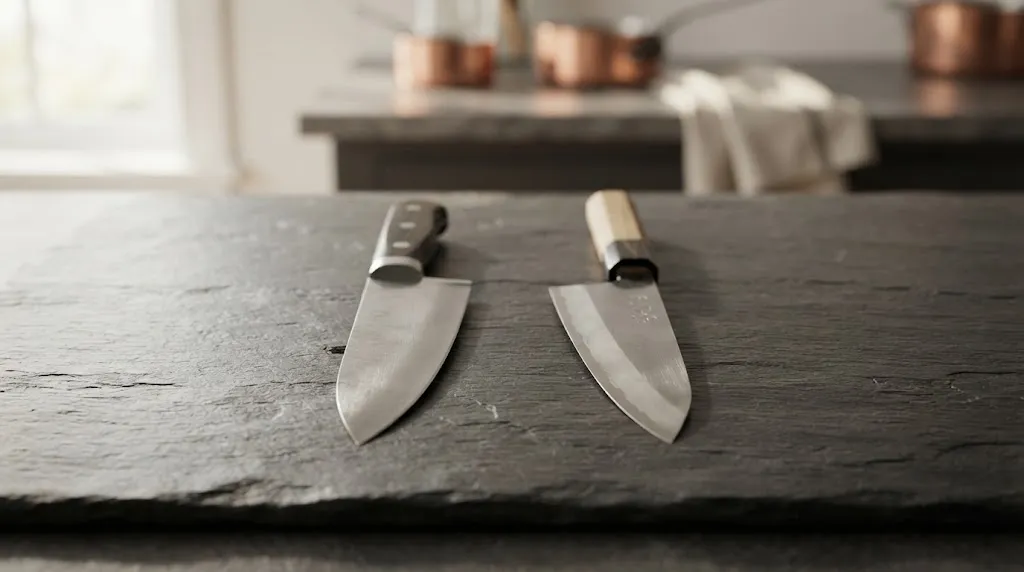
Knife bevels generally fall into two major categories based on how the steel is ground: single bevel and double bevel. Each design serves a distinct culinary tradition and offers unique advantages in the kitchen.
Double Bevel Knives
Double bevel knives are the standard for most Western-style cutlery, such as traditional French or German chef knives. In a double bevel blade, both sides of the steel are ground down symmetrically to form a V-shaped edge.
This symmetry makes double bevel knives intuitive to use, easy to sharpen on standard whetstones, and capable of cutting straight down through ingredients without veering to one side. They are rugged, versatile, and built to withstand the demands of general kitchen prep.
Single Bevel Knives
Single bevel knives are common in traditional Japanese cutlery, including styles like the yanagiba, deba, and usuba. In this design, only one side of the blade is ground to an edge, while the opposite side remains mostly flat or slightly concave.
This asymmetric geometry allows for extraordinarily fine, razor-sharp edges that create exceptionally clean cuts, which is especially prized in sushi preparation and precision vegetable work. However, single bevel knives require specialized sharpening techniques and take practice to steer straight because the flat side naturally pushes cuts in a specific direction.
Common Chef Knife Bevel Angles
The sharpness and durability of a chef knife depend heavily on the steepness of its bevel angle. Sharper angles slice with less resistance, while wider angles offer greater edge stability.
Here is how standard chef knife angles compare in practical kitchen use:
| Angle Range | Typical Knife Type | Performance Characteristics |
|---|---|---|
| 10° to 15° per side | Japanese chef knives (Gyuto), Santoku | Extreme sharpness, effortless push-cutting, but more delicate and prone to chipping if misused. |
| 15° to 20° per side | Western / German chef knives | Balanced durability and sharpness, excellent for all-purpose rocking and heavy chopping tasks. |
| 20° to 25° per side | Heavy utility, butchery, or boning knives | Maximum edge strength, resistant to rolling or chipping against bone and dense materials. |
When selecting or sharpening a knife, matching the angle to the steel hardness and intended use prevents premature dulling or structural damage.
How Bevel Geometry Affects Cutting Performance
The bevel shape dictates how a knife moves through food. A wide bevel angle wedges its way through ingredients, which can cause crisp vegetables like carrots or apples to snap apart rather than slice cleanly.
Conversely, a narrow, acute bevel glides through cellular structures with minimal friction. However, thinner edges lack the steel backing needed to absorb lateral twisting forces. If you twist a thin-beveled knife while it is embedded in a hard squash, the edge can easily chip or roll.
Key Insight
Blade steel hardness plays a major role in bevel stability. Harder steels like Japanese VG-10 or SG2 can hold an acute 15-degree angle without folding, whereas softer stainless steels used in many Western knives require a slightly wider 20-degree bevel to maintain edge integrity.
Understanding Compound Bevels and Micro-Bevels
Many modern knives utilize more than a single flat plane from spine to edge. Manufacturers often incorporate compound bevels or micro-bevels to optimize both cutting performance and durability.
A compound bevel features two or more distinct angles along the width of the blade. The primary grind creates the overall thinness behind the edge, while a secondary or tertiary grind forms the apex. This reduces drag while keeping the shoulders robust.
A micro-bevel is an extremely small, steep secondary angle applied directly to the edge apex during sharpening. Even if the main bevel is ground to a razor-thin 15 degrees, adding a tiny 20-degree micro-bevel reinforces the very tip of the edge, significantly reducing micro-chipping without noticeably increasing cutting resistance.
How to Maintain and Restore Your Knife Bevel
 Save
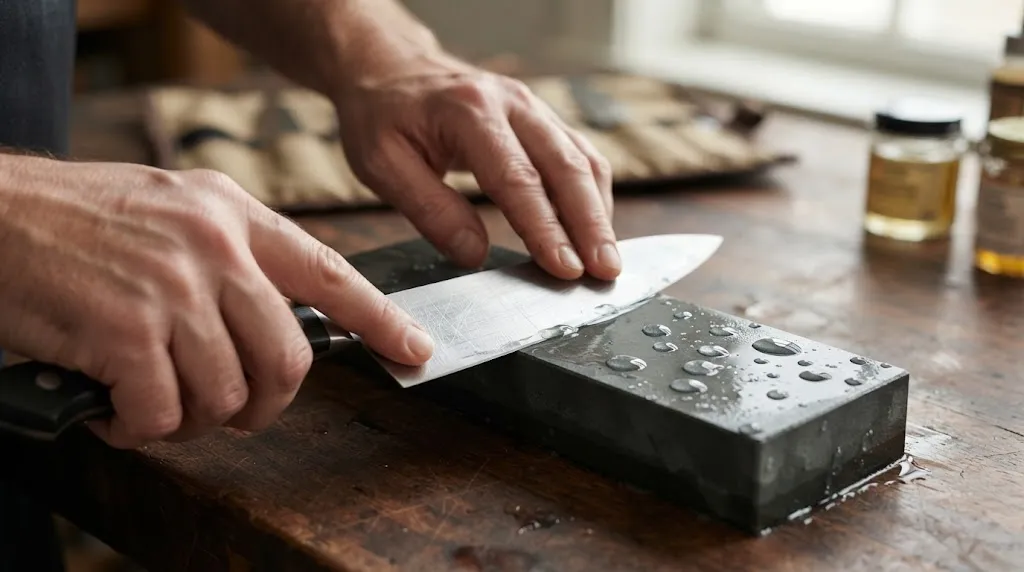
Over time, regular use wears down the bevel apex, causing the knife to feel dull. Restoring the bevel requires removing metal along the existing angle until a fresh apex is formed.
Here are the core principles for maintaining proper bevel geometry:
- Match the factory angle: Use a sharpening guide or muscle memory to maintain a consistent angle against your whetstone. Changing the angle unintentionally creates a rounded, ineffective edge.
- Work through grit progressions: Start on a medium-coarse stone (around 400 to 1000 grit) to re-establish the bevel and form a burr, then refine the finish on finer stones (3000 to 6000 grit).
- Deburr thoroughly: Ensure the tiny metal burr created during sharpening is completely polished away, or the knife will still feel sluggish when cutting.
- Honing vs. sharpening: Use a ceramic honing rod regularly to realign a slightly bent bevel between sharpening sessions, reserving actual stone sharpening for when the steel is truly dull.
Warning
Avoid using motorized pull-through sharpeners with fixed abrasive wheels unless your knife is inexpensive. These devices grind away steel indiscriminately, often ruining the precise factory bevel geometry and drastically shortening the lifespan of high-end chef knives.
Related Product
Whetstone Knife Sharpening Stone Set
A dual-grit whetstone allows you to precisely restore and maintain the exact bevel angle on your chef knife for long-lasting sharpness.
As an Amazon Associate, we earn from qualifying purchases.
Frequently Asked Questions
What is the ideal bevel angle for a home chef knife?
For most general kitchen tasks, a 15 to 20-degree angle per side offers the best balance of effortless slicing performance and everyday durability. Western knives typically sit near 20 degrees, while Japanese-style all-purpose knives lean closer to 15 degrees.
Can I change the bevel angle of my knife when sharpening?
Yes, you can change the angle, but it requires significant metal removal. Lowering the angle to 15 degrees creates a sharper edge but weakens thick steel, while increasing the angle to 20 or 25 degrees strengthens the edge at the cost of increased cutting resistance.
How can I tell if my chef knife has a single or double bevel?
Examine the edge under bright light. A double bevel knife shows a clear V-shaped grind meeting symmetrically in the center from both sides. A single bevel knife features a flat or concave back side with the bevel ground onto only the front face.
Why does my knife dull so quickly even after sharpening?
Rapid dulling usually stems from improper sharpening technique—such as failing to remove the wire burr completely—or using inappropriate cutting surfaces like glass, ceramic, or stone cutting boards that instantly blunt delicate steel edges.
What is the difference between honing and sharpening a bevel?
Honing uses a steel or ceramic rod to realign microscopic bending along the bevel edge without removing metal, which should be done frequently. Sharpening uses abrasive stones to grind away old steel and create an entirely new, sharp apex.
Do serrated chef knives have bevels?
Yes, serrated knives feature bevels, but they are ground into individual scallops or teeth rather than a continuous straight edge. Because of their unique geometry, they require specialized tapered rods rather than flat whetstones to sharpen properly.
Conclusion
The chef knife bevel is the fundamental engineering feature that governs cutting efficiency, edge retention, and versatility in the kitchen. Whether you rely on a sturdy double-beveled Western blade or a precise single-beveled Japanese knife, understanding your blade angle ensures proper maintenance and superior culinary performance. By respecting your knife’s geometry and utilizing correct sharpening practices, you can keep your edge sharp and reliable for years of food preparation.

